

If you’ve ever tried to “just get a price” for social media management, you’ve probably seen numbers that swing from a few hundred a month to five figures. That isn’t because the industry is chaotic—it’s because social media management can mean anything from scheduling posts to running a full content engine with paid media, creators, reporting, and a clear revenue plan.
This guide breaks down social media management pricing in a way that helps you compare offers, understand what drives cost, and choose a setup that fits your goals. The aim is simple: you should be able to look at any proposal and immediately spot what’s missing, what’s overpriced, and what’s genuinely valuable.
Article Outline
- What Is Social Media Management Pricing?
- Why Social Media Management Pricing Matters
- Framework Overview
- Core Components
- Professional Implementation
What Is Social Media Management Pricing?

Social media management pricing is the structure behind what you pay for planning, creating, publishing, and optimizing content across social platforms—plus the operational work that makes those outputs reliable. The most important word there is “structure.” You’re not just buying posts; you’re buying a predictable system that produces outcomes (awareness, leads, sales, retention, or customer support), with enough consistency that a business can plan around it.
That’s why the same label—“social media management”—can hide wildly different scopes. One provider might mean 12 templated posts a month and basic scheduling. Another might mean a weekly content sprint, video editing, community management, creator coordination, paid social testing, and monthly reporting tied to business metrics.
A useful way to think about pricing is to separate the labor market from the service package. On the labor side, marketplaces often show what execution-focused help costs; for example, Upwork’s rate guidance for social media managers shows typical hourly ranges that reflect baseline production and coordination work. On the package side, retainers bundle that labor into outcomes and accountability—strategy, creative direction, workflows, and performance management.
In practice, most pricing you’ll see fits into one of these models:
- Hourly or day rate: Best for ad-hoc support, overflow work, or short bursts of production.
- Monthly retainer: Best for ongoing growth, consistent content output, and measurable improvements over time.
- Project-based: Best for one-off campaigns, launches, or a “set up the system” engagement.
- Performance-linked add-ons: Sometimes layered on top of a retainer, usually for paid social management or revenue targets.
One more nuance: “social media management pricing” is often confused with ad spend. Those are separate lines. Management is the fee for strategy and execution; ad spend is the budget paid to platforms. The split matters because the IAB/PwC Internet Advertising Revenue Report for 2024 shows social media advertising is a massive (and growing) revenue category—money that flows to platforms, not to the person managing your accounts.
Why Social Media Management Pricing Matters
Pricing matters because it quietly defines your operating reality: how fast you can ship content, how quickly you can respond to audiences, and whether performance gets measured in a way leadership trusts. Cheap pricing often forces a provider into volume-mode (more clients, less attention), while premium pricing only pays off if it buys you leverage—better creative, tighter strategy, faster iteration, and clearer attribution.
The timing is also important. Social platforms aren’t “set and forget” anymore. Audiences are massive and still growing—DataReportal’s Digital 2025 social overview highlights billions of active social identities—yet organic reach is increasingly competitive, formats change quickly, and performance is shaped by consistency more than occasional bursts.
At the same time, marketing leaders are being squeezed. When overall marketing budgets flatten, scrutiny rises—and social teams get asked to prove value. That pressure shows up in executive surveys; Gartner’s 2024 CMO Spend Survey press release points to marketing budgets sitting at a lower share of revenue, pushing teams toward productivity and measurable outcomes. Social media management pricing becomes a strategic choice: do you pay for output, or do you pay for learning loops that get smarter every month?
There’s also a risk-management angle. Underpricing tends to remove the unglamorous work that prevents expensive mistakes: approval workflows, brand safety guidelines, community moderation rules, crisis response plans, and consistent reporting. Those items don’t look exciting on a quote, but they’re the difference between “we post” and “we operate.”
Finally, pricing matters because social has become more central to business strategy. When marketing leaders plan to shift budget toward social, the quality of management becomes more consequential. You can see that momentum in Sprout Social’s published findings on budget reallocation, where leaders describe increasing investment across paid, influencer, and organic social. In that environment, the real cost isn’t “paying too much.” The real cost is paying for the wrong scope and then wondering why nothing moves.
Framework Overview
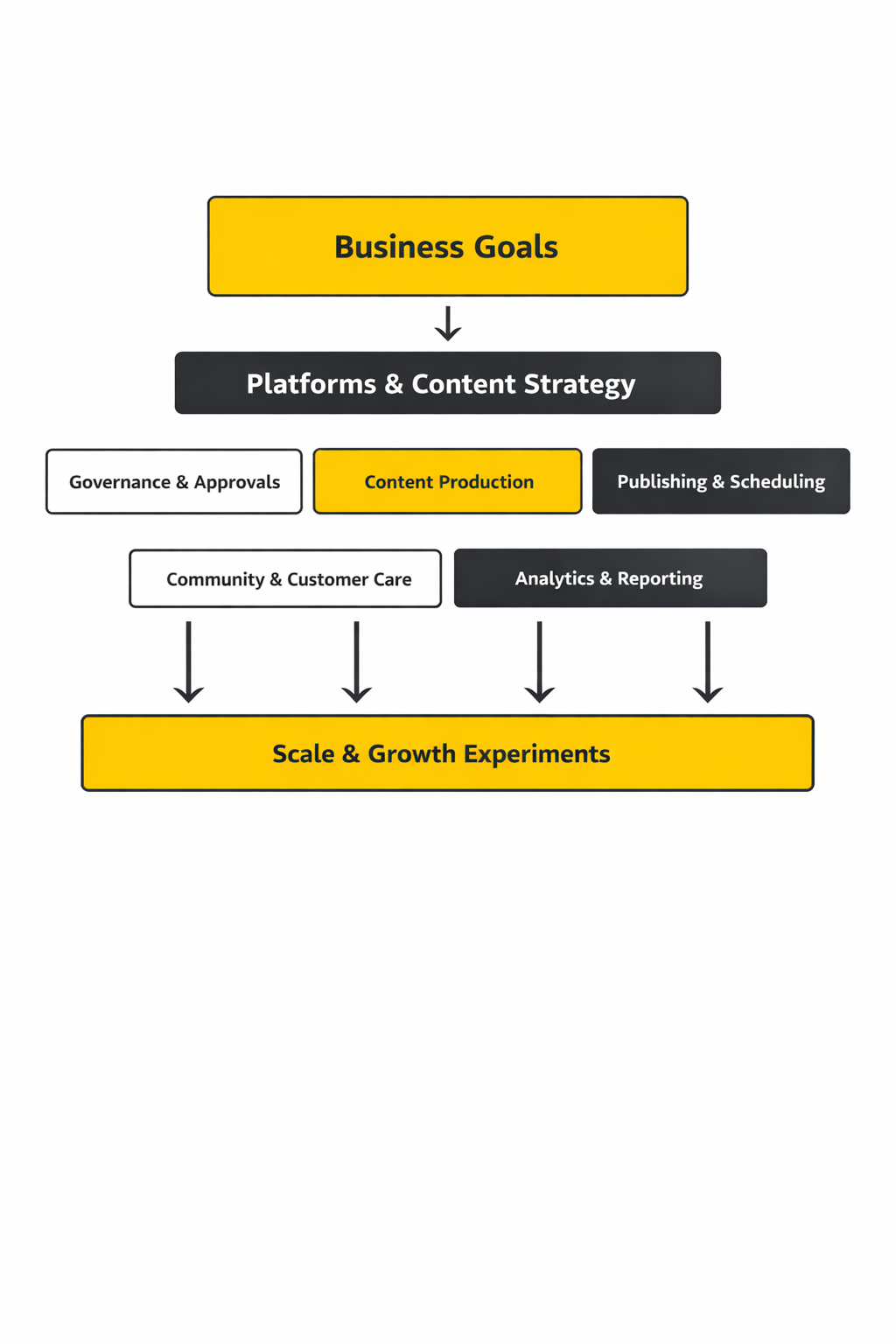
To make social media management pricing predictable, use a framework that ties cost to the real drivers of effort and impact. The simplest version is: Scope + Complexity + Cadence + Accountability. If you can map a proposal to these four levers, you can compare apples to apples—even when two providers describe their services differently.
Scope is what’s included: platforms, content types, community management, paid social management, influencer coordination, reporting, and strategic planning. The more scope you include, the more coordination overhead you add—even before you create a single post.
Complexity is how hard the work is: brand nuance, regulated industries, multiple stakeholders, multiple languages, tight legal review, product lines, and the level of creative originality expected. Complexity is why two brands can both post “three times a week,” yet one requires a lightweight workflow and the other needs a full approval pipeline.
Cadence is the rhythm: how often you publish, how fast you respond, how frequently you run creative iterations, and how quickly reporting turns into next month’s plan. Cadence is where retainer pricing usually wins, because learning compounds when you’re running steady cycles.
Accountability is how outcomes are owned: are you paying for content output, or are you paying for someone to set targets, measure progress, and make decisions based on data? As social ad and content ecosystems scale, accountability becomes the difference between “busy” and “effective.” IAB’s topline summary of the 2024 internet ad revenue report is a good reminder that the ecosystem is financially huge—so small measurement errors can turn into large wasted spend.
In the next sections, you’ll see how this framework translates into the components that actually show up on invoices, and how professionals package those components so you don’t pay for confusion.
Core Components
Most social media management pricing is built from the same set of building blocks. Providers may rename them, bundle them differently, or hide them inside “packages,” but the underlying components are consistent.
Strategy and Positioning
This is where goals become decisions: who you’re targeting, what you’ll be known for, what content pillars you’ll own, and how social supports the business (pipeline, e-commerce, recruiting, retention, or customer support). Strategy is also where constraints get negotiated—what you can realistically ship each week, what approvals are required, and what success will look like in 90 days.
Content Production
Production includes ideation, writing, design, editing, and formatting for each platform. It’s also where “cheap” offers often break: if a package doesn’t specify how many original assets are created, whether video is included, and how revisions work, you’re looking at an output promise without a production plan.
Publishing and Optimization
This covers scheduling, platform-native formatting, hashtags/keywords where relevant, and basic optimization—posting times, hooks, creative variations, and consistent testing. When a provider prices this well, they’re not charging you to click “publish.” They’re charging you to run a repeatable release process that improves quality over time.
Community Management
Community management is responses, moderation, escalation, and tone-of-voice consistency. The pricing driver here is not only comment volume; it’s response expectations. If your brand needs same-day responses or handles sensitive topics, community work can become a meaningful portion of the monthly fee.
Reporting and Insights
Reporting ranges from basic dashboards to decision-grade analysis that ties social activity to business outcomes. A simple way to judge value: does reporting tell you what happened, or does it tell you what to do next? When budgets are under pressure, insights matter more than raw metrics—something that shows up in executive-level budget discussions like The CMO Survey’s 2025 highlights report, where teams track channel investments closely and forecast shifts.
Paid Social Management
Paid social management is usually priced separately from organic management because it requires different skills: audience building, creative testing frameworks, conversion tracking hygiene, and ongoing optimization. Even when your spend is modest, professional management can prevent “silent failure,” where ads run but learn nothing because the setup can’t measure what matters.
Professional Implementation
Professional social media management pricing isn’t just a number—it’s a delivery system. The best operators make pricing feel boring because the process is so clear: you know what happens each week, who approves what, how results are reviewed, and how next month improves.
In a well-run engagement, implementation usually follows a simple arc:
- Week 1: Alignment on goals, audience, brand voice, and what “good” looks like in concrete terms.
- Weeks 2–4: Establish a publishing cadence, ship content, and tighten the feedback loop so approvals don’t stall the work.
- Month 2: Add structured experimentation—creative variations, format testing, and clear hypotheses.
- Month 3: Standardize what works into repeatable playbooks, then scale output or add channels without breaking quality.
One reason this matters: social is now tightly connected to paid media ecosystems and broader ad market shifts. When the ad market moves toward digital and social formats, the operational bar rises too; IAB’s full-year 2024 revenue reporting and broader ad forecasts from research firms and publishers (for example, Gartner’s 2025 CMO Spend Survey press release) point to a market where leaders protect performance-driving spend and demand measurable productivity.
So when you evaluate a quote, don’t ask only “how much.” Ask: what operational discipline does this pricing buy me? If the proposal can’t explain workflow, cadence, and measurement in plain language, it’s not really a pricing model—it’s a guess.
Step-by-Step Implementation
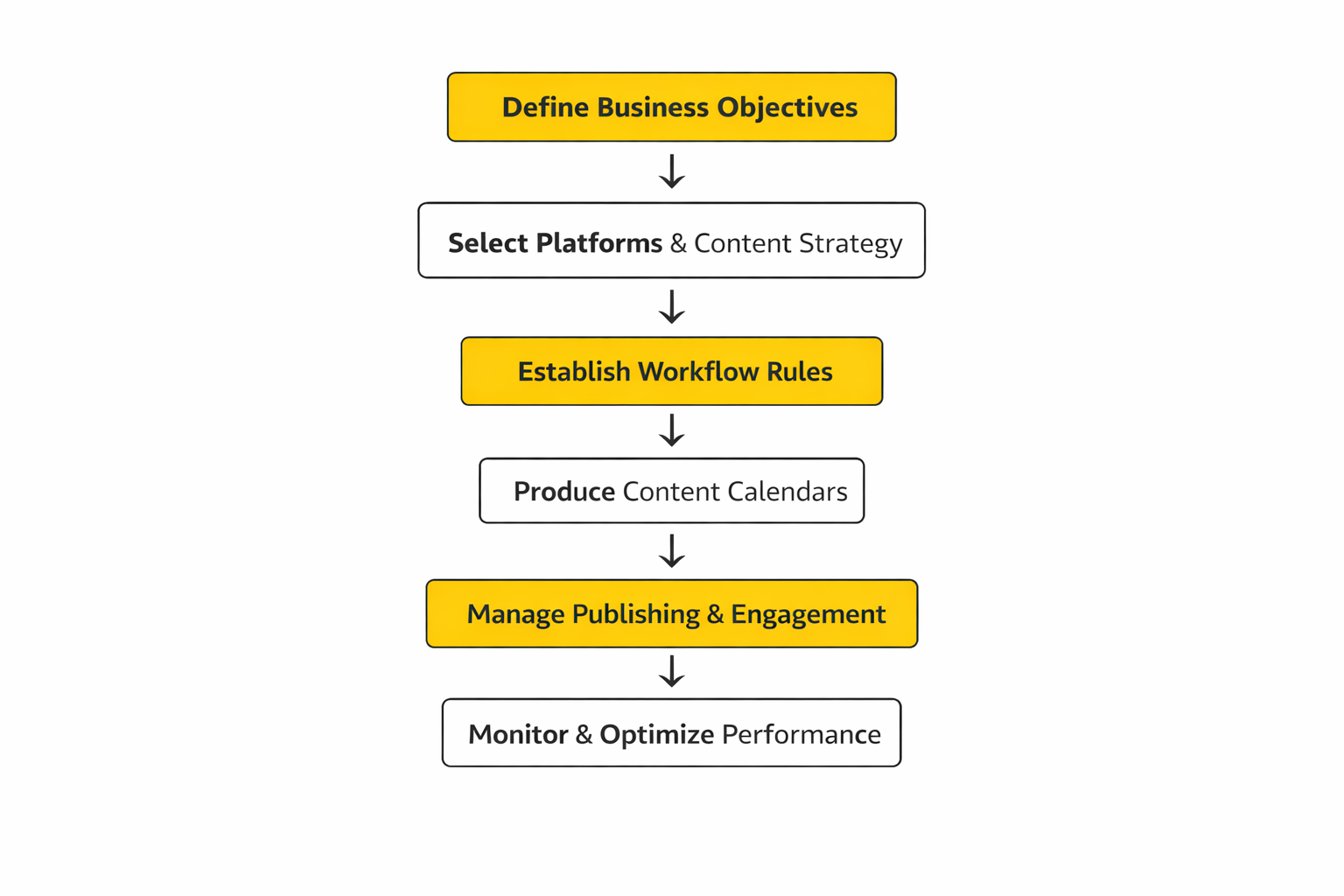
The fastest way to make social media management pricing feel “fair” is to build an implementation plan that shows where the hours go, what gets shipped, and how performance improves month over month. When that plan is missing, pricing becomes a guessing game—and the work turns into a pile of half-finished drafts, last-minute approvals, and reports no one trusts.
This step-by-step approach is built for real life: limited attention, multiple stakeholders, and platforms that punish inconsistency. It also keeps scope creep in check, because every extra “can you also…” has to fit into a defined workflow.
Step 1: Define the “success contract” before you create anything
Start with a single page that spells out what success means in plain language: the goal (pipeline, revenue, retention, employer brand, or customer care), the audience, the platforms that matter most, and the time horizon for meaningful change. If you can’t describe success without a dashboard, you’re setting yourself up for endless activity and vague outcomes.
Pricing gets cleaner here because you can separate what’s essential from what’s “nice to have.” A brand that needs social customer care will prioritize responsiveness and routing. A brand that needs growth will prioritize creative volume and experimentation. Those two situations can’t be priced the same way, even if both are called “social media management.”
Step 2: Audit what you have (and what you don’t)
The audit is not a vanity exercise. It’s about finding your constraints: missing brand guidelines, unclear approvals, inconsistent voice, weak analytics, or a content format mismatch. You also want to spot hidden time sinks—like teams doing everything in native apps, or approvals living in email threads with no final “yes.”
If social customer care is part of your scope, this is where you set expectations. Many customers treat social like a support channel, not a marketing channel, and they expect speed. Sprout’s research notes 73% of consumers expect a response within 24 hours or sooner, while Khoros describes how over one-third of customers anticipate a reply on social media within 30 minutes. Those expectations directly affect pricing because they determine staffing and coverage windows.
Step 3: Build the operating rhythm
This is where implementation turns into something you can run every week without drama. A simple rhythm that works for most teams looks like this:
- Weekly planning: pick content themes, assign owners, and define what “done” looks like for each piece.
- Batch production: write, design, and edit in focused blocks so you’re not switching contexts all day.
- Approval window: a fixed time slot for feedback so content doesn’t sit in limbo.
- Publishing and engagement: scheduled posts, plus an inbox routine that prevents “we missed that comment” moments.
- Weekly review: one short meeting to decide what to repeat, what to stop, and what to test next.
If you want a reference point for how teams formalize approvals, Hootsuite’s guide to building a social media approval workflow is a good example of turning “please approve” into a predictable system.
Step 4: Create a content library, not just a calendar
A calendar tells you what’s going out. A library tells you what you can reuse, remix, and scale. That means saving winning hooks, high-performing post structures, visual templates, and repeatable content pillars. Over time, this reduces production cost per post because you’re building on proven patterns instead of starting from zero every week.
This is one of the clearest levers in social media management pricing: teams with a mature library can spend more time on creative ideas and experiments, while teams without one spend more time reinventing basics.
Step 5: Instrument measurement so decisions are easy
Measurement isn’t there to “prove” social. It’s there to make next week easier. Decide what you will track at three levels:
- Content signals: saves, shares, completion rates, and comments that show real attention.
- Business signals: site actions, lead quality, support deflection, or sales influence where tracking allows.
- Operational signals: time-to-publish, approval cycle length, response time, and backlog size.
If you’re running both marketing and care through social, consumer research like Emplifi’s 2025 Social Pulse survey is useful context: responsiveness and trust aren’t soft ideas—they’re measurable expectations that shape how your operation needs to run.
Step 6: Scale only after the system is stable
Scaling too early is the most common reason retainers “don’t work.” The team adds platforms, increases posting volume, or launches new formats before approvals, analytics, and production are stable. The result is more output with less quality, and everyone feels like the price went up while performance went down.
Scale in this order: stabilize cadence, standardize approvals, build templates, then add volume or channels. That sequence protects quality and keeps pricing defensible.
Execution Layers
Implementation gets smoother when you think in layers. Each layer has a different skill set, a different tool need, and a different impact on social media management pricing. When a proposal feels expensive, it’s often because it includes more layers than you realized.
Layer 1: Foundation and governance
This is brand voice, guidelines, access control, and approvals. It’s also where risk gets managed—especially if multiple stakeholders touch the accounts. Without this layer, content may ship quickly, but the brand eventually pays for inconsistency and mistakes.
Layer 2: Production engine
This is the creative factory: briefs, scripts, design, editing, and versioning. The production engine determines how many quality assets you can create without burning out. It’s also where pricing changes dramatically when you add video, creators, or multi-language adaptations.
Layer 3: Distribution and publishing
This layer includes scheduling, platform formatting, tagging, and release management. The goal isn’t to “post on time.” The goal is to reduce friction so creative effort actually reaches the audience consistently.
Layer 4: Community and care
Community management is where brands win or lose trust in public. If care is part of scope, this layer becomes staffing-heavy because speed matters. That’s why expectations like responding within 24 hours and even the more intense expectation of responses within 30 minutes for a meaningful share of customers show up in pricing decisions as coverage windows, escalation rules, and routing workflows.
Layer 5: Intelligence and learning
This is reporting, insights, and listening—turning the noise of social into decisions. It’s also the layer that keeps pricing from becoming purely “hours for output,” because it’s where strategy evolves as evidence accumulates.
Layer 6: Growth experiments
Experiments are what separate “maintenance” from “momentum.” This layer includes creative testing, new formats, creator collaborations, and campaigns. If your scope includes influencer or creator work, the broader market context matters because investment is rising; IAB’s reporting on U.S. creator ad spend growing from $29.5B in 2024 toward a projected $37B in 2025 signals why more brands treat creator workflows as a core channel, not a side project.
Optimization Process
Optimization is where social media management pricing either earns its keep or starts to feel like a subscription you forgot to cancel. The difference is whether there’s a real loop—hypothesis, test, learn, repeat—or whether reporting is just screenshots and summaries.
Weekly loop: keep the machine running
Every week should end with decisions, not just observations. Pick two or three signals that matter for your goal, look for patterns, and decide what changes next week. If you’re doing social customer care, review response time, backlog, and escalation outcomes. If you’re doing growth, review top posts by saves/shares, not just likes.
Monthly loop: turn learning into structure
Monthly reviews should create new standards: which content pillars stay, which formats get retired, which templates get updated, and which experiments deserve another round. This is also when you decide if you’re ready to add scope. If the system feels fragile, don’t add more platforms—tighten the workflow first.
Quarterly loop: shift the strategy, not just the posts
Quarterly is where you zoom out and ask the questions that change pricing decisions: Are we aiming at the right audience? Are we investing in the formats that fit the platforms now? Are we staffed for the expectations we’ve set?
If short-form video is part of your plan, it helps to ground creative decisions in real evidence instead of vibes. Research in the Journal of Business Research explores which characteristics of short-form video ads influence consumer outcomes, which is a useful reminder that “post more Reels” is not a strategy—creative craft and structure matter.
Implementation Stories
The stories below are useful because they show what implementation really looks like when stakes are high: too many channels, too many messages, and a team that needs to move faster without losing quality. They also make pricing feel less mysterious because you can see the operational problems the budget is actually solving.
Salesforce’s Dreamforce pressure-cooker moment
The week before Dreamforce, the social team was staring at the kind of calendar that makes your stomach drop. Posts were scheduled across a huge network of accounts, stakeholders wanted last-minute changes, and the event was about to create a firehose of mentions that couldn’t be ignored. If they missed the moment, they’d look slow; if they responded recklessly, they’d look sloppy. Salesforce’s Sprout Social case study
The backstory is that Salesforce isn’t managing a “brand account.” They’re managing a large ecosystem of channels and communities, tied to one of the biggest technology events on the calendar. Social is part marketing, part customer relationship engine, and part real-time newsroom. That means the team needs both speed and coordination, especially when the audience is actively talking back. Salesforce’s Sprout Social case study
The wall they hit was manual work masquerading as process. Reporting meant pulling data in too many places and stitching it together. Approvals could get stuck when key stakeholders were traveling or distracted by the event itself. And when volume rises, even small inefficiencies turn into lost hours and missed opportunities. Salesforce’s Sprout Social case study
The epiphany was that “moving at the speed of social” requires workflows designed for motion. Mobile approvals mattered because the team wasn’t sitting at desks during Dreamforce. Listening mattered because you can’t engage well if you can’t see what people are saying in real time. And reporting mattered because leadership doesn’t accept “trust us”—they want evidence quickly. Salesforce’s Sprout Social case study
The journey was an enterprise-wide transition to a new platform, then pressure-testing it during the biggest event of the year. They connected a large number of social channels, leaned on listening and reporting, and built habits around faster stakeholder alignment. Over time, the work moved from “we’ll analyze later” to “we’ll decide now,” because the system made the data easier to access and share. The case study highlights measurable operational impact, including 12,000 hours saved since implementing Sprout in August 2022 and 150+ channels managed through a unified inbox workflow.
The final conflict was keeping the machine stable while the environment was unstable. Events create sudden spikes: new conversations, unexpected issues, and fast-moving narratives. If workflows are brittle, the team either freezes or improvises, and both options are risky. Their approach emphasized being able to secure approvals “on the go” and respond in real time without losing control. Salesforce’s Sprout Social case study
The dream outcome is a team that spends less time on manual reporting and more time on relationships and creative vision. It’s also the kind of outcome that makes social media management pricing easier to defend internally: you’re not paying for posts, you’re paying for a system that saves time, reduces chaos, and turns attention into strategic advantage. Salesforce’s Sprout Social case study
Papa Johns’ inbox problem that threatened brand trust
It started as a slow bleed: messages coming in from multiple platforms, a team bouncing between tools, and customers waiting longer than they should. Then the volume kept rising, and suddenly “just keep up” stopped being possible. When people complain about their order publicly, time isn’t just money—it’s reputation. Papa Johns’ Sprout Social case study
The backstory is that Papa Johns serves a wide mix of customers, and social isn’t just for marketing moments. Social is where customers ask questions, vent frustration, and decide whether a brand actually listens. Their team needed a way to handle multiple accounts with less friction, while still building brand engagement. Without that, every campaign sits on top of operational stress. Papa Johns’ Sprout Social case study
The wall was a tool that made work harder instead of easier. The team described the existing setup as cumbersome, which is the quiet killer of performance: you don’t notice it in a weekly meeting, but you feel it every hour. When basic tasks take longer than they should, you end up sacrificing the work that actually moves the needle—creative thinking, community relationships, and proactive engagement. Papa Johns’ Sprout Social case study
The epiphany was recognizing that customer care and brand building can share the same operational backbone. A unified inbox and clearer workflows don’t just speed up replies; they free mental space for better campaigns. It also made listening practical: you can’t catch opportunities if you’re drowning in manual triage. That shift turned social from “reactive” to “intentional.” Papa Johns’ Sprout Social case study
The journey was consolidation and routine. They used a shared inbox workflow to move through messages faster, layered in listening, and used analytics to guide decisions. The case study highlights concrete outcomes that came from making the system easier to run, including 600+ cases managed per week and over 830 hours saved annually. The key detail is that these are operational wins that translate directly into what social media management pricing should cover: time, structure, and reliability.
The final conflict was keeping service quality high while also trying to innovate. It’s easy for a team to become so focused on clearing the inbox that the brand feels flat and purely transactional. Papa Johns’ case describes balancing care improvements with campaigns and partnerships that resonated because they were rooted in real listening signals. When the system runs smoother, the brand can show up with more personality and less panic. Papa Johns’ Sprout Social case study
The dream outcome is speed that customers can feel. The case study frames it as response time being cut in half and a workflow that lets the team move through the inbox dramatically faster. That kind of outcome is why implementation should be part of social media management pricing: you’re not just paying for replies, you’re paying for the conditions that make good replies possible at scale. Papa Johns’ Sprout Social case study
Statistics and Data
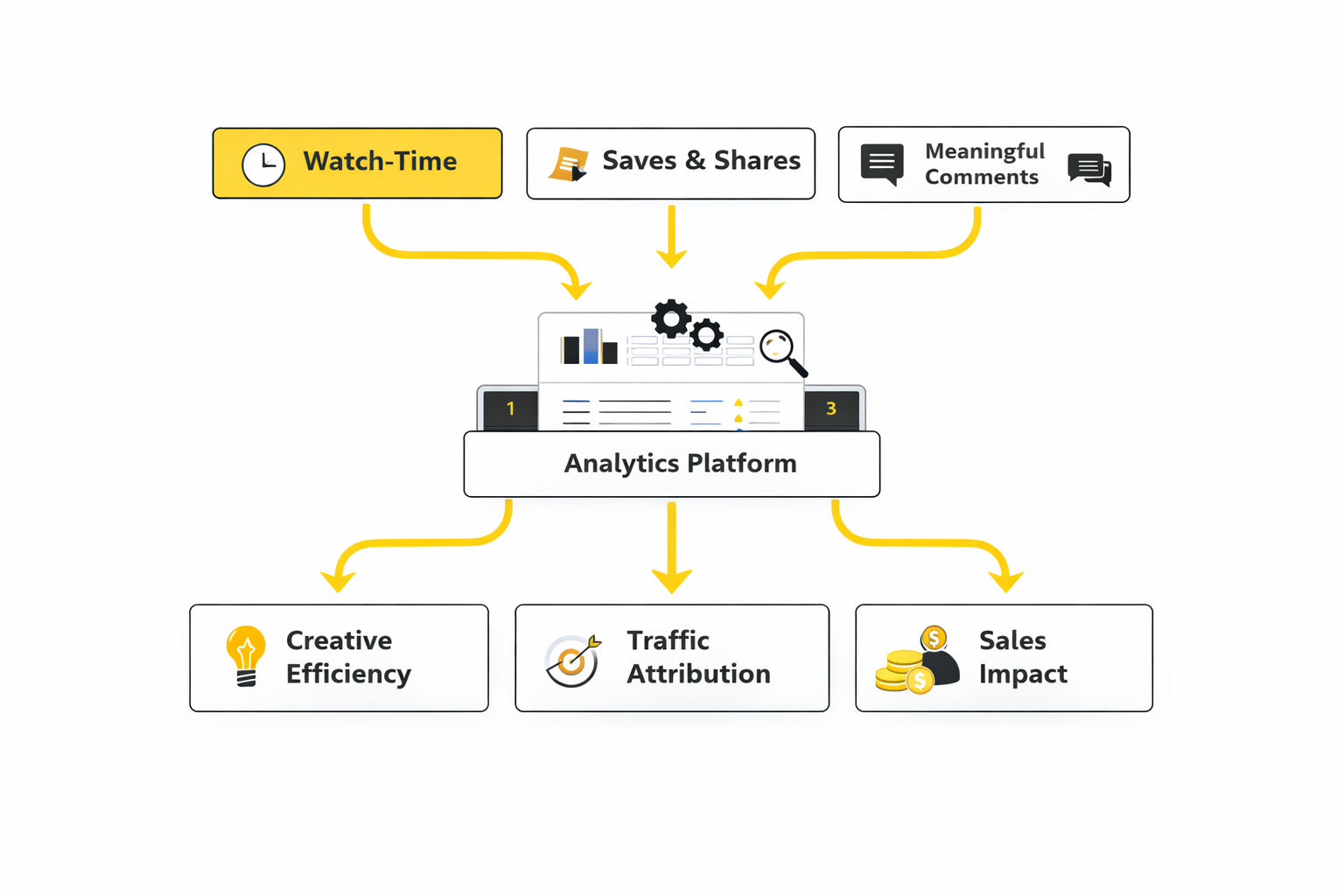
When social media management pricing feels confusing, it’s usually because the business is mixing two different things: output (posts, videos, replies) and outcomes (attention, trust, leads, retention). Data is what keeps those two worlds connected, so you can look at a monthly retainer and say, “Yes, this is buying us something real.”
The trick is not collecting more numbers. It’s collecting the right numbers, consistently, and then making decisions that show up in the next month’s performance.
If you want a quick reality check on where the market is heading, it helps to zoom out once: digital advertising hit a record $259B in 2024, and social media advertising revenue in the U.S. reached $88.8B that year in the IAB/PwC Internet Advertising Revenue Report (Full Year 2024). That matters because it signals where competition for attention is intensifying—and why strong measurement is becoming a pricing requirement, not a nice add-on.
Performance Benchmarks
Benchmarks are useful when you treat them like a map, not a scorecard. Every report measures engagement a little differently (by followers, by reach, by views), and industries behave wildly differently. Still, strong benchmarks give you two advantages: they stop you from panicking over normal fluctuations, and they stop you from celebrating numbers that are “good” only because your category is quiet.
Engagement trend benchmarks: what “normal” looks like right now
Across major networks, engagement has generally become harder to earn for brands, even as content volume rises. Rival IQ’s 2025 Social Media Industry Benchmark Report highlights year-over-year engagement rate declines across platforms (including Facebook, Instagram, TikTok, and X). Emplifi’s 2025 Social Media Benchmarks Report similarly points to shifting engagement dynamics as short-form video dominates brand publishing. Socialinsider’s 2026 Social Media Benchmarks overview also shows meaningful differences in average engagement rates by platform, which is a useful reminder that “we need higher engagement” is not a plan—you need platform-specific expectations and tactics.
This is where social media management pricing becomes easier to defend: the work is not “posting.” The work is earning attention inside a market where attention is getting more expensive.
Posting frequency benchmarks: volume helps until it doesn’t
Posting frequency benchmarks are best used to avoid two common mistakes: under-posting (so the algorithm never learns who you are) and over-posting (so quality drops and the audience tunes out). Hootsuite’s benchmark research shows how dramatically cadence varies by industry and network—for example, in government-related services, Facebook posting frequency averages over 16 posts per week in their analysis (Hootsuite’s government benchmarks update). That doesn’t mean every brand should copy it. It means cadence is often driven by operational realities (news cycles, service updates, public inquiries), which should be reflected in pricing.
Customer care speed benchmarks: expectations set the staffing cost
If engagement and customer care are in scope, response time is a benchmark that can quietly dominate social media management pricing. Consumers still expect timely replies on social, and Sprout’s research notes 73% of consumers expect a response within 24 hours or sooner. Once you accept that expectation, you’re no longer just pricing “community management.” You’re pricing coverage windows, escalation rules, and the operational discipline to hit them consistently.
Analytics Interpretation
Analytics isn’t about proving social is important. The business already knows social is visible. Analytics is about making decisions without guessing—so every month of social media management pricing creates compounding returns instead of repeating the same work.
Separate leading indicators from lagging indicators
Leading indicators tell you if your creative and distribution are working right now. Lagging indicators tell you if the business outcome is changing over time. Saves, shares, watch time, and meaningful comments tend to be better leading indicators than likes because they signal intent, not just acknowledgment. Leads, sales influence, retention, or reduced support burden tend to lag because they require multiple touches and longer cycles.
If your reporting is built only on lagging indicators, your strategy becomes emotionally exhausting: you’ll keep changing tactics before the signal has time to show up.
Normalize metrics so comparisons are fair
Social teams often get stuck in fights caused by bad comparisons: a launch week compared to a quiet week, a video compared to a carousel, a platform with high reach compared to a platform with high intent. Normalization fixes this. Compare like with like: format to format, platform to platform, and campaign period to campaign period.
Even “engagement rate” can become a trap if you don’t define it. Some benchmark reports track engagement rate by followers, while others use reach-based engagement. Emplifi’s 2025 benchmarks highlight reach engagement differences across formats, while Rival IQ’s industry benchmark report presents engagement rate trends in a way that’s commonly used for brand comparisons. If you’re consistent internally, you can still use external benchmarks as guardrails without forcing apples-to-oranges conclusions.
Turn analytics into pricing clarity
A clean way to connect analytics to social media management pricing is to tie metrics to the layer of work they come from:
- Production metrics: output volume, turnaround time, revision cycles, and format mix tell you if the content engine is healthy.
- Distribution metrics: reach, view velocity, and engagement quality tell you if the audience is receiving the work.
- Relationship metrics: response time, resolution flow, and sentiment shifts tell you if trust is being built or eroded.
- Business metrics: attributed actions, lead quality signals, and assisted conversions tell you if social is earning its seat at the table.
When a client asks, “Why does this cost what it costs?” you can point to which layer is being strengthened—and which metrics should move because of it.
Case Stories
Real stories make analytics feel human. They also make social media management pricing feel rational, because you can see the operational chaos that the budget is designed to eliminate.
Paychex: the moment “social” stopped being a checkbox
It started with a silent failure that looks harmless from the outside. Social publishing was happening, but it was treated like the last step in a campaign plan—something to “push out” after the real work was done. Meanwhile, customer care on social was trapped in manual processes that slowed responses and made reporting feel like a daily punishment. Paychex’s case study
The backstory is that Paychex operates in a world where trust and speed matter, and their social footprint isn’t just marketing—it’s a place customers expect real help. Their teams were split across systems, and the work couldn’t easily connect: publishing had limited feedback loops, and care relied on spreadsheets and legacy tracking. The result wasn’t just inefficiency; it was a missed opportunity to turn social into a source of business intelligence. Paychex’s case study
The wall hit hard when the team realized the tools were shaping behavior in the worst way. Instead of making decisions from insights, time was being burned on handoffs, reconciliation, and manual reporting. The care team had a strict service expectation—respond fast, every day—and the administrative drag made that standard harder to maintain. When social is both public and immediate, that drag turns into risk. Paychex’s case study
The epiphany was that unifying systems is not an “operations” project—it’s a strategy project. When social publishing and social care share a backbone, you don’t just move faster; you finally get a single view of what customers are asking for, reacting to, and worrying about. That’s when analytics stops being a report and becomes a decision engine. Paychex’s case study
The journey was a deliberate shift from siloed execution to shared intelligence. The team used reporting to track engagement rate by reach, share of voice, and attribution signals, while care moved into centralized case management and workload balancing. In the first month after onboarding Employee Advocacy (August 2025), their organic team reported $300,000+ in earned media value, and their care operation delivered a measurable efficiency win with a 67% reduction in SLA response time within 60 days. Paychex’s case study
The final conflict wasn’t technical—it was human. Care agents trained in traditional phone support still had to learn how to sound natural on social without drifting off-brand. High-volume inquiries don’t slow down just because you’re implementing a new system, and social conversations can escalate fast in volatile moments. The team leaned on workflow clarity and response-writing support to maintain both speed and tone under pressure. Paychex’s case study
The dream outcome is what most brands say they want but struggle to operationalize: a social presence that is simultaneously faster, more human, and more measurable. It’s also the kind of outcome that makes social media management pricing feel grounded, because you can see what the budget is truly buying—response speed, operational resilience, and an insight loop that improves month after month. Paychex’s case study
Boingo Wireless: when noise looked like demand
The customer care team was drowning, but not in the way leadership assumed. The firehose of social messages created the feeling of nonstop demand, yet much of it was noise—keywords pulling in irrelevant chatter that agents still had to triage. It’s the kind of situation where teams get blamed for being slow, even though the system is setting them up to fail. Boingo Wireless’s case study
The backstory is that Boingo operates connectivity networks in high-traffic environments like airports and stadiums, where problems become urgent fast. Their customer care quality is part of the product experience, and social is one of the most visible places those experiences surface. They also needed their social workflow to fit into a broader service ecosystem, including Salesforce Service Cloud. Boingo Wireless’s case study
The wall appeared when “monitoring” turned into wasted labor. Agents spent time weeding through irrelevant messages instead of helping customers who genuinely needed support. That doesn’t just hurt service metrics—it drains morale and creates a backlog that keeps growing. The team needed a way to identify what mattered without manually sifting through everything. Boingo Wireless’s case study
The epiphany was surprisingly simple: stop treating keywords like a blunt instrument and start treating targeting like a precision tool. By rethinking how listening and tagging worked—and by focusing on the right handles and signals—the team could shrink the noise floor dramatically. Suddenly, “fewer messages” didn’t mean “less care.” It meant “more care for the right people.” Boingo Wireless’s case study
The journey was a practical reset: integrate systems, tighten how messages were captured, and rebuild workflows so agents could spend their time on real requests. Training mattered, because a tool switch only works if agents trust it in the moment. The measurable outcome was striking—Boingo reported an 89% reduction in cases created from social channels after the transition and cleanup, which translated into agents spending less time on triage and more time on quality support. Boingo Wireless’s case study
The final conflict was resisting the temptation to treat the cleanup as a one-time project. Social noise creeps back in as brands add products, campaigns, and new naming conventions. If you don’t maintain governance, the inbox slowly fills with junk again, and response quality falls without anyone noticing at first. Their process leaned on an ongoing discipline of how signals are captured and routed, not just what tool is used. Boingo Wireless’s case study
The dream outcome is a care team that looks calm from the outside because the system is doing its job. For social media management pricing, this story matters because it shows a hidden lever: sometimes the best performance improvement isn’t “more people” or “more posts.” It’s better filtering, better routing, and a workflow that turns attention into action instead of overwhelm. Boingo Wireless’s case study
Professional Promotion
Professional promotion in analytics isn’t about bragging. It’s about making your results easy to understand, so decision-makers keep funding what works—and stop funding what doesn’t.
Build one narrative that ties effort to outcome
Your monthly performance story should answer three questions in order: What did we ship? What did it change in audience behavior? What are we doing next because of that change? When reporting becomes a narrative instead of a spreadsheet tour, social media management pricing feels like an investment with momentum.
Report what you control, then what you influence
You control creative quality, cadence, response discipline, and experimentation velocity. You influence reach, engagement quality, and sentiment. You contribute to leads, pipeline, and retention—but you rarely own them outright. Keeping that hierarchy honest makes stakeholders trust your reporting more, and it prevents social from being punished for metrics it can’t fully command.
Turn benchmarks into targets without turning them into traps
Use benchmark reports to set realistic guardrails, then set targets based on your own baseline. If the broader market is seeing engagement rate declines across platforms, as highlighted in Rival IQ’s benchmark analysis, your internal target might be “decline less than the market” while you rebuild creative advantage—or “hold steady while we increase output quality.” That kind of target is both mature and defensible.
When these habits are in place, analytics stops being a monthly ritual and becomes the engine that makes social media management pricing feel stable, explainable, and worth renewing.
Future Trends
The next wave of social media management pricing won’t be driven by “new platforms.” It will be driven by how fast teams can produce great creative, prove impact, and respond like humans—without burning out or losing brand consistency.
Three shifts are already shaping how smart teams budget and price their social work.
AI becomes a workflow standard, not a content shortcut
AI is moving from novelty to infrastructure. The winning teams use it to compress the boring parts of the job—research, pattern analysis, reporting structure, and workflow routing—so humans spend more time on the creative and relational work that audiences still reward. Hootsuite’s Social Media Trends 2026 report page highlights “creative acceleration and AI workflows” as a major theme, while Sprout’s January 2026 post performance report focuses on how audiences still seek out human-produced content even as AI-generated posts spread.
Pricing implication: clients will pay more for teams that can ship faster without lowering quality, because speed and consistency are becoming competitive advantages.
Human-made content becomes a differentiator, not a baseline
Audiences are getting better at sensing “machine-y” content and tuning it out. The brands that win build systems that keep content feeling human at scale—clear voice, real community interaction, and creative risk that fits the platform culture. Sprout’s 2026 Social Media Content Strategy Report is built on surveys of 2,300+ consumers and 1,200+ marketers, mapping where brand priorities don’t always match what audiences actually want.
Pricing implication: retainers increasingly include creative strategy, community moderation, and voice governance—not just execution.
Creator partnerships get more performance-driven
Creators are no longer a side experiment. They’re a core distribution channel—especially when paid social is crowded and organic reach is unpredictable. IAB’s 2025 Creator Economy Ad Spend & Strategy Report overview projects U.S. creator ad spend at $37B in 2025, and IAB’s companion announcement notes creator ad spend more than doubled since 2021 and reached $29.5B in 2024 (IAB’s news release).
Pricing implication: social media management pricing increasingly bundles creator ops—sourcing, vetting, briefs, rights, approvals, and measurement—because that’s where the real workload lives.
Social commerce and product discovery keep pulling budgets into “always-on”
As platforms keep tightening the loop between discovery and purchase, brands will put more budget behind content that behaves like a storefront: short-form demos, creator-led reviews, and community-driven Q&A. Sprout’s 2026 report also explores how consumer expectations differ by network, which is a practical warning for pricing: what works on one platform may be inefficient on another.
Pricing implication: clients pay for better measurement and faster iteration because the line between “content” and “revenue” keeps getting shorter.
Strategic Framework Recap

At this point, social media management pricing should feel less like a mystery and more like an ecosystem you can control. The core idea is simple: price the system you need, not the myth of “posting more.”
Use this recap as a final filter before you sign (or propose) any monthly plan.
- Start with outcomes: define what “success” means in business terms, then choose the platforms and formats that can realistically support it.
- Price by execution layers: governance, production, publishing, community/care, analytics, and growth experiments each add real workload and skill depth.
- Protect the operation: clear approval windows, scope boundaries, and reporting cadence prevent chaos and make retainers sustainable.
- Benchmark without getting trapped: use industry benchmarks as guardrails, then set targets from your own baseline so progress stays measurable and honest (Socialinsider’s 2026 benchmarks are a helpful snapshot of how platform averages differ).
- Scale systems before volume: stabilize rhythm, then expand format mix, then scale winners—so growth doesn’t collapse into burnout.
If you follow that ecosystem logic, pricing becomes a planning conversation: what layers are included, what gets shipped, and what metrics should move because of it.
FAQ – Built for the Complete Guide
What actually determines social media management pricing?
Pricing is driven by operational reality: how many platforms you’re managing, how much original creative you need, how complex approvals are, whether community management or customer care is included, and how deep reporting and experimentation go. When a proposal is expensive, it’s usually because it includes multiple execution layers that require different skills—not because someone is charging for “posting.”
Is hourly better than a retainer?
Hourly works when scope is uncertain or you’re doing short bursts (audits, launches, crisis coverage). Retainers work when you want a steady rhythm: production, publishing, engagement, and monthly optimization. Most teams end up mixing both: a retainer for the baseline system, and a separate project line for big campaigns or format expansions.
What should a professional monthly package include?
At minimum: a planning rhythm, defined deliverables, an approval process, publishing and engagement routines, and a reporting cadence tied to business goals. If customer care is included, response expectations must be explicit because consumers still expect timely replies, including responses within 24 hours or sooner for 73% of consumers.
How many platforms should one team manage on a single retainer?
It depends on format complexity and response load. A team can handle more platforms if content is repurposed intelligently and community expectations are modest. If the brand needs high-frequency short-form video, creator collaborations, or near-real-time community management, fewer platforms is often the smarter (and cheaper) path to real results.
Why does pricing jump when we add short-form video?
Because short-form video isn’t “one more post.” It adds scripting, editing, revisions, platform formatting, and higher creative iteration. It also changes measurement, because watch-time and completion become the primary feedback loop. Hootsuite’s 2026 trends research frames creative acceleration as a major competitive driver, which is another way of saying: high-performing video requires a real engine, not spare time.
What is scope creep in social, and how do you prevent it?
Scope creep is when extra work sneaks in without being priced: “one more platform,” “quick design tweaks,” “extra revisions,” “can you also reply to every DM,” or “let’s add influencer outreach.” Prevent it with written scope boundaries, revision limits, response windows, and a clear add-on rate for anything outside the baseline.
How long does it take to see results after we start?
Operational fixes can show up quickly: faster turnaround, fewer missed comments, cleaner reporting. Performance results usually follow a pattern: first you stabilize consistency, then you start learning what creative patterns work, then you scale winners. Many teams see clearer direction in 30–60 days and stronger compounding impact after 90 days, especially once experimentation becomes routine.
Which metrics matter most for pricing conversations?
Use metrics that map to the work being bought. For creative and distribution: watch time, saves, shares, and meaningful comments. For community/care: response time and resolution flow. For business impact: attributed actions where tracking is realistic. External benchmark snapshots can help set expectations—Socialinsider’s 2026 benchmark update shows how different “normal” looks across TikTok, Instagram, and Facebook—but your baseline is still the best reference point for pricing decisions.
Do we need creators, and how does that change pricing?
You don’t “need” creators, but they can be the fastest route to distribution and credibility in certain categories. Pricing changes because creator work adds operations: sourcing, vetting, contracting, briefs, rights, content review, and post-campaign analysis. The market shift is real—IAB’s creator economy update signals how quickly budgets are flowing into creator partnerships.
What are red flags in a social media management pricing proposal?
Vague deliverables, no approval process, no reporting cadence, unclear revision limits, and “we’ll go viral” promises. Another red flag is pricing that ignores customer care reality while still offering community management—if you’re expected to respond quickly, staffing and workflows must be included, because expectations like 24-hour response windows are common.
How do I choose between a freelancer, an agency, and an in-house hire?
Freelancers are great when you want specialized expertise and tight collaboration. Agencies are great when you need scale and multiple skill sets bundled. In-house is best when social is strategic enough to justify full-time ownership. The best choice is the one that matches your operational complexity: approvals, volume, and the need for continuous experimentation.
Work With Professionals
If you’re reading this because you’re tired of guessing—tired of proposals that feel inflated, tired of clients who want “more content” without clarity, tired of doing great work that still turns into feast-or-famine—there’s a cleaner way to build your pipeline.
Most marketing freelancers don’t lose deals because they’re not good. They lose deals because the market is noisy: too many platforms, too many gatekeepers, and too many fees that quietly eat margin. That’s why “commission-free” marketplaces are starting to matter more—margin is strategy when you’re building a freelance career.
Markework positions itself as a focused marketing marketplace with direct communication and no project fees, built so you can negotiate scope and pay without a middle layer. On the pricing side, it’s explicit: no commissions and no per-project fees, with monthly plans designed to keep costs predictable. And the work inventory is real and visible—its Find Work hub shows 1007 active listings with more available after you unlock full access.
If your goal is to turn social media management pricing into a steady freelance income, the play is simple: pick one outcome you’re great at (growth, conversion, retention, community/care), package it into a clear offer ladder, and place it in front of companies that already know they need help. A marketplace that removes commissions and lets you talk directly can make that loop faster.
The best part is the feeling you get when momentum returns: you stop begging for replies, you stop discounting to “win,” and you start choosing clients who respect the work because you can prove it and deliver it consistently.
 Filip Konecny Enterprises