

Social media can feel like a moving target when you’re running a small business. One week you’re getting steady comments and DMs, the next week it’s quiet, and you’re left wondering if your content “stopped working” or if you’re just buried under everything else you have to do.
The truth is: most small businesses don’t fail on social because they lack creativity. They fail because they don’t have a repeatable system—one that connects daily posting, customer conversations, and sales goals into something you can run consistently, even when you’re busy.
This guide is built to give you that system. You’ll see what social media management really includes, why it matters more than ever, and a practical framework you can apply without turning your business into a full-time content studio.
Article Outline
- What Social Media Management Looks Like for a Small Business
- Why Social Media Management Matters for Small Businesses
- Framework Overview
- Core Components
- Professional Implementation
What Social Media Management Looks Like for a Small Business

Social media management for a small business is the ongoing work of planning, publishing, listening, responding, and improving your presence across the platforms your customers actually use. It’s not “posting when you remember.” It’s building a dependable loop: you share useful content, people interact, you respond, and those interactions turn into trust, leads, and sales.
In practice, it usually includes:
- Strategy: choosing platforms, defining goals, and deciding what you will be known for.
- Content planning and publishing: turning your expertise into posts, videos, Stories, and offers that fit your weekly rhythm.
- Community and inbox management: replying to comments, DMs, and tags in a way that feels human and timely.
- Brand consistency: keeping your voice, visuals, and promises aligned across every post and conversation.
- Measurement: reviewing what’s working, what’s wasting time, and what to change next.
If you’re thinking, “That sounds like a lot,” you’re right—unless it’s structured. The goal of smart social media management isn’t to do more. It’s to do the right few things consistently, so the results compound over time.
One more important point: social media management isn’t limited to marketing. It’s also a customer experience channel now, especially because people expect quick answers where they already spend time. Research consistently shows that responsiveness and visible engagement influence how people judge trust and credibility—something highlighted across consumer studies like Emplifi’s social customer experience research, which found many people care about seeing brands respond publicly in social spaces (consumer-brand engagement on social media findings).
Why Social Media Management Matters for Small Businesses
For a small business, social media isn’t just “nice to have.” It’s one of the few channels where you can build awareness, relationships, and repeat sales without paying for every impression—if you manage it like a system instead of a gamble.
Here’s why it matters in a very practical sense.
Your customers are already there, and their attention is measurable
At the start of 2025, the connected audience is massive, and it keeps growing. Global digital reporting shows there were 5.56 billion internet users at the start of 2025, and the same ecosystem analysis tracks billions of social identities over time, including 5.66 billion social media user identities by October 2025. The broader flagship report widely used by marketers also documents the same trajectory of digital and social growth (Global Digital Report 2025 PDF).
That scale matters because it changes what “local” means. A neighborhood café still wins by serving the people nearby, but social media lets them stay top-of-mind between visits, promote time-sensitive offers, and build familiarity so new customers walk in already feeling like they know the place.
Trust is built in the replies, not just the posts
Small businesses usually can’t outspend bigger competitors. But you can out-care them. One of the clearest differentiators is responsiveness—especially when prospects are deciding whether you’re reliable.
Across multiple consumer and service studies, a fast response window keeps showing up as a baseline expectation. Social research from Sprout Social points to a “within 24 hours” norm for many consumers (social customer service expectation insights). Broader customer service reporting also highlights a similar expectation, including Freshworks’ roundup that notes a large share of customers expect a response within 24 hours on social channels (customer service statistics for 2025). Emplifi’s consumer-brand engagement survey adds another angle: many people actively want to see brands respond to customers in public social spaces (Emplifi Social Pulse consumer survey PDF).
When you manage social media intentionally, you don’t just “answer messages.” You create an experience: fast, helpful, and consistent. That experience becomes part of your reputation.
Creators and social content now shape buying decisions at scale
Even if you never hire an influencer, the creator economy affects your small business because customer attention is being trained by short-form video, creator-led recommendations, and social proof.
Ad investment is following that attention. The Interactive Advertising Bureau (IAB) projected U.S. creator ad spend would reach $37 billion in 2025, growing 26% year over year (IAB Creator Economy Ad Spend & Strategy Report 2025 PDF). The same figures are summarized in IAB’s own report page (IAB report overview) and echoed through the official release about the report’s findings (IAB report announcement coverage).
What this means for you: social platforms are not just “distribution.” They’re where product discovery, trust-building, and conversion can happen in a single scroll—especially when your content looks and feels native to the platform.
Framework Overview
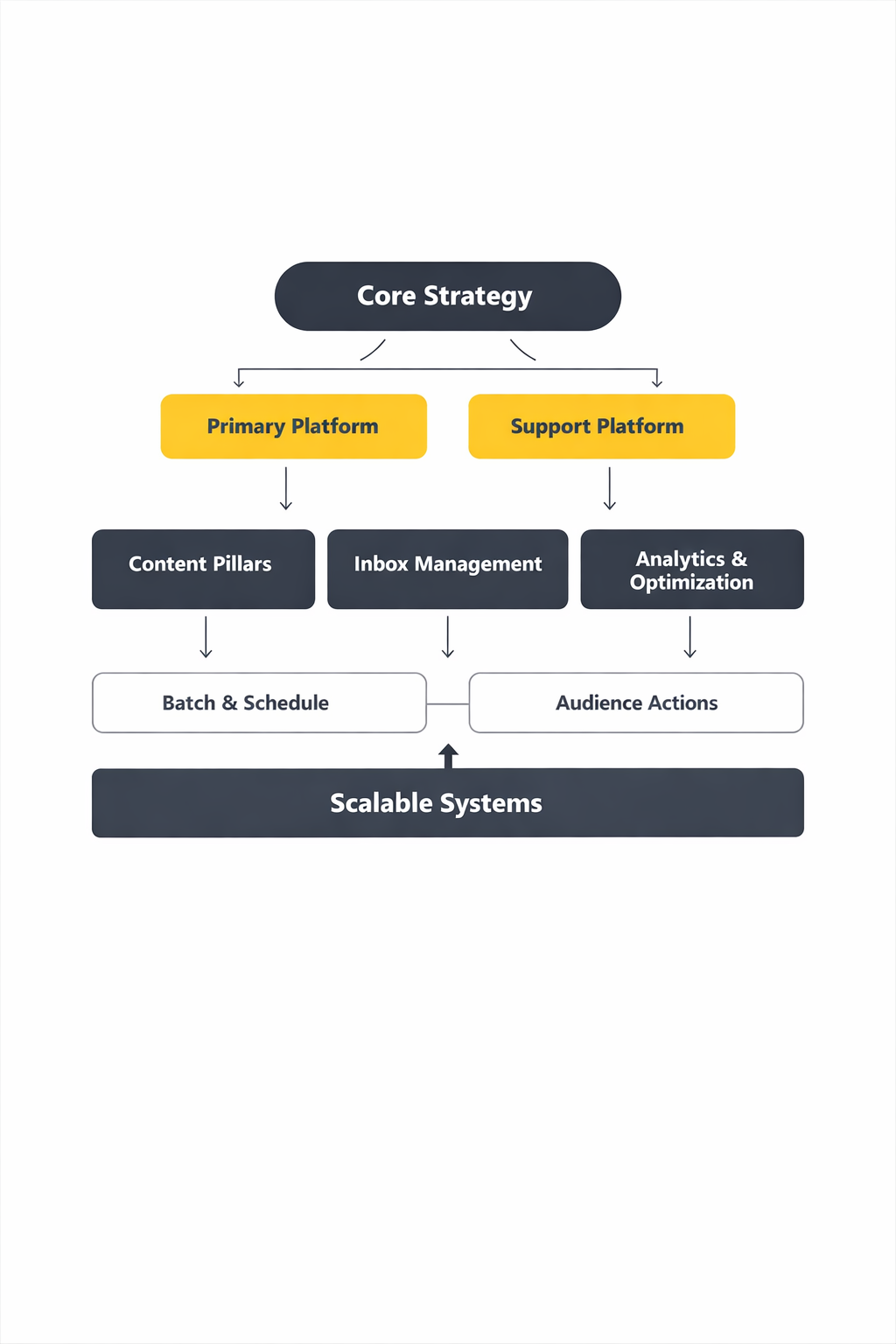
To keep social media manageable, you need a framework that makes decisions easier. The simplest way to think about social media management for a small business is a five-part loop that repeats every week:
- Position: decide what you stand for and who you help, so your content has a spine.
- Plan: turn your offers, FAQs, and customer stories into a content calendar you can actually maintain.
- Publish: post consistently with formats that match your capacity (not someone else’s).
- Participate: respond, comment, and engage like a real person—because that’s where trust is built.
- Prove: track a small set of metrics so you know what to repeat and what to stop doing.
This loop works because it respects how small businesses operate. You don’t need a massive content team. You need decisions that reduce chaos: what platforms matter, what to post, when to post, how to respond, and how to know if it’s paying off.
In the next sections, we’ll break the loop into specific building blocks you can implement without guessing.
Core Components
These are the core components that make social media management work for a small business without becoming overwhelming. Think of them as your “minimum viable system.”
1) Platform choices that match real customer behavior
Most small businesses don’t have a platform problem—they have a focus problem. The fastest way to burn out is trying to “be everywhere.” A better approach is to choose one primary platform (where you publish the most) and one support platform (where you repurpose and respond).
To make platform choices with confidence, use reliable audience data and match it to how your customers buy. For example, large-scale platform usage research can help you avoid building your whole strategy on a platform your audience barely touches. Pew Research Center’s platform usage reporting is one of the clearest snapshots of where U.S. adults actually are (Americans’ Social Media Use 2025), and it’s especially useful when you sell nationally or to English-speaking markets.
2) Content pillars that prevent “what do I post?” panic
Content pillars are recurring themes that make your posting predictable. Instead of inventing content from scratch every time, you rotate through a few categories that reflect why people hire you.
For most small businesses, strong pillars usually include:
- Proof: customer wins, testimonials, before/after, results, and reviews.
- Process: what you do, how you do it, and what customers should expect.
- Education: answers to common questions, mistakes to avoid, and quick tips.
- Personality: behind-the-scenes, values, and human moments that build familiarity.
- Promotion: offers, availability, launches, and clear calls to action.
When you use pillars, your content starts to feel consistent. That consistency matters because people rarely buy the first time they see you—they buy after repeated exposure that builds confidence.
3) Community management that turns attention into relationships
Posting is only half the job. The other half is participation: replying to comments, answering DMs, acknowledging tags, and interacting with your local community or niche.
This is where small businesses can outperform big brands, because your responses can be personal and fast. If you treat your inbox like a sales and service channel (not a distraction), you create a reputation advantage that compounds—especially when people can see your responsiveness publicly.
4) A workflow you can run even on busy weeks
Your workflow is what makes social media management sustainable. A solid small-business workflow is simple:
- One planning block: decide weekly themes, pick formats, and draft captions.
- One production block: record short videos or create visuals in batches.
- One scheduling block: load posts into your scheduler so you’re not scrambling daily.
- Daily engagement windows: two short check-ins to reply and interact consistently.
- One review moment: look at performance and decide what to repeat next week.
This is how you stop social from stealing your attention every day. You contain the work into predictable blocks—and that predictability is what keeps you consistent.
5) Measurement that supports decisions, not vanity metrics
Small businesses don’t need complicated dashboards to start. You need a few metrics that connect to outcomes.
A practical starter set looks like this:
- Reach and views: are you getting in front of enough people?
- Engagement: are people responding in ways that signal trust (saves, shares, comments, replies)?
- Clicks and inquiries: are people taking the next step (site visits, booking requests, DMs about pricing)?
- Conversion signals: can you connect social activity to sales conversations or purchases?
Measurement isn’t about proving you’re “good at social.” It’s about learning what your audience actually wants so you can do more of it with less effort.
Professional Implementation
At some point, most small businesses reach a crossroads: social media is clearly valuable, but doing it properly competes with running the business. That’s when professional implementation becomes the difference between “we post sometimes” and “social consistently drives leads and trust.”
Option 1: Build a lean in-house system first
If you’re not ready to outsource, your first professional step is documentation. Create a simple operating system for your social media management:
- Brand voice notes: 10–15 bullets describing how you speak, what you never say, and the tone you want.
- Content pillar definitions: what counts as “Proof,” “Education,” “Promotion,” and so on for your business.
- Posting cadence: a realistic weekly schedule you can keep for 90 days.
- Response guidelines: how you answer pricing questions, complaints, refunds, and “is this available?” messages.
- Escalation rules: when to move a conversation to email/phone, and when to stop replying.
This turns social media from an art project into operations. It also makes outsourcing easier later, because you’re not handing someone a blank canvas.
Option 2: Outsource execution without losing your voice
If you hire a freelancer or agency, your job is to protect what makes your small business special: your authenticity and your customer knowledge. Outsourcing works best when you keep strategic ownership while delegating production and scheduling.
A clean division of responsibilities looks like this:
- You own: offers, positioning, customer insights, approvals, and the final “yes/no” decisions.
- Your social manager owns: content planning, drafting, scheduling, light design/editing, reporting, and process.
- Shared: community management rules (who replies to what, and how fast).
This avoids the common failure mode where outsourced social looks polished but feels disconnected from the real business.
Option 3: Professionalize customer care on social
For many small businesses, the biggest hidden opportunity is social customer care. When your response speed improves and your answers get consistent, customers feel taken care of—and prospects watching from the sidelines feel safer choosing you.
If you want one operational benchmark to guide your implementation, the “respond within a day” expectation keeps surfacing across consumer research and service reporting, including social customer care analysis from Sprout Social (consumer expectations for responses on social), broader customer service trend reporting that highlights similar expectations (service statistics and response expectations), and consumer-brand engagement research emphasizing the importance of visible brand responses (Emplifi consumer-brand engagement survey).
Professional implementation isn’t about perfection. It’s about reliability: consistent posting, consistent replies, and consistent learning from what your audience does. In the next part, we’ll start turning this into a practical, step-by-step execution plan you can run week after week.
Step-by-Step Implementation
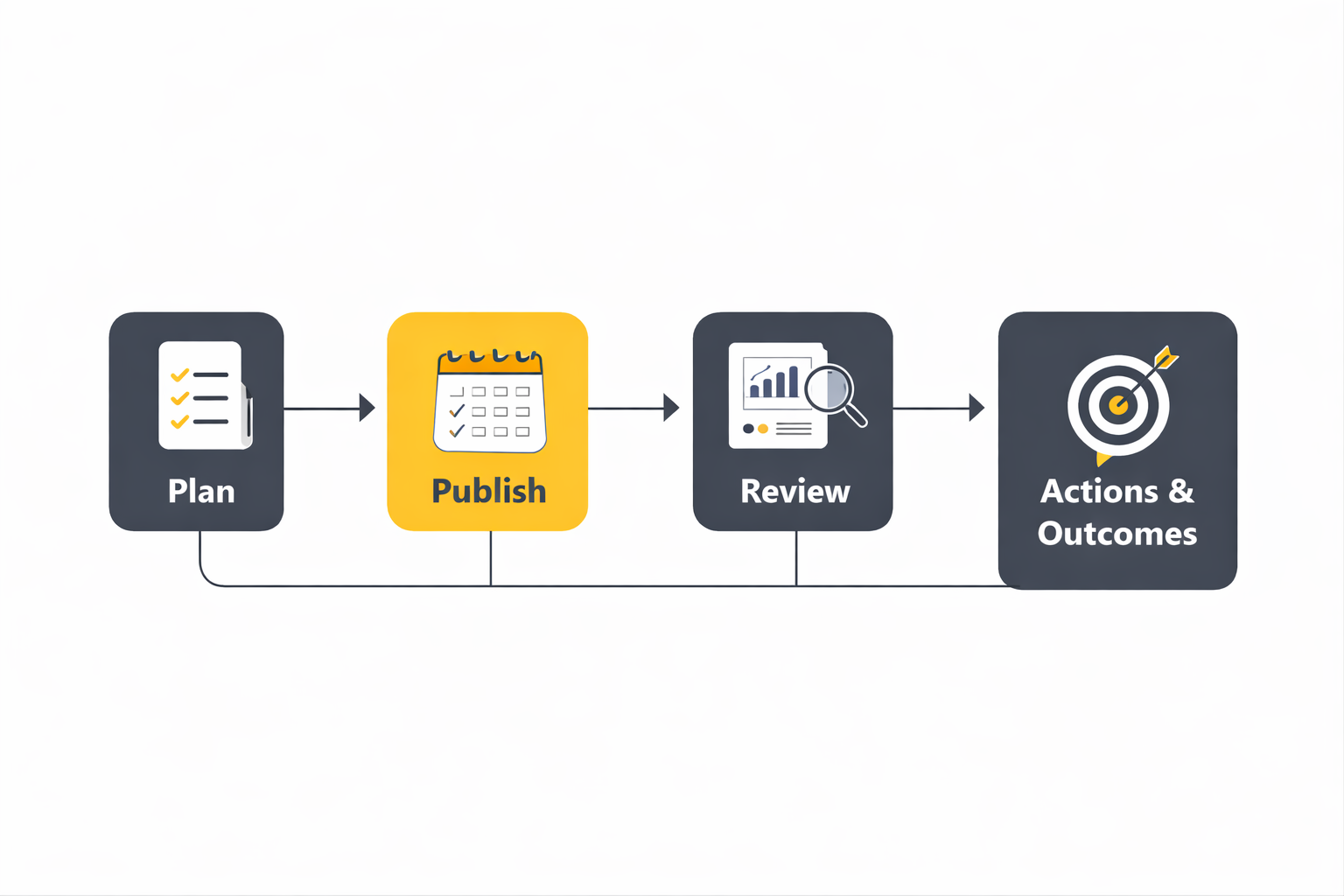
The easiest way to make social media management for small business feel “manageable” is to treat implementation like a rollout, not a reinvention. You’re building a system you can run on your busiest week, not your most motivated week.
This step-by-step plan is designed for a small team (or one person) and works whether you’re starting from scratch or cleaning up years of inconsistent posting.
Week 1: Set the guardrails so you stop improvising
- Pick one primary platform and one support platform. Use real audience behavior to guide the choice; platform usage data like Pew’s 2025 platform breakdown helps you see where people actually spend time (Pew Research Center social media use report).
- Write a one-page “voice and boundaries” note. Include what you stand for, what you don’t say publicly, and how you handle sensitive topics.
- Define three content pillars you can sustain. If you can’t name three pillars in 10 minutes, your strategy is too complicated.
- Create a response promise. A simple standard like “reply within 24 hours on business days” aligns with what many consumers now expect on social (Sprout Social customer response expectations) and what Emplifi’s 2025 consumer survey highlights around responsiveness and trust (Emplifi Social Pulse 2025 survey PDF).
Week 2: Build a repeatable content engine
- Collect real customer language. Pull 20 phrases from reviews, emails, and DMs and use them as hooks for posts. If you want content that converts, start with how customers actually talk.
- Batch produce. Record 6–10 short videos in one session, then slice them into multiple formats (short clips, carousels, Stories prompts, Q&A posts).
- Schedule the week. If you’re in the Meta ecosystem, planning and scheduling can live inside Meta Business Suite’s Planner (Meta Business Suite scheduling). If LinkedIn is your main channel, scheduling can happen directly in-platform (LinkedIn post scheduling).
- Create a “content bank.” Keep a list of post ideas, proof assets, FAQs, and reusable prompts so you don’t start from zero every Monday.
Week 3: Turn engagement into a daily habit
- Two engagement windows per day. One in the morning, one late afternoon. Short and consistent beats long and occasional.
- Reply publicly when it helps others. Comments are reusable answers; DMs are private answers. Use both intentionally.
- Assign ownership if more than one person helps. Meta’s Inbox features are built for shared responsibility and conversation assignment (Meta Inbox best practices).
Week 4: Add measurement that changes your decisions
- Put UTM tracking on every link you control. This is the fastest way to connect posts to outcomes in GA4 (Google Analytics campaign URL builder).
- Choose five numbers to review weekly. One reach metric, one engagement metric, one action metric (clicks/inquiries), and two business metrics that reflect your goal (bookings, calls, orders, foot traffic).
- Look for patterns, not single-post wins. Meta recommends looking for trends in audience activity and growth over time inside Business Suite insights (Meta insights analysis best practices).
Execution Layers
Implementation falls apart when everything feels equally urgent. A layered approach keeps the essentials running while still leaving room for creativity and growth.
Layer 1: Always-on basics
This is the minimum layer that should never stop. If your social media management for small business can only handle one layer during a chaotic month, keep this one alive.
- Scheduled posts: consistent publishing using a planner or scheduler (Meta Business Suite scheduling).
- Response habit: a daily inbox routine aligned with consumer expectations for timely replies (24-hour response expectation trend).
- Proof rotation: at least one post per week that shows real outcomes (reviews, before/after, customer stories).
Layer 2: Growth content
This layer is where discovery happens. It’s built around formats that travel further than your current follower base.
- Short-form video series: repeatable topics with a recognizable structure, so you’re not reinventing each time.
- Community-first prompts: questions, polls, and “choose this vs that” content that invites replies.
- Collaborations: partner posts with local businesses or creators when it’s a natural fit.
Growth content works best when you can keep the loop tight: publish, watch what triggers saves/shares, and repeat the pattern quickly. Shorter reaction cycles are increasingly important for staying relevant in fast-moving feeds (Sprout Social Index 2025 trend coverage).
Layer 3: Conversion paths
This layer turns attention into revenue without making every post feel like an ad.
- One clear next step: book, call, DM, visit, or buy.
- Landing page hygiene: fast page load, clear offer, and a frictionless way to take action.
- Tracking discipline: campaign URLs so you can see which posts drive meaningful visits and actions (GA4 UTM tracking).
Optimization Process
Optimization is where social media stops being “content” and becomes a business system. The goal is to create a weekly loop that produces better outcomes with roughly the same effort.
The weekly loop
- Monday: Review last week’s top performers, then decide what to repeat with small variations.
- Tuesday: Batch production (record, design, edit). Protect this time like a client appointment.
- Wednesday: Schedule and QA (check captions, links, tags, and calls to action).
- Thursday: Community day (reply deeper, comment on others, build relationships).
- Friday: Measurement and insights (note patterns, update the content bank, set next week’s focus).
Meta’s own guidance on reviewing insights emphasizes looking for patterns like when your audience is active and how growth changes over time (Meta Business Suite insights analysis). That’s the mindset to bring into your weekly loop: you’re not chasing one lucky post, you’re finding repeatable signals.
How to test without burning out
Testing often fails because people try to test everything. Instead, test one variable at a time for two weeks.
- Hook test: keep the topic, change the first line or first two seconds.
- Format test: same idea as a Reel vs a carousel vs a simple text post.
- Timing test: same content posted at two different times; use platform insights to guide the window (audience activity trends in Meta insights).
- CTA test: “DM me” vs “book here” vs “comment a keyword.”
Keep a simple rule: if the test doesn’t change a business outcome (inquiries, bookings, orders), it’s not worth repeating, even if it gets likes.
Optimize your responses like you optimize your posts
For many small businesses, the inbox is where revenue quietly happens. Tightening your response system can be a bigger growth lever than posting more often.
Consumer research consistently shows that fast responses matter; Sprout’s Index reporting highlights that many people expect a brand response within 24 hours (Sprout Social customer care expectations), and Emplifi’s 2025 survey frames responsiveness as a foundation of trust (Emplifi Social Pulse 2025 PDF). If you improve response speed and clarity, you often improve conversion without changing your content at all.
Implementation Stories
Here’s a real implementation story that shows what happens when a small business stops treating social like a side quest and starts using it as a structured lifeline.
Nails by Madilyn: One Post, Then a System
Start at a point of high drama.Madilyn Kolb had opened her nail studio and hit the moment every new service business fears: the doors were open, but the calendar was empty. Rent was due, and the number was painfully specific—$600 with no clients to cover it. With the pressure rising, she filmed a TikTok that wasn’t polished, wasn’t strategic, and wasn’t planned—it was just honest (People.com story on Nails by Madilyn).
It could have disappeared like most posts do. Instead, it exploded. The video reached more than two million people, and strangers began booking appointments almost immediately (People.com story on the viral TikTok).
Backstory.She wasn’t a random creator chasing views—she was an 18-year-old who moved to Wichita to chase the dream of building a salon experience that felt kinder than what she’d experienced growing up. She went to cosmetology school during the week and worked weekend mall shifts to keep herself afloat while she prepared to launch (details on her move and work schedule). Even grief became part of the story when she lost her grandfather, someone she described as a core believer in her future (context about her turning point).
That backstory mattered because it made her business legible. People weren’t just booking nails; they were supporting a person with a clear why. Social works like that more often than people admit.
The wall.After she found a studio space with a friend and officially opened “Nails by Madilyn,” the reality was brutal: they were starting from scratch with no clients (opening the studio with no clients). Posting “normal business content” wasn’t moving fast enough, and paid ads weren’t the immediate fix for an urgent rent deadline. The wall wasn’t lack of talent; it was lack of attention at the exact moment attention mattered most.
This is the part many small businesses recognize. You can have a real offer, a real service, and a real location—and still feel invisible. That invisibility is what makes implementation feel so urgent.
The epiphany.Her viral moment didn’t teach a magic trick. It taught a principle: honesty travels further than polish when you’re telling the truth people can feel (how her honesty drove the response). She realized she didn’t need to manufacture a brand persona; she needed to document the real journey. And once bookings started pouring in, the goal shifted from “please help” to “how do I show up consistently for the people who just trusted me?”
That’s the pivot from luck to system. A viral post can open the door, but a repeatable process keeps the room full.
The journey.After the post took off, she kept sharing her journey and built a growing following, which extended the momentum beyond a single spike (continuing to share and build community). She described how bookings jumped overnight—from one client to being booked for the rest of the week, then the rest of the month (bookings timeline after the post). That sequence is exactly why implementation matters: when demand arrives suddenly, you need a workflow to manage content, replies, and scheduling without dropping the ball.
In practical terms, this is where social media management for small business becomes operations. You set engagement windows, you answer questions quickly, you pin key info, and you turn repeated questions into posts so future prospects self-educate. The system catches the demand your content creates.
Final conflict.Viral attention is messy. She didn’t even notice the video was taking off at first—she was Christmas shopping and not checking her phone until someone called to tell her what was happening (how she discovered it was going viral). That’s a real operational risk for small businesses: attention arrives when you’re living your life, and if you don’t have a process, you miss it. The other risk is emotional—sudden visibility can bring pressure, expectations, and a fear of messing up in public.
This is why response standards matter so much. When people reach out, silence feels like rejection, and the goodwill from the viral moment can evaporate. A simple inbox routine and clear next steps protect the trust you’ve earned.
Dream outcome.She didn’t just get sympathy views; she got booked months out, plus local community support that turned into sustained momentum (community support and sustained bookings). She framed the experience as a reminder that it’s okay to start before you feel fully ready—and that honesty and community can be powerful (her reflection on the experience). The “dream outcome” wasn’t fame; it was a real business with real clients in real chairs, created through social visibility and follow-through.
That’s the lesson to borrow: don’t wait for a viral moment, but build a system that can handle one. If your implementation can handle the surge, even a small spike can change your year.
Build a simple operating system
- Weekly plan: themes, offers, and posting slots locked by Wednesday for the following week.
- Batch production: one session for recording/designing, one session for editing and scheduling.
- Inbox coverage: a defined response promise aligned with what consumers expect on social (24-hour response expectation trend).
- Measurement discipline: UTM links and a weekly review, so the business learns from real behavior (GA4 campaign URL tracking).
Quality control that prevents “small mistakes” from becoming public problems
Professionalism is often invisible. It’s the pre-flight checklist: broken links caught before they ship, captions checked for clarity, and sensitive topics handled with care. It also includes planning for the real-world weirdness of platforms—like measurement changes and reporting shifts—so your performance story stays credible over time (explaining Meta reporting changes in 2025).
Scaling without burning out
If you want to scale social output, don’t scale complexity. Scale reuse.
- Turn FAQs into series. One topic, five posts, one clear CTA.
- Turn results into templates. One proof format you can repeat every week.
- Turn insights into rules. If a pattern repeats in your data, bake it into your plan (using Meta insights to spot patterns).
When you implement like this, social stops being “extra marketing.” It becomes a predictable part of how the business earns attention, builds trust, and converts interest into customers.
Statistics and Data
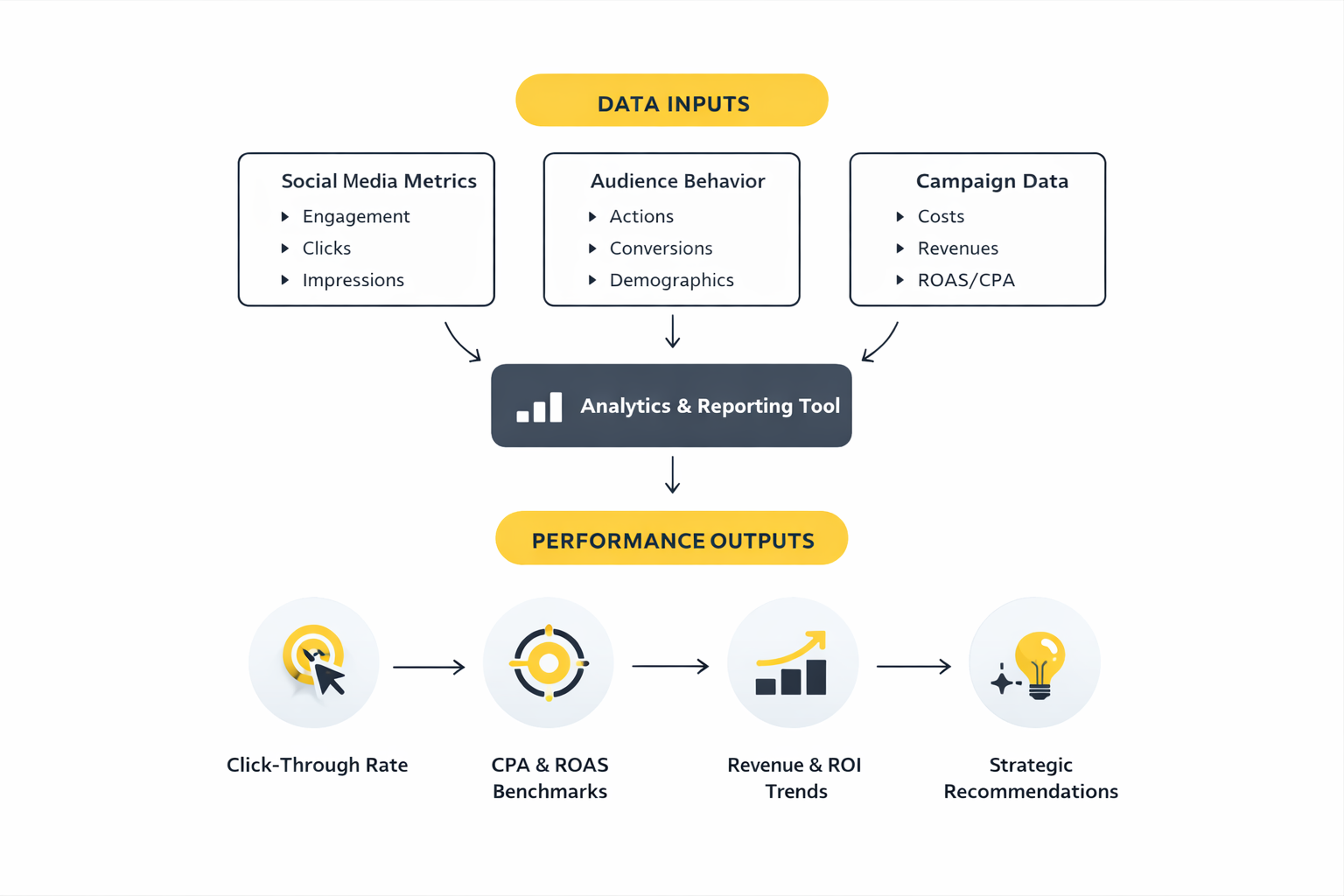
Data is what turns social media management for small business from “we posted a lot” into “we know what’s driving calls, bookings, and sales.” The trick is to use a small set of numbers that actually change decisions, instead of drowning in dashboards that look impressive but don’t tell you what to do next.
It helps to zoom out for a second. The audience is enormous and still growing: 5.56 billion people were using the internet at the start of 2025, and Kepios’ ongoing tracking shows 5.66 billion social media “user identities” by October 2025. The same global reporting ecosystem is also available as a consolidated PDF used widely by marketers and analysts (Global Digital Report 2025).
That scale is why measurement matters. When attention is that abundant, “posting more” is rarely the answer. Learning faster is.
What to track without getting lost
- Attention: reach/views and watch time (are people seeing it, and are they staying?)
- Trust signals: saves, shares, meaningful comments, and DM replies (are people treating it as valuable?)
- Actions: link clicks, profile actions, direction requests, calls, bookings, checkout starts (are they moving?)
- Outcomes: qualified leads, appointments, revenue, repeat purchases (did it matter to the business?)
For platform-specific reporting, Meta documents how insights in Business Suite help you understand performance across organic and paid activity (Meta Business Suite insights overview), and it also defines core measurement concepts like reach in a way that keeps your reporting consistent over time (Meta reach definition).
Performance Benchmarks
Benchmarks are useful for one reason: they stop you from panicking. If engagement is down everywhere, you don’t need a total rebrand—you need a smarter iteration plan. The best benchmarks do two things at once: they show what “typical” looks like right now, and they tell you where the platform is shifting.
Platform-level engagement trends
Rival IQ’s 2025 benchmarking research reported that engagement rates fell across major platforms year over year, with drops including Facebook (-36%), Instagram (-16%), TikTok (-34%), and X (-48%) (Rival IQ 2025 Social Media Industry Benchmark Report). Their long-form PDF benchmarking work also covers the reality that declines can happen alongside strategic wins like improved content formats and smarter posting frequency (Rival IQ 2024 Benchmark Report PDF).
This matters for small businesses because it changes what “good” looks like. You’re not chasing last year’s numbers—you’re chasing today’s behaviors: saves, shares, watch time, and conversions.
Format signals that actually guide what you post
Benchmarks become actionable when they show what formats are winning attention. Rival IQ highlighted that carousels led Instagram engagement in its 2025 benchmarks, outperforming Reels in engagement for many brands (carousels outperforming Reels insight). Emplifi’s benchmarking work similarly emphasizes format-led strategy, framing Reels and carousels as consistently stronger interaction drivers than static images (Emplifi social media benchmarks overview).
For social media management for small business, this is liberating: you don’t need to guess. Use the formats the platform is currently rewarding, then layer your messaging on top.
Customer care benchmarks that influence revenue
Posting is visible, but responsiveness is felt. Sprout’s consumer research has repeatedly found that nearly three-quarters of consumers expect a response within 24 hours on social (Sprout Social customer service statistics). Emplifi’s 2025 consumer survey also frames responsiveness as a trust-builder and highlights how consumers evaluate brands based on how they engage publicly and privately (Emplifi Social Pulse 2025 PDF).
This is a benchmark worth treating like an operational KPI. A faster, clearer inbox routinely creates more business impact than squeezing out one extra post per week.
Analytics Interpretation
The most common analytics mistake in small business social is reading numbers like a report card. Analytics isn’t a grade. It’s feedback. The goal is to turn platform signals into decisions you can repeat.
What “good” looks like in practice
“Good” is not a single number. It’s alignment. A post can have modest reach but still be great if it drives high-intent DMs. A Reel can have huge views but still be weak if nobody takes the next step.
A simple way to interpret performance is to ask three questions in order:
- Did it earn attention? (reach/views, watch time, retention)
- Did it earn trust? (saves, shares, thoughtful comments, replies)
- Did it move someone closer? (profile actions, clicks, inquiries, bookings)
If you’re using Meta’s ecosystem, it helps to keep your definitions stable. Meta’s own help center documentation is useful for grounding what each metric means so your reporting doesn’t drift over time (Meta metric definitions).
Attribution that doesn’t require a data team
If you want to connect social activity to business outcomes, the simplest upgrade is consistent campaign tagging. GA4’s campaign URL builder lets you add UTM parameters so you can see which posts and campaigns drove sessions and conversions (GA4 campaign URL builder).
This is where small business reporting becomes persuasive. Instead of “Instagram felt busy,” you can say “these three posts drove these sessions, these inquiries, and these bookings.”
Signal vs noise: what to ignore
- Ignore one-off spikes. Treat them as clues, not conclusions.
- Ignore vanity growth. Follower count matters less than conversion actions.
- Ignore metrics you can’t act on. If a number doesn’t change a decision, it’s decoration.
What to prioritize: repeatable patterns. If a format repeatedly earns saves and shares, it’s telling you your audience wants to keep that information. Build a series from it.
Case Stories
Here’s a real case story that shows what “analytics-backed execution” looks like when a small business stops winging it and starts running social like a system.
Apricotton: When a Small Brand Had to Prove Growth Fast
Start at a point of high drama.Apricotton didn’t need “better vibes” on social—they needed results. A small retail brand can’t afford months of slow iteration when inventory and cash flow are on the line. They entered Hootsuite’s Social Media Makeover for Small Businesses with a simple pressure: make social drive sales, or keep bleeding time on content that wasn’t moving product (Hootsuite Apricotton case study).
The spotlight made it worse. When your business is featured, you don’t get to hide behind excuses. Every post becomes a test of whether you actually understand your audience.
They had to ship a new approach quickly, measure it, and prove it.
Backstory.Apricotton is a small brand in the kind of category where competition is relentless and attention is expensive. Their challenge wasn’t creativity—it was consistency and clarity: getting the right message in front of the right people often enough to convert. They leaned into a structured plan that blended content upgrades with paid support and a clearer analytics routine (how the makeover program structured the work).
That’s the reality for many small businesses: you can make great products, but if your social operation is chaotic, your results are chaotic too. The brand needed a repeatable workflow, not a one-time campaign.
The wall.The wall wasn’t “we don’t know what to post.” The wall was time and uncertainty. Without a clean measurement loop, it’s easy to confuse activity with progress. If you can’t tell what content is driving outcomes, you end up changing everything at once—and then you learn nothing.
They also faced a classic small-business constraint: every hour spent manually reporting is an hour not spent improving the actual strategy. They needed to save time while still getting clearer performance feedback (hours saved through analytics tooling).
The epiphany.The shift was treating analytics as a weekly operating habit instead of a monthly “post-mortem.” Rather than chasing random trends, they used performance review to double down on what actually moved the needle. That kind of routine changes everything because it makes learning inevitable.
They weren’t trying to become a “content brand.” They were trying to become a disciplined brand—one that could test, measure, and iterate without burning out.
The journey.The makeover paired improvements in content with smarter execution and measurement. Over a short window, the brand generated 66,000 impressions across social platforms in two weeks and reported saving 8 hours per week through analytics-driven tracking (impressions and time-saved metrics). That freed up time to do the real work: refine creative, tighten targeting, and improve the conversion path.
Most importantly, their approach didn’t rely on “one lucky post.” It relied on a repeatable loop: plan, publish, review, improve. That’s the heart of social media management for small business when you’re serious about outcomes.
Final conflict.Small brands don’t get endless retries. When you change messaging or offers, you risk confusing the audience or breaking what was already working. And when you start leaning on performance data, you face another risk: optimizing so hard for metrics that the brand voice gets diluted.
The tension is real: you want numbers to guide you, but you can’t let numbers strip out the humanity that makes people buy. They had to keep the content feeling like a brand people trust while still tightening performance.
Dream outcome.The headline result was concrete: a 108% increase in sales tied to the makeover effort (108% sales increase result). But the bigger win was operational. They walked away with a system that made growth repeatable: clearer planning, smarter measurement, and less time wasted on reporting.
That’s what data is supposed to do for a small business: reduce guesswork, reduce wasted time, and make the next month better than the last.
Professional Promotion
If you sell social media management for small business as a service, data is your best marketing asset—because it turns “trust me” into “here’s the proof.” The goal is not to drown prospects in dashboards. The goal is to tell a clean performance story that a business owner immediately understands.
Lead with outcomes, then backfill with metrics
Start your promotion with the business outcome the client actually cares about: leads, bookings, foot traffic, revenue. Then support it with a small set of metrics that explain why that outcome moved.
- Outcome: bookings increased
- Support metrics: DMs up, profile actions up, clicks up, conversions tracked via UTMs (UTM tracking in GA4)
This keeps the conversation grounded. It also helps you avoid the trap of selling “engagement” to a client who really wants sales.
Use benchmarks to build credibility, not excuses
Benchmarks give your pitch context. If a prospect is worried because their engagement is down, show that platform engagement has been trending downward in many categories while still leaving room for smart format-led wins (Rival IQ 2025 engagement trend findings). Then explain what you’ll do about it: improve formats, tighten the message, and measure actions, not vanity signals.
Sell responsiveness as a revenue lever
Many small businesses underestimate how much money sits in the inbox. Customer care expectations are now a competitive edge, and research keeps pointing to the same baseline: many consumers expect a response within 24 hours (Sprout Social response time expectations). Pair that with a practical implementation promise: inbox coverage, response templates, escalation rules, and weekly review of the questions that keep coming up.
That pitch lands because it’s not abstract. It’s operational. It feels like “this will make my business run better,” not “this will make my Instagram prettier.”
Create a simple proof package you can show in every sales call
- One-page KPI summary: outcomes first, metrics second
- Three post examples: one that earned attention, one that earned trust, one that drove action
- One screenshot of attribution: GA4 campaign performance or UTM-driven results (campaign URL reporting basics)
- One benchmark slide: context from reputable benchmarking research (2025 benchmark trends)
When you promote your work this way, you’re not just selling content creation. You’re selling a measurable operating system—exactly what small businesses are usually missing when social feels frustrating.
Advanced Strategies
Once the basics of social media management for small business are running reliably, “advanced” doesn’t mean complicated. It means you’re intentionally stacking advantages: content that earns attention, systems that protect your time, and growth loops that keep working even when you’re busy.
Turn your content into social search results
People increasingly use social platforms like a search engine: “best café in Prague,” “how to fix dry skin,” “accountant for freelancers,” and so on. Your strategy shifts when you realize you’re not only posting for followers—you’re publishing answers that can be discovered later.
- Build “searchable” series: repeat the same topic weekly with different angles so the platform learns what you’re about and customers recognize you.
- Name the problem clearly: use the exact words customers use in DMs, reviews, and calls.
- Pin your best answers: make your profile a mini knowledge base so new visitors can self-educate quickly.
Use employee-generated content and customer proof without making it awkward
Small businesses often win because they feel human. That advantage gets even stronger when customers see the real people behind the business, and when proof comes from real customers, not brand claims.
Sprout Social has been pushing hard on the idea that employee voices can outperform brand voice when audiences are tired of polished marketing (employee-generated content and employee influencers). Their broader Index research also focuses on what consumers want from brands on social right now: authenticity, responsiveness, and content that feels real enough to trust (2025 Sprout Social Index).
- Employee prompts: “One thing customers misunderstand,” “The most common mistake,” “What I’d do if I were starting today.”
- Customer proof loops: ask for a quick photo/video at the moment of delight (pickup, delivery, finished service).
- Proof formatting: turn one testimonial into three assets: a short video, a quote graphic, and a behind-the-scenes post explaining the result.
Partner with creators like a small business, not like a big brand
Creator marketing is no longer a niche tactic. The IAB projected U.S. creator ad spend would reach $37B in 2025 with strong year-over-year growth (IAB Creator Economy Ad Spend & Strategy Report 2025 PDF), and the same projection is summarized in IAB’s official announcement (IAB report announcement).
For social media management for small business, the best creator partnerships are usually local or niche, and they feel like recommendations—not commercials.
- Start with product seeding + a story angle: give creators a reason to talk about you that isn’t “here’s a discount code.”
- Optimize for reusability: negotiate usage rights so you can turn the creator’s content into paid ads later.
- Track the real outcome: use tagged links and a clear call to action so you can tell if it worked.
Add social commerce only when your content engine is stable
Social commerce can be a growth accelerant, but it’s unforgiving if your content is inconsistent. The adoption curve is real: eMarketer projected the number of U.S. social buyers would reach 100.7 million in 2024 (eMarketer social commerce buyer estimates).
If you’re considering shoppable features, treat them as an extension of your content system, not a replacement for it.
- Make buying frictionless: one clear path from post to product to checkout.
- Use “demo” content: show the product in action, show what changes after using it, show the unboxing, show the real fit.
- Use live selling only if you can commit: consistency matters more than one big event.
Scaling Framework
Scaling social media management for small business is mostly about removing bottlenecks. You’re not trying to post “more.” You’re trying to create more outcomes per hour and build systems that keep working even when the team is stretched.
Stage 1: Stabilize
This is where you get consistent enough to learn. You lock a realistic cadence, protect two daily engagement windows, and build a content bank that prevents panic posting.
- Goal: consistent publishing + consistent replies.
- System: one planning home, one scheduler, one weekly review habit.
Stage 2: Systemize
This is where you stop relying on individual effort and start relying on repeatable formats. You build series, templates, and clear workflows so content output doesn’t collapse when someone is busy.
- Goal: repeatable series that earn saves, shares, and inquiries.
- System: SOPs for posting, approvals, community responses, and escalation.
Stage 3: Amplify
Once organic is stable, you can amplify what already works. You use small paid budgets to push proven posts, retarget people who engaged, and turn your best creators and UGC into ads.
- Goal: predictable lead flow and measurable ROI.
- System: attribution discipline with campaign tagging so you can connect posts to outcomes (GA4 campaign URL tracking).
Stage 4: Expand
This is where you add channels, languages, or new products without losing the voice that made people care in the first place. Expansion is successful when your core system is portable.
- Goal: broaden reach without sacrificing response quality and brand consistency.
- System: roles, approvals, and a shared content library that prevents reinvention.
Growth Optimization
Growth optimization is the art of learning faster than competitors. It’s not about chasing every trend—it’s about running small experiments that build on what you already know your audience responds to.
Build serialized content that trains your audience
One-off posts are fragile. Series are durable. A series creates expectation, increases return viewership, and makes production easier because you’re repeating structure while changing the example.
- Series ideas: weekly “myth vs truth,” weekly “mistake to avoid,” weekly “behind the scenes,” weekly “customer question.”
- Series discipline: keep the title format consistent so the audience recognizes it immediately.
Sprout’s research into what consumers want from brands consistently emphasizes that brands break through when they create memorable content and invest in authenticity instead of chasing trends purely for reach (Sprout Social Index 2025 overview).
Optimize for the engagement signals that actually spread
Different platforms reward different behaviors, but a reliable cross-platform truth is that “deeper” engagement often signals higher value than quick likes. LinkedIn, for example, explicitly encourages meaningful commenting as a visibility lever (LinkedIn algorithm best practices).
- Ask for a specific response: “Comment ‘guide’ and I’ll DM it,” “Pick A or B,” “What would you do?”
- Design for saves: checklists, templates, step-by-step posts, and “do this first” content.
- Design for shares: quick wins people want to send to a friend or coworker.
Create community loops that compound
Community is the part of social media management for small business that compounds over time. The more people feel seen, the more they return. The more they return, the more the platform learns who to show your content to.
- Weekly community ritual: a Q&A day, a behind-the-scenes day, or a customer spotlight day.
- Commenting strategy: leave thoughtful comments on partners and local businesses so your presence shows up where your customers already spend time.
- Response speed as strategy: faster replies protect trust and reduce lost leads, aligning with ongoing consumer expectations research (social customer care expectations).
Reduce platform risk with diversification and reuse
Scaling breaks when it’s tied to one platform’s mood. A safer approach is to build a content asset once, then distribute it across formats and channels.
- One idea, many outputs: one long explanation becomes a short video, a carousel, a pinned post, and an email.
- Build a library: your best posts become internal training material and future templates.
- Protect measurement: consistent campaign tracking keeps performance comparable over time (GA4 campaign tagging).
Scaling Stories
Here’s a real scaling story that shows how growth can happen fast—and why “scaling” often comes with a hidden cost that small businesses have to plan for.
L’ERA: The Growth That Demanded More Content Than the Team Expected
Start at a point of high drama.Lara Mar and her daughters were running a jewellery brand when TikTok Shop started turning into a serious shopping channel in the UK. Sales momentum began to spike in a way that didn’t feel like “steady growth,” but like a wave you either ride or get knocked over by. The moment you realize your sales are increasingly tied to social content output is the moment scaling stops feeling fun and starts feeling urgent (The Guardian’s reporting on TikTok Shop and L’ERA).
Backstory.They weren’t a massive retailer with a studio team and a media budget. They were a family-led brand trying to balance product, fulfillment, and marketing all at once. TikTok Shop offered an opportunity that traditional channels often don’t: people could discover the product and buy it without ever leaving the app (The Guardian’s reporting on how TikTok Shop works).
The wall.The wall wasn’t demand—it was the workload that demand created. Live shopping became a key growth driver, and the schedule required repeated long sessions every single week. At a certain point, “more sales” starts to mean “more pressure,” because the platform rewards the brands that can keep showing up consistently (The Guardian’s reporting on live selling intensity).
The epiphany.They realized content wasn’t just marketing anymore—it was operations. The content calendar became a revenue calendar, and the team had to treat social like a storefront that’s open when they’re live. The real shift was building routines that protected the business from the chaos of “always being on” while still feeding the channel that was driving growth (The Guardian’s reporting on the pressures of constant content).
The journey.Scaling meant tightening the system: planning content themes, preparing product demos, and treating each live session like an event with a beginning, middle, and end. It also meant understanding that discovery was now built into the platform—people weren’t only searching for them; the platform was delivering them to shoppers who were ready to buy. That shift is part of the broader social commerce trend, where platforms are pushing more users toward in-app shopping behavior (eMarketer’s coverage of TikTok Shop and social commerce growth).
Final conflict.Growth didn’t remove risk—it introduced new kinds of it. The pressure to keep producing content can push small businesses toward discounting, trend-chasing, and a “race to the bottom,” especially when competitors copy what works and flood the same feed. Even when sales improve, the brand has to fight to keep its identity intact while the platform tries to pull it toward whatever converts fastest (The Guardian’s reporting on the downside risks).
Dream outcome.The dream outcome wasn’t simply “more views.” It was building a predictable system that let the family brand grow without the founders burning out. The real win is when social media management for small business becomes stable enough that growth doesn’t depend on emergency energy. That’s what scaling is supposed to look like: not chaos, but repeatable momentum.
Package your service around the bottleneck you remove
- Consistency package: planning, content batching, scheduling, and weekly reporting.
- Conversion package: content + UTM tracking + landing page coordination so outcomes are measurable (GA4 campaign URL tracking).
- Community package: inbox coverage, comment management, response templates, and escalation rules aligned with customer expectations (customer care expectations on social).
- Growth package: series strategy, creator partnerships, paid amplification of proven content, and monthly optimization sprints.
Sell proof like a story, not a spreadsheet
Small business owners want clarity. Show a short narrative backed by a few numbers: “Here’s what we changed, here’s what improved, and here’s what we’re doing next.” If you use benchmarks, use them to set expectations and explain strategy—especially as engagement patterns shift year to year (Rival IQ benchmark context).
Position creator and social commerce work as a smart add-on
Many clients are hearing nonstop hype about creators and social shopping. You can sound instantly credible by anchoring your recommendation in real market movement—like the IAB’s projection of creator ad spend growth (IAB creator economy spend projection) and the rise of social commerce buyers in the U.S. (eMarketer social commerce buyer estimates).
Then bring it back to business reality: you’ll test one channel expansion at a time, protect the client’s brand voice, and measure outcomes—not hype.
Close with an operational promise
Advanced strategy is exciting, but what clients buy is relief. Sell the operational outcome: fewer missed messages, fewer last-minute scrambles, more predictable content output, and cleaner measurement. When you frame your offer as “a system that keeps working when things get busy,” you stop competing with cheap posting services and start competing as a growth partner.
Future Trends
The next wave of social media management for small business won’t be won by whoever posts the most. It’ll be won by whoever builds the cleanest system for trust, discovery, and conversion while the platforms keep changing the rules.
AI content is everywhere, so brand perspective becomes the differentiator
AI tools are accelerating production, and that’s creating a new problem: feeds are filling up with content that feels interchangeable. Hootsuite’s 2026 trends research calls out how fast AI content is scaling and how quickly audience skepticism can show up when brands lean too hard on synthetic ads (Hootsuite Social Media Trends 2026).
The winning move is “human-led AI.” When you use AI for drafts, edits, and speed, but the point of view still sounds like a real business with real standards, you keep the trust while gaining the efficiency (HubSpot 2026 State of Marketing Report).
Authenticity becomes a measurable advantage, not a nice-to-have
Consumers are getting better at sensing when content is overly automated, overly polished, or simply not true. The public backlash to high-profile AI campaigns shows how quickly sentiment can turn when people feel craftsmanship and humanity have been replaced by shortcuts (Business Insider coverage of AI ad backlash).
For small businesses, this is good news. You don’t need to outspend bigger brands. You need to out-human them: customer proof, behind-the-scenes, and a consistent voice that feels like it comes from a real place.
DMs and messaging become the new front desk
Messaging is moving from “support channel” to “primary sales channel,” especially for service businesses. WhatsApp’s 2026 business messaging research focuses on how messaging now influences discovery, purchase, and retention across the customer journey (WhatsApp State of Business Messaging report).
For social media management for small business, this shifts the priority from “perfect content calendar” to “fast, helpful replies with clear next steps.” The brands that respond like a great receptionist—warm, quick, organized—will win.
Social commerce keeps growing, but it demands operational discipline
Social commerce is turning into a serious revenue channel in multiple markets. In the UK, social commerce sales are projected to reach £11.75B in 2026 (eMarketer UK social commerce outlook), and platform-led shopping continues to expand through formats like live selling and in-app checkout.
The opportunity comes with a cost: content output becomes tied directly to revenue, and teams feel pressure to produce constantly. The UK’s TikTok Shop expansion—reported as 200,000+ UK small businesses signing up—shows both the upside and the intensity of the channel (The Guardian report on TikTok Shop adoption).
Creators become a standard line item, not an experiment
Creator marketing is no longer fringe. The creator economy is becoming a mainstream budget category, with IAB projecting U.S. creator ad spend reaching $37B in 2025 (IAB Creator Ad Spend & Strategy Report 2025 PDF).
Small businesses that win here won’t necessarily “go big.” They’ll go specific: micro-creators, local creators, niche creators, and UGC that can be repurposed into ads and landing pages.
Trust, provenance, and safety become part of the marketing job
As synthetic media improves, platforms and regulators are pushing harder on detection, labeling, and provenance. Coverage of content provenance standards like C2PA shows how messy the rollout can be—and why brands that stay transparent will keep trust longer (The Verge on provenance labels and “AI slop”).
At the same time, the rise in harmful synthetic content is driving more scrutiny and enforcement pressure on platforms (Reuters on the rise of AI-generated abuse imagery and enforcement actions). Small businesses won’t control platform policy, but you can control your own credibility: disclose when you use AI, keep proof authentic, and avoid anything that could damage trust.
Strategic Framework Recap

If you want social media management for small business to feel simpler (and produce better outcomes), the full framework comes down to a few repeatable moves:
- Choose fewer channels, run them better. Pick a primary platform and a support platform based on where your customers actually spend time.
- Build content pillars that match real customer intent. Your posts should answer questions people are already asking, not just “look active.”
- Batch production, then schedule like inventory. You’re not trying to be creative every day. You’re trying to ship consistently.
- Run the inbox like a sales desk. Messaging is a growth channel, especially as business messaging becomes more central to the customer journey (WhatsApp business messaging research).
- Measure actions, not applause. Track clicks, inquiries, bookings, and sales—then use that feedback to improve weekly.
- Scale with systems, not stress. When social commerce grows, the workload grows too—so scaling requires operational discipline, not just ambition (UK social commerce growth outlook).
The goal is a small-business ecosystem where content earns attention, responses build trust, and measurement keeps you improving without guessing.
FAQ – Built for the Complete Guide
How many platforms should a small business focus on?
Most small businesses do best with one primary platform and one support platform. When you spread thin across five channels, consistency and response time usually collapse. It’s better to become memorable in one place than forgettable everywhere.
How often should I post for results?
Post as often as you can stay consistent for 90 days. Consistency creates learning, and learning creates growth. If you can sustain three strong posts per week plus reliable replies, that beats seven rushed posts that burn you out.
What metrics matter most for social media management for small business?
Start with actions and outcomes: inquiries, bookings, calls, direction requests, and sales. Use attention metrics (reach/views) and trust metrics (saves/shares) to explain why actions moved, but don’t let vanity numbers become the goal.
How do I track sales from social without complicated tools?
Use tagged links so you can see exactly which posts drove visits and conversions. GA4’s campaign URL builder makes this simple and repeatable (GA4 campaign URL builder).
Should I run ads or focus on organic first?
Build a stable organic system first, then amplify what already works. Ads are most effective when they promote content that has already earned attention and trust organically, because you’re paying to scale a proven message, not gambling on a guess.
What content formats tend to work best right now?
Formats shift, but practical patterns remain: short-form video for discovery, carousels/checklists for saves, and proof-driven posts for conversion. Trend research in 2026 consistently emphasizes moving fast while still protecting authenticity (Hootsuite Social Media Trends 2026).
How fast do I need to respond to comments and DMs?
Fast response is a competitive advantage. Many consumers now expect replies within 24 hours, and slow responses can quietly kill leads (Sprout Social customer care expectations).
Can I use AI for content creation without hurting trust?
Yes—if you treat AI as an assistant, not a replacement for your voice. Use it for drafts, structure, and speed, then rewrite in your real tone and back claims with real proof. Marketing trend research for 2026 repeatedly stresses balancing efficiency with humanity (HubSpot 2026 State of Marketing Report).
Is social commerce worth it for a small business?
It can be, especially for products that benefit from demos, before/after, and live explanations. But it’s operationally demanding. Social commerce growth projections show momentum, which also means competition and content pressure (UK social commerce outlook).
When should a small business hire someone to manage social?
Hire when inconsistency is costing you revenue: missed messages, weeks without posting, and no tracking of what drives inquiries. A professional can bring structure—planning, production, community management, and reporting—so social becomes predictable instead of stressful.
What should I avoid if I want long-term growth?
Avoid trend-chasing that doesn’t fit your brand, and avoid posting content you can’t sustain. Also avoid “fake proof” or exaggerated results—trust is fragile, and the internet is fast at calling out anything that feels off.
Work With Professionals
There’s a moment every marketer hits: you’ve learned the theory, you’ve built the system, you even know what to post… but your pipeline still depends on luck. One month is full. The next month is quiet. And you’re tired of proving your value from scratch over and over again.
If you want more control over your income, the fastest lever is access to better opportunities. That’s where a marketplace built specifically for marketing work changes the game—especially when the process is designed to be direct and frictionless.
MarkeWork positions itself as the marketing marketplace where you can build a profile, browse listings, and connect directly with companies—without commissions or project fees getting in the way (MarkeWork homepage).
Picture what that does to your week. Instead of chasing random leads, you can spend your time doing what you’re best at: performance, paid social, SEO, lifecycle, content, analytics—then letting your profile and positioning do the heavy lifting (browse marketing roles on MarkeWork).
And because the platform emphasizes no commissions and direct communication, you keep more control: you negotiate directly, you set expectations clearly, and you build relationships that can turn into repeat work (no commissions and direct communication).
If you’re ready to turn your skills into a steadier stream of serious opportunities, start where modern marketing teams are already looking:
 Filip Konecny Enterprises