

If your social presence feels “busy” but not profitable, you’re not alone. Social platforms reward consistency, clarity, and speed—yet most teams are stuck juggling content, comments, paid boosts, and reporting with no single system holding it together.
A social media management consultant brings that system. Not just more posts, but a repeatable way to turn audience attention into measurable outcomes: demand, pipeline, retention, and brand trust.
Article Outline
- What a Social Media Management Consultant Does
- Why Hiring a Social Media Management Consultant Matters
- Framework Overview
- Core Components
- Professional Implementation
What a Social Media Management Consultant Does

A social media management consultant is hired to make social media perform like a business channel—not a content hobby. The work sits at the intersection of brand strategy, performance marketing, customer experience, and operations.
In practice, that means the consultant:
- Diagnoses what’s holding results back (positioning, audience-fit, creative direction, channel mix, internal workflow, or measurement gaps).
- Builds a strategy that connects content to real outcomes: awareness that converts, demand that becomes pipeline, and community that reduces churn.
- Designs a production system so publishing doesn’t rely on heroic effort (templates, briefs, approval flow, and repurposing rules).
- Aligns social with the rest of marketing so it supports launches, sales enablement, email, SEO, partnerships, and customer success.
- Installs reporting you can trust with a clear line from activities to signals to revenue impact.
Think of it like this: a manager runs the day-to-day. A consultant makes the day-to-day worth running.
Why Hiring a Social Media Management Consultant Matters
Social media got harder—and more valuable—at the same time. Harder because attention is fragmented and algorithms shift constantly. More valuable because social now influences discovery, buying decisions, and trust at scale.
On the “value” side, the audience is undeniable. Most estimates put the global social audience at just over five billion user identities, with year-over-year growth still adding hundreds of millions of new users (DataReportal’s Digital 2025 overview, DataReportal’s Digital 2024 overview, Hootsuite’s 2026 social media statistics roundup).
On the “harder” side, the bar for professional execution keeps rising. Platforms are increasingly optimized for short-form video and algorithmic recommendations, pulling audience time away from traditional media and forcing brands to compete on speed, creative quality, and relevance (Deloitte’s 2025 Digital Media Trends, DataReportal Digital 2025, Sprout Social’s 2025 state of social coverage).
For many businesses, the real pain isn’t a lack of effort—it’s a lack of coordination. Social touches brand, demand gen, recruiting, partnerships, and support. When those functions aren’t aligned, social becomes noisy: inconsistent messaging, missed sales moments, slow response times, and reporting that no one believes.
That’s where a social media management consultant earns their keep: they reduce wasted motion, clarify priorities, and build a system the team can actually sustain.
Framework Overview
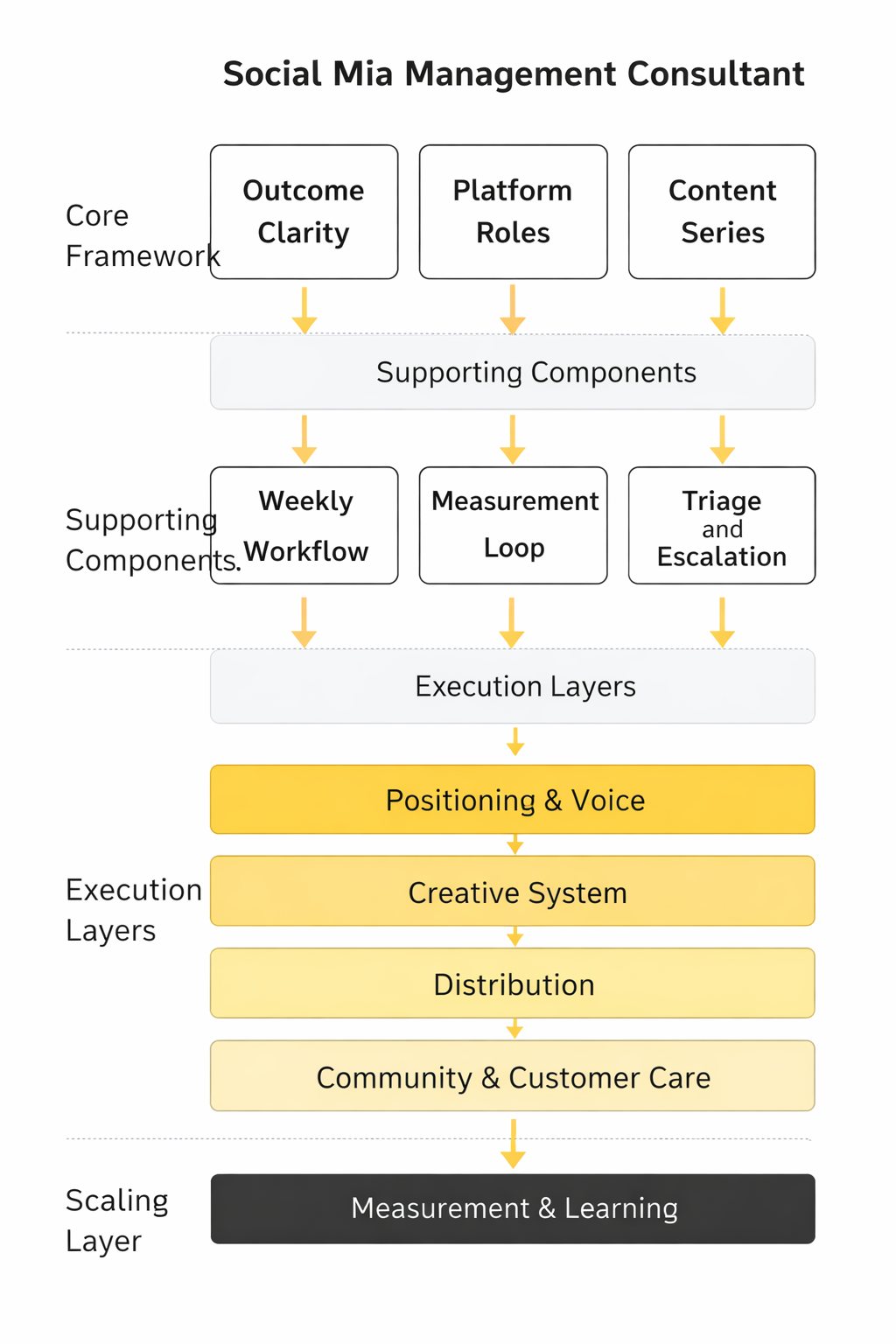
The simplest way to understand the consultant’s job is to view social as an operating system with five layers. Miss one layer and everything downstream suffers.
- 1) Strategy: Who you serve, what you stand for, and what outcomes social must drive.
- 2) Audience Intelligence: What your buyers care about, what they resist, and what they need to believe before they take action.
- 3) Creative System: Formats, recurring series, production workflow, and repurposing rules that keep quality high without burning out.
- 4) Distribution: Organic + paid amplification, creator partnerships, community activation, and channel-specific publishing decisions.
- 5) Measurement: A reporting model that connects social signals to business impact and guides what to do next.
This framework is intentionally practical: it gives you a place to put every decision. If an idea doesn’t strengthen one of these layers, it’s probably distraction.
Core Components
Most consulting engagements revolve around a handful of core components. The difference between “random improvements” and “compounding growth” is whether these components are designed to work together.
Channel Role Clarity
Every platform should have a job. A social media management consultant helps you define which channels are for discovery, which are for authority, which are for community, and which are for conversion support. Without clear roles, brands copy-paste content everywhere and wonder why nothing lands.
Content Pillars That Map to Buyer Decisions
Strong social strategy isn’t “topics you like.” It’s a set of content pillars tied to what buyers must understand to choose you. That usually includes credibility (proof and expertise), relevance (pain and outcomes), differentiation (why you), and momentum (how to start).
A Production System That Survives Real Life
Consistency is rarely a motivation problem—it’s a workflow problem. Consultants often build lightweight systems: briefs that don’t get ignored, approval flows that don’t stall, and repurposing that turns one strong idea into multiple native posts.
Community and Customer Care Standards
Social is now a frontline touchpoint, not just a billboard. Many consumers expect brands to be responsive and engaged on social, and larger research efforts increasingly frame trust and responsiveness as core expectations (The 2025 Sprout Social Index, Emplifi’s Social Pulse 2025 survey, Sprout Social’s 2025 state of social coverage).
Measurement That Doesn’t Lie
Vanity metrics aren’t useless—they’re just incomplete. A consultant typically sets a measurement stack with three layers: (1) platform health (reach, watch time, saves), (2) demand signals (clicks, profile actions, leads), and (3) business impact (pipeline influence, conversion assist, retention signals). The goal is to make decisions faster, not to produce prettier dashboards.
Professional Implementation
Hiring a social media management consultant works best when the engagement is structured like an operating upgrade, not a pile of deliverables. Here’s what “professional implementation” usually looks like.
Step 1: A Social Audit With Business Context
The consultant reviews content performance, channel mix, creative patterns, audience signals, and competitor positioning—but also connects it to your goals and constraints: sales cycle, margins, team capacity, and what your brand can credibly promise.
Step 2: A Strategy Brief the Team Can Actually Use
You don’t need a 60-page deck. You need a short strategy that survives daily decision-making: who the content is for, the few messages that must repeat, what “good” looks like per channel, and what not to do anymore.
Step 3: Installation of the Content Engine
This is where results become sustainable. The consultant helps set up recurring series, a weekly workflow, reusable templates, and a repurposing plan so the team can publish without reinventing everything each time.
Step 4: Distribution and Experimentation Rules
Instead of random A/B tests, a consultant defines a simple experimentation loop: what to test, how long to run it, what signals qualify as “working,” and how to scale what wins—especially when platforms change their incentives.
Step 5: Reporting Cadence and Stakeholder Alignment
Finally, the consultant builds a reporting rhythm that leadership can trust. The best cadence is predictable: a short weekly pulse for actions and a deeper monthly readout that ties social performance to business priorities.
In the next section of the article, we’ll go deeper into how this framework turns into day-to-day execution—what to measure, how to prioritize platforms, and how to build an ecosystem that keeps compounding even when trends shift.
Step-by-Step Implementation
When a social media management consultant is brought in to “fix social,” the fastest path isn’t a content calendar. It’s a disciplined implementation sequence that turns goals into habits, habits into output, and output into reliable signal.
This step-by-step approach keeps momentum high while reducing the most common failure point: teams trying to change everything at once, then quietly snapping back to old behavior two weeks later.
Step 1: Define the Outcome in One Sentence
Start with a single sentence that forces clarity: “Over the next 90 days, social will primarily drive X for Y audience by Z mechanism.” If the sentence can’t be written without arguing, the consultant pauses implementation and fixes alignment first.
This matters because tools, formats, and posting frequency are downstream decisions. Without an outcome sentence, every stakeholder can claim they’re “right,” and the work turns into competing preferences instead of a coherent plan.
Step 2: Lock the Audience and the Non-Negotiable Messages
A social media management consultant will usually narrow the target to one primary segment for the first iteration, even if the business serves many. It’s not because other segments don’t matter, but because implementation needs traction before it needs complexity.
Then come the non-negotiable messages: the few ideas the audience must remember about you even if they forget every individual post. This becomes the filter for what gets created and what gets cut.
Step 3: Assign Each Platform a Job
Implementation gets dramatically easier when every channel has a role. One platform might be for discovery, another for authority, another for community or customer care. The consultant is looking for a clean operating map that prevents copy-paste publishing and “we should be everywhere” fatigue.
Once roles are set, content decisions become obvious. You stop trying to make every post do everything, and you start building a system that compounds.
Step 4: Build Three to Five Repeatable Content Series
Series are the backbone of professional execution because they make quality repeatable. Instead of reinventing the wheel, the team ships familiar formats with fresh angles.
A consultant typically defines each series with: the promise (why the audience cares), the format (what it looks like), the cadence (how often), and the “definition of done” (what qualifies as publish-ready).
Step 5: Install a Weekly Workflow That Survives Real Weeks
Most social teams don’t fail from lack of ideas. They fail because the workflow collapses under normal business chaos. Implementation should assume someone will be sick, approvals will be late, and priorities will shift.
That’s why a social media management consultant builds a weekly rhythm with buffer: batching, templates, and a lightweight approval path. If the process can’t survive a hectic week, it isn’t a process yet.
Step 6: Set a Measurement Loop You Can Actually Keep
Over-reporting kills momentum. Under-reporting kills learning. The sweet spot is a small set of signals the team can review consistently without turning every week into a data project.
When platforms change what’s available via APIs or shift metrics, measurement must adapt quickly. That risk is real and documented, especially for Facebook Page Insights changes and deprecations that can break dashboards overnight (Meta’s Page Insights API update notice, Meta Marketing API out-of-cycle change log, Supermetrics’ explanation of the November 2025 field changes).
Execution Layers
A social media management consultant typically builds execution in layers so the system stays stable as volume increases. If you skip layers, you can still post a lot—but it won’t feel controlled, and it won’t be easy to scale.
Layer 1: Positioning and Voice
Positioning is the invisible layer that makes content feel coherent. Voice is the layer that makes it feel human. Without both, social becomes a rotating cast of tones, messages, and priorities that confuses the audience and drains the team.
Layer 2: Creative System
This layer is where the work becomes repeatable: series, templates, shot lists, hook patterns, and a house style for visuals and copy. It’s also where many teams reduce production time without lowering quality—because the system carries the load instead of one overworked person.
For short-form video, creative research tools can accelerate iteration by showing patterns behind high-performing ads and content styles (TikTok’s Creative Insights documentation, Creative Insight inside TikTok Creative Center, TikTok’s SMB Creative Playbook (2025)).
Layer 3: Distribution
Distribution is not “post it and hope.” It’s deciding what gets amplified, what gets repurposed, where the community is activated, and what gets supported with paid. A consultant will often formalize distribution rules so the team isn’t making the same decisions from scratch every week.
Layer 4: Community and Customer Care
When social becomes a service channel, execution has to include triage and escalation. Consumers increasingly expect brands to be responsive and genuine, and many surveys frame responsiveness as a core trust signal (Emplifi’s Social Pulse consumer-brand engagement survey (2025), PwC’s 2025 customer experience survey, Qualtrics contact center trends (2025)).
This layer is where a social media management consultant protects the brand. The goal isn’t just replying faster—it’s responding consistently, with context, and with a playbook that prevents small issues from turning into public meltdowns.
Layer 5: Measurement and Learning
The measurement layer exists to make decisions easier, not to produce impressive charts. Many marketing leaders still struggle to prove social impact with confidence, which is exactly why implementation needs a clear KPI model and consistent reporting habits (Sprout Social’s 2025 Impact of Social Media report, Sprout’s summary of the 2025 impact research, Sprout Social’s 2024 annual filing describing how the company positions measurable value).
Optimization Process
Optimization is where teams either level up fast or slowly drift into busywork. A social media management consultant usually installs a simple loop that keeps learning honest: decide what to test, run it long enough to matter, review signal, and then lock in what works.
1) Set the Hypothesis Before You Post
Every meaningful test starts with a prediction. “If we change the hook structure, watch time improves.” “If we publish this series twice weekly, saves increase.” Without a hypothesis, you’re just collecting outcomes and retrofitting explanations.
2) Maintain a Small Test Queue
A consultant will usually cap active experiments so the team can learn cleanly. Too many tests at once means you can’t tell which change caused which outcome—and the team loses trust in the process.
3) Run a Creative Review Like a Writer’s Room
High-performing teams treat the comment section as live feedback and the content pipeline as collaborative craft. That “writer’s room” model has been publicly discussed in coverage of Duolingo’s social approach, including how the team uses community signals to drive ideas (The Wall Street Journal interview with Duolingo’s departing social media manager, Adweek’s look at Duolingo’s social-first strategy, Business Insider’s reporting on Duolingo’s cultural reach).
4) Build Metric Sanity Checks Into the Routine
If a number suddenly drops to zero, treat it as a tooling problem before you treat it as a performance problem. Platform measurement changes are a standing operating risk, especially for Facebook Page Insights and related analytics endpoints (Meta’s Page Insights API update notice, Meta out-of-cycle changes, Sprinklr’s explanation of impressions metric deprecation and replacements).
5) Scale What Works With a Repurposing Rule
When something hits, scale it with intention instead of repeating it until it dies. A consultant typically sets a repurposing rule: turn one winning concept into multiple native variations, adjusted for channel role and format, so you capture momentum without burning out the audience.
Implementation Stories
To see what professional implementation looks like in the real world, it helps to zoom in on teams that built a system—not just a viral moment. These stories aren’t “perfect playbooks,” but they show the messy middle where structure makes the difference.
Duolingo: The Week the Mascot “Died” and the System Got Stress-Tested
The posts hit like a shockwave, and the internet reacted as if a celebrity had vanished. The comment sections turned into a frenzy of jokes, grief, and disbelief, and the brand’s feed became the story people refreshed. For the team behind it, this wasn’t a cute stunt anymore—it was a live event with the entire audience watching.
The backstory was years in the making. Duolingo had already built a social identity that leaned hard into culture and community, and leadership had let the team treat social as a creative engine instead of a compliance channel. Over time, that approach helped Duolingo become one of the most visible brands on TikTok, with follower counts widely reported in the mid–teens of millions (WSJ’s profile of the departing social media manager, Business Insider’s coverage, Adweek’s reporting).
Then came the wall: virality is not the same as control. When a moment catches fire, the team has to produce fast without losing voice, respond without stepping into controversy, and keep internal stakeholders calm while the public narrative evolves in real time. The strain is real, and even successful teams have talked openly about the anxiety and burnout pressure that can come with being “the brand everyone watches” (WSJ interview details on stress, mistakes, and expectations).
The epiphany is what separates the pros from the lucky. Duolingo’s team has described a mindset where the community drives the brief, and the comment section becomes a source of direction instead of just applause. That’s not improvisation—it’s a feedback system that keeps creative aligned with audience reality (Adweek’s coverage of the team’s approach, Axios on the “death of Duo” moment and why it worked, WSJ on the writer’s room model).
The journey wasn’t “post and pray.” It was fast iteration, tight voice control, and a team structure designed to ship in response to culture. Coverage of the team highlights how they’ve fine-tuned a social-first process across platforms, and how listening shapes what they make next (Adweek’s reporting on the social-first build, Business Insider on cultural resonance signals, WSJ on internal operating style).
And of course, something went wrong along the way. When you move at cultural speed, the margin for error shrinks, and backlash becomes part of the landscape. Even in profiles celebrating the brand’s success, there’s frank discussion of missteps and the learning curve of being publicly witty at scale (WSJ discussion of mistakes and backlash).
The dream outcome wasn’t just attention—it was a repeatable engine. The “Duo is dead” moment worked because it sat on top of a system: a voice audiences recognize instantly, a team structure that can ship quickly, and a feedback loop that keeps content anchored in what the community responds to. That’s exactly what a social media management consultant tries to install for clients: not a stunt, but a machine that can handle the next one.
Ryanair: When Memes Became a Strategy, Not a Side Effect
The brand voice was so loud online that people who hadn’t booked a flight in years still recognized it instantly. Posts spread because they were funny, yes—but also because they felt native to the platform instead of packaged for marketing. The public saw “cheap airline chaos,” while the team was actually building a consistent pattern of attention.
The backstory is a classic constraint story. Low-cost airlines live in a world of thin margins, scrutiny, and a customer base that can turn impatient fast. In that environment, paid spend isn’t always the lever you can pull endlessly—so earned attention becomes a serious business asset.
The wall hit when attention didn’t automatically translate into a controlled brand narrative. Meme accounts can drift into random jokes, and random jokes don’t protect you when the market turns or operational issues spike. Without a system, the same voice that wins you attention can become a liability.
The epiphany was making the tone intentional. Interviews and analysis of Ryanair’s approach describe how the company turned meme-style content into a repeatable strategy—using platform-native humor and cultural timing as a deliberate marketing lever, not an accidental personality (Skift’s interview with Ryanair’s CMO, Journal of Consumer Research research referencing Ryanair’s TikTok context, Research on low-cost airlines using TikTok (2025)).
The journey looked like structure disguised as spontaneity. A consistent format, predictable humor patterns, and fast reaction to platform culture create the illusion of improvisation while staying on brand. That’s exactly the kind of “controlled chaos” a consultant helps teams build without losing governance.
Then the final conflict shows up: real-world operations don’t always cooperate with social tone. When delays, complaints, or reputational issues spike, the same channels used for memes become service channels instantly. That’s why implementation needs escalation rules and customer-care readiness, not just creative speed (Emplifi’s research on consumer expectations for brand engagement, PwC’s customer experience findings, Qualtrics on wait-time and experience impact).
The dream outcome is a brand that stays visible without constantly buying attention. When meme-style content becomes a repeatable operating system—with distribution habits, community patterns, and risk controls—it stops being “a lucky streak” and starts being a channel you can manage. That’s the difference between copying Ryanair’s jokes and copying the way they execute.
Week 1: Build the Foundation
- Outcome sentence: finalize the one-sentence objective and what success looks like.
- Channel roles: assign a job to each platform so content decisions stop being random.
- Series list: define three to five series with clear formats and a “definition of done.”
Week 2: Install the Workflow
- Weekly cadence: schedule ideation, production, approvals, and publishing with buffer.
- Creative standards: create simple templates and guardrails the whole team can follow.
- Inbox rules: set triage and escalation so community and support don’t get neglected.
Week 3: Start the Optimization Loop
- Test queue: pick one or two hypotheses to run, not five.
- Creative review: run a weekly review that focuses on learnings, not opinions.
- Measurement sanity checks: confirm metrics are stable, especially when platforms change reporting surfaces (Meta’s Page Insights API update, Meta’s change log, Supermetrics on field replacements).
Week 4: Scale What Works Without Burning Out
- Repurpose winners: turn one strong concept into multiple native variants across channel roles.
- Document decisions: write down what you learned so progress doesn’t disappear when people change.
- Protect the team: set realistic expectations around speed and volume, because sustainable output beats periodic “viral sprints” that collapse under pressure.
This is the heart of implementation: a system that keeps producing even when the novelty wears off. In the next part, we’ll go deeper into analytics and how a social media management consultant builds reporting that leadership trusts and teams can act on.
Statistics and Data
When you hire a social media management consultant, you’re not paying for “more reporting.” You’re paying for better decisions. Data becomes valuable only when it helps you choose what to do next, what to stop doing, and where to invest with confidence.
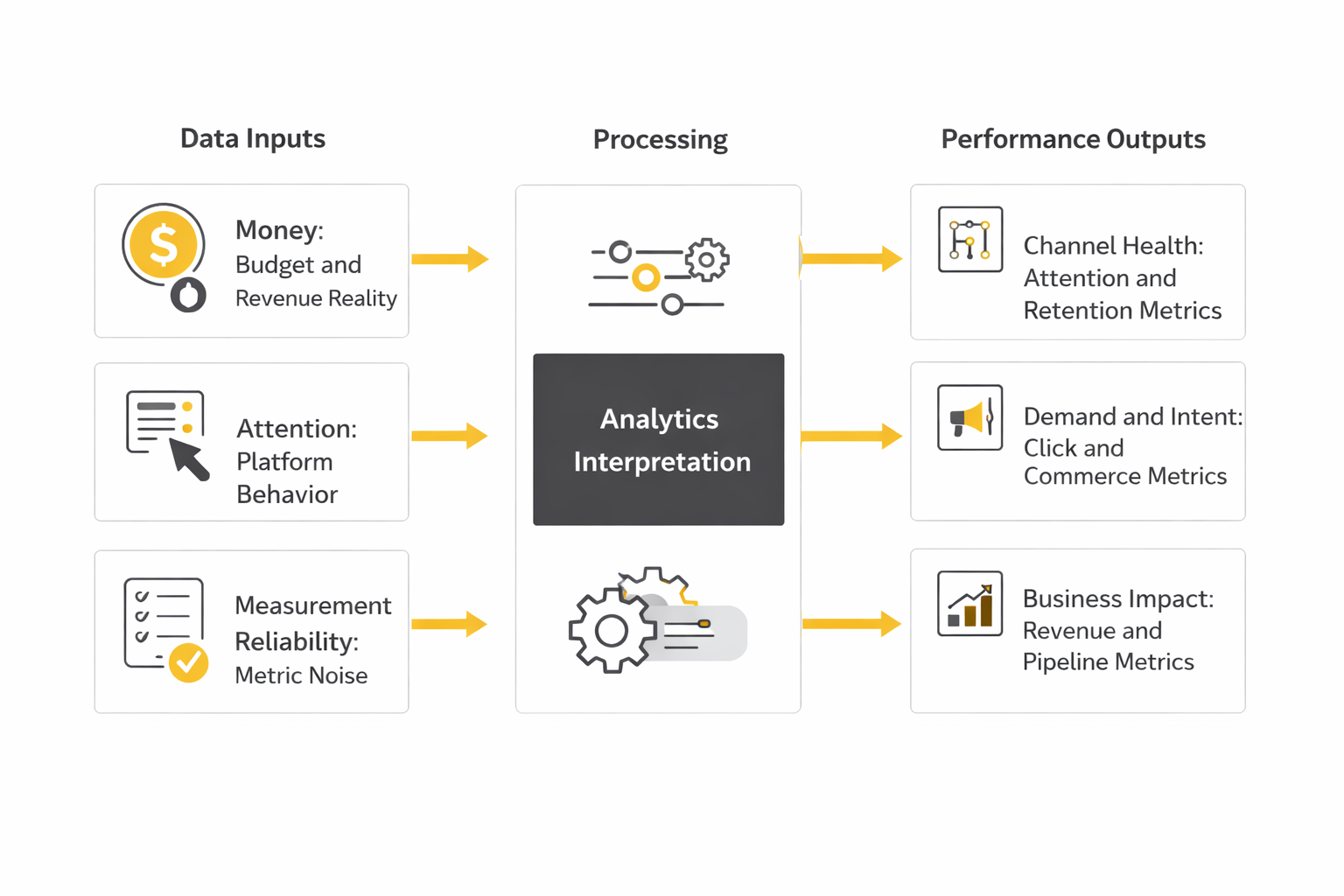
The simplest way to keep analytics grounded is to track three realities at the same time: money (budget and revenue pressure), attention (what people actually do on platforms), and measurement reliability (how trustworthy your numbers are when platforms change).
- Money is moving into social fast. WARC’s 2025 forecast put global social media ad spend at $306.4B, with double-digit growth year over year (WARC’s Global Ad Trends summary, eMarketer’s write-up of WARC’s forecast, MediaPost coverage of WARC’s 2025 projection).
- Social is a heavyweight inside digital ad revenue. The IAB/PwC report for full-year 2024 put US social media advertising revenue at $88.8B (IAB/PwC Full Year 2024 report PDF, IAB’s report announcement, MarTech’s breakdown of the IAB/PwC findings).
- Social is increasingly part of product research. McKinsey’s 2025 consumer research noted a rise in social media use for product research across markets (McKinsey’s State of Consumer (2025)), which fits with the broader trend of social influencing purchase journeys and trust.
None of these numbers tells you what to post tomorrow. But they do explain why measurement discipline matters: more budget is flowing into social, executives want proof it works, and the brands that win are the ones who can connect attention signals to outcomes without getting fooled by noisy dashboards.
Performance Benchmarks
Benchmarks are useful when they stop you from overreacting. A social media management consultant will rarely treat benchmarks as “targets.” Instead, they use them as guardrails to answer two questions: are we underperforming because our execution is weak, or because the platform/category behaves differently?
The safest way to use benchmarks is to keep them directional and context-specific (industry, region, creative mix, and audience size). Across major benchmark publishers, one theme keeps showing up: engagement and click behavior can swing year to year, so you need a consistent internal baseline, not just an industry median (Rival IQ’s 2025 Industry Benchmark Report, Emplifi’s 2025 Social Media Benchmarks Report PDF, Sprout Social’s 2025 benchmarks by industry).
- Engagement rate benchmarks: Expect volatility. Rival IQ’s 2025 report highlighted broad engagement-rate declines across major platforms year over year, which is exactly why “we’re down” doesn’t automatically mean “we’re failing” (Rival IQ 2025 benchmark findings).
- Short-form video benchmarks: Emplifi’s 2025 benchmarks showed Reels reach engagement still outperforming TikTok in their dataset, even as video engagement rates shifted versus the prior year (Emplifi’s video engagement comparison). The lesson isn’t “Reels is always better.” It’s “format mix changes the math.”
- Customer-care expectations: Survey-based research consistently signals that responsiveness matters to consumers, with Deloitte’s 2025 research highlighting that roughly three-quarters of consumers expect brands to respond on social, reinforced by similar expectation themes in consumer-brand engagement research (Deloitte Digital State of Social Research 2025, Emplifi Social Pulse 2025 survey PDF, PwC Customer Experience Survey (2025)).
Benchmarks become genuinely powerful when you pair them with your own data. If your numbers move in the same direction as the broader market, you’re probably seeing a platform or behavior shift. If your numbers move against the market, you’ve found a real execution problem—or a real opportunity.
Analytics Interpretation
The most common analytics mistake is treating social like one channel with one score. A social media management consultant usually interprets performance through a layered model, because different metrics answer different questions.
1) Channel Health Signals
These metrics tell you whether the platform is distributing your content and whether the audience is paying attention: reach, watch time, retention, saves, shares, and profile actions. A consultant looks at these first because weak health makes every downstream metric noisy.
If health signals drop suddenly, don’t assume your creative got worse overnight. Platforms do change measurement surfaces and available insights, which can break reporting pipelines or alter what “counts” in dashboards (Meta Page Insights API updates, Meta out-of-cycle change log (2025), Sprinklr’s note on impressions metric changes).
2) Demand and Intent Signals
These metrics tell you whether social is pushing people toward action: link clicks, click-through rate, landing page views, lead submissions, add-to-carts, and assisted conversions. A consultant will segment these by content series and audience type, because a blended average hides what’s actually working.
On commerce-heavy platforms, “intent” can be seen directly inside the platform. TikTok’s ecosystem has made shopping behavior and live commerce more visible, with reporting showing real spikes tied to shopping events and livestreaming (Business Insider on TikTok Shop Black Friday performance).
3) Business Impact Signals
This layer is where analytics becomes political, because it touches revenue. A consultant will define what counts as impact (pipeline influence, attributed revenue, retention proxy signals) and make the rules explicit so stakeholders don’t fight over interpretation.
It also helps to remember that attribution models miss value. Research and practitioner guidance on modern measurement emphasizes that short-term attribution alone undercounts longer-term effects, which is why teams combine experiments, incrementality thinking, and brand indicators (Google on measuring long-term ROI effects, WARC commentary on measurement trends in 2025, IAB/PwC 2024 report overview emphasizing shifts in measurement and formats).
Case Stories
Analytics becomes real when you see it change decisions under pressure. These are two documented stories that show what happens when teams treat measurement as a tool for learning, not a post-mortem.
New Look: The A/B Test That Stopped a Performance Slide
The numbers were moving in the wrong direction, and the team could feel it before the dashboard confirmed it. Ads were running, budgets were being spent, and yet the campaign performance wasn’t improving the way it should. Every day the trend continued, it got harder to justify the spend with confidence.
New Look wasn’t experimenting for fun. The brand was in the middle of a broader digital transformation, and TikTok was a channel where performance needed to be measured rigorously. They weren’t looking for “a viral moment” as much as a repeatable way to make their catalog ads convert.
Then they hit the wall: creative fatigue and format assumptions. Video-only catalog ads were a comfortable default, but comfort doesn’t guarantee efficiency. The team needed to prove whether a different creative structure could unlock better results without blowing up their workflow.
The breakthrough was choosing a clean test instead of guessing. New Look ran a controlled A/B test inside TikTok Catalog Ads, comparing video-only ads to a Carousel + Video approach that paired an attention-grabbing video with a browsable product carousel. They also tightened measurement by using third-party last-click attribution to keep results consistent with their internal reporting model (TikTok’s New Look success story).
The journey was disciplined: test one variable, read the signal, then operationalize the winner. The Carousel + Video strategy delivered a 61% lift in ROAS, alongside a 32% increase in conversion rate and a 54% increase in CTR within the test structure (TikTok case study results). That kind of lift matters because it’s not just “better creative,” it’s a better system for matching products to people at the right moment.
Of course, the messy part comes after the win. Scaling a new format means rebuilding templates, retraining the creative process, and making sure the team can produce consistently without quality dropping. Performance improvements can vanish fast if the workflow can’t sustain the format.
The dream outcome is a stack that learns. New Look didn’t just get a better week—they got a measurement-backed decision they could repeat, iterate, and defend. That’s the exact kind of momentum a social media management consultant aims to create: fewer opinions, more proof.
FACES: When “More Creative” Wasn’t the Answer, Better Measurement Was
The team had what most brands think they need: plenty of product images, plenty of campaign ideas, and plenty of spend. And yet performance wasn’t scaling cleanly. When the inputs are there but the outputs don’t improve, frustration starts to creep into every weekly review.
FACES wasn’t trying to reinvent advertising. They wanted to scale product creative more efficiently and keep performance moving in the right direction. The real problem was that “business as usual” campaigns weren’t making it obvious what was driving gains and what was just noise.
The wall was familiar: static assets can become stale fast, and scaling variations manually eats time. The team needed a way to bring products to life, create more variation without chaos, and understand whether the change actually improved outcomes.
The turning point was adding catalog product video and treating it as a measurable creative upgrade, not just a new format. The initiative wasn’t positioned as “we need more videos.” It was positioned as “we need a smarter way to scale variations and prove impact.”
The journey produced measurable results in the documented case study: FACES saw a 41% increase in purchases, a 12% increase in ROAS, and a 29% drop in CPA compared to their baseline campaign setup (Smartly.io’s FACES catalog product video case study). The specific numbers matter less than the pattern: creative scale plus clearer measurement can change the slope of performance.
Then the final conflict shows up: attribution debates. When performance improves, stakeholders often argue about what “caused” the improvement, especially if multiple channels were active. That’s why professional teams keep measurement rules explicit and stable—and why they watch for platform reporting shifts that can silently change dashboards (Meta change log (2025)).
The dream outcome is confidence. When the team can scale creative variation and still trust what the data is telling them, budgets become easier to defend, and optimization becomes calmer. That’s how social stops feeling like gambling and starts feeling like controlled experimentation.
Professional Promotion
Data doesn’t just improve performance. It improves your leverage—especially when you’re a social media management consultant who needs buy-in from founders, marketing leads, or skeptical sales teams.
Professional promotion isn’t “selling yourself harder.” It’s making your impact obvious, credible, and easy to repeat. Here are the analytics-based assets consultants use to win trust without hype:
- A one-page KPI map: three layers (health, demand, business impact) with plain-language definitions so nobody argues over what metrics mean.
- A monthly learning memo: what you tested, what changed, what you’re scaling next, and what you’re stopping. This is the antidote to “we posted a lot, but…”
- A measurement reliability note: a short section that flags platform changes that could affect reporting, so leadership understands when a metric shift is a tooling issue, not a team failure (Meta’s Page Insights update notice, Meta’s documented change log, IAB/PwC report PDF showing how formats and channels are shifting).
- A benchmark sanity slide: one chart that shows how your internal baseline compares to reputable benchmark publishers, used as context—not as an excuse (Emplifi benchmarks, Rival IQ benchmarks, Sprout benchmarks).
When you package your work this way, promotion becomes a natural byproduct of clarity. Clients don’t have to “believe” you’re effective—they can see it in the decisions, the experiments, and the outcomes your system produces.
Advanced Strategies
Once the fundamentals are stable, a social media management consultant typically shifts from “making social work” to “making social scale.” At that stage, the goal isn’t more content. It’s more leverage from the same effort—so every post, partnership, and paid dollar reinforces the same growth engine.
Build a Zero-Click Content Engine
More platforms are designed to keep users on-platform, so the most scalable strategy often gives the value upfront. That means writing and designing content that answers the question inside the feed—then earning the next step through trust, not friction.
A social media management consultant will usually build “zero-click” series that create micro-commitments: save this, share this, comment for the template, DM for the checklist. When it works, you’re not fighting the algorithm with links—you’re using behavior signals to earn distribution and build intent.
Turn Creators Into a Distribution Flywheel
Creators aren’t just “influencers” anymore. They’re often the most efficient distribution partners because they already have trust, and they can ship content at cultural speed.
That’s why more money is flowing into creator partnerships. US creator ad spend was projected to reach $37B in 2025 in the IAB 2025 Creator Economy Ad Spend & Strategy Report, echoed in coverage like Business Insider’s summary of the report and reinforced by the broader growth appetite described in IAB UK’s 2025 influencer marketing snapshot.
In practice, a social media management consultant builds a “creator flywheel”: a pipeline to recruit creators, a brief system that protects brand voice while leaving room for native storytelling, and a measurement model that tracks incremental lift—not just likes.
Design for Social Commerce Without Becoming a Discount Brand
Social commerce is no longer a side experiment. TikTok Shop alone cleared $500M in US sales over Black Friday–Cyber Monday 2025, with that figure repeated across multiple reports and platform summaries (Business Insider’s BFCM 2025 report, Social Media Today’s roundup quoting TikTok’s campaign recap, Reuters coverage referencing Adobe’s BFCM context).
The advanced move is to treat commerce content as brand-building, not just conversion. A consultant will often build product storytelling series, creator affiliate programs, and “proof content” (reviews, demos, comparisons) so the brand earns trust even when the feed is noisy.
Use Community Signals to Shape Product and Messaging
At scale, the comment section becomes research. The brands that win aren’t just posting—they’re listening for objections, language patterns, and product desires, then feeding that insight back into messaging, offers, and content series.
This is one reason social-first organizations are doubling down on community and conversion together, rather than treating them as separate departments (Deloitte Digital’s State of Social Research 2025, Deloitte’s 2025 Digital Media Trends, Sprout Social’s 2025 impact research).
Scaling Framework
Scaling isn’t a creative problem first—it’s an operating problem. A social media management consultant will usually install a scaling framework that protects quality while increasing output, speed, and learning rate.
1) Build a Content Supply Chain, Not a Calendar
Calendars are fragile. Supply chains are resilient. Instead of planning posts one by one, the consultant defines inputs (insights, offers, product moments), transforms (briefs, scripts, edits), and outputs (series, variations, distribution).
This is where “repurposing” stops being laziness and becomes engineering. One strong idea becomes multiple native executions, each aligned to the platform’s role and the audience’s stage of awareness.
2) Separate Roles: Strategy, Production, Community, Measurement
Teams stall when everyone is responsible for everything. At scale, the consultant separates roles so the system doesn’t collapse when one person is overloaded.
- Strategy: defines series, distribution rules, and what “good” means.
- Production: ships assets fast with consistent quality.
- Community: protects the brand in public and feeds insights back into strategy.
- Measurement: keeps reporting stable even when platforms change metrics and APIs.
This structure matters more as platforms evolve reporting surfaces. Meta’s ongoing insights changes are a real example of why measurement needs an owner, not a shared afterthought (Meta’s Page Insights API update notice, Meta Marketing API out-of-cycle change log, Supermetrics’ breakdown of the November 2025 field changes).
3) Install Governance That Doesn’t Kill Speed
Governance is what prevents “scaling” from turning into brand risk. The consultant typically builds a lightweight approval model: what needs legal review, what needs brand review, and what the team can ship without waiting.
When social also functions as customer care, governance includes escalation paths and service standards—because one mishandled public thread can cost more than a month of content helped (Emplifi’s 2025 consumer-brand engagement survey, PwC’s 2025 customer experience survey, Qualtrics contact center trends).
4) Define Distribution Rules Before You Add Budget
Paid amplification should be a multiplier, not a crutch. A social media management consultant will usually define what earns spend: posts that pass a signal threshold (watch time, saves, shares), campaigns tied to a business moment, or creator content that already proved resonance.
This is where many teams unlock efficiency: they stop boosting random posts and start scaling proven messages.
Growth Optimization
When social is scaling, optimization becomes less about isolated tactics and more about tightening the loop between creative, distribution, and measurement. The consultant’s job is to increase learning velocity without turning the team into a lab that never ships.
Run Fewer Tests, Make Them Cleaner
At scale, messy testing creates false confidence. A consultant will usually limit active experiments, define one success metric per test, and run it long enough to reduce “one good day” noise.
That discipline becomes especially important as industry benchmarks fluctuate year over year. Reports like Rival IQ’s 2025 Social Media Industry Benchmark Report and Emplifi’s 2025 benchmarks report highlight how engagement trends can shift across platforms, making sloppy testing feel like progress when it’s actually just market movement.
Add Incrementality Thinking to Prove Real Lift
When budgets grow, attribution arguments get louder. A social media management consultant reduces conflict by using incrementality logic where possible: holdouts, lift studies, and “what would have happened anyway?” reasoning.
Modern measurement guidance increasingly emphasizes that last-click attribution alone misses longer-term impact, which is why teams combine experiments, brand indicators, and behavioral signals (Google’s guidance on hidden and long-term ROI, WARC’s 2025 measurement commentary, IAB/PwC’s 2024 digital ad revenue report).
Scale With Creators, Then Amplify What Works
Creator-led content often performs differently because it feels native and trust-driven. TikTok’s own guidance frames creator collaboration as a way to scale storytelling that resonates, not just “add influencers” (TikTok’s Creator Advantage article (Nov 2025), TikTok’s commerce updates and BFCM performance notes, TikTok Creative Insights documentation).
The consultant’s optimization play is simple: creators test narratives at speed, the brand identifies the winners, then paid spend amplifies the messages that already earned attention.
Scaling Stories
Scaling looks clean in a framework and chaotic in real life. These two stories show what happens when brands treat social as a growth system—one built around creators, commerce, and operational discipline.
Medicube: The Moment Virality Turned Into a Global Machine
The pop-up line got so intense it looked like a concert queue, not skincare shopping. A single creator-driven wave sent thousands of people rushing toward the brand in person, and suddenly “online buzz” had a physical footprint. The team wasn’t just watching views climb—they were watching demand spill into the real world.
The backstory was methodical, not magical. Medicube built its positioning around clinically backed skincare and device-led routines, then rode a rising cultural interest in at-home beauty tech. Over time, creator mentions and product demonstrations helped the brand break out beyond Korea and into global consumer attention (Vogue’s profile of Medicube’s breakout).
Then the wall hit: attention is fragile when fulfillment and scale aren’t ready. When demand spikes, supply chains strain, customer expectations rise, and every late shipment becomes a public complaint risk. The brand needed to turn unpredictable virality into a repeatable revenue engine without losing credibility.
The epiphany was treating creators as a system, not a one-off tactic. The brand leaned into creator partnerships, affiliate-style distribution, and shoppable pathways that reduced friction between “I want it” and “I bought it.” That shift mattered because it turned product demos into measurable commerce, not just engagement (Vogue’s reporting on creator and commerce execution).
The journey became a multi-layer scale-up: creators and affiliates for distribution, TikTok Shop for conversion, and retail expansion to stabilize demand beyond the feed. Vogue reported over six million units sold globally and detailed how TikTok Shop revenue became a meaningful channel in the brand’s growth story, alongside broader international expansion (Medicube’s growth details in Vogue).
And then the final conflict: scale attracts scrutiny. The bigger the brand got, the more it had to defend product claims, protect customer experience, and manage the risks that come with platform dependence and public conversation. Even when the story is positive, the operating pressure rises with every new audience wave.
The dream outcome wasn’t “a viral TikTok.” It was a machine that could absorb attention and convert it into sustained growth—commerce pathways, creator distribution, and real-world retail presence reinforcing each other. That’s what a social media management consultant is ultimately trying to build: not a moment, but a system that survives the next one.
PerfectTed: The First TikTok Live That Changed the Growth Curve
The live started, and the numbers didn’t just look good—they looked unreal. Viewers piled in fast, and the team realized they weren’t running a normal campaign anymore. It was a high-pressure sales event happening in public, with real-time reactions shaping every minute.
The backstory was already ambitious. PerfectTed had traction as a matcha-based beverage brand, but like most consumer brands, it faced the familiar ceiling: paid ads get expensive, retail growth is slow, and organic attention is unpredictable. The team needed a way to create demand at speed without losing brand story.
Then the wall hit: live commerce is brutally exposing. If the host feels inauthentic, if the story doesn’t land, or if the operational setup can’t handle demand, the audience leaves—and they leave publicly. There’s no hiding behind a polished edit when you’re live for hours.
The epiphany was treating TikTok Live like a show, not a sales pitch. The team invested in training the host, structured storytelling, and pre-promotion so the live event had momentum before it began. That choice turned the live into an experience instead of a hard sell (The Times on PerfectTed’s first TikTok Live).
The journey was designed like a funnel: paid promotion to build awareness, a landing page to capture intent, then the live event to convert with interaction and proof. The Times reported nearly 200,000 viewers on the first live, with a large share new to the brand, and sales beating the company’s own forecasts in the moment (PerfectTed’s TikTok Live results in The Times).
Then the final conflict arrived: live success creates operational stress immediately. More viewers means more orders, and more orders means fulfillment pressure, customer questions, and heightened expectations. The team had to balance growth with reliability, because social commerce can turn against brands when delivery fails—something even major TikTok Shop sellers have had to navigate publicly (The Guardian on TikTok Shop scale and pressures).
The dream outcome was a repeatable growth lever, not a one-night spike. PerfectTed walked away with a clearer playbook for live commerce: storytelling, training, pre-promotion, and operational readiness. That’s scaling: turning a scary first attempt into a system you can run again with confidence.
Future Trends
The job of a social media management consultant is getting harder in one specific way: the rules of trust are changing faster than the rules of content.
In the next 12–18 months, three forces are going to reshape what “good social” looks like for brands and freelancers alike.
AI Labels and Content Provenance Will Stop Being Optional
Audiences are getting hit with waves of synthetic content, and platforms are under pressure to make “what’s real” easier to verify. That’s why you’re seeing everything from provenance standards like C2PA showing up in platform conversations to regulators pushing visible labeling requirements (how major platforms are approaching labels and provenance).
For consultants, the practical shift is simple: clients will want a policy for when AI is used, how it’s disclosed, and how brand voice stays consistent when speed increases. If you don’t have that policy, someone else will write it for you—usually legal, usually late, usually in a way that slows the team down.
Regulation Will Reach Everyday Social Workflows
Two timelines matter for anyone running social professionally. In the EU, the European Commission has already published a first draft of a Code of Practice on marking and labelling AI-generated content, with transparency obligations tied to the EU AI Act becoming applicable in August 2026 (the Commission’s draft and timeline, EU AI Act transparency timeline).
At the same time, other jurisdictions are moving quickly. India’s IT Rules amendments described new requirements around labeling deepfakes and synthetic media as of February 2026 (summary of the amended rules and labeling expectations). In the US, New York signed legislation requiring disclosure for AI-generated performers in advertising, with an effective date in June 2026 (Reuters on New York’s disclosure requirement).
This won’t just affect “big brands.” It will show up in briefs, approvals, ad production, and influencer usage—especially when human likeness and synthetic performers are involved.
Creator Partnerships Will Become the Default Distribution Layer
Creators are no longer a “nice-to-have” bolt-on. The market is moving toward creator-led storytelling as a primary way to reach audiences who ignore traditional brand content. That shift is visible in the IAB’s projection of US creator ad spend reaching $37B in 2025 (IAB’s creator economy report).
The consultant advantage here is building systems: creator recruiting, briefing, approvals, whitelisting, measurement, and repurposing. The brands that win won’t be the ones who “work with influencers.” They’ll be the ones who can scale creator output without losing brand safety or creative quality.
Strategic Framework Recap
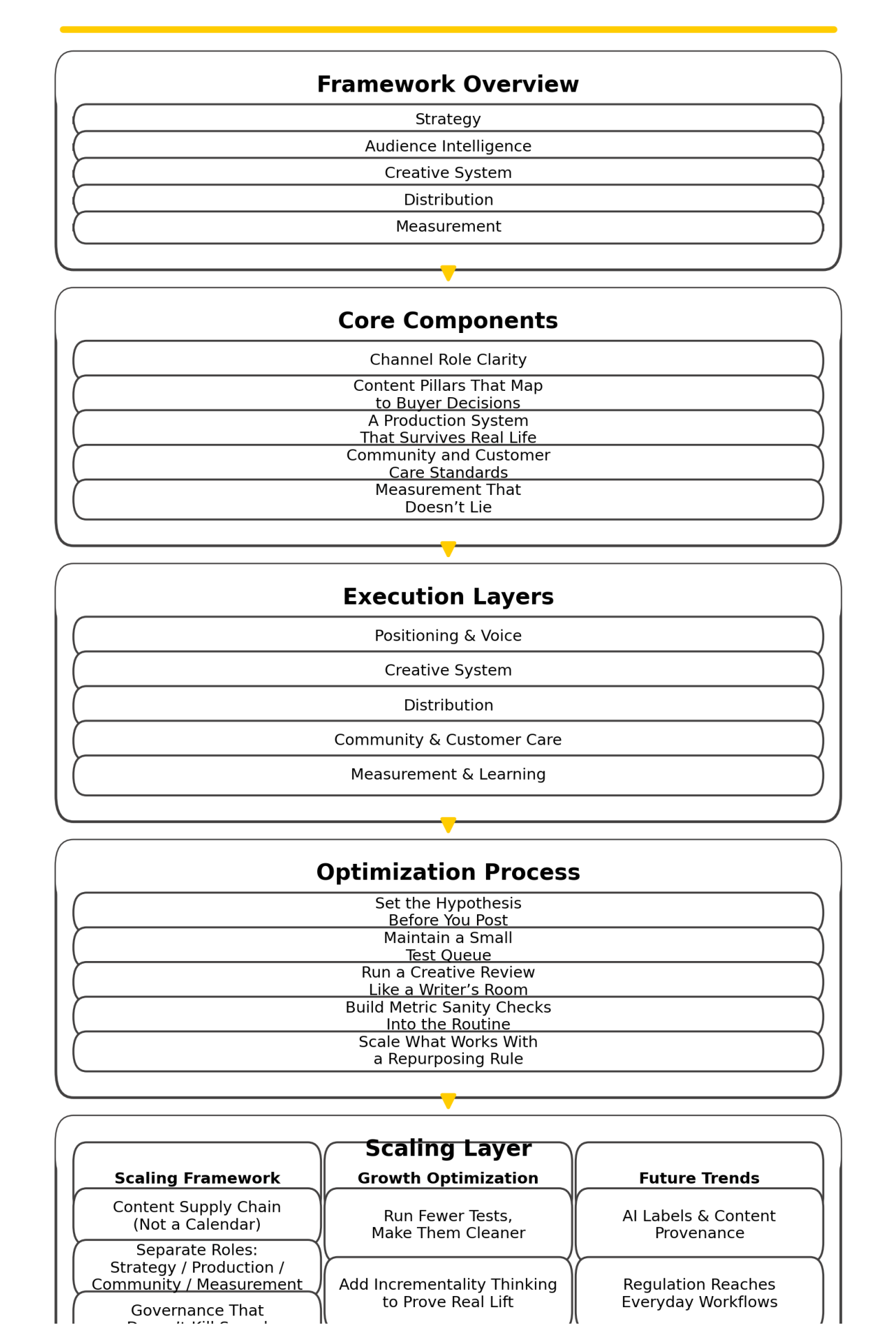
If you zoom out, the social media management consultant playbook in this guide is really an ecosystem—because social performance doesn’t come from one tactic. It comes from aligned parts working together.
- Outcome clarity: a single sentence that defines success, so content decisions stop turning into debates.
- Channel roles: each platform has a job, so your strategy isn’t copy-paste publishing.
- Series-based execution: repeatable formats that make quality scalable and reduce production stress.
- Distribution rules: clear decisions about when to amplify, when to repurpose, and when to lean into creators.
- Measurement you can trust: a small set of signals that drive weekly decisions, plus safeguards when platforms change reporting surfaces.
- Governance without paralysis: approvals and escalation that protect the brand without slowing the team to a crawl.
When those pieces lock together, social stops feeling like constant reinvention. It becomes a predictable system that can handle growth, team changes, and platform volatility.
FAQ – Built for This Complete Guide
What does a social media management consultant actually do?
A social media management consultant designs the operating system behind your content: strategy, series, workflow, distribution rules, measurement, and governance. They don’t just “post for you.” They build a repeatable system that a team can run without burning out.
When should I hire a social media management consultant instead of a social media manager?
If you already have someone creating content but results feel inconsistent, or your workflow keeps collapsing under normal business chaos, that’s consulting territory. A manager can execute inside a system; a consultant builds or rebuilds the system.
How quickly can a consultant improve results?
Most meaningful gains come from tightening the workflow and series within the first few weeks, then improving performance through structured testing over the next 60–90 days. The fastest visible wins tend to be consistency, clearer messaging, and better distribution choices.
Which platforms should a consultant focus on first?
The best starting point is the platform where your audience already shows intent and where you can produce consistently. A consultant will usually assign each platform a role, then build depth on one or two channels before expanding.
What metrics matter most in a consultant-led social strategy?
The answer depends on the channel’s job. Discovery channels need attention and retention signals. Authority channels need saves, shares, and profile actions. Conversion-focused programs need intent signals like clicks, leads, and assisted conversions. The key is matching metrics to purpose so you don’t chase vanity numbers.
Should I use industry benchmarks to judge performance?
Benchmarks are helpful as context, not targets. A consultant uses them to sanity-check whether a drop is a platform trend or an execution issue, then relies on your internal baseline to guide decisions.
How should brands handle AI-generated content on social?
Start with a simple policy: where AI is allowed, what must be reviewed by a human, and how you disclose usage when needed. This is becoming more important as regulators push transparency requirements tied to AI-generated or manipulated content (EU’s draft code of practice on labeling, New York’s disclosure requirement for synthetic performers in ads).
Do I need creators or influencers to grow?
You don’t need them to start, but they can become your fastest scaling lever once your message and offer are clear. Many brands are shifting budget toward creator partnerships because creators can distribute and translate stories in a way brand accounts often can’t (IAB’s creator spend projection for 2025).
How much does it cost to work with a social media management consultant?
It varies based on scope and whether the consultant is also executing. Some engagements focus on strategy and systems (fixed project). Others combine strategy, creative direction, and optimization (monthly). The price is less about “hours” and more about how much operational change the consultant is responsible for.
What should I prepare before working with a consultant?
Bring three things: your business goal for the next 90 days, any past performance data you trust, and examples of content you believe reflects your brand at its best. A consultant can work without perfection, but clarity speeds everything up.
How do I scale content without burning out?
Move from one-off posts to repeatable series, batch production, and clear “definition of done” standards. The goal is to make quality predictable so your output doesn’t depend on last-minute inspiration.
Work With Professionals
If you’ve read this far, you’re probably not trying to “do social.” You’re trying to build a career or a business that wins because your marketing skills are real—and you’re tired of platforms that take a cut, hide the best opportunities, or make you chase leads that go nowhere.
That’s where Markework fits. It’s built as a focused marketing marketplace where companies and marketers connect directly—without commissions and without project fees (Markework’s marketplace overview, how Markework removes middleman friction).
When you’re a social media management consultant, momentum comes from volume and clarity: more relevant listings, faster conversations, and fewer hoops between “I can help” and “Let’s start.” Markework is designed for that flow, with direct communication and plans that emphasize access to large pools of work instead of per-project tolls (Markework’s no-project-fee pricing model).
And the opportunity is active, not theoretical. The platform publicly shows over 1,000 active listings available to browse, with more accessible after signup (Markework’s active jobs and projects page).
If you want the next chapter of your freelance career to feel cleaner—less chasing, more closing—build a profile that sells your outcomes, pick a niche you can own, and start applying to listings that actually match your skills.
 Filip Konecny Enterprises