
Social media influencer marketing used to be the “nice-to-have” line item you tried when paid ads got expensive. Now it’s often the fastest way to turn attention into trust, and trust into sales—because it lets real people do what brand accounts struggle to do: make recommendations feel human.
The problem is that most teams still run influencer campaigns like one-off collaborations: a handful of posts, a discount code, and a hope that the algorithm cooperates. That approach can work, but it’s unpredictable. If you want consistent results, you need a professional system that treats creators like a media channel, a production pipeline, and a relationship program—all at once.
This guide breaks down social media influencer marketing into a clear framework you can apply whether you’re hiring micro-influencers for a niche product or building a long-term creator roster to power your whole content engine.
Article Outline
- What Is Social Media Influencer Marketing?
- Why Social Media Influencer Marketing Matters
- Framework Overview
- Core Components
- Professional Implementation
What Is Social Media Influencer Marketing?
Social media influencer marketing is a partnership model where a brand works with creators (influencers, streamers, subject-matter experts, or community voices) to produce and distribute content that influences real purchase behavior. Sometimes that influence is direct—“here’s the product, here’s why I use it.” Other times it’s indirect—building credibility over time so the brand feels like the obvious choice when the audience is ready.
It’s helpful to think of it as three things happening at once:
- Distribution: the creator gives you reach inside a feed your brand can’t fully buy or algorithmically guarantee.
- Creative: you’re paying for content that’s native to the platform and shaped by someone who knows the audience language.
- Trust transfer: credibility is “borrowed” from the creator’s relationship with their community—when the partnership is authentic and transparent.
In practice, social media influencer marketing shows up in a few common formats:
- Sponsored content: posts, videos, Stories, livestream mentions, podcasts, or newsletters with a paid partnership.
- Affiliate programs: creators earn commissions via tracked links or codes, often layered on top of a base fee.
- Product seeding and gifting: sending products with no guaranteed post (high variance, but useful for discovery and relationship building).
- Creator licensing: the brand pays to reuse creator-made assets in ads, product pages, email, or retail displays.
- Ambassador programs: longer-term agreements that prioritize consistency, creative iteration, and compounding trust.
One important line to draw early: influencer marketing isn’t automatically “authentic.” Authenticity is earned through fit, clear disclosures, and creative freedom. That’s why modern programs also treat compliance as part of the craft—especially around transparent sponsorship labeling and material connection disclosures, which the FTC guidance covers in detail for endorsements and influencer relationships in the US.
FTC endorsement and influencer disclosure guidance is worth bookmarking even if you don’t operate in the US, because many platforms and global brands model their rules around it.
Why Social Media Influencer Marketing Matters
The biggest reason social media influencer marketing matters is simple: people scroll past ads, but they stop for people. Creator content can behave like entertainment, advice, and product discovery at the same time—especially on short-form video platforms where the “ad look” is punished and native storytelling wins.
It also matters because the economics are shifting. Brands increasingly expect influencer work to do more than “awareness.” They want creator partnerships to drive measurable outcomes—and the data is starting to reflect that expectation.
- Long-term impact is where creators can shine. Analysis from the IPA shows influencer marketing delivering a long-term ROI index of 151 and highlighting the compounding effect when creator activity is sustained rather than treated as a one-off burst.
- Brands are funding it more seriously. CreatorIQ’s research reports that 55% of organizations increased influencer marketing investment year over year, with a meaningful share of respondents allocating $1M+ annually.
- Measurement is getting more rigorous. Nielsen has been testing influencer assets with controlled exposure methods to quantify brand lift signals in environments that mirror social feeds, outlined in its influencer marketing study approach.
There’s also a strategic reason that doesn’t show up in spreadsheets right away: influencer marketing can become your content engine. When you build a roster of creators who understand your product and customer, you’re no longer scrambling to invent “fresh” social content every week. You’re directing a pipeline—testing hooks, angles, and formats that can later be repurposed across ads, landing pages, and email.
But there’s a catch: the same shift that makes influencer marketing powerful also makes it easy to waste money. If you don’t set the right expectations, define what success looks like, and run a tight operational process, you’ll end up paying for content that performs like a lifestyle post when you needed it to perform like a sales asset.
Framework Overview
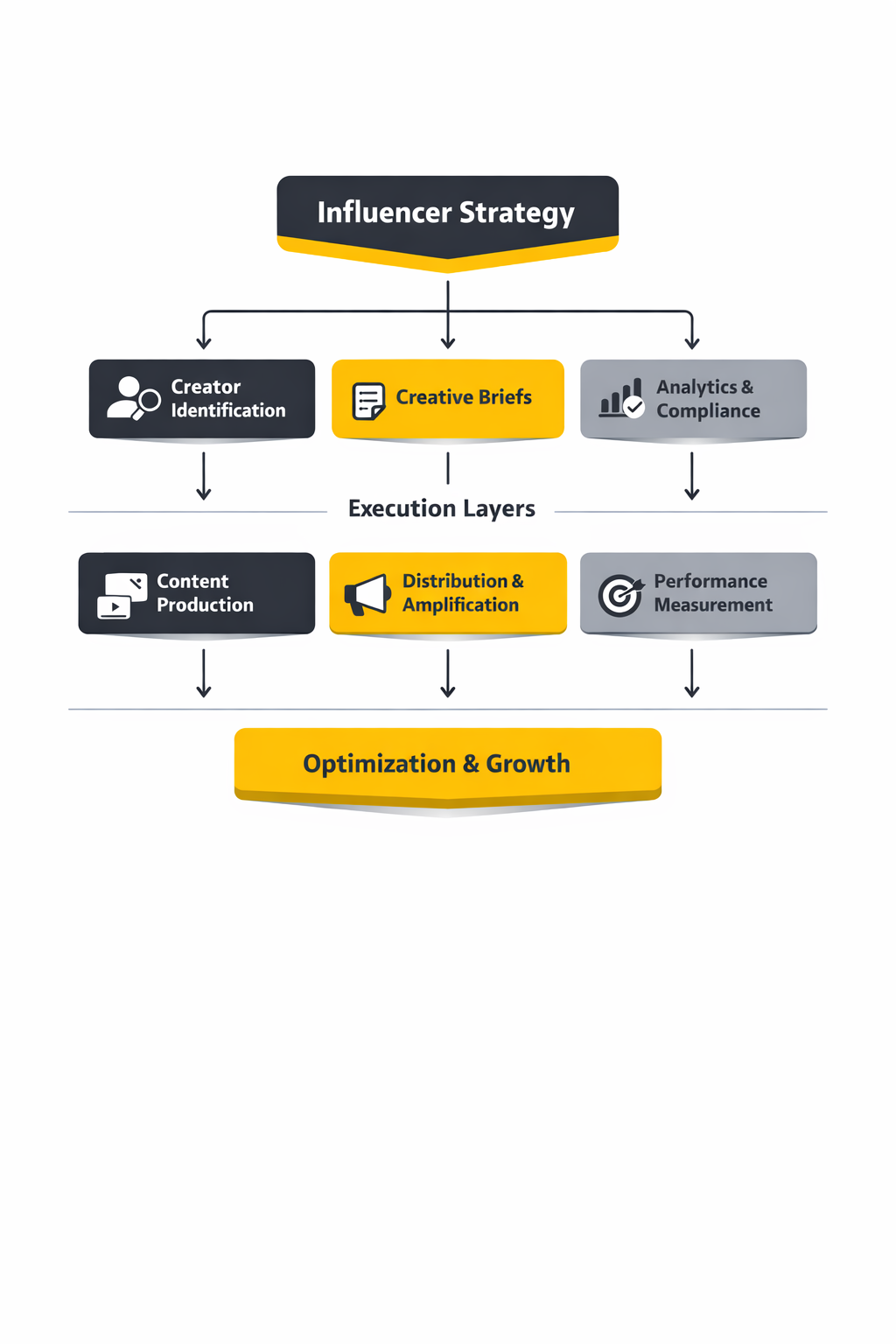
This article uses a simple, professional framework for social media influencer marketing that keeps campaigns predictable without killing creativity:
- Strategy: decide the job-to-be-done (awareness, consideration, conversion, retention) and the role creators play alongside ads, email, SEO, and PR.
- Partner Fit: choose creators based on audience alignment and content behavior, not follower counts.
- Creative System: build repeatable briefs, clear boundaries, and room for the creator’s voice so content stays native.
- Activation: coordinate posting windows, whitelisting/licensing, and distribution so you’re not relying on one moment to carry results.
- Measurement & Governance: track outcomes that match the goal, protect the brand with compliance, and improve performance through iteration.
Why this structure works: it separates what must be controlled (strategy, measurement, compliance, asset usage rights) from what should be flexible (creator voice, storytelling, platform-native execution). That balance is where high-performing influencer programs tend to live.
Core Components
When social media influencer marketing is working well, you can usually trace the success back to a few core components—each one fixable, each one measurable in its own way.
- Clear objectives: one campaign can’t be responsible for every funnel stage. Decide what you’re optimizing for before you hire creators.
- Creator-audience-product fit: the creator’s content style and community expectations must match what you sell and how you sell it.
- Offer clarity: audiences don’t need pressure, but they do need a clear reason to act (a benefit, a bundle, a limited drop, or a strong “why now”).
- Content designed for reuse: if you plan to run creator content as ads or place it on your site, negotiate licensing up front and brief accordingly.
- Operational discipline: timelines, approvals, disclosures, and usage rights are boring—until they break your launch week.
As influencer marketing spend and expectations rise, governance matters more too. The FTC’s updated materials on endorsements and deceptive reviews make it clear that brands share responsibility for proper disclosure practices, not just creators.
The fastest way to protect your program is to standardize: a disclosure checklist, a contract clause that matches platform norms, and a review step that checks the basics without rewriting the creator’s voice. The goal is consistency, not micromanagement.
Professional Implementation
Professional influencer marketing isn’t “finding creators” and hoping for the best. It’s building a system that produces creative output on schedule, learns from performance, and compounds relationships.
In the next parts of this guide, you’ll see how to run that system in practice: how to source and qualify creators without getting fooled by inflated engagement, how to structure briefs that creators actually like, how to negotiate deliverables and licensing cleanly, and how to measure results in a way your finance team will respect.
And because influencer marketing is now scrutinized more than ever, the implementation approach also bakes in compliance from day one—using clear disclosures aligned with the FTC’s updated endorsement guidance materials so partnerships stay trustworthy and defensible.
If you’re ready to move from one-off collaborations to a repeatable engine, the framework above is the backbone. Everything else—creator lists, content calendars, whitelisting, tracking, and optimization—plugs into it.
Step-by-Step Implementation
The fastest way to make social media influencer marketing reliable is to run it like a channel launch, not a series of collaborations. That means you set up the operating system first (goals, tracking, rights, workflow), then you let creators do what they do best: make content that feels native and believable.
Use this step-by-step sequence to go from “we’re trying influencer marketing” to “we can run this every month and improve it.”
Step 1: Define the job the campaign must do
Pick one primary outcome per campaign cycle: demand creation, product education, direct sales, or retention. When teams try to do all four at once, briefs become contradictory and measurement becomes emotional. A simple way to stay honest is to decide what you want to move first, then choose the best signal for that outcome.
- Demand creation: reach plus lift signals (brand search, ad recall, consideration surveys).
- Education: saves, watch time, comments that show comprehension, site engagement quality.
- Direct sales: tracked links/codes, attributed orders, and incremental lift tests when you can run them.
- Retention: creator-led onboarding, usage tips, referral loops, community content.
When you need causality instead of “pretty dashboards,” build in incrementality. TikTok’s Conversion Lift Study approach is one example of how platforms are pushing brands toward controlled tests instead of last-click stories.
Step 2: Choose your creator mix like a media plan
Don’t cast creators one by one. Build a portfolio: a few higher-reach creators for distribution, a larger set of micro-creators for volume and creative variation, and one or two “authority” voices if your category needs credibility. This is especially useful now that platform dynamics are shifting; large-scale benchmark datasets show meaningful changes in how brands perform by network year to year, which is why reports like Emplifi’s 2025 social media benchmarks can help you sanity-check where to place your bets.
Selection filters that keep you out of trouble:
- Audience match: language, geography, purchase power, and category interest.
- Content behavior: do they consistently earn attention, or do they spike once a quarter?
- Brand safety: past controversies, disclosure habits, and community tone.
- Proof of influence: comments that show intent (“I’m buying this”), not just compliments.
Step 3: Build a brief that protects essentials and frees the creator
A strong influencer brief reads like a helpful collaboration note, not a script. It should protect what must be true (claims, positioning, disclosures, usage rights) while leaving the creator in control of voice, format, and story.
- Non-negotiables: claim boundaries, must-include product truths, required disclosures, prohibited topics.
- Creative menu: 3–5 angles the creator can pick from, plus “what we’ve seen work” context.
- Proof assets: product demo points, FAQs, and “how it actually works” details.
- Usage rights: where the content can live (ads, site, email), how long, and in which territories.
When compliance is part of the brief, it becomes routine instead of awkward. The FTC’s endorsements and influencer guidance makes it clear that disclosure is not optional when a material connection exists, and it’s much easier to get right when it’s baked into the workflow from day one.
Step 4: Lock the offer and the landing experience before anything posts
Creators can create interest, but your offer and landing path convert it. Before the first deliverable goes live, confirm:
- Offer clarity: what’s the “why now” that feels fair (bundle, limited drop, early access, value add)?
- Friction removal: mobile speed, clear product promise, visible social proof, easy checkout.
- Tracking primitives: unique links and codes, consistent UTMs, and a plan for delayed conversion.
If you’re running a commerce-heavy campaign, plan for social commerce behavior, not just website clicks. News coverage shows how TikTok Shop is reshaping discovery-to-purchase flows and compressing the funnel for certain categories, which is why stories like Retail Dive’s reporting on TikTok Shop’s expansion matter when you design your path to purchase.
Step 5: Produce in batches, then publish in waves
One creator post is a moment. A batch of creator assets is a system. Ask for multiple deliverables per creator (or multiple creators per angle) so you can learn quickly without restarting the whole process.
- Batch production: multiple hooks, multiple formats, multiple CTAs.
- Wave publishing: stagger posts to learn, then amplify the winners.
- Asset library: store raw files, captions, whitelisting permissions, and rights terms together.
When you need a clean model for a full-funnel influencer build, the playbook described in Think with Google’s influencer campaign guide shows how major brands structure creator content across the journey instead of trying to force one post to do everything.
Step 6: Amplify what wins, not what you hoped would win
Professional programs treat influencer content as performance creative once it proves resonance. The rule is simple: organic performance chooses the paid amplification candidates, then paid spend turns them into predictable distribution.
On Meta, partnership ads are built for exactly this kind of scaling, and Meta has been explicit that creator collaborations become more powerful when brands can amplify content while keeping the creator handle visible, outlined in its creator marketplace and partnership ads overview.
Step 7: Close the loop with a learning review
Every cycle ends with a short review that feeds the next one. Keep it practical:
- What hooks earned attention fast? (first 2 seconds, first line, first visual)
- What objections showed up in comments? (price, trust, claims, alternatives)
- What drove action? (offer, demo clarity, creator credibility, urgency)
- What should be repeated next cycle? (format, creator type, platform, CTA)
This is how influencer marketing compounds: each wave makes the next wave cheaper, faster, and sharper.
Execution Layers
Social media influencer marketing gets easier when you separate execution into layers. Each layer has a different owner, a different timeline, and a different definition of “done.”
Layer 1: Program foundation
This is your infrastructure: contracts, disclosure guidelines, usage rights language, creator database hygiene, and basic reporting definitions. The goal is to make “how we do things” consistent, so you can scale without renegotiating the basics every time.
Compliance belongs here, not at the end. The FTC’s advertisement endorsements overview reinforces that influencer and endorsement marketing is subject to the same truth-in-advertising principles as every other channel.
Layer 2: Campaign operations
This is the weekly rhythm: outreach, brief handoff, approvals, asset collection, posting schedules, and whitelisting permissions. You can run this layer with simple tools at small scale, but once you manage dozens of creators, operations becomes the main thing that determines whether you hit deadlines.
Layer 3: Creative production
This is where performance is born. The best teams treat creator content like an experiment lab: multiple concepts, fast feedback, and a bias toward iteration. A benchmark mindset helps you keep expectations realistic, which is why datasets based on large account samples like Emplifi’s 200,000+ account benchmark methodology are useful as reference points when stakeholders ask for miracles.
Layer 4: Distribution and amplification
Organic posts spark interest. Paid amplification scales it. Retail placements and email extend the shelf life. When you design distribution intentionally, the campaign stops being dependent on one post going viral.
Layer 5: Measurement and learning
Measurement isn’t one dashboard; it’s a set of questions you answer in order:
- Did people pay attention? (view quality, saves, shares, comment depth)
- Did perceptions move? (lift, brand search, consideration signals)
- Did behavior change? (sales, leads, subscriptions, repeat purchases)
- Was it incremental? (holdouts, lift studies, matched-market tests)
Incrementality is becoming more common because attribution is getting noisier. Platform-native testing options like TikTok’s Conversion Lift Study framework are a sign of where serious programs are heading.
Optimization Process
Optimization in social media influencer marketing isn’t “change everything.” It’s choosing the one lever that will most likely improve the next wave, then running the smallest test that can prove it.
The optimization loop that doesn’t burn out your team
- Diagnose: pick one bottleneck (attention, trust, conversion path, or offer).
- Hypothesis: write the simplest possible explanation for why it happened.
- Test design: change one variable (hook, format, creator type, CTA, landing page).
- Execute: run the next wave with controlled variation.
- Decide: keep what wins, kill what loses, and document why.
What to test first (in the order that usually matters most)
- Hook and framing: the opening seconds and the first claim determine whether anyone stays.
- Proof: show the product working, not just being held; demos beat beauty shots in many categories.
- Creator credibility cues: expertise, lived experience, and specificity beat vague enthusiasm.
- Offer and CTA: reduce decision fatigue; tell people what to do and why it benefits them.
- Distribution strategy: amplify proven creatives through partnership ads to turn peaks into consistency.
Measurement guardrails that prevent self-deception
If your team is optimizing purely on clicks, you’ll reward creators who generate curiosity without conviction. If you optimize purely on last-click sales, you’ll undervalue creators who create demand that converts later. A more balanced approach is to combine direct-response signals with lift tests when possible, using methods like TikTok’s incrementality testing model to validate that you’re creating new outcomes, not just stealing credit.
Implementation Stories
Implementation is where influencer marketing becomes real. The stories below show what it looks like when a brand stops treating creators like a garnish and starts treating them like a growth engine.
Medicube: The Week a Pop-Up Nearly Broke, and a Creator Wave Made It
Start (high drama): The LA pop-up was supposed to be a brand moment, not a stampede. Then a wave of TikTok attention hit, and suddenly the brand was dealing with a surge that could have turned into a public failure just as easily as it could have become a breakout. When a brand isn’t ready for the crowd, virality doesn’t feel like luck—it feels like risk.
Backstory: Medicube had been building momentum with clinically positioned skincare and beauty devices, leaning into the kind of creator-friendly “show it working” content that performs well on TikTok. The brand’s products fit the platform’s appetite for at-home routines and visible results. Over time, it attracted attention from major creators and celebrities, which helped push it from niche curiosity to mainstream obsession, covered in Vogue’s reporting on Medicube’s global breakout.
The wall: Social proof can create demand faster than operations can handle. A pop-up is unforgiving: you can’t “scale servers” when people are physically showing up and filming their experience. If the product isn’t available, staff isn’t trained, or the story isn’t clear, the same creators who built the hype can accidentally broadcast the disappointment.
The epiphany: The brand’s growth wasn’t just about influencer mentions—it was about aligning creator energy with a purchase path people could actually use. Medicube leaned into commerce mechanics and creator affiliate behavior, not just awareness, which helped convert attention into revenue. The scale of that shift shows up in the way the story connects creators, TikTok Shop performance, and real business outcomes in Vogue’s breakdown of Medicube’s creator-driven acceleration.
The journey: Medicube kept feeding the loop: creators demonstrated devices, audiences searched, and the brand translated that interest into accessible buying moments and retail expansion. The strategy wasn’t “post more.” It was “make the content and the path to purchase fit together,” which is why creator commerce became a meaningful driver of the brand’s momentum. The results and scale described in the Vogue feature show how influencer marketing can move beyond buzz and into measurable growth when the system is built to catch demand.
The final conflict: When growth gets public, scrutiny follows. Claims, disclosures, and product expectations all get louder, and the brand has to stay credible while moving fast. That’s where a compliance-first workflow matters, supported by clear disclosure norms like the FTC’s endorsement guidance so creator partnerships don’t create avoidable trust issues.
Dream outcome: The story ends with a brand that didn’t just “go viral,” but converted creator-driven attention into durable scale, including major retail presence and high revenue impact described in Vogue’s reporting. That’s the difference between a spike and a system. Social media influencer marketing becomes a growth channel when you can survive the surge and keep compounding afterward.
Fanttik: The 30,000-Creator Machine and the Chaos of Going Too Big
Start (high drama): One month, your brand is a quiet product on a shelf. The next, your tools are everywhere on TikTok, and the internet is effectively your sales team. That kind of scale feels intoxicating—until you realize the machine never sleeps, and every day you don’t feed it, attention moves on.
Backstory: Fanttik entered a crowded category where most products look the same to consumers. It needed a way to make everyday tools feel desirable, giftable, and easy to understand in seconds. TikTok is built for that kind of visual persuasion, and Fanttik leaned hard into creator-led demonstrations and product-centric storytelling, detailed in The Verge profile of Fanttik’s rise.
The wall: Scale creates its own problems. When you work with huge numbers of creators, quality control becomes difficult, brand voice can fragment, and inventory planning becomes a constant stress test. A program that large also invites skepticism: if everyone is posting, audiences start asking whether the product is truly good or simply everywhere.
The epiphany: The way out of “too much noise” isn’t to slow down; it’s to professionalize. You separate creator tiers, enforce clearer creative standards, and build a governance layer that prevents the program from becoming spam. The Verge story highlights the magnitude—thousands of creators and massive reach—making it obvious that operational discipline is the only thing that can keep the system sustainable at that scale, captured in its reporting on Fanttik’s creator strategy.
The journey: Fanttik leaned into product demos that make tools feel oddly satisfying and instantly understandable, which is perfect for short-form video. That content style also makes optimization easier: you can test hooks, angles, and use-cases with speed because the format is repeatable. The scale described in The Verge profile suggests a program built around volume and iteration rather than a handful of “hero” partnerships.
The final conflict: When creator marketing becomes your primary growth engine, any platform shift, policy change, or creative fatigue becomes a business risk. You also inherit disclosure complexity, because the larger the program, the harder it is to ensure consistent transparency. That’s why it’s safer to treat disclosure as a non-negotiable checklist aligned with the FTC’s endorsement and influencer guidance, not as something you “hope creators remember.”
Dream outcome: The Verge reports Fanttik becoming a recognizable name in a category that rarely produces brands people talk about, supported by massive creator volume and meaningful sales scale described in its profile of Fanttik’s growth. The takeaway is not “copy the volume.” It’s that social media influencer marketing becomes unstoppable when execution, creative iteration, and governance evolve together.
The operating rhythm that scales
- Weekly: publish in waves, monitor comment objections, capture winning hooks, and flag amplification candidates.
- Biweekly: refresh creator pipeline, test new angles, and rotate offers to avoid creative decay.
- Monthly: run a learning review, update briefs, renegotiate top creator partnerships, and lock next month’s batch production.
- Quarterly: formalize an ambassador roster, standardize licensing terms, and validate incrementality with lift testing where possible.
Five non-negotiables that keep performance predictable
- Rights clarity: usage rights are negotiated up front so winning content can be amplified without panic.
- Disclosure consistency: your workflow is aligned with the FTC’s endorsement guidance, and disclosure checks are routine.
- Batch production: you always have fresh creative entering the system, so you’re never dependent on one creator.
- Amplification pipeline: organic performance chooses what gets spend, supported by partnership ad workflows like the ones Meta emphasizes in its creator marketplace overview.
- Incrementality discipline: when budgets get serious, you validate impact with controlled testing models like TikTok’s Conversion Lift Study approach instead of relying on fragile attribution narratives.
In the next part, the focus shifts from “how to run it” to “how to prove it”: tracking, analytics, attribution pitfalls, and the measurement methods that help influencer marketing earn long-term budget instead of constantly re-arguing its value.
Statistics And Data

If you want social media influencer marketing to behave like a predictable growth channel (instead of a creative lottery), you need to anchor decisions in a handful of numbers that can survive scrutiny.
The loudest signal right now is budget movement. The creator economy is no longer a “test line item” for many teams: U.S. creator economy ad spend was projected to reach $37 billion in 2025, up 26% year over year, with IAB framing the category as growing roughly four times faster than the overall media industry in that same window. IAB’s 2025 Creator Economy Ad Spend & Strategy Report summary and the press release that published the headline figures were echoed in coverage from Forbes and Marketing Dive, which matters because it tells you this isn’t a single-vendor narrative.
At the same time, sponsored content spend is hitting symbolic thresholds that change how CFOs treat the channel. U.S. influencer marketing spending was projected to surpass $10 billion in 2025, with one widely cited estimate placing it at $10.52 billion. That figure appears in eMarketer’s press release, is repeated in MediaPost’s write-up, and is referenced in The Wall Street Journal’s reporting on agency consolidation in influencer marketing.
Those are “market gravity” numbers. For day-to-day work, the data you need is simpler: the minimum set of signals that tell you whether your influencer content is (1) getting attention from the right people, (2) changing intent, and (3) converting in a way you can defend. In Part 4, we’ll turn that into benchmarks and interpretation rules you can actually use.
Performance Benchmarks
Benchmarks only help when you use them the right way. The goal isn’t to chase a universal engagement rate; it’s to build a sanity-check range so you can spot when a campaign is under-delivering, over-delivering, or simply optimized for the wrong outcome.
Start with cross-channel engagement benchmarks as a directional compass, not a scoreboard. Dash Social’s 2025 benchmark reporting put TikTok engagement at 5.0% versus 3.6% on Instagram and 3.4% on YouTube, while also noting that Instagram tends to win on reach (reported as roughly 42% more reach on average than TikTok in their dataset). You can verify those numbers directly on Dash Social’s benchmark page, in the Dash Social press release, and in the GlobeNewswire distribution.
Now translate that into what to expect from social media influencer marketing. If your primary KPI is awareness, you may accept lower engagement if reach efficiency is strong and the content is being shared by the right communities. If your KPI is conversion, you should expect higher variance: a creator can generate fewer visible interactions but still drive qualified clicks and purchases because their audience trusts them and is already near the decision point.
Watch “momentum signals” that predict downstream performance. Dash Social highlighted that shares are increasingly meaningful, with shares reported as up 31% on TikTok and 86% on Instagram in their benchmark release. Dash Social’s release, GlobeNewswire, and Dash Social’s own social post all repeat the same directional takeaway: sharing is becoming the clearest “this is spreading” indicator.
Finally, align benchmark expectations with spend reality. When a channel is projected to pass $10.52B in U.S. influencer marketing spend, leadership expects measurement maturity. The benchmark you should hold yourself to is not “did we get likes,” but “can we explain why this creative won, where it won, and what we’re doing next because of it.”
Analytics Interpretation
The fastest way to waste money in social media influencer marketing is to misread what the dashboard is trying to tell you. Good interpretation is mostly about separating signals (what predicts business impact) from noise (what makes you feel busy).
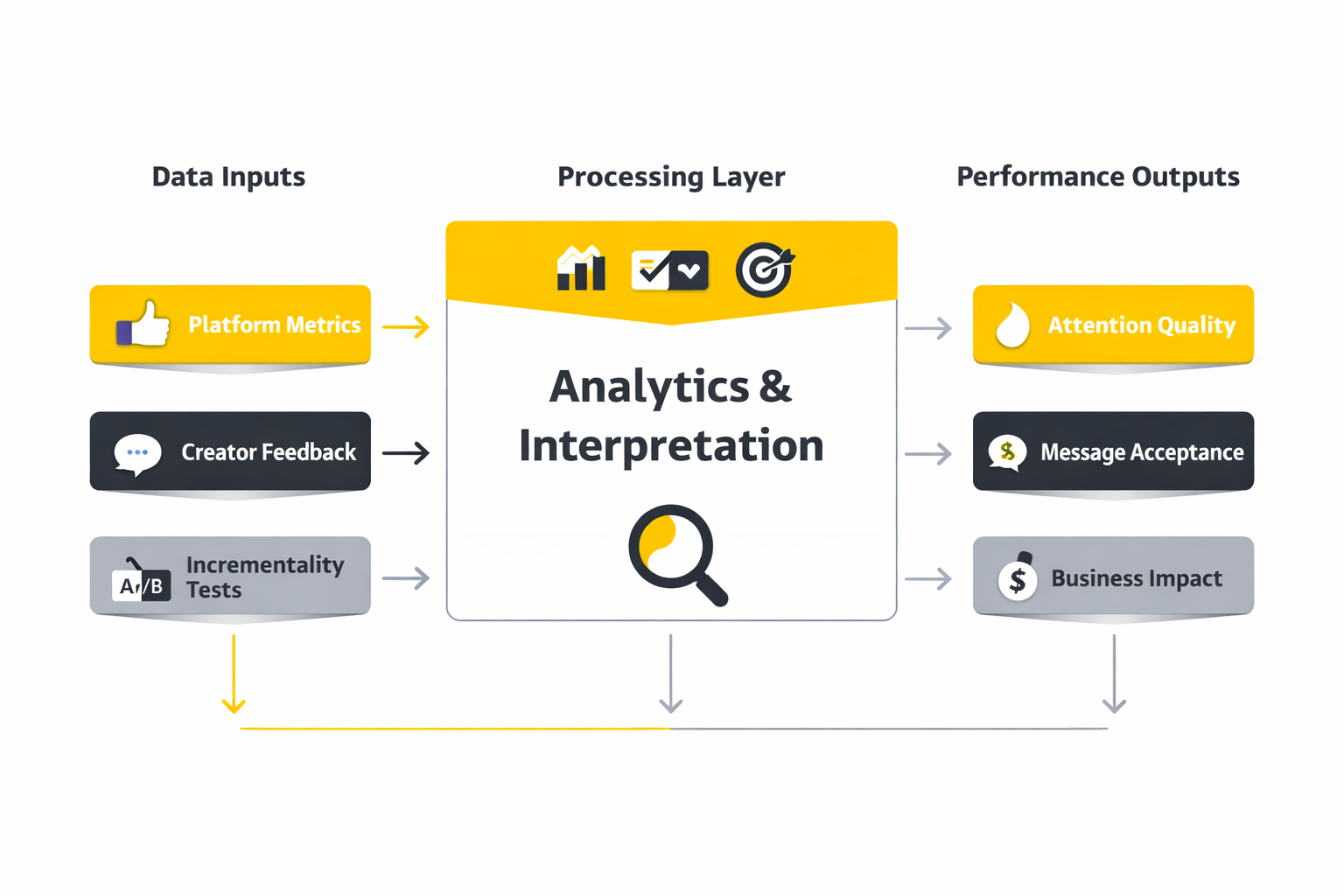
Use a three-layer reading order:
- Layer 1: Distribution quality. Did the content reach the audience you intended, at the frequency you intended, without exhausting them? This is where view-through rate, retention curves, and share rate earn their keep.
- Layer 2: Message acceptance. Did people treat the content like a recommendation or like an ad? Saves, shares, thoughtful comments, and click intent matter more here than raw likes.
- Layer 3: Business behavior. What changed outside the platform: branded search, site behavior, add-to-cart, leads, trials, purchases, repeat purchase signals, and customer quality metrics.
Then decide what type of truth you’re chasing. Attribution answers “what got credit,” but it doesn’t prove “what caused the outcome.” If your team is serious about causality, you graduate to lift studies, holdouts, and incrementality frameworks. That’s why you’re seeing platforms and agencies talk more openly about experiments and creator content that can be measured like performance media.
One clear example is the rise of creator whitelisting and partnership ad formats, where brands can amplify creator posts directly inside ad systems. eMarketer summarized Meta’s own data as showing partnership ads delivering 19% lower CPAs and 13% higher click-through rates on average versus standard brand ads. You can cross-check that performance claim in eMarketer’s coverage, and see the same Meta-referenced figures repeated in operational guidance from DataSlayer and Social Native.
Interpreting those numbers correctly is important. They don’t mean “partnership ads are magic.” They usually mean the system performs better when the creative looks native, the creator’s identity adds trust, and the ad delivery model gets richer engagement signals to optimize against. In practice, it’s a reminder that measurement should follow how people actually decide: they watch, they feel, they compare, they search, and only then do they buy.
Case Stories
Publicis And The Measurement Arms Race
In May 2025, the pressure wasn’t subtle anymore. Big brands were asking agencies a brutal question: “If we move more budget into creators, can you prove what we got back?” At the same time, rivals were stacking creator platforms, measurement layers, and identity graphs like it was an arms race.
The backstory is that influencer marketing had matured faster than most operating models. Spend was accelerating, creators were becoming a default media channel, and clients wanted creator work connected to the same performance standards as everything else. That shift shows up in the way the industry talked about scale and accountability alongside the headline growth of the creator economy. IAB’s 2025 report framing and the published $37B projection made it clear that “creator” had become a boardroom category.
The wall came from fragmentation. Creator discovery lived in one tool, contracting in another, measurement in a third, and identity-based targeting somewhere else entirely. Every handoff added risk: inconsistent reporting, mismatched definitions, and the kind of ambiguity that makes finance teams cut budgets.
The epiphany was that agencies didn’t just need more creators, they needed a single operating layer that could unify creator programs with connected data. That’s why Publicis moved to acquire Captiv8 and positioned it as part of a connected influencer platform anchored in identity. The deal was widely reported as $150 million, and the rationale centered on scale, social commerce, and measurement. The Wall Street Journal’s reporting, Publicis Groupe’s announcement, and Marketing Dive’s coverage all describe the same strategic intent.
The journey wasn’t about buying a shiny platform and calling it done. The real work is operational: standardizing metrics, aligning definitions, integrating identity, and making creator performance legible next to paid social, retail media, and CRM outcomes. The moment you try to roll that out across global teams, you discover how many “small” reporting differences can derail trust.
The final conflict is that consolidation raises expectations immediately. Once you tell the market you can unify creator strategy and measurement, clients stop accepting fuzzy answers and start demanding clearer causal proof. That’s when lift studies, clean reporting, and honest postmortems become part of the product, not optional extras.
The dream outcome is a creator program that behaves like an accountable media channel while still feeling human. When systems get unified, creators get briefed better, brands learn faster, and you stop mistaking noise for impact. And in a market where creator spend is scaling rapidly, that operational advantage becomes compounding.
When Creator Content Turned Into Performance Media
It starts the way these stories usually start: the campaign looked “fine” on paper, but leadership still didn’t believe it. The content had views, likes, and comments, yet the numbers that mattered most—cost per acquisition and qualified traffic—weren’t moving the way the team needed. The fear wasn’t that influencer marketing didn’t work; it was that the team couldn’t prove when it worked well enough to scale.
The backstory is that privacy shifts and weaker tracking have made last-click reporting less trustworthy for many teams, especially when creators influence decisions upstream. So brands began pushing creator content into ad systems through partnership/whitelisting formats, trying to combine authenticity with optimization. That trend shows up not just in product releases, but in how performance claims are now framed publicly by the ecosystem around Meta.
The wall was measurement confusion. Creator content would spike engagement, but attribution models would argue about who deserved credit, and teams would either underinvest or blindly scale. Without a consistent interpretation rule, the dashboard became a source of debate instead of a source of learning.
The epiphany was realizing that creator content can be treated like a performance asset when the distribution model and signals are right. Meta’s partnership ad data was summarized as showing 19% lower CPAs and 13% higher click-through rates on average versus standard brand ads, which gave teams a defensible reason to test creator-led paid amplification instead of relying on organic reach alone. You can verify the same Meta-referenced performance figures in eMarketer’s coverage, DataSlayer’s January 2026 analysis, and Social Native’s January 2026 breakdown.
The journey becomes disciplined experimentation. Teams take a set of creator posts, whitelist them, run controlled creative rotations, and force themselves to answer a simple question every week: “Which creator narrative is pulling cost down, and why?” Instead of treating “creator” as a channel, they treat each creator asset as a hypothesis with a measurable outcome.
The final conflict is creative fatigue and false certainty. Once a creator-led ad starts winning, the instinct is to over-scale it until performance collapses, then blame the creator instead of the rotation plan. The fix is boring but powerful: rotate variants, refresh hooks, and use the same interpretation model across every test so you don’t mistake short-term volatility for a strategy failure.
The dream outcome is a system where creativity stays human and measurement stays rigorous. Creators get room to sound like themselves, brands get assets they can responsibly scale, and the analytics stops being a scoreboard and becomes a steering wheel. That’s the version of social media influencer marketing that survives scrutiny and still grows.
Professional Promotion
Professional promotion in social media influencer marketing isn’t “boosting posts.” It’s engineering distribution so the best creator content reaches the right people, repeatedly, without losing credibility.
Start with a simple rule: organic proves the concept, paid scales the concept. If a creator post earns real momentum (especially shares and saves), it’s a candidate for amplification. Dash Social’s 2025 benchmark reporting highlighted shares as a fast-rising signal, which is exactly why many teams now treat share velocity as an early indicator for “this can travel.” Dash Social’s benchmark release and the GlobeNewswire distribution both reinforce that shift.
Then choose your promotion path based on the job the content is doing:
- Reach expansion: promote creator content to lookalikes and interest clusters that match the creator’s audience profile, not just the brand’s historic targeting.
- Consideration building: sequence content so a discovery asset leads into proof (reviews, demos, comparisons), then into an offer.
- Conversion capture: use creator-led partnership/whitelisting formats so the ad feels native while still optimizing for business events.
Finally, make promotion auditable. Define your success metric before you launch, document what you changed (creative, audience, landing path), and force a weekly decision: scale, iterate, or kill. When the market is big enough to justify $10B+ in annual spend, professionalism means your next move is always explained by evidence, not vibes.
Future Trends
Social media influencer marketing is shifting from a “creative tactic” into a structured media channel, and the next wave will reward teams that can combine creator authenticity with grown-up measurement and governance.
The money is already moving that way. U.S. creator economy ad spend was projected to reach $37B in 2025 with 26% year-over-year growth, and it’s been positioned as growing roughly 4x faster than the overall media industry. IAB’s Creator Economy Ad Spend & Strategy Report overview and the published headline findings in IAB’s announcement make the direction hard to ignore.
Trend 1: Creator content becomes performance creative by default
“Nice engagement” isn’t enough anymore. Teams increasingly treat creator assets as performance creative once organic proves resonance, then scale with partnership-style ads and whitelisting workflows. Meta has openly shared that partnership ads in business-as-usual campaigns have delivered 19% lower CPAs and 13% higher click-through rates on average, which is why creator-led paid amplification is becoming normal rather than experimental. Meta’s partnership ads performance note and the same figures repeated in eMarketer’s December 2025 coverage
Trend 2: Shares matter more than follows
Attention is shifting from “who followed” to “who shared.” Benchmark reporting has highlighted shares as a clearer signal of momentum, with shares reported as up 31% on TikTok and 86% on Instagram in the same benchmark release that framed shares as outpacing follows as a growth signal. Dash Social’s 2025 benchmarks press release
Trend 3: Incrementality becomes the standard for proving value
As attribution gets noisier, serious programs will increasingly rely on controlled tests to answer the only question leadership truly cares about: “Did this create new business?” TikTok has been pushing lift testing as a “gold standard” approach, and its Conversion Lift Study documentation explicitly frames the method as measuring incremental impact rather than relying on fragile attribution stories. TikTok’s Conversion Lift Study help documentation and the platform explanation of lift testing in TikTok’s CLS overview
Trend 4: Marketplaces and open applications scale creator sourcing
Instead of spending weeks in outbound discovery, more brands will publish briefs and let creators apply, then curate the best fits. That dynamic reduces bias, increases volume, and often improves creative diversity—especially for brands that need lots of variations for testing. TikTok’s Creator Marketplace has been building structured workflows for this model through features like Open Applications.
Trend 5: Compliance and trust controls tighten
The more the channel scales, the more scrutiny it attracts. The FTC’s endorsement guidance emphasizes clear disclosure of material connections and consistent monitoring practices, and its updated Endorsement Guides framework is designed to reflect how modern endorsements and reviews work across social platforms. FTC endorsements, influencers, and reviews guidance and the FTC’s update announcement in the 2023 Endorsement Guides press release
Strategic Framework Recap

If you only remember one thing from this guide, let it be this: social media influencer marketing becomes reliable when you treat it like a system—strategy, creator fit, creative operations, distribution, and measurement—working together.
- Start with one job-to-be-done: awareness, education, conversion, or retention.
- Build a creator portfolio: authority + micro/mid volume + selective reach spikes.
- Design briefs that protect essentials and free the creator voice: clear boundaries, room to perform.
- Batch production and wave publishing: faster learning with less chaos.
- Amplify proven winners: organic signals pick the creative, paid makes it predictable.
- Measure like a grown-up channel: interpret signals correctly, validate with lift tests when possible.
- Protect trust: disclosures and claims governance are part of the workflow, not a last-minute scramble.
FAQ – Built for the Complete Guide
What counts as an influencer in social media influencer marketing?
An influencer isn’t defined by follower count as much as influence. In practice, it’s any creator whose audience trusts them enough to consider a recommendation, especially when the content style fits the platform and the creator can demonstrate real product understanding.
How many creators do I need to start?
Start with a small portfolio rather than one “hero” creator. Many teams learn faster with 5–15 creators producing multiple variations each, because you get creative diversity and reduce the risk of one partnership underperforming.
Should I pay creators a flat fee, affiliate commission, or both?
For most brands, the cleanest structure is a base fee for quality work plus performance upside for results. That keeps creators motivated without forcing them to take all the risk, and it avoids the “coupon spam” vibe that can hurt trust.
What metrics matter most for influencer campaigns?
It depends on the campaign job-to-be-done. For awareness, focus on attention quality and sharing; for consideration, watch saves, shares, and comment depth; for conversion, track clicks, sales, and customer quality. Shares are increasingly treated as a key momentum signal in benchmarks like Dash Social’s 2025 benchmark release.
How do I prove ROI without lying to myself?
Attribution can be useful, but it doesn’t always prove causality. When budgets get serious, validate performance with incrementality methods like lift studies. TikTok’s measurement materials describe lift testing as a way to measure incremental impact rather than relying on credit assignment. TikTok Conversion Lift Study documentation
What should an influencer brief include?
A good brief has non-negotiables (truthful claims, disclosure rules, usage rights) plus a creative menu (multiple angles the creator can choose from). It should read like a collaboration note, not a script.
Do I need contracts for every creator?
Yes, especially once you’re paying fees, licensing content, or running partnership ads. Contracts protect timelines, deliverables, usage rights, and disclosure expectations so you can scale without renegotiating basics every time.
How should disclosures work in influencer marketing?
Disclosures should be clear, easy to notice, and consistently used when there’s a material connection. The FTC’s guidance on endorsements and influencers is a helpful reference for building internal checklists and training creators on expectations. FTC endorsements and influencer guidance
What is whitelisting or partnership ads, and why does it matter?
It’s when a brand can run paid ads using creator content (often under the creator’s handle) with proper permissions. This often improves performance because the creative feels native and the creator identity adds trust. Meta has publicly shared average performance lifts tied to partnership ads formats. Meta’s partnership ads performance note
How long should an influencer campaign run?
Short bursts can create spikes, but reliable programs usually run in monthly cycles: batch production, wave publishing, amplification of winners, and a learning review that feeds the next cycle.
What platform should I start with?
Start where your customers already discover products, not where the hype is loudest. Use benchmarks as context—TikTok tends to lead engagement while Instagram often leads reach in large benchmark datasets, which can influence how you structure your creator portfolio. Dash Social’s 2025 benchmarks
How do I avoid fake influence and inflated engagement?
Look for comment intent (questions, comparisons, purchase language), not just vanity metrics. Cross-check audience location, suspicious engagement spikes, and creator disclosure history. Build a small test before committing to long-term deals.
Work With Professionals
If you’re good at marketing, the hardest part isn’t doing the work—it’s finding the right clients consistently. And when you’re building your career around high-skill services like social media influencer marketing, you don’t want a middle layer taking a cut or slowing down the deal.
That’s why marketplaces built specifically for marketers are becoming more attractive: direct communication, clear positioning, and simpler economics. Markework describes itself as a marketing marketplace where teams can hire and marketers can find work, with “no middleman” and “no project fees,” plus direct messaging and simple plans. markework.com’s homepage
Now zoom out and look at the demand. There are 12,000+ open marketing gigs on Upwork alone at any given time, which tells you the market is deep and constantly renewing. Upwork’s live count of marketing freelance jobs
Picture what happens when you combine those two realities: businesses are actively hunting for marketers, and you can present yourself in a place designed for direct hiring instead of fighting a generic feed. Markework’s setup emphasizes direct negotiation without commissions, and predictable monthly plans for activity. Markework’s “No commissions” positioning and plan examples shown on its plan selection page
If you want to turn influencer expertise into a steady pipeline of remote contracts, build a profile that makes you easy to trust: show your framework, show your proof (assets, reporting screenshots, before/after learnings), and show your specialty (TikTok creator systems, Meta partnership ads, UGC licensing, measurement). Then apply consistently, message directly, and close faster—without handing over a percentage of every win.
 Filip Konecny Enterprises