

Social media is no longer a “nice to have” channel that lives somewhere between PR and marketing. For most companies, it’s where buyers learn what you stand for, where customers decide whether you’re worth the effort, and where employees and partners form their first impression before they ever open your website.
It’s also messier than it used to be. Attention is fragmented, algorithms shift, and the same post can land as “helpful” in one context and “noise” in another. The companies that win aren’t the ones posting the most—they’re the ones building a system that turns social into a predictable business asset.
This series breaks that system down into a framework you can actually run with a team, a calendar, and real constraints.
Article Outline
- What Social Media for Companies Really Is
- Why It Matters Now
- Framework Overview
- Core Components
- Professional Implementation
What Social Media for Companies Really Is

At its best, social media for companies is a repeatable operating system for earning attention, trust, and demand—using content, conversations, and community. It’s not just “posting,” and it’s definitely not a pile of random trends.
Think of it as three jobs running in parallel:
- Market visibility: making sure the right people notice you in the moments they’re exploring options.
- Trust building: reducing perceived risk by showing competence, clarity, and consistency over time.
- Business movement: creating measurable outcomes like leads, pipeline, recruiting lift, retention, or customer support deflection.
That last part matters because social isn’t “free.” Even if your distribution costs look low, the real cost shows up as time, creative bandwidth, review cycles, and the opportunity cost of running the wrong play for months. When social is treated as a business system, decisions get easier: what to publish, where to show up, what to measure, and what to stop doing.
It also helps to be honest about what “social” includes today. It’s public feeds, yes—but it’s also DMs, comments, community spaces, creator partnerships, employee advocacy, and platform-native search behavior. That shift is one reason companies keep investing: global social media adoption continues to rise, with user identities counted in the billions and growing year over year, which keeps social as one of the most important attention surfaces available to brands.
For example, the global count of social media user identities has been tracked at scale by the Kepios team in the Global Digital Reports, including their recent Digital 2025 global overview and continuing updates like their global social media statistics hub.
Why It Matters Now
Most companies feel the pressure because “everyone is on social.” The real reason it matters is more specific: social has become a primary layer of evaluation. People check your credibility there—often before they click your site—and they use it to answer questions they don’t want to ask a sales rep yet.
Here are the practical forces making social media for companies harder to ignore:
- Distribution is a moving target: you can’t rely on any single platform or format staying stable. The only durable advantage is a system that can adapt.
- Expectation for responsiveness keeps rising: consumers increasingly treat social as a customer experience channel, not just a marketing one. Research-based benchmarking from large-scale surveys like the 2025 Sprout Social Index and the State of Social Media 2025 shows how strongly audiences connect brand perception with how brands show up and respond in social spaces.
- Paid, creators, and organic now blend: creator partnerships and paid amplification are no longer “extra.” They’re often how companies scale what already works. In the U.S., creator economy ad spend has been measured in the tens of billions, with growth projections detailed in the IAB Creator Economy Ad Spend & Strategy Report (2025).
- Budgets follow attention: social ad spend continues to rise globally, with forecasts and market analysis captured in industry trackers such as WARC’s reporting on social media ad expenditure in 2025.
There’s also a governance angle companies underestimate. Social is a reputational risk surface, a compliance surface, and a brand safety surface. When you have a framework, you can move quickly without turning every post into a legal debate—or worse, letting speed win over judgment.
Finally, social increasingly influences what people believe is “real.” For companies operating in regulated industries, sensitive categories, or high-consideration purchases, that trust layer is not optional—it’s part of the product experience.
Framework Overview
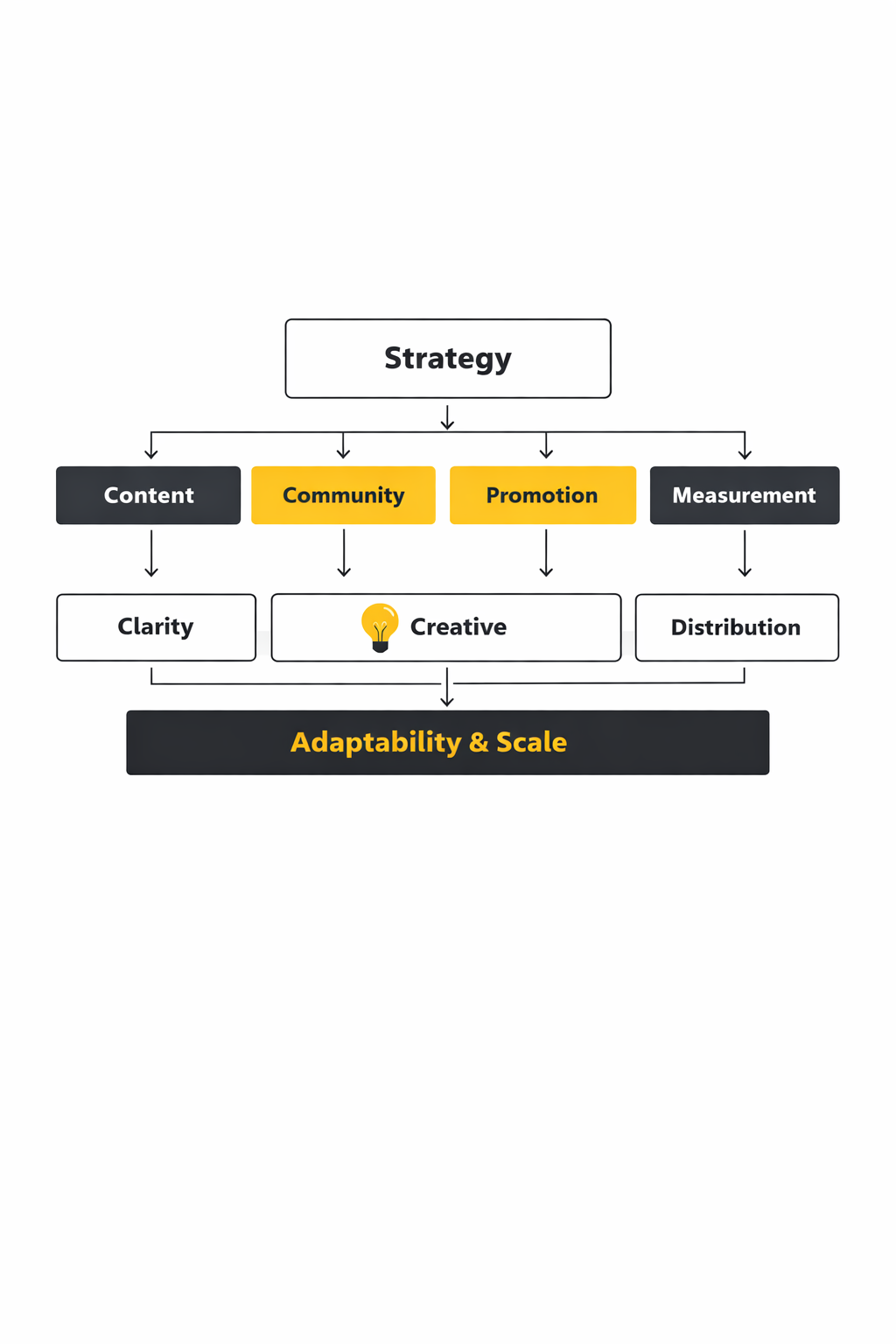
This framework is built to do one thing: turn social media for companies into a consistent output engine that produces consistent business outcomes—without relying on viral luck.
It’s organized around five connected layers:
- Strategy: what you want social to do for the business, and who it’s for.
- Content system: how you repeatedly create posts that earn attention and build trust (not just fill a calendar).
- Distribution: how you maximize reach and relevance across platforms, formats, and paid support.
- Engagement: how you turn attention into conversation, community, and customer experience.
- Measurement: how you prove impact, improve decisions, and justify investment.
The important part is that these layers are connected. If you’re posting frequently but don’t have a content system, you burn out. If you have content but no engagement motion, you look polished and invisible. If you do everything except measurement, social becomes vulnerable to budget cuts the moment leadership needs to “tighten spend.”
In later parts of the article, we’ll go deep into implementation: role design, approvals, analytics, and an operating cadence that can survive busy seasons. For now, you’ll get the structure and the decisions you need to make before you ever open a scheduling tool.
Core Components
To make this work in real companies—where time is limited and priorities change—you need a few core components that keep the whole thing stable.
1) Clear Objectives That Don’t Compete With Each Other
A common failure mode in social media for companies is trying to do everything at once: brand awareness, recruiting, product education, customer support, community, partnerships, lead gen. You can do multiple things, but you can’t do them all with the same content and the same metrics.
A cleaner approach is to pick one primary objective and one secondary objective per quarter. That forces tradeoffs and removes the “random acts of content” problem.
- Primary objective examples: pipeline influence, product adoption, customer retention, hiring velocity, category authority.
- Secondary objective examples: creator partnerships, event demand, customer education, brand trust repair.
2) A Real Audience Model
“Our audience is everyone who could buy” is how companies end up talking to nobody. A useful audience model includes intent level and context:
- Explorers: curious, browsing, comparing approaches.
- Evaluators: narrowing options, looking for proof and reassurance.
- Users: already customers, need onboarding, tips, and confidence.
- Advocates: customers, partners, employees who can amplify you.
Why this matters: each group needs different content. Explorers need clarity. Evaluators need evidence. Users need enablement. Advocates need assets and recognition.
3) A Content Engine Built on Pillars and Proof
Your content pillars are the few themes you can credibly own. The best pillars match what your buyers care about and what your company can actually prove.
A strong pillar system usually includes:
- Point of view: what you believe that shapes how you work.
- Education: making the market smarter (and making you the teacher).
- Proof: case studies, demos, outcomes, testimonials, data, behind-the-scenes.
- Humanity: the people, values, and decisions behind the company.
This lines up with what large studies keep showing: audiences respond when brands are distinct and coherent, not when they chase every trend. That theme appears repeatedly in research-based insights such as the State of Social Media 2025 and the broader consumer and marketer survey findings presented in the Sprout Social Index.
4) Distribution That Matches How People Actually Discover You
Distribution isn’t just “post at the best time.” It’s the full set of decisions that determine whether the right people ever see your work.
- Platform fit: what formats your audience expects in each channel.
- Repetition without boredom: reusing ideas across formats so one insight becomes multiple assets.
- Paid support: amplifying the posts that already earn engagement so performance scales instead of resetting every week.
- Creator and partner lift: borrowing trust and distribution where it’s earned, not rented.
Budgets are increasingly reflecting this blend. Social ad spend forecasts and growth projections—like those summarized in WARC’s coverage of social media expenditure trends—underline why “organic only” is often a ceiling, not a strategy.
5) Measurement That Leadership Actually Trusts
Vanity metrics aren’t useless, but they’re incomplete. Reach and engagement can tell you if your message resonates. They don’t automatically tell you if social is helping the business.
A measurement system that works for social media for companies usually includes three layers:
- Attention signals: reach, views, saves, watch time, profile actions.
- Trust signals: comment quality, DMs, repeat engagement, branded search lift, sentiment patterns.
- Business signals: qualified traffic, demo interest, pipeline influence, hiring conversions, support deflection.
When you connect those layers, social becomes defendable. Many teams also lean on ROI research and benchmarking from multi-country surveys of marketing leaders—like the findings compiled in Sprout Social’s 2025 Impact of Social Media Report—to align leadership on what “impact” can realistically look like.
Professional Implementation
This is where most companies either become consistent—or quietly quit. Professional social media for companies isn’t about having the best ideas. It’s about building an operating rhythm that produces quality output every week without drama.
Start With Roles, Not Tools
Before you choose a scheduler or an analytics suite, decide who owns what. Even small teams can run this cleanly when responsibilities are explicit:
- Strategic owner: sets objectives, approves pillars, protects focus.
- Editor/producer: turns raw ideas into publishable assets and keeps quality consistent.
- Community owner: manages responses, flags issues, and builds relationships in comments and DMs.
- Analyst/operator: tracks performance, surfaces insights, and connects results to business outcomes.
In many companies, one person covers multiple roles. That’s fine—the point is to make the hats visible, so “posting” doesn’t consume all the time while engagement and measurement quietly die.
Use a Cadence That Protects Creative Work
A simple cadence that scales:
- Weekly: one planning session to pick themes and assets, one production block, one performance review.
- Monthly: a deeper retro—what’s working, what’s not, what to stop.
- Quarterly: reset objectives, refresh pillars, align with business priorities.
This cadence matters because platforms move, but systems endure. When your company has a rhythm, you can absorb change—new formats, new features, shifts in reach—without rewriting your entire strategy every time an algorithm sneezes.
Build Guardrails for Speed and Safety
Social is fast, but companies still need good judgment. The best teams create guardrails that make speed safer:
- Voice and tone guide: a few examples of what “on brand” looks like in real posts.
- Escalation rules: what gets answered, what gets moved to private channels, what gets escalated.
- Review tiers: low-risk posts move fast; higher-risk posts get more review.
Public companies and major platforms provide a reminder of how material social and advertising ecosystems are to the broader market. For example, Meta’s investor reporting includes large-scale platform usage and advertising delivery metrics that show how deeply brand activity is embedded into everyday social behavior, as reflected in their Q4 and full-year 2024 results release and related disclosures.
Next, we’ll start turning this framework into the practical building blocks: channel selection, pillar design, content formats, and how to create posts that feel human while still driving measurable outcomes.
Tools Supporting the Framework
Once your strategy and operating rhythm are clear, tools stop being a confusing shopping spree and start being simple infrastructure. The goal isn’t to “have the best platform.” The goal is to make social media for companies easier to run at a professional standard: faster publishing, cleaner collaboration, safer governance, and reporting that leadership won’t dismiss.
A useful way to think about tools is by the job they do inside the framework:
- Execution: planning, publishing, approvals, and asset management.
- Conversation: inbox, moderation, routing, and service collaboration.
- Insight: analytics, listening, competitive context, and reporting.
- Integration: connecting social activity to CRM, support, ecommerce, and BI.
First-party tools can cover a lot for smaller teams, especially on Meta. Meta positions Meta Business Suite as a single place to manage posts, messages, and insights across Facebook and Instagram, and their own learning materials walk through how teams use inbox and reporting features in practice via the Meta Business Suite inbox and insights course. When social media for companies becomes multi-platform, multi-team, or compliance-heavy, that’s where dedicated platforms become less “nice” and more “necessary.”
Tool Categories
Most teams get stuck because tool conversations start with brand names. Start with categories instead. When you map categories to your workflow, you’ll immediately see what you truly need, what you can defer, and what will create more complexity than value.
First-Party Platform Tools
If you’re operating mainly on one platform, first-party tools can be surprisingly capable. They’re also the most “policy safe” because they evolve with the platform’s rules.
- Meta: scheduling, inbox, and insights live inside Meta Business Suite, with feature guidance in Meta’s own training content like their inbox and insights lesson.
- TikTok: if your workflow depends on publishing automation or integrations, it helps to understand what TikTok officially supports through TikTok API for Business documentation and developer guidance such as content posting and sharing guidelines.
First-party tools are often enough for a single brand, a single region, and a single set of stakeholders. The moment you’re coordinating multiple business units, multiple approvals, or multiple platforms, you usually outgrow them.
Social Media Management Platforms
These tools exist to reduce the “too many tabs” problem: they centralize publishing, approvals, collaboration, and engagement workflows. They also reduce operational risk, because your team can work from one place with consistent permissions and audit trails.
- Publishing and engagement focus: platforms like Hootsuite emphasize unified publishing and inbox workflows, including the way their inbox consolidates multi-platform replies as described in their social media customer service guide.
- Insight-led and cross-functional reporting focus: Sprout frames the “why” behind dedicated tooling in its 2025 overview of social media technology, especially when social work has to serve marketing, comms, and customer care simultaneously.
- Enterprise unified CX focus: platforms like Sprinklr position themselves as unified systems across marketing and service, and publish multi-industry customer stories through their customer stories library.
Social Listening and Research
Listening tools are where social media for companies shifts from “what we posted” to “what the market is saying.” They help with category insights, product feedback, reputation monitoring, and issue detection.
- Best for enterprises and regulated categories: unified platforms that combine listening with routing and governance, like the modules described across Sprinklr’s customer stories.
- Best for small teams: starting with platform-native search plus a lightweight monitoring workflow, then upgrading when volume makes manual monitoring unreliable.
Analytics, Reporting, and BI
Analytics tools do two things well: they reveal what to do next, and they make your work defendable. If your reporting lives in screenshots, your program becomes fragile the second leadership asks hard questions.
Many teams pair platform analytics with a social suite’s reporting, then push the most important metrics into the same place the business already trusts (CRM dashboards, BI tools, weekly exec reporting). Research-based benchmarking can help you set expectations without guessing, like the industry benchmarking approach outlined in Hootsuite’s 2025 benchmarks overview.
Creator, Influencer, and UGC Workflow Tools
When creator partnerships become part of your distribution mix, you need tooling that supports sourcing, approvals, licensing, and reporting. If that sounds “extra,” it’s worth remembering how fast creator spending and strategy matured, as highlighted in the IAB creator ad spend and strategy research.
Governance, Compliance, and Security
Governance tools aren’t glamorous, but they prevent expensive mistakes. The core needs are simple:
- Permission design: who can publish, who can approve, who can respond.
- Auditability: what changed, when, and by whom.
- Escalation: how sensitive messages move to legal, PR, or support.
For enterprise teams, external validation can also shape procurement decisions, like the way IDC MarketScape positioning is referenced by Sprinklr for large-enterprise social marketing software.
Tool Comparison
Tool comparisons are usually written like feature checklists. That’s not how real teams succeed. The best choice depends on your workflow, risk profile, and the kind of company you are right now.
Choose Tools by “Friction Removed,” Not “Features Added”
In social media for companies, every tool should remove a specific friction point. If it doesn’t, it’s just another login and another place for things to break.
- If publishing is chaotic: prioritize planning, approvals, and asset workflows.
- If engagement is stressful: prioritize a unified inbox, routing, templates, and moderation.
- If reporting is ignored: prioritize executive-ready reporting and clean exports into the systems your company already trusts.
- If brand risk is real: prioritize governance, permissions, and audit logs.
Three Stack Archetypes That Fit Most Companies
You don’t need the same tooling at every stage. These archetypes cover most realities without forcing you into a one-size-fits-all solution.
- Starter stack (single platform or two platforms): first-party tools plus a lightweight workflow for content storage and approvals. For Meta-heavy teams, that often starts with Meta Business Suite.
- Growth stack (multi-platform marketing team): a management platform for publishing and engagement, plus structured reporting. Teams often compare options like Hootsuite or a platform guided by the operational needs described in Sprout’s social media technology overview.
- Enterprise stack (marketing + service + governance): unified systems designed for scale, where service routing, listening, and compliance live together, similar to the workflows showcased across Sprinklr’s enterprise customer stories.
Integration Reality Check
A tool stack only works if the hard edges connect: publishing permissions, asset libraries, tracking links, and handoffs to sales or support. If you’re relying on automation or custom workflows, treat official platform documentation as the source of truth, like TikTok’s API for Business docs and TikTok’s posting and compliance guidance.
When integration is ignored, teams end up with reports that don’t match, links that can’t be attributed, and customer conversations that fall through cracks. When integration is designed intentionally, social becomes easier to measure and much harder to dismiss.
Real Tool Stack Stories
Tool stacks become meaningful when you see what they’re built to survive: a surge in demand, a crisis-level volume spike, or a global organization trying to speak with one voice. The stories below are real, documented cases where the operational problem forced a tool-and-process rethink.
KLM: When Social Became the Front Line of Customer Care
The notifications didn’t slow down—they multiplied. Customers weren’t browsing; they were stranded, anxious, and demanding answers in public threads that anyone could read. Every missed reply wasn’t just a lost customer moment; it was a visible failure happening in real time on the open internet. :contentReference[oaicite:0]{index=0}
KLM had already been moving toward social as a customer experience channel, but moments of disruption made the need impossible to ignore. They weren’t dealing with one inbox or one platform—they were dealing with customers across channels, each with different expectations and context. The business challenge wasn’t “post more,” it was “serve customers where they already are.” :contentReference[oaicite:1]{index=1}
The wall was operational: social conversations were scattered across platforms, and scaling service meant scaling complexity. Even if individual teams worked hard, the system itself fought against speed, consistency, and quality. Without a hub approach, every extra channel created more fragmentation instead of more coverage. :contentReference[oaicite:2]{index=2}
The breakthrough was treating social as part of omnichannel service infrastructure, not a marketing side quest. KLM’s transformation narrative shifts from “social presence” to building a Social Media Hub approach that connects channels and internal systems. That’s the mindset shift that turns tools into a framework: the tool isn’t the strategy, the tool enables the strategy to actually function. :contentReference[oaicite:3]{index=3}
The journey became integration-heavy by design. TCS describes building API-based solutions and integrating social messaging platforms into KLM’s existing IT setup so service actions could be taken directly from messaging channels like Facebook Messenger and WhatsApp. The point wasn’t novelty; it was making real customer tasks possible where customers were already talking. :contentReference[oaicite:4]{index=4}
The final conflict was maintaining speed without losing control. As soon as you spread customer service across multiple public and private channels, governance and routing stop being “process” and start being safety equipment. KLM’s story makes it clear that being present 24/7 online isn’t just staffing—it’s systems, escalation, and a workflow that doesn’t break under pressure. :contentReference[oaicite:5]{index=5}
The dream outcome wasn’t “more engagement.” It was a social operation that could handle customer care at scale while protecting the brand in public moments—and that’s exactly why KLM is still referenced as a social-first service leader in enterprise customer experience conversations. When social media for companies is treated like infrastructure, the company can be fast, human, and consistent even when everything gets noisy. :contentReference[oaicite:6]{index=6}
Uber: Scaling Social Care Like a Global Operations Team
The volume didn’t arrive politely—it arrived like a wave. Conversations about service and safety could surface anywhere, at any time, and the cost of missing the right message was bigger than a bad comment thread. When customers talk in public, the brand is on stage, whether it planned to be or not. :contentReference[oaicite:7]{index=7}
Uber’s backstory is global growth layered on top of constant customer demand. As the company expanded into more markets, the number of social handles, languages, and operational edge cases expanded too. A single-team, single-inbox approach wasn’t realistic anymore. :contentReference[oaicite:8]{index=8}
The wall was coordination. Global publishing had to stay consistent while local teams still needed flexibility, and customer care needed to route messages to the right people fast. Without a unified platform, those requirements collide: either you centralize and become slow, or you decentralize and lose control. :contentReference[oaicite:9]{index=9}
The epiphany was to unify the work instead of adding more separate tools. Uber’s story describes building on a platform approach that supports publishing, listening, and service workflows together, so teams don’t spend their day stitching screenshots and spreadsheets into something usable. The tool stack becomes a workflow stack. :contentReference[oaicite:10]{index=10}
The journey is described as layered capability over time: publishing across many handles, expanding community management capacity, adding listening for critical issues, and strengthening triage and routing so high-priority problems reach the right team. This is what professional social media for companies looks like: not one giant rollout, but a system that evolves with the business. :contentReference[oaicite:11]{index=11}
The final conflict is that scaling care can accidentally strip out humanity. When speed becomes the only KPI, brands start sounding robotic, and trust erodes. Uber’s case emphasizes balancing scale with a consistent voice and service quality, which is exactly why governance and agent workflows matter as much as analytics. :contentReference[oaicite:12]{index=12}
The dream outcome is a social care operation that can keep up with global demand without collapsing into chaos. The deeper lesson is simple: tools don’t replace good service, but the wrong tools make good service nearly impossible to deliver consistently. :contentReference[oaicite:13]{index=13}
Roll Out in Phases, Not a Big Bang
The safest professional approach is to implement in layers:
- Phase 1: publishing workflows, approvals, and a clean content calendar.
- Phase 2: unified engagement workflows and response routing.
- Phase 3: reporting, listening, and integration into business dashboards.
This approach matches what practitioners describe when they talk about the “real” cost of scattered tooling—manual work, inconsistent reporting, and fragmented collaboration—challenges emphasized in Sprout’s discussion of social media technology in 2025. :contentReference[oaicite:14]{index=14}
Design Permissions Like You’re Protecting Revenue
Permissions are not admin trivia. They’re how you prevent mistakes, protect brand voice, and keep response quality high.
- Separate creators from publishers: most teams should allow drafting broadly but publishing narrowly.
- Define response authority: who can reply publicly, who can move to DMs, who escalates issues.
- Document “high-risk” topics: pricing, legal claims, medical or financial claims, crisis language.
Build an Inbox Workflow That Matches Customer Expectations
If social is part of your customer experience, the inbox isn’t optional. It’s the operating center. Many consumers explicitly value fast responses and helpful engagement, reflected in survey-based findings summarized through sources like Search Engine Journal’s review of social customer service trends, which references results from Hootsuite’s consumer research, and supported by Hootsuite’s own discussion of service workflows in their social media customer service guide. :contentReference[oaicite:15]{index=15}
Practically, that means defining:
- Response tiers: what gets answered in-thread, what moves private, what escalates.
- Coverage windows: realistic hours, with clear expectations and fallbacks.
- Templates with judgment: starting points that reduce time without making you sound like a bot.
Make Measurement Portable Across Teams
Social reporting becomes powerful when it’s portable—when marketing, comms, customer support, and leadership can all use it without reinterpreting it. That’s why professional teams often standardize a small set of KPIs and reporting definitions, then connect them to business questions.
For ongoing context and performance expectations, benchmarking resources like Hootsuite’s 2025 benchmarks can help teams avoid unrealistic targets and focus on consistent improvement instead of chasing random spikes. :contentReference[oaicite:16]{index=16}
Procurement and Vendor Reality
If you’re choosing platforms for a larger organization, validate three things early:
- Channel coverage: the platforms your company actually relies on today, plus the ones you’re expanding into next.
- API and compliance posture: what’s officially supported, especially if your plan depends on automation or integrations, using sources like TikTok’s official API documentation and developer usage guidelines. :contentReference[oaicite:17]{index=17}
- Governance and support: audit logs, permission models, onboarding, and security posture.
When the tool choice matches your workflow and your risk profile, the stack fades into the background—which is exactly what you want. The tools shouldn’t be the story. The business outcomes should be.
Step-by-Step Implementation
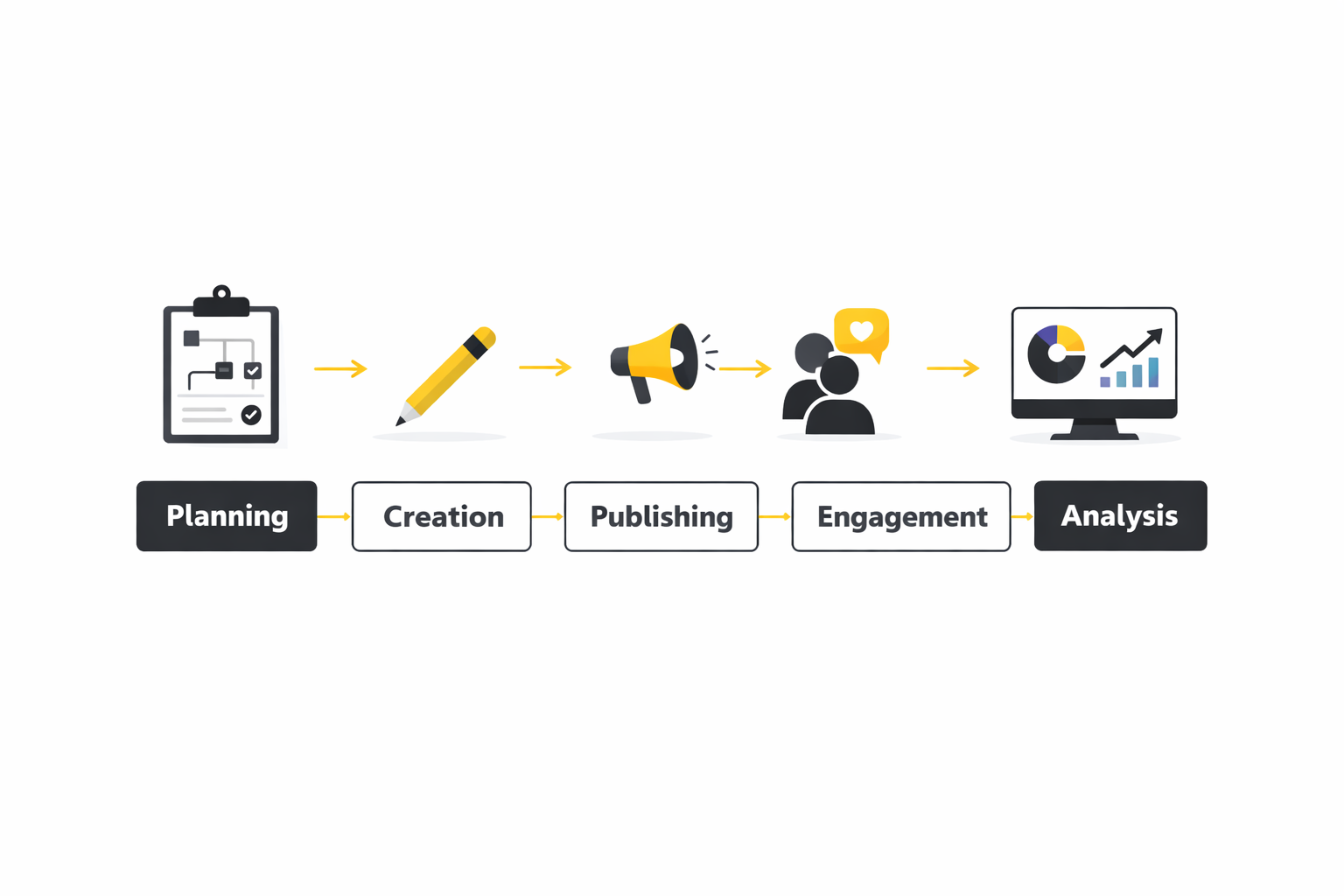
The fastest way to make social media for companies feel “hard” is to treat it like art: a new idea every day, endless approvals, and no repeatable workflow. The fastest way to make it feel manageable is to treat it like operations: clear inputs, a predictable process, and feedback loops that get stronger every cycle.
This implementation path is built to work in the real world—when you have product launches, customer issues, leadership opinions, and a team that can’t live inside one platform all day.
Step 1: Lock the outcome before you touch the calendar
Pick one primary outcome for the next 90 days and write it in plain language. If you can’t explain what success looks like without naming a platform, you’re not ready to scale execution.
- Examples of outcomes that actually guide decisions: “Increase qualified demo conversations from social,” “reduce support load by resolving common issues in public threads,” “make hiring easier by showing how the team works,” “earn trust in a new category.”
For B2B teams, it helps to pressure-test that outcome against what senior marketers are prioritizing right now—LinkedIn’s research on org and leadership challenges gives a reality check on where attention and budgets are moving, including the priorities summarized in the LinkedIn B2B Benchmark Report (2024). :contentReference[oaicite:0]{index=0}
Step 2: Define the audience by intent, not demographics
Most companies don’t lose because they don’t know who their audience is. They lose because they don’t know what stage of intent they’re speaking to in each post. Build a simple intent map and commit to it:
- Explorers: learning the landscape and vocabulary.
- Evaluators: comparing approaches and looking for proof.
- Users: trying to get value and avoid mistakes.
- Advocates: ready to share, recommend, and defend you.
When social media for companies is mapped this way, content stops being “random.” You know why you’re posting, and you know what you want someone to do next.
Step 3: Build content pillars that your company can prove
Create three to five pillars and write a short “proof list” under each one: the internal data you can share, the experts you can quote internally, the product truths you can demonstrate, and the stories you can tell responsibly.
If you want a sanity check for what audiences respond to today, TikTok’s own research materials tend to be useful for understanding what formats and themes are resonating, like the directional insights in TikTok’s What’s Next 2025 Trend Report. :contentReference[oaicite:1]{index=1}
Step 4: Decide the workflow before you decide the posting frequency
A consistent workflow beats an ambitious posting goal every time. A practical workflow for social media for companies typically has these stages:
- Idea capture: where raw ideas live (and how they’re tagged to pillars and intent).
- Drafting: who writes, who designs, who edits video.
- Review: what needs approval and what doesn’t.
- Publishing: who presses the button, and what “ready” means.
- Engagement: who replies, how handoffs work, what gets escalated.
- Learning: weekly review that turns performance into next week’s decisions.
Teams that rely heavily on customer care workflows often formalize this even more, because the inbox can’t be treated like a creative playground. Sprout’s guidance on social media customer service highlights why consistency and routing matter once social becomes a service channel, not just a marketing one. :contentReference[oaicite:2]{index=2}
Step 5: Put governance in writing so speed doesn’t create risk
Governance doesn’t need to be heavy, but it does need to exist. Write a one-page rule set that covers:
- Permissions: who can publish, who can respond, who can approve.
- High-risk topics: what needs legal or PR review.
- Escalation: how fast sensitive issues move to the right people.
- Voice guardrails: what “on brand” means in real examples.
Enterprise teams often underestimate how quickly scale creates chaos—Sprinklr’s discussion of managing social at scale is useful here because it frames the operational failure modes that show up when teams and regions multiply. :contentReference[oaicite:3]{index=3}
Execution Layers
If the steps above are your setup, execution layers are how you keep the machine running. This is where social media for companies becomes durable: each layer supports the next, and none of them depend on one heroic person carrying the whole program.
Layer 1: Planning that’s tied to the business calendar
Plan around business moments: launches, events, seasonal demand, hiring pushes, customer education cycles. Your social calendar should feel like it belongs to the company, not like it came from a separate universe.
Layer 2: Production built for reuse
One strong idea should turn into multiple assets: a short video, a post, a carousel, a comment thread, and a newsletter snippet. That’s not content spam—it’s operational efficiency.
Workflow guidance like Metricool’s social media workflow template (2026) is helpful as a process reference, especially around batching and approvals, as long as you adapt it to your company’s risk profile and review reality. :contentReference[oaicite:4]{index=4}
Layer 3: Publishing that matches platform-native behavior
Publishing is not “copy-paste everywhere.” It’s choosing what belongs on each platform and adjusting format, length, and tone so it feels native instead of recycled.
Layer 4: Engagement that treats comments and DMs as product feedback
Engagement isn’t just politeness. It’s where you discover objections, confusion, feature requests, and sentiment shifts early—before they show up in churn or pipeline friction.
When customer care is part of the mix, engagement becomes operationally critical. Sprinklr’s guidance on implementing social media customer service shows why teams move from ad-hoc replies to structured triage, routing, and escalation. :contentReference[oaicite:5]{index=5}
Layer 5: Measurement that turns into decisions
Metrics are only useful if they change behavior. A solid weekly review looks like this:
- What created meaningful attention? Not just views—saves, high-intent clicks, thoughtful comments, qualified DMs.
- What built trust? Repeat engagement, objections resolved in public threads, positive sentiment patterns.
- What moved the business? Demo conversations, support deflection, recruiting lift, partner interest.
If your team struggles to connect social performance to business outcomes, it’s often a tracking and definition problem, not an effort problem. That’s why B2B teams regularly lean on broader context like the LinkedIn B2B Benchmark Report to align measurement with the realities leadership cares about. :contentReference[oaicite:6]{index=6}
Optimization Process
Optimization is where social media for companies stops being a “content output” exercise and becomes a learning system. The goal is not to tweak everything every week. The goal is to run small, controlled changes that make results more predictable.
The weekly loop that actually improves performance
- Collect signals: pick five to ten posts and study what people did, not just what they saw.
- Name the pattern: what did these posts have in common (hook, structure, topic, proof type, tone)?
- Make one bet: change one variable next week (format, hook style, proof type, posting window, CTA).
- Protect the baseline: don’t change everything at once, or you won’t know what worked.
The monthly retro that prevents burnout
A monthly retro is where you decide what to stop doing. That’s the most underrated optimization lever. If a pillar isn’t earning attention or trust, either it needs a new proof angle, or it needs to be retired.
Change management when platforms shift
Platforms change. Rules change. Formats change. Your response shouldn’t be panic—it should be a structured test plan. TikTok’s own materials on how trends evolve can help teams stay realistic about change, like the directional research framing in What’s Next 2025. :contentReference[oaicite:7]{index=7}
Implementation Stories
Frameworks sound clean on paper. Implementation is where the mess shows up: approvals, internal politics, platform shifts, and the moment your team realizes the inbox is just as important as the feed. These are real stories where the operational choices made the difference.
Duolingo: Shipping Fast Without Losing the Plot
The comment section was moving faster than the team could think. Every viral moment created another wave of expectations: people wanted more, now, and they wanted it to feel native—not like a brand trying to borrow a meme. The pressure wasn’t just to be funny; it was to be consistently relevant without becoming sloppy. :contentReference[oaicite:8]{index=8}
The backstory is that Duolingo’s social presence became known for quick reactions and a strong personality, which sounds like pure creativity until you notice what’s underneath it: a deliberate choice to keep the social operation lean. In a 2025 interview-style write-up about how the team works, the company’s approach is framed around small team dynamics, creative freedom, and reduced friction in getting content out the door. :contentReference[oaicite:9]{index=9}
The wall arrived the way it always does for companies: process. The moment multiple stakeholders feel ownership, approval chains grow, speed collapses, and social turns into a cautious corporate broadcast. Duolingo’s team highlighted that keeping approvals minimal was part of how they protected speed and kept the content feeling genuinely of-the-moment. :contentReference[oaicite:10]{index=10}
The epiphany wasn’t “post more.” It was realizing that for social media for companies, the bottleneck is usually decision-making, not ideation. When decision-making is simplified, the team can spend its energy on quality and timing instead of internal debate. That shift—treating approvals as a design problem—changes everything. :contentReference[oaicite:11]{index=11}
The journey became a repeatable way of working: capture trends, decide quickly, produce fast, publish, and learn from real audience behavior. Even if your brand will never use Duolingo’s tone, the operational lesson is portable: define what needs approval and what doesn’t, and you unlock consistency. :contentReference[oaicite:12]{index=12}
The final conflict is that speed can backfire. When you move fast, you risk inconsistency, off-brand moments, or content that doesn’t connect with your actual business goals. The only way to avoid that is to pair creative freedom with clear guardrails—voice rules, escalation rules, and a shared definition of what the brand is here to do. :contentReference[oaicite:13]{index=13}
The dream outcome is a social operation that feels alive without feeling chaotic. That’s the real win: a company that can respond to culture quickly, protect quality, and still run social as a business asset instead of a daily emergency. :contentReference[oaicite:14]{index=14}
Sephora: Turning Digital Conversations Into an Omnichannel Engine
The stakes weren’t theoretical—the market was moving, and customer expectations were escalating. Beauty shoppers weren’t satisfied with browsing; they wanted guidance, confidence, and human help at the exact moment they were deciding. When that help wasn’t available in the flow of their day, they bounced, and the brand lost the moment. :contentReference[oaicite:15]{index=15}
The backstory is that Sephora has spent years building a digital experience that blends discovery, advice, and community into something that feels personal. In a 2024 interview about Sephora’s omnichannel and personalisation approach, their app is described as enabling self-service discovery while also connecting consumers with expert advisors and customer services—an important signal that digital touchpoints were treated as growth levers, not side features. :contentReference[oaicite:16]{index=16}
The wall showed up in the form of fragmentation: different channels, different expectations, and different teams responsible for pieces of the customer experience. If social media for companies isn’t connected to how customers actually get help and make decisions, social becomes entertaining but operationally irrelevant. That gap is where many brands quietly lose long-term loyalty. :contentReference[oaicite:17]{index=17}
The epiphany is that “social” isn’t only feed content—it’s conversation and service architecture. When your experience layers connect, your social presence stops being a broadcast and starts being a living part of the customer journey. That’s the same principle behind social CRM thinking: extending customer context into the places people actually talk, like the approach described in Brandwatch’s social CRM overview (2025). :contentReference[oaicite:18]{index=18}
The journey is operational, not cosmetic: define routing, connect teams, standardize how advice and support are delivered, and build the tooling and training to keep it consistent. This is where process matters more than clever posts—because the customer experience only feels “seamless” when the inside of the company is coordinated. :contentReference[oaicite:19]{index=19}
The final conflict is scale. As interactions grow, it’s easy to lose humanity and slip into templated replies that feel cold. The teams that win treat templates as starting points and invest in training, knowledge, and tone so the experience still feels like a person helping, not a system deflecting. :contentReference[oaicite:20]{index=20}
The dream outcome is that digital and social touchpoints don’t just “support” the business—they drive it. When customers can discover, ask, and decide without friction, growth becomes less dependent on constant discounting and more dependent on trust and experience. :contentReference[oaicite:21]{index=21}
A practical 30–60–90 rollout
- Days 1–30: lock objectives, pillars, workflow, and governance; ship consistently at a sustainable pace.
- Days 31–60: tighten engagement routines, define escalation, and start weekly optimization loops.
- Days 61–90: connect measurement to business reporting, test paid support where it makes sense, and formalize what you will stop doing.
If your social operation includes customer care, treat inbox workflows as first-class work. The implementation patterns described across guidance like Sprinklr’s social media customer service implementation overview are useful because they emphasize triage, routing, and consistency—things that become non-negotiable when volume increases. :contentReference[oaicite:22]{index=22}
How to keep leadership aligned without slowing everything down
Leadership alignment is easiest when it’s predictable. Give stakeholders a monthly view, not a daily veto.
- Monthly: the story (what you learned, what changed, what you’re doing next).
- Quarterly: the business link (how social supports pipeline, retention, hiring, or service).
This approach also protects speed. You’ll always need occasional review for higher-risk topics, but you don’t want every post to become a committee meeting—Duolingo’s small-team, low-friction approach is a reminder that reduced approval drag can be a competitive advantage when it’s paired with clear guardrails. :contentReference[oaicite:23]{index=23}
The quality bar that keeps social from turning into noise
Before anything ships, it should pass a simple test:
- Is it useful or emotionally resonant?
- Is it provably true?
- Does it match a pillar and an intent stage?
- Does it create a clear next step?
If it fails, don’t “post anyway.” The fastest way to make social media for companies underperform is to fill the feed with content your own team wouldn’t stop to read.
Statistics and Data
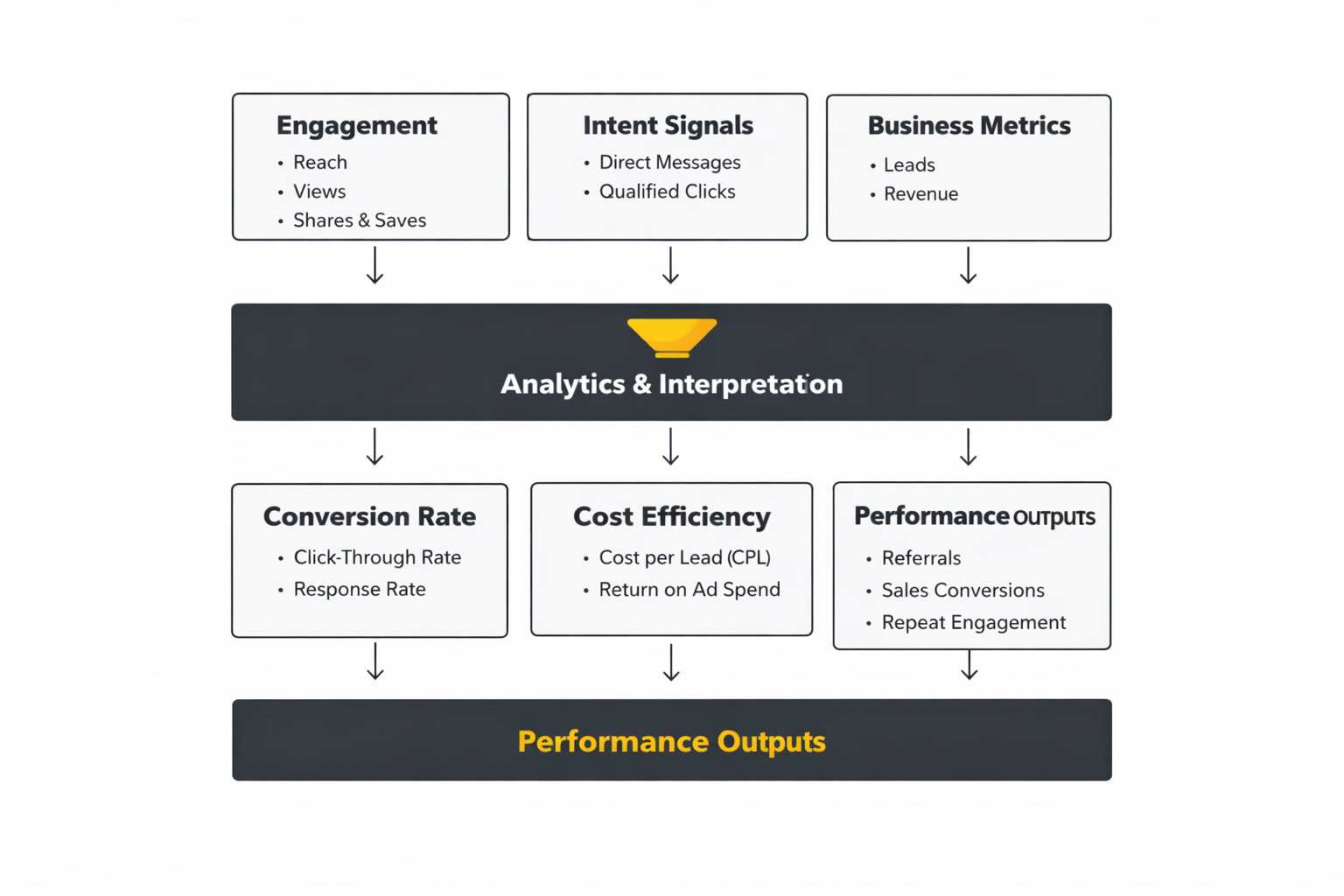
If social media for companies feels unpredictable, the data usually tells you why. Not in a “stare at a dashboard for hours” way, but in a pattern-recognition way: what people are doing on platforms, what they expect from brands, and how hard organic reach has become in a feed that’s increasingly crowded.
At the big-picture level, social still isn’t shrinking. Kepios’ Digital 2026 Global Overview reports 5.66 billion social media user identities as of early October 2025, framed as “two in three people on Earth” in their companion analysis Digital 2026: two in three people use social media, with Meltwater’s overview page for Digital 2026 global digital trends reinforcing how central social has become in everyday digital behavior.
Time spent is also a reality check. Datareportal’s state of social in 2025 section (using GWI data) puts typical daily social media use around 2 hours and 21 minutes, and the broader Digital 2025 Global Overview adds context on overall daily online time, which helps explain why attention is available but fiercely competed for.
The paid side continues to grow because attention keeps moving toward feeds and short-form video. Meta’s investor release for full-year 2025 results shows just how large the ad delivery machine is, with ad impressions up year over year and pricing also rising, while forecasts like eMarketer’s Worldwide Ad Spending Forecast 2026 underline why social and platform video keep winning budget battles.
And expectations are getting sharper. Consumer surveys in Sprout’s 2025 Index-based analysis highlight that nearly three-quarters of consumers expect a response within 24 hours, while Emplifi’s Social Pulse consumer-brand engagement survey pushes it further by showing a meaningful share of consumers expecting replies within an hour for tags and DMs. Zendesk’s guidance on first reply time expectations is a practical operational translation of the same reality: brands are judged on speed, not just tone.
Performance Benchmarks
Benchmarks are useful when they stop you from making two common mistakes: expecting “viral” engagement every week, or concluding social media for companies is broken because your reach dipped after one algorithm shift. They’re not useful when they become a scoreboard divorced from your business goals.
Engagement rates are widely reported as declining across major platforms, and that’s an important baseline because it changes what “good” looks like. Rival IQ’s 2025 Social Media Industry Benchmark Report describes broad engagement rate declines across platforms year over year, while Socialinsider’s 2026 Social Media Benchmarks summarizes 2025 engagement levels (and shifts) across TikTok, Instagram, and Facebook. Emplifi’s Social Media Benchmarks Report 2025 adds a format lens, comparing reach engagement rates across Reels and TikTok and showing why format choice can matter as much as topic.
Benchmarks get even more valuable when you use them the way finance teams use baselines: to explain variance. If you’re below benchmark, you’re not “bad,” you’re learning what your audience doesn’t respond to yet. If you’re above benchmark, the job isn’t to celebrate; it’s to identify the repeatable ingredients before the next platform wave changes the surface.
A realistic way to apply benchmarks in social media for companies is to track three things together, over time:
- Consistency: can you publish and engage at a sustainable pace without quality collapsing?
- Format performance: which formats reliably earn attention in your niche, as shown in format comparisons like Emplifi’s 2025 benchmarks report?
- Intent signals: which posts produce saves, replies, DMs, or meaningful clicks that suggest trust, not just scrolling?
Analytics Interpretation
A dashboard can either make you smarter or make you anxious. The difference is whether you treat metrics as signals that inform decisions, or as a weekly judgment of your creativity.
For social media for companies, it helps to interpret analytics in layers, because each layer answers a different question:
- Attention metrics: did people notice this? Think reach, views, watch time, and profile actions.
- Engagement metrics: did people react in a meaningful way? Think saves, shares, comments, and thoughtful replies.
- Trust and intent metrics: did people move closer? Think DMs, qualified conversations, repeat engagers, and branded search behavior.
- Business metrics: did it matter? Think leads, conversions, support deflection, retention, and recruiting outcomes.
This is also where you avoid the most common analytics trap: optimizing the wrong thing. If your goal is pipeline influence, you care far more about the kind of engagement that indicates intent than you do about raw views. If your goal is customer experience, you care about response time, resolution quality, and whether people stop escalating publicly.
Response expectations are not abstract anymore, which is why service-aligned analytics belongs in the same conversation as content analytics. Sprout’s Index-based reporting on consumer response expectations and Emplifi’s survey results in The Social Pulse give you a simple operational benchmark: if you’re consistently slow, you’re not just losing customers, you’re losing trust in public.
Finally, treat platform-wide business signals as context for your own performance. Meta’s full-year 2025 results reporting on ad impressions and pricing is a reminder that feeds are increasingly monetized and optimized for paid delivery. That doesn’t mean organic is dead, but it does mean organic often needs a promotion plan to consistently scale what works.
Case Stories
Analytics becomes powerful when it changes how you operate. Here’s a real example of a brand using measurement to move from “we think it’s working” to “we can prove what’s working,” and then using that proof to scale confidently.
Gruvi: When Measurement Turned Guesswork Into Confident Growth
The numbers started looking wrong in the most frustrating way. Sales were moving, but the team couldn’t honestly say which campaigns were driving it and which ones were just riding the tide. Every time someone asked what was working, the answer sounded like a theory dressed up as a report. The uncertainty felt expensive, because budgets don’t like ambiguity. Gruvi’s Meta success story
Gruvi is a direct-to-consumer brand selling non-alcoholic wine, and like many ecommerce businesses, it depends on performance marketing that can hold up under scrutiny. They weren’t building content for applause; they were trying to acquire customers efficiently while protecting margin. When you live in that world, marketing is only as strong as your ability to measure impact cleanly. That’s why the story centers on experimentation and lift, not just creative ideas. Gruvi’s Meta success story
The wall hit when attribution stopped being trustworthy enough to guide decisions. It’s not hard to get clicks; it’s hard to know what would have happened without the ads, especially when audiences are exposed across placements and devices. The team needed a way to separate real incremental impact from activity that looked good in-platform but didn’t change outcomes. Without that, scaling spend is basically scaling uncertainty. Gruvi’s Meta success story
The breakthrough was shifting the question from “did we get results?” to “did we create lift?” Gruvi used a Meta Conversion Lift study with a search lift methodology during a defined campaign window, which reframed measurement around causality instead of correlation. That kind of measurement doesn’t just produce a number; it produces confidence, because it tells you whether spend is creating incremental value. Once you have that clarity, creative and budgeting conversations become calmer and faster. Gruvi’s Meta success story
The journey after that is what most teams underestimate: operationalizing the learning. Instead of treating lift as a one-time test, you turn it into a habit: test creative angles, test audiences, test placements, and learn which combinations reliably move business outcomes. You also start documenting what works in a way the whole company can use, so performance knowledge doesn’t live in one person’s head. Over time, analytics stops being a monthly report and becomes a weekly decision tool. Gruvi’s Meta success story
Then the final conflict arrived in a familiar disguise: scaling without losing discipline. The moment something works, teams rush to do more of it, and that’s how you accidentally turn a winning campaign into an exhausted audience and a flat performance curve. Scaling requires guardrails: creative rotation, audience saturation monitoring, and a testing roadmap so you’re always learning while you grow. Without that structure, “successful” marketing quietly drifts into diminishing returns. Gruvi’s Meta success story
The dream outcome is not just better numbers; it’s better decision-making. When your team can prove impact with credible measurement, it’s easier to defend budget, easier to align stakeholders, and easier to scale what genuinely works. That’s what mature social media for companies looks like: creativity supported by measurement, and measurement driving smarter creativity. Gruvi’s Meta success story
Professional Promotion
Promotion is the difference between “we posted something great” and “the right people actually saw it.” For social media for companies, professional promotion isn’t just boosting posts—it’s a structured approach to amplifying proven winners, protecting efficiency, and building a pipeline of attention you can rely on.
Start with this principle: earned performance comes first, then paid scales it. When a post earns unusually high saves, strong watch time, or thoughtful comments, it’s telling you something important about resonance. Paid promotion at that point isn’t cheating; it’s taking a signal the market already gave you and making sure more of the right people see it.
The platform business reality supports this approach. Meta’s 2025 results show ad impressions growing year over year and pricing rising too, which is a practical reminder that feeds are optimized for ad delivery and competition. eMarketer’s Worldwide Ad Spending Forecast 2026 reinforces the same direction: budgets keep flowing toward digital and platform ecosystems where measurement and targeting are strongest.
A professional promotion plan usually has five parts:
- Winner amplification: put budget behind posts that already earned strong attention and trust signals.
- Audience layering: separate cold prospecting from warm retargeting so you don’t waste money talking to the wrong intent stage.
- Creative rotation: keep performance steady by cycling angles and formats, guided by benchmarks like Emplifi’s 2025 format performance comparisons.
- Creator collaboration: when creators are a fit, use them to earn trust and unlock new distribution, and keep your expectations grounded in market-wide research like the IAB creator ad spend and strategy report.
- Proof-grade measurement: whenever possible, validate incrementality with lift-style approaches like the ones described in Meta success stories such as Gruvi’s conversion lift study example.
Promotion also needs to respect what’s happening in commerce-native social. TikTok Shop’s growth in the UK, including the scale described in reporting like the Guardian’s coverage of small business adoption, is a reminder that paid promotion and creator distribution increasingly sit inside the buying experience, not just “on the way” to the website.
The teams that get the best results treat promotion as a system: earn the signal, scale the signal, measure the lift, and feed the learning back into what you create next. That’s how social media for companies stops being a weekly performance mystery and starts feeling like a controllable growth lever.
Advanced Strategies
Once the basics are stable, social media for companies stops being a content treadmill and becomes a leverage game. Advanced strategy is less about “posting smarter” and more about building advantages that compound: trust you don’t have to rebuy, distribution you don’t have to borrow, and learning loops that keep improving even when platforms change.
Build “social search” assets, not just feed posts
People increasingly use social platforms as discovery engines, especially for products, travel, and local decisions. That changes what you create: not only timely posts, but evergreen answers that earn long-tail views and repeated shares.
- Create an “answer library”: 20–50 posts that directly address the questions your sales and support teams hear every week.
- Optimize for clarity: strong first line, plain language, and a single clear takeaway.
- Refresh winners: re-record or rewrite your best answers quarterly instead of chasing brand-new topics forever.
This strategy pairs well with the reality that audiences are still engaging but becoming more selective, a pattern discussed in Sprout’s 2026 analysis of organic reach and inbound engagement trends.
Shift from “audience” to “community,” then measure it properly
Community-led growth isn’t a buzzword when you make it operational. It means you create recurring conversation formats and treat your replies, comments, and DMs as part of your product experience.
- Recurring formats: weekly Q&A, “mistakes we see,” teardown posts, behind-the-scenes decision logs.
- Conversation prompts: ask for reactions that reveal objections and confusion, not just likes.
- Community metrics: repeat engagers, comment quality, and DM volume that signals intent.
Response expectations are a major part of this. Sprout’s consumer research in their 2025 Index-based analysis and Emplifi’s findings in The Social Pulse consumer survey both point to speed and responsiveness as trust signals, not optional niceties.
Turn employees into distribution with guardrails
Employee advocacy is one of the few scalable ways social media for companies can earn credibility without spending more on ads. It also reduces over-reliance on the brand handle, which is a major risk when organic reach fluctuates.
- Make it easy: give employees ready-to-post prompts and a simple content library.
- Make it safe: publish short policies and training so people know what “good” looks like.
- Make it human: encourage personal takes and practical lessons rather than corporate slogans.
Trust context matters here. The 2025 Edelman Trust Barometer highlights that “my employer” tends to be more trusted than many other institutions, which is exactly why employee voices can carry weight when brand messaging feels generic. Operationally, the need for training and policy is reinforced in benchmarking like DSMN8’s 2025 employee advocacy findings, which flags how often programs run without formal guidance.
Use creators as a performance channel, not a lottery ticket
Creator partnerships scale best when you treat them like a repeatable media channel: clear briefs, repeatable formats, trackable outcomes, and a roster you build over time.
- Build a roster: prioritize consistent creators over one-off “big” names.
- Design for repurposing: negotiate usage rights so creator content can become ads, landing page assets, and onboarding content.
- Measure incrementality: track lift, not just likes, so you know what’s actually driving results.
The economics explain why this keeps growing. IAB’s 2025 Creator Economy Ad Spend & Strategy report and the full PDF report download describe U.S. creator ad spend reaching $37B in 2025 with strong year-over-year growth. In the UK and Europe, appetite for scaling creator work is also documented in IAB UK’s 2025 influencer marketing analysis.
Scaling Framework
Scaling social media for companies is less about “more content” and more about multiplying what already works. The framework below scales in a way that protects quality, reduces risk, and makes results more predictable.
Stage 1: Stabilize the core engine
Before you scale, prove you can run consistently for 6–8 weeks without burnout. That means your workflow works, your approvals don’t choke speed, and your team can ship without heroic effort.
- Minimum viable cadence: a sustainable pace you can keep during busy weeks.
- Minimum viable governance: clear permission rules and escalation for sensitive issues.
- Minimum viable reporting: a weekly review that turns into next week’s decisions.
Teams often underestimate the operational impact of approval and governance. Practical guidance like Hootsuite’s 2025 approval workflow breakdown and Emplifi’s 2025 social media governance guide are useful reminders that scale fails when permissions and review tiers are unclear.
Stage 2: Expand formats and proof, not topics
Most teams scale by chasing more topics. Better teams scale by deepening proof: turning the same core ideas into different formats and stronger evidence.
- Format expansion: short video, explainers, “before/after” posts, carousels, lives, and comment threads.
- Proof expansion: demos, customer outcomes, behind-the-scenes, and decision-making stories.
- Distribution expansion: repurpose and repackage winners instead of reinventing everything.
Format-level benchmarking can keep your expectations realistic as you expand. Socialinsider’s 2026 benchmarks, Rival IQ’s industry benchmark reporting, and Emplifi’s 2025 benchmarks report all provide context on what “normal” looks like across platforms and formats.
Stage 3: Add distribution layers
Distribution is where scale really happens. You keep your core creative engine intact, then add layers that multiply reach and intent without multiplying workload at the same rate.
- Paid amplification: put budget behind proven posts, not untested ideas.
- Creator layer: build a roster and re-run winning briefs.
- Employee layer: equip internal experts to share and comment in a coordinated way.
This aligns with where budgets are moving. Meta’s full-year 2025 results release shows the continued scale of ad delivery, and eMarketer’s 2026 ad spending outlook supports the broader trend of digital and platform ecosystems continuing to win spend.
Growth Optimization
Growth optimization is how you keep scale from turning into expensive noise. The goal is to improve outcomes while keeping effort and spend efficient, even when feeds and algorithms shift.
Run tests like a lab, not like a lottery
Testing works when it’s structured. Pick one variable, run it long enough to learn, and compare it to a stable baseline.
- Creative tests: hook style, proof type, format length, and CTA placement.
- Audience tests: cold vs warm, interest layers vs lookalikes, new vs repeat engagers.
- Distribution tests: time window, platform-native edits, creator whitelisting, paid boosts.
When teams want a reality check on what’s happening across the industry, trend research like Hootsuite’s 2026 social trends report can help you frame tests around what’s emerging without blindly chasing it.
Upgrade measurement from “activity” to “impact”
As you scale, leadership questions get sharper. A dashboard full of engagement doesn’t answer whether social is actually creating incremental value.
- Use lift-style thinking: focus on what changed because of your effort, not just what happened near it.
- Track intent signals: DMs, qualified conversations, repeat engagement, and branded search behaviors.
- Align with business reporting: export key signals into the tools leadership already trusts.
If your scale plan includes influencer spend, measurement rigor becomes even more important. Context like eMarketer’s influencer measurement coverage is useful because it frames why brands are pushing harder for proof-grade reporting as budgets grow.
Scale with brand safety and governance built in
When you scale, the cost of mistakes scales too. Governance isn’t what slows you down; unclear governance is what slows you down.
- Create review tiers: most posts move fast, a few require deeper review.
- Design escalation paths: define how fast issues move to PR, legal, or support.
- Protect account access: permissions and security practices matter more with more hands involved.
Governance guidance like Emplifi’s 2025 social media governance overview is helpful precisely because it treats governance as an enablement system, not a compliance tax.
Scaling Stories
Scaling sounds simple until you feel the pressure: more eyes, more expectations, more chances to get it wrong. These are real stories where scale wasn’t achieved by “posting more,” but by building a stronger operating system.
Ryanair: Turning a Low-Cost Brand Into a High-Attention Machine
The comments weren’t polite, and the brand didn’t get to choose the tone of the conversation. Every day brought a new wave of jokes, complaints, and viral ridicule that could have easily turned into reputational drift. The pressure wasn’t just to respond; it was to stay visible without spending like a premium airline. The turning point is described in an interview-style breakdown of the strategy in Skift’s 2025 look inside Ryanair’s marketing approach.
The backstory is classic low-cost reality: tight margins, fierce competition, and constant scrutiny. Ryanair didn’t have the luxury of building attention through expensive campaigns every quarter, so brand visibility had to be earned. Over time, their social voice evolved into something distinctive enough that people would watch even if they weren’t booking a flight that day, as outlined in Skift’s interview with Ryanair’s CMO.
The wall came from a constraint that breaks most teams: scale without bloated spend. When you rely on paid reach for everything, growth becomes fragile the moment ad costs rise or budgets tighten. When you rely on “viral luck,” you can’t plan capacity or prove value internally. Ryanair needed an approach that could produce attention repeatedly while staying aligned with the low-cost brand promise, a tension explored in the Skift strategy breakdown.
The epiphany was leaning into the brand’s truth instead of trying to look like a “nice” airline. The strategy described is built around embracing bluntness, humor, and meme-native content that matches how audiences actually behave on platforms. That kind of creative alignment reduces the need for constant reinvention because the brand voice itself becomes a reusable asset. The shift is central to the operational framing in Skift’s Ryanair marketing story.
The journey to scale wasn’t one big campaign. It was a repeatable system: ship frequently, stay native to the platform, respond in the comment culture, and build a recognizable personality that people expect to see. Over time, that consistency turns into compounding reach because every new post benefits from the audience’s familiarity with the voice. The system-level approach is described through leadership commentary in the Skift interview.
The final conflict is what always happens when you scale a sharp voice: the margin for error shrinks. A joke can land wrong, a reply can be screenshotted, and the same tone that earns attention can create backlash if it crosses the line. Scaling requires guardrails, not to kill the personality, but to keep it from becoming reckless. Governance systems like review tiers and escalation paths are the difference between bold and careless, a theme echoed in operational guidance like Emplifi’s governance framework.
The dream outcome is a brand that stays top-of-mind without buying attention every time. Ryanair’s approach shows what becomes possible when social media for companies is treated as a disciplined system: the brand becomes a channel people seek out, not a message that begs to be seen. That’s the kind of scale that survives budget cycles and platform shifts, and it’s why the strategy is analyzed in sources like Skift’s 2025 feature.
Budget like a portfolio: core, growth, experiments
A practical promotion model for social media for companies divides spend into three buckets:
- Core: always-on amplification for your highest-performing evergreen assets.
- Growth: campaigns tied to launches, seasonal moments, or market expansion.
- Experiments: controlled tests for new formats, creators, or targeting models.
This structure keeps you from overreacting to weekly volatility and aligns with the reality of platform monetization and rising competition discussed in Meta’s 2025 results release and broader market outlooks like eMarketer’s 2026 forecast.
Scale creators with clear rights and measurable goals
When creators become a serious growth lever, the professional move is to design campaigns that can be repeated and measured. That means usage rights, whitelisting where appropriate, and clear reporting standards so the channel can scale without turning into a subjective debate.
The budget signal is strong. The economics and strategy shifts described in IAB’s creator economy report and the full 2025 report PDF help explain why creator partnerships are increasingly treated as a core media line item rather than a side experiment.
International scale needs local voice, central guardrails
When you expand across regions, your biggest risk is sounding like a single global script. Your second biggest risk is losing brand coherence.
- Centralize pillars and proof: core narratives, product truths, and brand boundaries.
- Localize execution: language, cultural references, and platform norms per region.
- Standardize governance: permissions, escalation, and high-risk review tiers.
This is the point where “process” becomes your growth enabler. Clear approval and governance systems like those described in Hootsuite’s workflow guidance and Emplifi’s governance overview help teams move faster because fewer decisions are ambiguous.
What “good” looks like at scale
When promotion is professional, you’ll feel it in how calm the operation becomes. Your team knows what gets amplified, why it gets amplified, and how success is judged. Your creative work gets reused instead of forgotten after 24 hours. And your growth stops depending on luck because social media for companies is now running like a system that can scale on purpose.
Future Trends
The next wave of social media for companies won’t be won by whoever posts the most. It’ll be won by teams that can stay believable while the internet gets noisier, can sell without feeling salesy, and can prove what’s working when leadership wants answers in real time.
Authenticity becomes a measurable advantage in an AI-saturated feed
In 2026, the battle isn’t “AI vs humans.” It’s “believable vs forgettable.” Reports like Hootsuite’s Social Media Trends 2026 and TikTok’s own TikTok What’s Next 2026 trend report keep circling the same point: audiences are gravitating toward real process, real people, and content that feels lived-in, not polished into blandness.
That changes how social media for companies should use AI. AI still helps behind the scenes—planning, drafts, insights, analysis—but the on-screen value increasingly comes from perspective, specificity, and proof. If your content feels like it could have been posted by any brand in any industry, it’s already losing.
Content provenance and “trust signals” move from niche to mainstream
As synthetic media becomes easier to generate, the cost of confusion rises. Brands are already being pushed toward detection, transparency, and verification systems because trust is fragile in feeds packed with manipulated visuals and audio. That pressure shows up in policy and research like Reuters’ coverage of an ITU-linked UN report urging stronger deepfake detection measures.
For social media for companies, this will show up as practical operating standards: clear labeling when AI is used, stronger review workflows for high-risk content, and a tighter link between brand voice and identifiable humans on camera or in commentary. If you’re building a long-term brand, trust signals will matter as much as creative.
AI disclosure rules and enforcement expand
Disclosure is turning from “nice to do” into “must do” in more markets. A visible signal of where this is heading is AP’s reporting on South Korea requiring AI-generated ads to be labeled starting in early 2026. Even if your region doesn’t mandate it yet, platforms and consumers are moving in that direction.
The smart move is getting ahead of it: define how your team uses AI, what must be reviewed, what must be disclosed, and how you’ll keep the brand’s voice consistent even as tooling changes.
Social commerce keeps shifting from “feature” to “default behavior”
In many categories, discovery and checkout are collapsing into the same scroll. Social commerce is no longer just a trend story; it’s becoming a distribution reality, especially as TikTok Shop expands its footprint and normalizes in-app buying. That momentum shows up in forecasts like eMarketer’s TikTok Shop share and growth outlook and in recent analysis like Forbes’ February 2026 take on TikTok Shop as a demand engine.
The implication for social media for companies is simple: content has to earn trust fast, because the buying decision is happening closer to the post. Your “proof assets” (demos, comparisons, creator validation, customer outcomes) matter more than brand adjectives.
Social search grows, and “answer content” becomes evergreen inventory
More people are discovering products, services, and local recommendations through platform search and creator commentary. That makes “answer content” a compounding asset: posts built to solve a specific question that can keep earning reach long after publication.
The teams that win this shift treat social media for companies like a knowledge layer: a library of answers, proof, and perspective that supports sales and customer experience even when the algorithm mood swings.
The audience is huge, but attention is more selective
Social is still massive. Kepios’ tracking of global social media user identities shows 5.66 billion user identities as of October 2025, reinforced in their broader Digital 2026 global overview. The opportunity isn’t shrinking; the standards are rising.
So the future isn’t about chasing every platform shift. It’s about building a system that can adapt without losing your voice, your proof, or your ability to measure what matters.
Strategic Framework Recap

Here’s the simplest way to remember the complete system for social media for companies: you’re not “doing social.” You’re building an ecosystem where strategy, content, community, promotion, and measurement reinforce each other.
1) Clarity: know what you’re trying to change
Every strong system starts with a clear outcome: pipeline influence, revenue, retention, recruiting, customer experience, or category leadership. If the outcome is fuzzy, every metric becomes a distraction.
2) Creative: ship proof, not slogans
Modern feeds reward specificity. Your best-performing content usually has one of three ingredients: proof (real outcomes), perspective (a clear point of view), or process (showing how work actually happens). Trend reports like TikTok What’s Next 2026 and Hootsuite’s Social Media Trends 2026 keep reinforcing that audiences want the real story, not the perfect story.
3) Community: treat replies like product quality
For many buyers, your comment section is your first sales call. Responsiveness and tone create trust, and consumer surveys like Emplifi’s Social Pulse 2025 show how quickly expectations form around brand interaction.
4) Distribution: amplify what already earned attention
Professional teams don’t “boost randomly.” They amplify what already resonated. This matters even more as ad ecosystems keep expanding and competition rises, reflected in Meta’s full-year 2025 results with ad impressions and pricing both increasing.
5) Measurement: prove impact, not activity
Views and likes can be useful signals, but they’re not the destination. Mature social media for companies connects attention metrics to intent signals (DMs, qualified conversations, repeat engagement) and then to business outcomes. When you can explain what changed because of your work, scaling becomes easier to defend.
6) Adaptability: build trust systems for the AI era
The next phase rewards brands that can stay credible as synthetic content rises. That means governance, disclosure, and verification habits that anticipate where policy is heading, signaled by moves like South Korea’s AI-ad labeling rule and broader concern captured in deepfake detection calls from the ITU-linked UN reporting.
FAQ – Built for the Complete Guide
How long does it take to see results from social media for companies?
Most teams feel early traction in 4–8 weeks if they publish consistently and actively engage in comments and DMs. Reliable business outcomes usually take longer because trust has to build, and you need enough iterations to learn what resonates with your audience.
What should we focus on first: followers or leads?
Focus on leads, pipeline influence, or customer outcomes first. Followers can be helpful, but they’re a side effect of useful content and consistent engagement. A smaller audience with real intent is more valuable than a large audience that never acts.
Is organic still worth it, or is everything pay-to-play now?
Organic is still worth it because it builds credibility and creates content you can repurpose into paid. Paid helps you scale, but organic is often where you discover what messaging and proof your market actually responds to.
How many platforms should a company use?
Start with one or two where your buyers actually pay attention and where your team can execute well. Add platforms only after you can run a stable publishing and engagement rhythm without quality dropping.
What content formats work best right now?
The best format is the one you can produce consistently with real proof. Short-form video is strong across many platforms, but clear written posts, carousels, and creator collaborations can work just as well when they’re built around specific insights and real examples.
How do we avoid sounding generic?
Use specifics: real decisions, real trade-offs, real mistakes, real lessons. Replace broad claims with proof and process. If your content could be copied and pasted onto a competitor’s profile without anyone noticing, it needs sharper perspective.
What should we measure weekly?
Pick a small set that matches your goal: reach or views for awareness, saves and shares for resonance, DMs and qualified clicks for intent, and leads or revenue influence for business impact. Weekly measurement should drive next week’s decisions, not just create reports.
How do we handle negative comments without making it worse?
Respond quickly, stay calm, and aim to solve, not win. If it’s a real issue, acknowledge it and move to a private channel when appropriate. If it’s trolling, don’t feed it—set boundaries and moderate consistently.
Should we use AI to create our social content?
Use AI to speed up research, ideation, drafts, and analysis, but keep the human voice in the final output. In an era where audiences are craving real perspective, your advantage is the lived experience and judgment your team brings.
What’s the most common reason social media for companies fails?
Inconsistency paired with unclear goals. Teams post sporadically, chase trends without a plan, and measure everything except what they actually want to change. A simple system beats sporadic bursts of effort every time.
How do we scale without burning out the team?
Scale by reusing what works. Build repeatable formats, repurpose winners into multiple edits, and create an “answer library” that keeps generating value. Add distribution layers—paid, creators, employees—only when your core workflow is stable.
Do we need creators or influencers to win?
No, but they can accelerate trust and distribution when they’re a genuine fit. The key is treating creators like a repeatable channel: clear briefs, measurable goals, and long-term relationships instead of one-off gambles.
Work With Professionals
If you’re serious about social media for companies, the hardest part isn’t learning what to do. It’s doing it consistently while still running a business. Content needs to ship, comments need answers, and your best posts deserve amplification before the moment passes.
That’s where momentum matters. When you have the right marketer, things stop feeling chaotic. Your strategy gets sharper. Your content starts sounding like you. Your growth becomes explainable instead of lucky.
Markework is built for that kind of momentum: a focused marketplace where companies and marketers connect directly, without project fees or a middleman slowing everything down. The platform is designed around speed and fit—clear listings, rich profiles, and straightforward plans, highlighted on the Why Us and Pricing pages.
If you’re a marketing freelancer, the value is simple: you can build a profile, browse and apply to marketing roles, and talk to companies directly. If you’re a company, you can post listings, review specialists, and move faster toward a hire. Markework’s model is subscription-based with no commissions and no project fees, so you’re not watching your earnings disappear into per-project platform cuts.
When you’re ready to turn social into a system—consistent content, stronger proof, and a real operating rhythm—start where the friction is lowest and the fit is highest.
 Filip Konecny Enterprises