

Creating meaningful social media content doesn’t happen by accident. The most successful brands and creators approach their social presence with deliberate plans that guide what they publish, who they’re speaking to, and why each post matters. Rather than posting at random or simply reacting to trends, a thoughtfully structured social media content plan ensures you’re consistently delivering value — and driving progress toward real business objectives that matter in 2026.
In this first part of our multi-section guide, we’ll define what social media content plans are, explain why they matter today, and outline the core elements that make up an effective plan you can follow.
Article Outline
- What Is a Social Media Content Plan
- Why Social Media Content Plans Matter
- Social Media Content Plan Framework Overview
- Core Components of a Plan
- Professional Implementation Tips
What Is a Social Media Content Plan

A social media content plan is a clear and organized guide that outlines what content a brand or creator will publish across their social channels, why they’re publishing it, and when it will go live. At its core, it maps topics, formats, audience segments, and posting schedules to strategic goals such as building awareness, engaging communities, or driving conversions. This level of preparation keeps content from feeling random and instead makes each post purposeful and aligned with broader business priorities.:contentReference[oaicite:0]{index=0}
Unlike a high-level strategy — which describes overarching goals and principles — a content plan lays out the specific actions, timelines, and content forms that will bring those ideas to life. It turns strategy into a practical roadmap your team can follow reliably.:contentReference[oaicite:1]{index=1}
Why Social Media Content Plans Matter
Social platforms are saturated. Every minute, millions of posts compete for attention, which means that spontaneous posting without a plan often results in inconsistent messaging and low engagement. A structured plan elevates your presence from scattershot noise to a coherent voice your audience can recognize and trust.
When you plan content intentionally, you’re more likely to hit key marketing objectives. For instance, your plan can be calibrated to build awareness among specific demographics, foster genuine engagement with your followers, and even steer traffic to owned channels like your website or newsletter. Having this clarity also makes performance measurable, so you can see what content resonates and refine your plan accordingly.:contentReference[oaicite:2]{index=2}
Consistency is another compelling reason content plans matter. Audiences reward reliability, whether that’s a weekly video series or daily stories that educate, entertain, or inspire. Without a plan, maintaining that cadence becomes a struggle, and your brand loses momentum.:contentReference[oaicite:3]{index=3}
Social Media Content Plan Framework Overview
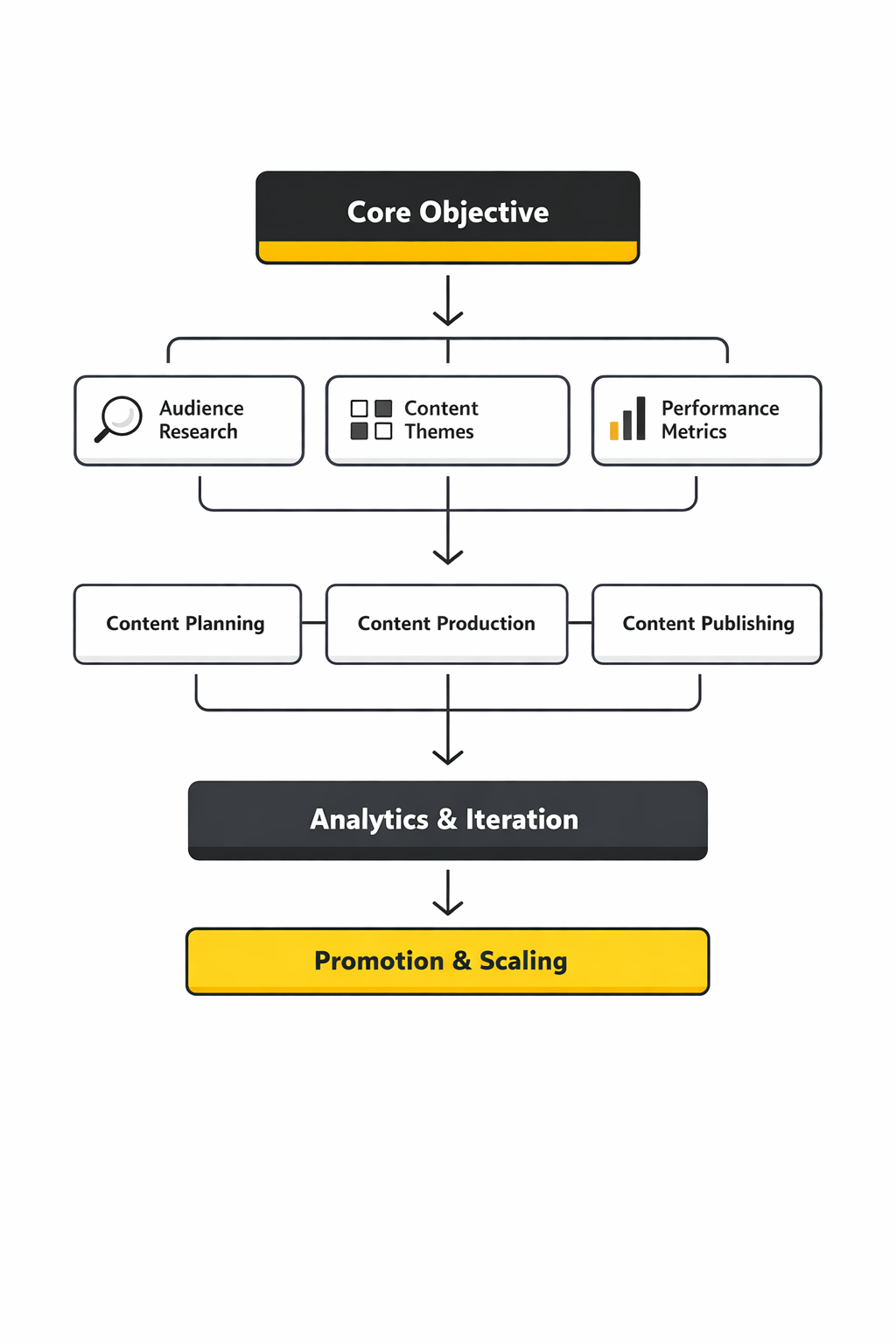
An effective social media content plan follows a structured framework that guides every decision, from daily posting schedules to long-term engagement goals. At a high level, this framework links your business strategy to the content you create:
- Goal Alignment: Establish what success looks like — whether that’s awareness, leads, website visits, or community growth. Each part of your plan ties back to one or more specific objectives.:contentReference[oaicite:4]{index=4}
- Audience Understanding: Knowing who you’re speaking to — their challenges, preferences, and content habits — ensures your posts resonate.:contentReference[oaicite:5]{index=5}
- Content Themes and Pillars: Identify the core topics and formats (videos, carousels, stories, etc.) that support your message and appeal to your audience.:contentReference[oaicite:6]{index=6}
- Publishing Schedule: A calendar or timeline that specifies when content will go live, helping maintain regularity and relevance.:contentReference[oaicite:7]{index=7}
- Performance Tracking: Set metrics that show whether your content is moving the needle, such as engagement rates, reach, or conversions.:contentReference[oaicite:8]{index=8}
Following a framework like this makes social media activities predictable and trackable, which is crucial for ongoing improvement and long-term impact.
Core Components of a Plan
A comprehensive social media content plan brings several core elements together into a unified whole:
- Goals and KPIs: Define what you want to achieve (e.g., audience growth, engagement lift) and how you’ll measure success.:contentReference[oaicite:9]{index=9}
- Audience Personas: Detail the people you’re trying to reach, including their interests, needs, and preferred platforms.:contentReference[oaicite:10]{index=10}
- Content Calendar: A timeline with publishing dates and formats so your team knows what goes live and when.:contentReference[oaicite:11]{index=11}
- Topic Clusters or Pillars: Organize your content around themes that tie back to strategic objectives and make planning more efficient.:contentReference[oaicite:12]{index=12}
- Distribution Tactics: Outline how you’ll share content across platforms and amplify it through community engagement or paid support.:contentReference[oaicite:13]{index=13}
Pulling these pieces together ensures every section of your plan has a purpose and supports your overall strategy.
Professional Implementation Tips
Developing a strong plan is one thing — executing it consistently is another. Professionals in the field focus on a few key practices to make implementation smoother:
- Use Tools Wisely: Scheduling and analytics tools help maintain consistency and assess performance without manual effort.:contentReference[oaicite:14]{index=14}
- Collaborate Across Teams: Align content creators, designers, and strategists around shared goals to produce cohesive work.:contentReference[oaicite:15]{index=15}
- Review and Refine: Regularly check your performance data and adjust your plan to focus on what’s working.:contentReference[oaicite:16]{index=16}
- Stay Flexible: While plans provide structure, be ready to adapt to trends or audience feedback.:contentReference[oaicite:17]{index=17}
With these approaches, a social media content plan becomes a living document that evolves as your brand grows and audience expectations shift.
Step-by-Step Implementation
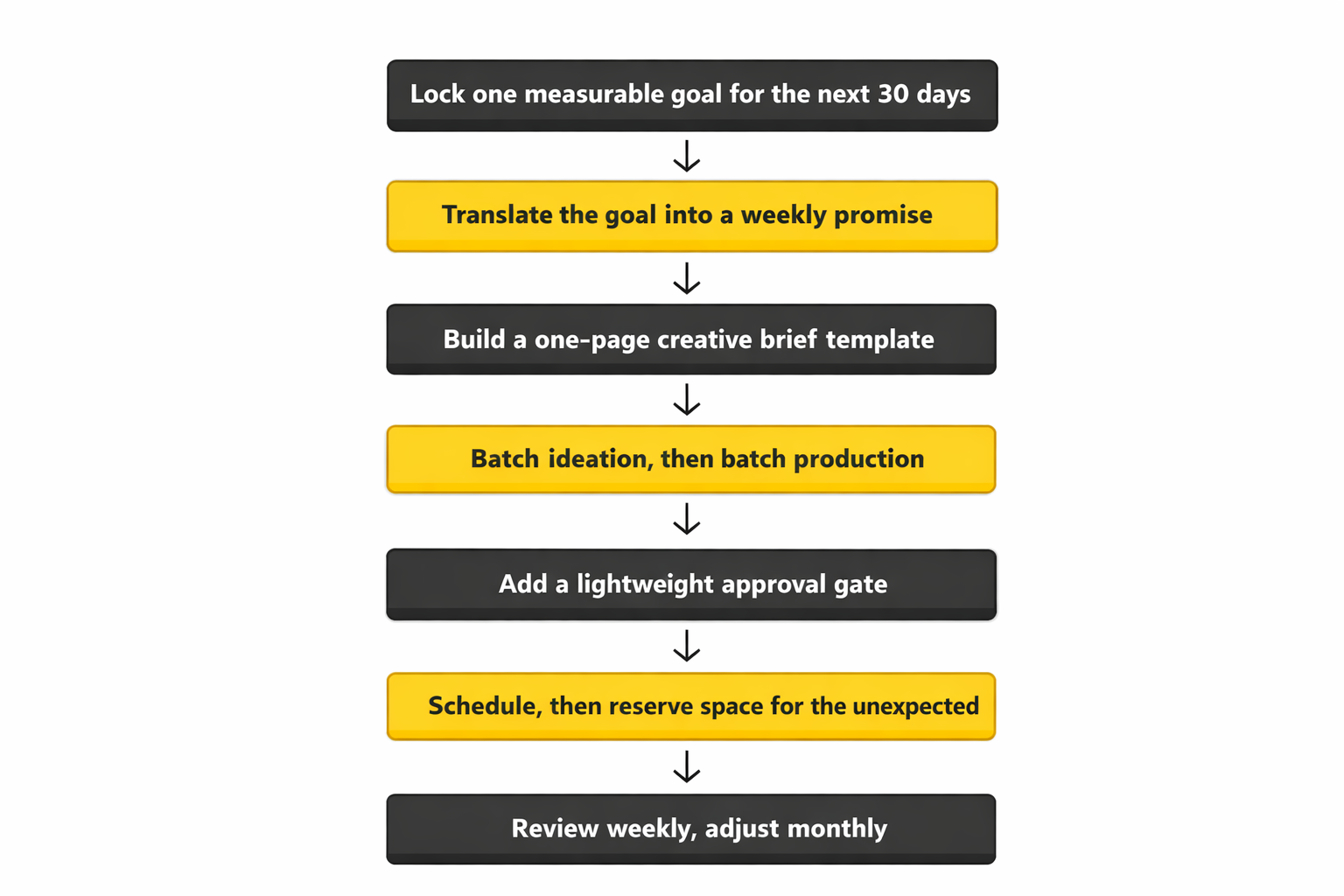
Turning social media content plans into real output is less about “being creative” and more about building a routine that survives busy weeks, last-minute requests, and platform chaos. The goal is simple: make good publishing feel boringly repeatable, so your best ideas don’t depend on perfect conditions.
Here’s a practical implementation flow you can run with a team or solo. It’s designed to protect quality while keeping speed high.
Step 1: Lock one measurable goal for the next 30 days
Pick a single primary outcome and make it visible inside your content calendar. If everything is a priority, nothing is — and your posts will drift into “we should post something” territory. Your goal should be something you can observe weekly, not a vague ambition.
Step 2: Translate the goal into a weekly promise
Social media content plans work best when you set a realistic cadence you can keep even when life gets messy. This is your weekly promise: “We publish X pieces in Y formats, built around Z themes.” You’re not chasing volume — you’re committing to consistency you can sustain.
Step 3: Build a one-page creative brief template
A brief prevents endless revisions because it forces clarity before production starts. Include: audience intent, hook, key message, proof, CTA, format, and distribution notes. Teams that write complete briefs upfront tend to reduce rework, which is exactly why structured editorial workflows emphasize “definition before production.”
Step 4: Batch ideation, then batch production
Ideation is one brain mode; production is another. Mixing them creates slow, scattered work and inconsistent output. Keep them separate: one session for ideas and outlines, another for filming/design/writing, another for scheduling and distribution.
Step 5: Add a lightweight approval gate
If more than one person touches your brand, you need a simple approval gate for accuracy, compliance, and tone. This doesn’t have to be bureaucratic — it just needs to exist. A structured approval workflow helps teams avoid preventable errors and protects brand consistency during fast publishing cycles.
Step 6: Schedule, then reserve space for the unexpected
Schedule your “evergreen” posts early, then leave intentional room for reactive content. Trends are unpredictable, and your plan should be strong enough to adapt without blowing up the entire calendar. This is how you keep social media content plans stable while still staying culturally relevant.
Step 7: Review weekly, adjust monthly
Weekly reviews help you catch performance signals while they still matter. Monthly reviews help you make bigger strategic shifts without constantly changing direction. The combination creates momentum: stable enough to build trust, flexible enough to improve.
Execution Layers
Once implementation starts, social media content plans operate in layers. Thinking in layers stops you from “fixing” the wrong thing — like rewriting captions when the real issue is weak creative direction or inconsistent distribution.
Layer 1: Strategy guardrails
This layer includes your voice guidelines, content pillars, audience segments, and the definition of success for the period. It’s the layer that says “this is what we’re here to do” and “this is what we refuse to do,” which becomes even more important as social platforms reward fast, reactive posting.
Layer 2: Production system
This is your repeatable method for turning briefs into finished assets: scripts, visuals, edits, captions, and cutdowns. If production is chaotic, you’ll feel “behind” no matter how good your strategy is. Clean production systems make creativity easier because the team isn’t constantly reinventing the process.
Layer 3: Publishing and distribution
This layer covers scheduling, platform adaptation, community engagement, and basic amplification. The same idea often needs different packaging for different platforms, even when the message stays consistent. When distribution is treated as its own craft, your strongest posts don’t die quietly after a single upload.
Layer 4: Measurement and feedback
This layer connects performance signals back to decisions. Without a feedback loop, you’ll either keep repeating weak content or you’ll change direction based on vibes. Social-first organizations increasingly treat measurement as a continuous practice, not a quarterly reporting task.
Layer 5: Governance and risk control
As your footprint grows, risk grows with it: brand safety, account security, legal compliance, and crisis response. Governance isn’t about slowing teams down — it’s about letting teams move fast without stepping on landmines. Social governance frameworks help brands stay consistent and safe while still responding quickly.
Optimization Process
Optimization is where social media content plans stop being “a calendar” and start becoming a compounding system. The goal isn’t to endlessly tweak small things — it’s to learn what reliably moves outcomes, then scale that learning.
Start with signal quality, not vanity spikes
One viral post can be fun, but it can also distort your judgment. Focus on repeatable signals: content that consistently earns saves, meaningful comments, qualified clicks, or downstream conversions. When you optimize for repeatability, you build a system that survives algorithm changes.
Run one controlled test at a time
Testing only works when you know what changed. If you adjust the hook, the visual style, the CTA, and the posting time all at once, you learn nothing. A clean optimization process changes one variable, measures, then either adopts or discards the change.
Use platform reality as a constraint
Social platforms are increasingly optimized for algorithmic feeds, short-form video, and rapidly shifting audience preferences. That’s not a reason to panic — it’s a reason to treat content like an ongoing product. Research on social consumption patterns shows how quickly attention moves, which is why short feedback loops matter more than perfect upfront plans.
Protect human capacity
If your process burns out your team, your output will eventually collapse. Professional teams optimize for sustainability: batching, templates, clear approvals, and realistic cadence. A workflow that your team can repeat for months is more valuable than a sprint that dies after two weeks.
Anchor measurement to platform scale
It’s easy to forget how crowded the arena is. Meta’s ecosystem alone averaged 3.58 billion family daily active people in December 2025, a scale also reflected in Meta’s reporting on its “Family metrics” and reiterated in prepared remarks noting more than 3.4 billion people using at least one Meta app each day. In an environment that large, optimization isn’t optional — it’s how your content earns attention consistently instead of randomly.
Implementation Stories
It’s one thing to describe implementation steps. It’s another to see how messy implementation looks in real life — especially when the volume and complexity are high.
One of the clearest real-world examples comes from Positive Adamsky, an agency operating at a scale where “just use a spreadsheet” stops being a serious option. Their public case study describes managing hundreds of social channels and coordinating a large team through a structured system.
Story: Positive Adamsky’s shift from chaos to a scalable workflow
Everything started breaking in public. Posts were being pushed out across dozens of brands, and the smallest mistake could become a client escalation within minutes. The team wasn’t failing because they lacked talent — they were failing because volume punished every weak link in the workflow.
The backstory is almost predictable for fast-growing agencies. Positive Adamsky scaled into managing hundreds of brand profiles, with work flowing through multiple people and multiple time zones. Their published case study notes the sheer scope: 330+ social media channels, 100+ brands, and 200+ teammates, which turns “coordination” into a daily survival skill.
The wall hit when coordination costs became higher than creation costs. Approvals slowed everything down because feedback wasn’t centralized and responsibilities weren’t clear. When the team is publishing at high volume, even a small delay compounds into missed windows, rushed edits, and inconsistent quality.
The epiphany wasn’t “we need better posts.” It was “we need a system that makes quality the default.” The moment the workflow became visible — who creates, who reviews, who approves, and when — the team could finally diagnose bottlenecks instead of arguing about opinions.
The journey was operational, not inspirational. They centralized planning, standardized how content moved through review, and created predictable publishing routines across brands. Their case study highlights how removing limits and friction in channel management supported growth without collapsing the workflow.
Then the final conflict showed up: scaling always reveals new problems. The more efficient the engine became, the more content the system could handle — and that raised the bar for governance, brand consistency, and QA. High throughput is only a win when quality controls scale alongside it.
The dream outcome was stability at scale. Their published results point to smoother collaboration and faster approvals while handling extreme publishing volume, including thousands of posts published in a single month. In other words, the workflow didn’t just help them “post more” — it helped them run social media content plans like an operational discipline, not a daily scramble.
Professional Implementation
Professional implementation is where social media content plans become resilient. It’s not just about having a plan — it’s about building a plan that still works when stakeholders disagree, legal needs a review, a platform changes a format, or a crisis hits your category.
Set roles that match the workflow
Most teams fail implementation because responsibilities are fuzzy. Define who owns strategy, who owns production, who owns publishing, and who owns community engagement. Clear roles reduce rework because feedback arrives from the right people at the right time.
Design a review process that protects speed
Approval should be a gate, not a maze. A simple workflow — draft, review, approve, schedule — is often enough, especially when paired with a strong brief. When review steps are clear, social teams can move faster without sacrificing accuracy or brand consistency.
Build governance early, not after a mistake
Governance is the difference between “fast” and “fast and safe.” Social governance frameworks help teams stay on-brand, compliant, and secure while still being responsive. This matters even more in 2026, when brands are navigating increased scrutiny around brand safety and content environments.
Standardize reporting so decisions don’t depend on one person
Professional teams don’t hide analytics in someone’s head. They standardize weekly snapshots, monthly performance reviews, and clear documentation of what changed and why. This turns optimization into a shared practice — and it keeps your content plans improving even when team members rotate.
Keep the plan alive with a monthly reset
The most effective social media content plans behave like living systems. Every month, revisit what you learned, what you’re doubling down on, and what you’re dropping. That rhythm — stable execution with intentional iteration — is what separates professional social programs from busy posting.
Statistics And Data
Good social media content plans don’t start with “post more.” They start with reality: the audience is enormous, attention is finite, and algorithms reward what people actually do (watch, save, share, click) rather than what we wish they’d do.
At a global level, 5.66 billion social media user identities creates a weird paradox: reach is “easy” to find, but meaningful reach is expensive. When almost any niche can be found somewhere, the job becomes filtering down to the few signals that prove your content is working for your business.
Time is the next constraint. The typical internet user spends 2 hours and 21 minutes per day on social media, and the same report shows people rotate through 6.83 platforms per month. That’s not “one channel dominance.” It’s an ecosystem, and your plan needs measurement that travels with the audience across formats and platforms.
The money side matters too, because it shapes what platforms prioritize. Meta’s FY2025 results show just how large the machine is: advertising revenue was $196.595B for 2025, with ad impressions up 12% year over year. In practice, that means your content plan should assume distribution is partly “earned” and partly “built” through consistent creative testing and selective amplification.
Performance Benchmarks
Benchmarks are useful when they stop you from overreacting. They’re dangerous when you treat them like universal truth. Different reports calculate engagement differently (per follower, per reach, per view), and platform formats have shifted fast enough that last year’s “good” can be this year’s average.
One clear directional signal is that organic engagement has been under pressure across major platforms. Rival IQ’s 2025 Social Media Industry Benchmark Report highlighted declines in engagement rates year over year across Facebook, Instagram, TikTok, and X. That doesn’t mean “organic is dead.” It means content plans need tighter creative feedback loops and fewer “we’ll know at the end of the month” surprises.
For TikTok specifically, the numbers swing because the denominator changes. If you benchmark engagement by views, Socialinsider reported an average TikTok engagement rate around 4.90% in the first half of 2025. If you benchmark engagement differently (for example, median engagement rates observed across large sets of brand accounts), you’ll see much larger figures in some datasets, such as Emplifi’s reporting of TikTok median engagement reaching 27.6% in Q4 2025. Treat those as two different lenses, not two “competing truths.”
On Instagram, format selection still shows up in the data. Social media content plans that prioritize “whatever is easiest this week” often underperform plans that deliberately pick formats for outcomes. For example, Socialinsider’s 2026 Instagram benchmarks highlight carousels as a resilient engagement format, with a cited carousel engagement rate of 0.55% in their dataset. Whether your number lands above or below that, the takeaway is stable: pick formats with a reason, then measure that reason.
Use benchmarks as guardrails:
- If you’re far below the benchmark, investigate fundamentals first: weak hooks, unclear positioning, inconsistent posting cadence, or mismatched creative to audience.
- If you’re near the benchmark, optimize leverage points: better packaging, stronger CTAs, and tighter iteration cycles.
- If you’re above the benchmark, don’t celebrate too early—identify what caused it, document it, and pressure-test it with repeats and variations.
Analytics Interpretation
The hardest part of analytics isn’t dashboards. It’s deciding what a number means inside your social media content plans, and what you’ll do next because of it.
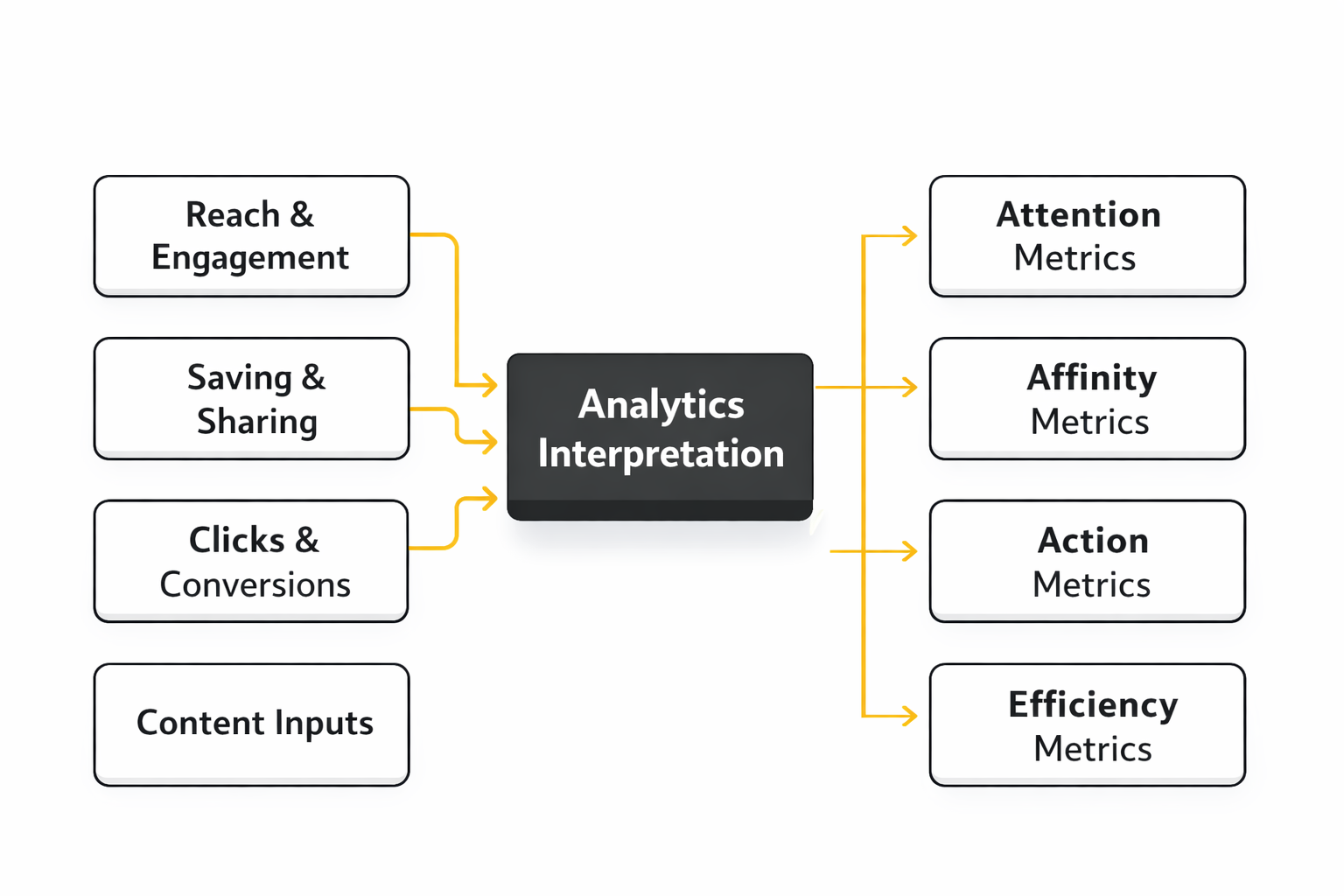
A practical way to interpret performance is to separate metrics into four “jobs” your content can do. When you know the job, your plan becomes easier to manage because you’re no longer comparing unrelated posts.
- Attention: reach, impressions, video views, and watch time. These tell you whether the platform is willing to distribute your content beyond your current audience.
- Affinity: saves, shares, meaningful comments, profile visits, and follow actions. These tell you whether people want more of you, not just one viral hit.
- Action: link clicks, website sessions, sign-ups, demo requests, or store visits (depending on your funnel). These tell you whether your content creates momentum outside the platform.
- Efficiency: content cost (time or money), production throughput, and performance per unit of effort. These tell you whether your plan is sustainable.
Once you’re tracking the right job, interpretation becomes more human. A post with “average reach” but unusually high saves is telling you the idea is valuable but the packaging is weak. A post with high reach but low completion rate is telling you the hook worked, but the payoff didn’t. A post with high engagement but no profile visits is telling you people enjoyed the moment but didn’t understand who you are or what you do.
Social media content plans get dramatically stronger when you turn interpretation into a weekly habit:
- One hour to label winners by job (attention, affinity, action, efficiency).
- One hour to extract patterns (hook types, topics, formats, posting times, creative styles).
- One hour to build the next batch as controlled variations, not random new ideas.
This approach keeps your plan honest. It also prevents the common trap where teams chase whatever “felt good” instead of what reliably moves the business forward.
Case Stories
At the worst possible moment, the internet decided Duolingo’s mascot belonged everywhere. Photos of people in green owl costumes started spreading fast, and the brand’s social presence turned into a cultural punchline that was too big to ignore. Then the financial world reminded everyone how brutal attention can be: a strong quarter can still end with the stock getting hit when expectations aren’t met, even as the brand dominates conversation in public.
The backstory is that Duolingo has been open about how it thinks about growth and brand. In its annual filing, the company describes brand marketing as something that drives press, social sharing, and word-of-mouth virality as part of long-term growth. That framing matters because it positions social not as decoration, but as a compounding asset inside the business strategy.
Then came the wall. Viral attention is noisy, and noise can be a trap: it’s easy to generate views that don’t translate into anything durable, and it’s easy for a mascot to become a meme people laugh at without remembering the product. Even Duolingo’s CEO has emphasized that product effectiveness and retention matter more than “marketing moments,” which is another way of saying: attention alone doesn’t pay the bills.
The epiphany was visible in how the story played out publicly. The company didn’t treat the owl chaos as a one-off stunt; it treated it as proof that the brand voice had become recognizable enough to travel without explanation. When a single costume post can rack up over 10 million TikTok views, you’re not just publishing content—you’re building a character the audience can carry for you.
From there, the journey becomes a lesson in building social media content plans around repeatable signals. Duolingo’s social presence has leaned into consistent humor and recognizable “Duo” behavior, and the CEO has pointed to the mascot’s cultural footprint during an earnings call cycle covered by the press. Meanwhile, the company’s public filings keep reinforcing the same underlying logic: brand investments are meant to attract new learners and keep existing learners engaged over time.
Of course, the final conflict is that fame comes with friction. The same Business Insider coverage notes how the company’s shares dropped sharply after missing projections, even while the mascot was everywhere online. That’s the tension every modern brand faces: social can win the culture and still lose the quarter if the rest of the system isn’t aligned.
The dream outcome is what happens when your plan connects the dots between culture, consistency, and business reality. Duolingo’s TikTok presence sitting at 16.8 million followers isn’t just a vanity number; it’s distribution you can activate whenever you launch a new feature, new course, or new message. And when leadership can talk about scale—like more than 50 million daily active users—the best social media content plans become the bridge between a brand people recognize and a product people actually use.
Professional Promotion
Promotion is where social media content plans become unfair—in a good way. When you know what content reliably earns attention or drives action, you can stop “boosting randomly” and start scaling what already works.
The simplest professional approach is a two-lane system:
- Lane 1: Organic learning — publish consistently, identify repeatable winners, and build a library of proven hooks and formats.
- Lane 2: Paid amplification — put budget behind the winners, not the guesses, so you’re paying to scale certainty rather than paying to discover it.
Platform economics are the reason this works. Meta’s scale is staggering—its Q4/FY2025 release notes 3.58 billion Family daily active people and continued growth in ad delivery. In other words: the inventory is there, but the algorithm still needs signals. Strong organic performance gives you signals; promotion gives you controlled distribution.
Professional promotion also means choosing the right measurement for the job:
- If you’re building awareness, track reach quality (video completion, shares, saves) and brand search lift or direct traffic trends.
- If you’re building demand, track click quality (landing page engagement, sign-up rate, downstream conversions) rather than clicks alone.
- If you’re building revenue, track contribution (assisted conversions, pipeline influence, repeat purchase signals) so social gets credit for what it truly drives.
Most importantly: promotion should protect your creative team. When you scale only what’s already proven, you reduce burnout, reduce random content churn, and make your plan feel calm instead of chaotic. That’s what professional social media content plans look like—creative freedom on the front end, ruthless learning in the middle, and disciplined amplification at the back end.
Future Trends
The next generation of social media content plans will be less about “what should we post” and more about “how do we stay trusted, discoverable, and measurable when everything is moving?” Platforms are changing fast, audiences are shifting toward private sharing, and AI is reshaping both creation and distribution.
Social search becomes a default discovery path
More people now look for recommendations inside social platforms the way they used to use Google. That pushes social media content plans to include “searchable packaging” (clear titles, on-screen text, and keywords that match real user intent), not just clever hooks. Trend reporting focused on 2026 keeps calling out social search as a core strategic shift, especially for brands that want to be found long after a post goes live, as described in Sprout Social’s 2026 trend coverage and industry analysis like Bannerflow’s 2026 social trends roundup.
AI content controls and labeling become normal
AI-generated content is flooding feeds, and platforms are starting to respond with controls, labels, and policy changes. TikTok’s move to give users more power over how much AI content they see is part of that trend, covered in The Guardian’s reporting on TikTok’s AI content controls. Regulations are tightening too—South Korea’s decision to require labeling of AI-generated ads in early 2026 is a signal that disclosure expectations are rising globally, covered by AP News.
Trust signals matter more than polish
As “AI slop” spreads, provenance and trust signals become a competitive edge. Platforms and standards bodies are experimenting with provenance systems like C2PA, but implementation is inconsistent and often stripped away by platforms, which is exactly the tension explored in The Verge’s reporting on C2PA and content labeling gaps. For your plans, the takeaway is practical: build recognizable series, show real proof, and design content that feels human and accountable.
Social commerce shifts toward conversational discovery
Shopping on social isn’t just “tap to buy” anymore—it’s increasingly guided by conversation, creators, and AI-assisted product discovery. LTK’s launch of an AI shopping chatbot inside its consumer app is a clear example of where discovery is heading, covered by Business Insider. Social media content plans that connect content to commerce will need tighter product storytelling and clearer handoffs from inspiration to action.
Budgets keep flowing toward social, but pressure rises on ROI
With global social media ad spend projected to reach USD $277 billion in 2025, the expectation is that social teams will prove impact, not just activity. That’s why future-proof plans will blend organic learning with paid scaling, and will treat measurement as part of creative production rather than a separate reporting function.
Strategic Framework Recap

Across the complete guide, the point has stayed consistent: strong social media content plans are not “a calendar.” They’re an ecosystem that turns strategy into repeatable output, then turns output into learning, and learning into growth.
- Clarity first: one primary goal for a defined period, supported by a small set of measurable outcomes.
- Audience reality: content themes and formats chosen because they match how your audience behaves, not just what your team enjoys making.
- Execution discipline: briefs, batching, and predictable workflows that make quality the default.
- Tool support: planning, production, publishing, and analytics systems that reduce friction and protect creative energy.
- Measurement with meaning: interpreting results by the job each post is trying to do (attention, affinity, action, efficiency).
- Scaling with control: promotion and amplification that expand what’s already proven instead of funding guesses.
If you want the ecosystem to hold up long-term, design your plan so it can survive change: platform shifts, format changes, team changes, and market volatility. That’s the difference between a burst of content and a sustainable system.
FAQ – Built for a Complete Guide
1) How far ahead should I plan social media content?
Most teams do best with a 30-day plan for structure and a 7-day window for flexibility. A month gives you campaign continuity, while a weekly refresh lets you adapt to what’s performing and what’s happening in culture.
2) What’s the difference between a strategy and a content plan?
Your strategy explains what you’re trying to achieve and why. Your plan is the operational roadmap—what you’ll publish, in what formats, when it goes live, and how you’ll measure success.
3) How many content pillars should a brand have?
Usually three to five is enough. Fewer than that can feel repetitive, and more than that often becomes hard to sustain. The best number is the one your team can execute consistently without diluting the message.
4) What if we don’t have enough ideas to post consistently?
That’s usually a workflow issue, not a creativity issue. Build a system that turns one idea into multiple outputs: a short video, a carousel, a story sequence, a comment-reply post, and a newsletter-style recap.
5) Should we prioritize trends or evergreen content?
Both, but with clear roles. Evergreen content builds durable discovery and trust; trend content buys relevance and reach. A healthy plan reserves space for trends without sacrificing the baseline cadence.
6) What metrics matter most for social media content plans?
Match metrics to intent. For attention, watch time and completion matter. For affinity, saves and shares usually beat likes. For action, track downstream behavior, not clicks alone. For efficiency, measure performance per unit of effort.
7) How do we know if we should post more or improve quality?
If you’re inconsistent and rarely publish, increase cadence first—algorithms and audiences can’t learn you if you rarely show up. If you publish consistently and results are flat, focus on quality levers: hooks, packaging, and clearer audience targeting.
8) Is it better to publish on many platforms or focus on one?
Start focused, then expand. Build a stable engine on one or two platforms, then repurpose outward. Data shows audiences rotate across multiple networks, so expansion becomes valuable once your core system is reliable, reflected in global usage patterns highlighted in Digital 2026 reporting.
9) How do we handle approvals without slowing everything down?
Create a brief, define what “good” looks like, and use a simple gate: draft, review, approve, schedule. The more clarity you build upfront, the fewer revisions you need later.
10) What’s the best posting frequency in 2026?
There isn’t one universal answer because formats and audiences differ. The best frequency is one you can sustain for months, not weeks. Choose cadence based on production capacity, audience response, and the job your content is trying to do.
11) How should we adapt to AI-generated content flooding feeds?
Build trust signals into your content: real proof, consistent voice, and transparent storytelling. Platforms are actively responding with labeling and controls, like the changes covered in TikTok’s AI content controls, so human credibility becomes a differentiator.
12) When should we use paid promotion to support the plan?
Use paid to scale proven winners. Publish organically, identify which posts reliably achieve attention or action, then amplify those posts to extend reach and control distribution—especially when your plan needs predictable outcomes.
Work With Professionals
If you’ve made it this far, you already know the truth: social media content plans only work when execution is consistent. And execution gets harder when you’re juggling client work, pitching new leads, reporting results, and trying to stay creative under pressure.
That’s why marketplaces built specifically for marketing specialists are becoming a serious advantage. When you can connect directly with companies who already want marketing help, you stop wasting weeks on cold outreach and start building a pipeline you can actually control.
MARKEWORK.com positions itself as a marketing-focused marketplace where companies and marketers connect directly, with no project fees or commissions and messaging that happens without a middle layer. It’s designed for momentum: create a profile, browse roles, apply, and move straight into real conversations.
What makes it especially attractive for freelancers is the business model: you keep what you earn because the platform isn’t taking a percentage cut from your contracts. The platform also shows meaningful marketplace activity publicly, including 1007 active listings visible in its job browser and “access to thousands of job listings” described in its plan details.
If your goal is to grow your client list without drowning in platform fees, slow посредники, or endless bidding wars, a focused marketplace can be the difference between “posting content and hoping” and “building a predictable freelance business.”
Build your profile like a landing page. Showcase your strongest proof, your service focus, and the outcomes you drive.
Apply with a plan, not with desperation. Choose listings that match your niche, then pitch a clear first step that makes it easy for the client to say yes.
Keep the relationship direct. Negotiate scope, timelines, and pay without extra layers, which the platform emphasizes as part of its model on its “Why Us” page.
 Filip Konecny Enterprises