

Social platforms aren’t “just awareness” anymore. They’re where people discover products, compare alternatives, ask friends for recommendations, and decide whether a brand feels trustworthy enough to buy from.
At the same time, social media and business marketing is getting harder to run on intuition. Budgets are under pressure, paid media is being protected while everything else gets squeezed, and teams are expected to prove outcomes with cleaner measurement. Gartner’s 2024 CMO survey highlighted how paid media’s share has grown even as overall budgets fell, which is exactly why your social strategy needs to connect to revenue and retention, not just reach.
This series breaks the work into a clear system you can apply whether you’re a solo marketer, an in-house team, or a freelancer managing multiple brands.
Article Outline
- What Social Media and Business Marketing Is
- Why Social Media and Business Marketing Matters
- Framework Overview
- Core Components
- Professional Implementation
What Social Media and Business Marketing Is

Social media and business marketing is the discipline of turning attention on social platforms into measurable business outcomes: demand, pipeline, sales, repeat purchases, referrals, and lower service costs. It’s not “posting content” as a task. It’s a full-funnel growth system that combines creative, distribution, community, and measurement.
In practice, that means your social presence does four jobs at once:
- Discovery: Helping the right people find you when they’re not actively searching.
- Trust: Proving you’re credible through consistency, proof, and human signals (reviews, creators, employees, customers).
- Demand capture: Turning curiosity into clicks, messages, email signups, demos, or purchases.
- Retention: Keeping customers engaged through updates, education, community, and fast support.
The scale is no longer niche. Social platforms represent billions of identities worldwide, which is why they’re now a default part of the buying journey for almost every category. DataReportal’s Digital 2025 report and We Are Social’s Global Digital Report 2025 illustrate how deeply embedded social has become in daily life and media consumption.
But the most useful way to think about social media and business marketing is this: social is where the market talks in public. Your job is to listen, show up with something helpful, and make it easy to buy when the timing is right.
Why Social Media and Business Marketing Matters
Social matters because it shifts where decisions are made. People don’t move through tidy “awareness to purchase” steps anymore. They bounce between creator content, brand pages, comment sections, review videos, friends’ DMs, and comparison posts. If your brand isn’t present in those moments, you’re effectively invisible while the decision is happening.
For many consumers, social is also becoming a research layer. McKinsey’s State of the Consumer work notes an increase in social media use for product research across markets, which is a strong signal that “social content” now competes with search results and product pages for influence.
It also matters because attention has structurally shifted toward social video and creators. Deloitte’s 2024 Digital Media Trends research highlights how younger audiences increasingly prefer social video and live streams, which changes what “good marketing” looks like: fast clarity, strong hooks, proof early, and content that earns its place in the feed.
And there’s a business reason teams can’t ignore: budgets are being judged harder. Paid media remains a protected line item, but leadership expects it to perform. Gartner’s 2025 CMO spend survey shows paid media continuing to dominate marketing spend, which makes social performance and measurement literacy non-negotiable.
Finally, social now touches customer experience. When customers treat your comments and inbox as support channels, response speed becomes part of the brand. The Sprout Social Index findings referenced in Sprout’s customer service guidance highlight how quickly consumers expect brands to respond, and that expectation directly influences loyalty and word-of-mouth.
Framework Overview
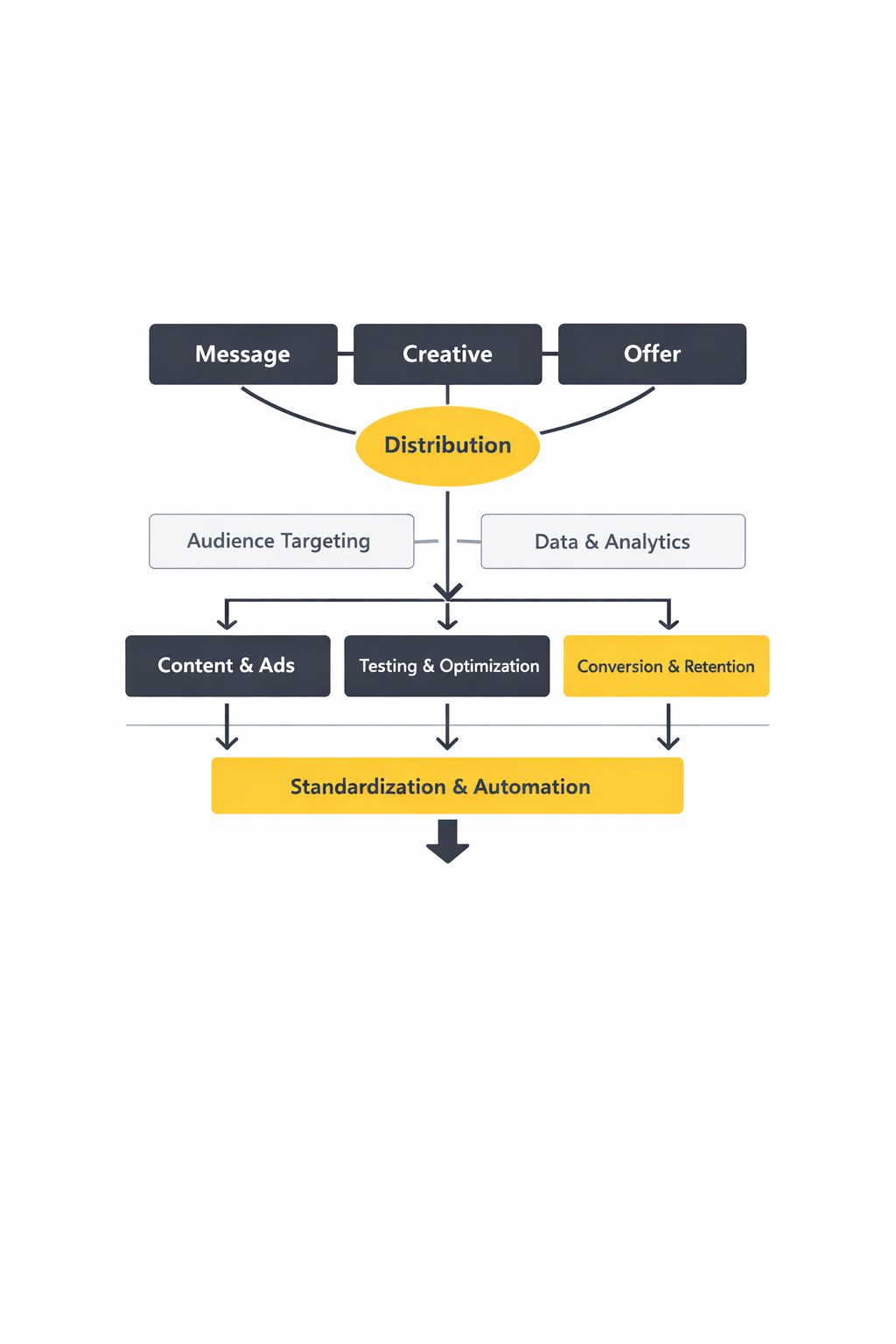
A professional approach to social media and business marketing needs a framework that stays stable even when platforms change. Algorithms will shift. Formats will rise and fall. What works this quarter might stall next quarter. Your strategy can’t be “we post every day and hope.” It needs a repeatable loop.
Use this five-part framework to connect social activity to business outcomes:
- Market: Who you serve, what they believe, what they fear, what they want, and what alternatives they’re considering.
- Message: A clear promise plus proof. What you help people do, why you’re credible, and why now.
- Media: The platform and format mix that matches your buyer’s behavior (organic, paid, creators, community, email capture).
- Momentum: Cadence and systems that compound (content series, UGC pipelines, creator partnerships, employee advocacy, community rituals).
- Measurement: A simple set of metrics tied to business goals, tracked consistently, and used to make decisions.
This framework fits both B2C and B2B. The difference is emphasis. B2B usually leans harder on trust, expertise, and relationship building, which is why thought leadership and credibility signals matter. You can see that priority reflected in the Edelman-LinkedIn 2024 B2B Thought Leadership Impact Report and LinkedIn’s own 2024 B2B Marketing Benchmark, both of which focus on how buyers respond to credible, value-first content.
For commerce brands, the same loop applies, but “media” and “momentum” often tilt toward short-form video, creator-led distribution, and social commerce mechanics. McKinsey’s view of social commerce growth and platform-driven buying behavior shows why that shift is accelerating. McKinsey’s 2024 consumer trends report
Core Components
To make the framework real, you need a few core components that are easy to maintain and hard to copy. These are the building blocks that separate “busy social” from business-driving social.
Positioning and Offer
If your offer is fuzzy, your content will be fuzzy. Your social content should make one idea obvious within seconds: what you help people achieve, and why you’re the safest bet. That clarity isn’t just branding; it’s conversion rate optimization for the feed.
A simple way to pressure-test your positioning is to scan your last 12 posts and ask: would a stranger be able to explain what you sell, who it’s for, and why it’s worth it? If not, adjust your message before you “post more.”
Content Pillars That Earn Attention
Strong social media and business marketing usually sits on 3–5 repeatable content pillars. The goal is to build familiarity and expectation, not randomness.
- Proof: outcomes, testimonials, demos, before/after, third-party validation.
- Education: frameworks, checklists, common mistakes, myth-busting, teardown content.
- Perspective: informed takes that show how you think (especially powerful in B2B).
- Personality: behind-the-scenes, founder voice, team moments, human context.
- Participation: community prompts, Q&A, duets/stitches, comment-to-DM workflows.
What makes pillars “earn attention” is relevance plus timing. Social algorithms are getting better at matching content to interest, but they can’t rescue vague messaging. Platform research and trend reports consistently emphasize the value of native formats and culturally fluent creative. TikTok’s What’s Next 2025 Trend Report is a practical example of how platforms expect brands to build with culture, not bolt onto it.
Distribution Mix: Organic, Paid, and Creators
Organic gives you learning speed and credibility. Paid gives you control and scale. Creators give you distribution through trust that audiences already have. The best systems combine all three, because each channel covers a weakness in the others.
The economics are moving that way, too. Creator-led media is attracting serious budget because it can outperform traditional formats for attention and trust. The shift is reflected in industry reporting on creator ad spend and the broader move toward user-generated content in the ad market. IAB and PwC’s Internet Ad Revenue report and recent coverage of creator advertising growth in 2025 both point to the same direction: creators are no longer experimental.
Video is also a bridge channel: it can do both storytelling and performance. Google’s research with BCG highlights how video influences consideration and purchase decisions, and that not all platforms influence those decisions equally. The new rules of influence research summary
Customer Care as Marketing
For many industries, the fastest ROI on social is not a new campaign. It’s taking your existing inbound questions and handling them publicly and quickly. That reduces support load, increases confidence for lurkers, and turns your social presence into a living FAQ.
Response expectations are tightening, and brands that treat social inboxes like an afterthought pay for it in lost trust. The consumer expectation signal is clear in Sprout Social’s research and guidance on modern customer service behaviors. Sprout Social’s customer service insights
Professional Implementation
Professional execution starts with treating social media and business marketing like an operating system, not a pile of posts. You need roles, routines, and a measurement rhythm that makes the work predictable.
Here’s what “professional” looks like in practice:
- A weekly planning loop: one hour to review performance, customer questions, sales objections, and what competitors are running; then choose next week’s themes.
- A production system: templates for scripts, hooks, captions, and creative briefs so content quality stays consistent when you’re busy.
- A testing cadence: one variable at a time (hook style, offer framing, creator vs brand voice, landing page angle) so you learn quickly without chaos.
- A measurement spine: a small dashboard that ties reach and engagement to clicks, leads, revenue, retention, and support outcomes.
This matters because platform dynamics can shift faster than most teams can adapt. Even large platforms report meaningful changes in pricing and impression volume year over year, which influences performance planning. Meta’s full-year 2024 results show changes in ad impressions and average price per ad, a reminder that “the same campaign” won’t behave the same way forever.
In Part 2, we’ll turn this into a step-by-step setup: goal mapping, audience intelligence, platform selection, and a content system you can run without burning out.
Step-by-Step Implementation
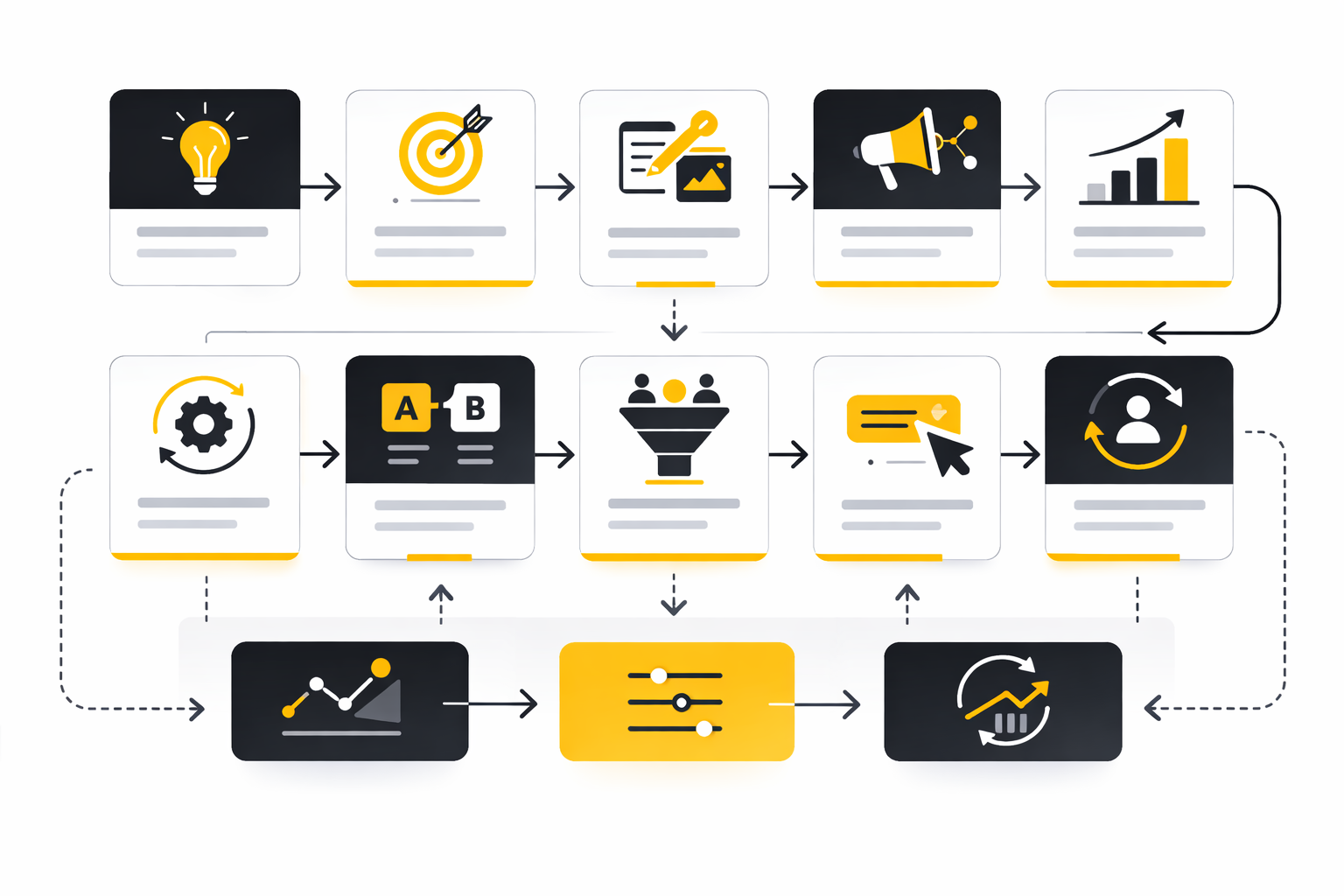
Implementation is where social media and business marketing either becomes a growth engine or a content treadmill. The difference is usually not effort. It’s whether you set up the work so learning compounds instead of resetting every Monday.
This step-by-step approach is designed to work even when platforms shift, tracking gets messy, or leadership wants proof that your social strategy is driving real outcomes.
1) Pick one business outcome and a time horizon
Start by choosing one outcome you can defend in a meeting: qualified leads, purchases, subscriptions, booked calls, or retained customers. If you try to optimize for everything at once, you’ll end up measuring everything and improving nothing.
Give the outcome a clear time horizon. A 30-day goal forces you to focus on distribution and conversion mechanics; a 90-day goal gives room for trust-building content to compound.
2) Map the real journey people take before they buy
Instead of guessing, map what prospects actually do: what they search, what they watch, who they trust, and what makes them hesitate. This is where social media and business marketing becomes practical, because your content plan stops being “topics we like” and starts answering objections in the exact language people use.
Make the journey visual on one page: first touch, consideration touchpoints, trust signals, and the moment of action. If you can’t explain where social fits into that journey, you’ll struggle to justify budget later.
3) Build your measurement spine before you publish more
Measurement is the part everyone wants to postpone because it feels technical. But the cost of postponing it is months of content and spend you can’t confidently learn from.
For Meta-heavy programs, the most stable setup usually combines browser events with server-side events so you’re not relying on a single fragile signal. The official pieces to understand are Meta Pixel conversion tracking and the Meta Conversions API.
If TikTok is part of your plan, build the same redundancy. TikTok describes Events API as a reliable connection across web, app, and offline data, and it explicitly recommends pairing it with Pixel to maximize performance benefits. TikTok’s Events API overview
If you need a disciplined way to prove what’s truly incremental, calibrate what your dashboards say with experiments. The logic is clearly explained in Google’s measurement playbook, where attribution performance is adjusted using the results of incrementality experiments. Google’s Modern Measurement playbook
4) Design a creative system, not a content calendar
A calendar tells you when to post. A system tells you what to produce, why it should work, and how you’ll iterate when it doesn’t.
Start with a small set of repeatable formats you can ship weekly: a hook-driven educational series, a proof series, a founder perspective series, and a community-driven prompt series. Then decide how you will generate variations, because performance usually comes from testing angles and execution styles, not repeating one “winning post” forever.
5) Launch a two-week pilot with strict learning goals
For the first two weeks, your goal isn’t perfection. Your goal is to learn what the market reacts to when it sees your message in the wild.
Keep the pilot intentionally narrow: one audience segment, one primary offer, and a small number of creative angles. Track what happens at each step—stops, clicks, messages, leads, purchases—so you can spot exactly where momentum breaks.
6) Scale with a repeatable loop
Once you see traction, scale by repeating the loop rather than “posting more.” Add creative variations, widen distribution, and improve conversion paths one bottleneck at a time.
This is where social media and business marketing becomes reliable. You’re not hoping for viral moments; you’re building a system where each cycle produces stronger messages, better creative, and cleaner measurement.
Execution Layers
When execution gets messy, it’s usually because everything is happening in one pile: content ideas, posting, paid, reporting, and community management all fighting for attention. A layered approach separates responsibilities so you can improve one part without breaking another.
Layer 1: Strategy and constraints
This layer defines the outcome, budget boundaries, risk tolerance, and what “success” means in business terms. It also defines what you will not do, which is just as important when social media and business marketing competes with everything else on a team’s to-do list.
Layer 2: Message and proof
This layer turns your offer into a clear promise and backs it with proof. Proof can be customer stories, product demos, third-party validation, or transparent behind-the-scenes content that makes the brand feel real.
If this layer is weak, everything downstream becomes expensive. Ads cost more, content gets ignored, and your team ends up trying to “optimize” a message the market doesn’t want.
Layer 3: Creative production
This is the engine room: scripts, edits, design, captions, and versioning. The key is throughput without quality collapse.
If you’re in B2B, video creative still has to earn attention, but the tone often leans toward clarity and authority. LinkedIn Creative Labs’ research focuses on the storytelling elements that correlate with impact in B2B video ads, which is a useful reference when your stakeholders want “more premium” content without losing performance. LinkedIn’s Art & Science of Video Storytelling report
Layer 4: Distribution and amplification
Distribution is where many teams underinvest. They spend hours making content, then “post and pray.”
Make distribution a deliberate mix: organic publishing for learning speed, paid for control and scale, and creators for borrowed trust. When you treat distribution as a layer, you stop blaming the creative for problems that are actually delivery and targeting issues.
Layer 5: Conversion path
This layer is what happens after the click, the view, or the DM. It includes landing pages, lead forms, booking flows, product pages, and follow-up sequences.
In B2B, conversion tracking can get messy because deeper-funnel actions happen off-site or later in time. LinkedIn’s playbook explains how Conversions API supports deeper-funnel conversion value and stresses data cleanliness and deduplication, which matters when you’re trying to trust your reporting. LinkedIn’s Conversions API Playbook
Layer 6: Community and customer care
This layer turns social from a broadcast channel into a relationship channel. It includes moderation, replies, DM handling, and community rituals that keep people coming back.
When this layer is strong, it creates a second flywheel: your audience starts helping you market, because they feel seen and because your brand behaves like a participant, not a billboard.
Optimization Process
Optimization isn’t “tweak buttons until ROAS improves.” It’s a structured decision-making process: find the bottleneck, form a hypothesis, test one variable, and keep what improves outcomes.
The most important upgrade you can make to social media and business marketing is shifting from opinion-based iteration to evidence-based iteration, especially when tracking is imperfect.
Start with bottlenecks, not metrics
Pick the stage where momentum breaks. If people watch but don’t click, the problem is likely the offer framing or call-to-action. If people click but don’t convert, the problem is likely the landing page or mismatch between promise and reality.
This keeps your work grounded. You’re not optimizing “engagement” in the abstract; you’re improving a specific leak in the journey.
Use creative testing discipline without chaos
Creative testing works when you treat it like a lab. Keep your variables clean: test hooks against hooks, offers against offers, edits against edits.
When you find a winning angle, don’t just scale it once. Build a small family of variations so performance doesn’t collapse the moment the audience gets tired of seeing the same thing.
Protect data quality and deduplicate signals
If you stream events from multiple sources, you need consistency and deduplication, or your reporting becomes inflated and decisions get worse. LinkedIn explicitly discusses how Conversions API can discard duplicate events when event IDs match, which is a useful mental model even if your main spend is elsewhere. LinkedIn’s guidance on deduplication and data cleanliness
On TikTok, stable optimization depends on having the prerequisites in place for web conversion objectives, including Pixel or Events API setup. TikTok’s Events API setup prerequisites
Prove incrementality when the stakes rise
When budgets grow, leadership eventually asks the uncomfortable question: “Would we have gotten those results anyway?” That’s where incrementality testing earns its keep.
TikTok positions Conversion Lift Study as an incrementality approach through experimentation, which is one of the cleanest ways to validate real impact when attribution is noisy. TikTok’s Conversion Lift Study explanation
For cross-channel teams, Google’s modern measurement guidance shows how to calibrate attribution with experiment results, so your budget decisions reflect estimated incremental value rather than platform-reported credit. Calibration via incrementality experiments in Google’s playbook
Implementation Stories
Implementation stories matter because they reveal what teams do when reality hits: deadlines, creative fatigue, tracking issues, and pressure to prove results. The point isn’t to copy tactics blindly. The point is to see how a real brand sets goals, chooses formats, measures impact, and keeps iterating when things get complicated.
On’s full-funnel push on TikTok
Start (high drama): The brand was trying to do two hard things at once: protect its credibility with performance-minded buyers and still win the attention of Gen Z. It’s the kind of tension that breaks a lot of campaigns, because “premium” can easily read as boring in a fast feed. Every missed creative choice feels louder when you’re trying to change perception and drive sales in the same breath.
Backstory: On had already built a reputation around performance engineering and distinctive design, but it was evolving into a broader premium sportswear brand. That kind of shift requires more than ads; it requires a new story people actually want to repeat. TikTok became a priority channel precisely because it can move culture fast when creative lands.
The wall: The team needed proof that the channel could do more than awareness, because brand transformation without sales impact gets questioned quickly. They also needed a way to measure incremental value, not just platform-reported conversions. Without credible measurement, social media and business marketing starts to feel like a cost center instead of a growth lever.
The epiphany: The breakthrough was treating TikTok as a full-funnel system rather than a top-of-funnel playground. That meant building creative that could earn attention, while also creating paths that could convert. It also meant being serious about lift measurement so the results could stand up outside the platform dashboard.
The journey: The campaigns were designed to drive both brand outcomes and sales outcomes, using a structure that could support learning across the funnel. Creative and messaging were built to fit the platform, while still reinforcing the brand’s premium positioning. The work was measured with a framework that reported lift, not just clicks, so the team could understand what changed because the campaign existed.
The final conflict: Full-funnel work often creates internal conflict: performance teams want faster returns, brand teams want stronger storytelling, and everyone wants the numbers to be clean. Any wobble in creative performance can trigger reactive changes that destroy the test. Keeping the system stable long enough to learn is often the hardest part.
The dream outcome: The results page shows measurable lift across outcomes that matter to both brand and performance teams, including a +7.7% awareness lift, a +7.9% conversion lift, and +75% total incremental conversions. That combination is the real win: social media and business marketing that can defend both perception change and revenue impact. It’s also a reminder that the most persuasive reporting is often lift-based, because it answers the question leadership actually asks: what changed because we did this?
The 90-minute weekly cycle
Run social media and business marketing on a weekly cadence that forces clarity. Spend 30 minutes reviewing performance by bottleneck (attention, click, conversion, retention). Spend 30 minutes deciding which hypotheses you will test next week. Spend 30 minutes translating those tests into creative briefs your team can ship.
The signal and tracking baseline
Before you scale budgets, stabilize your signals. For Meta-heavy programs, that means understanding both Pixel and server-side event collection so optimization isn’t relying on one fragile source. The official reference points are Meta Pixel conversion tracking and Meta Conversions API.
For TikTok conversion programs, the same discipline applies. TikTok’s documentation is direct about the role of Events API in capturing missing conversions and improving targeting, especially when browser inconsistency impacts Pixel reporting. TikTok’s Events API benefits
The experiment layer that keeps you honest
When you can’t fully trust attribution, experiments become your reality check. Use lift studies and incrementality tests when the spend level justifies it, and use those results to calibrate how you interpret platform dashboards.
That calibration approach is laid out clearly in Google’s modern measurement playbook, and TikTok frames the logic behind incrementality through its own lift study methodology. TikTok’s Conversion Lift Study overview
What “good” looks like after 60 days
After 60 days, you should be able to point to a small set of repeatable creative formats that consistently produce results, a clear view of where the funnel is leaking, and a measurement approach that doesn’t collapse the moment a platform changes reporting rules.
When that’s in place, scaling stops being scary. You can spend more, publish more, or hire more, because the system is doing what it’s supposed to do: turn effort into learning, and learning into growth.
Statistics and Data
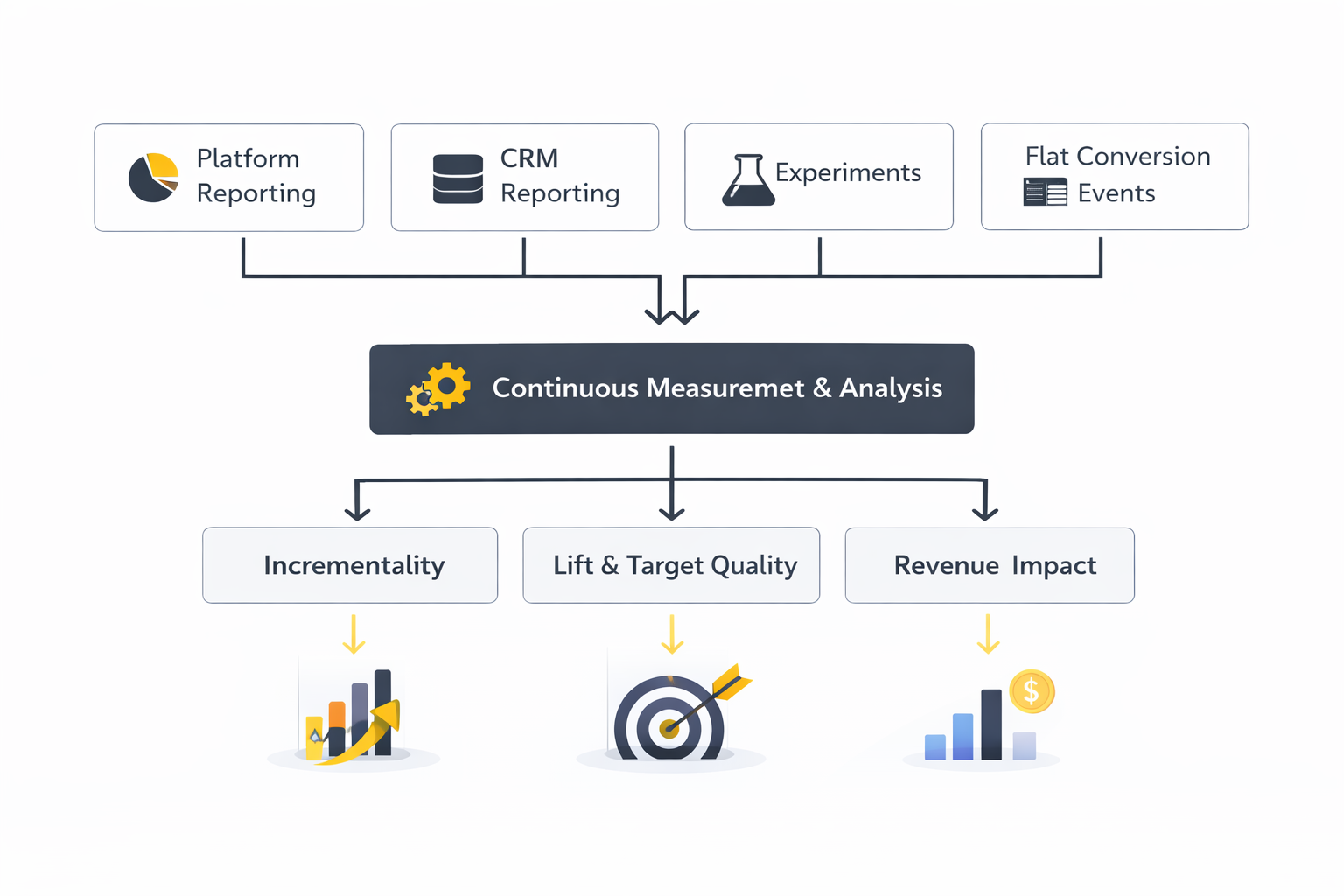
When social media and business marketing is working, you can feel it: stronger inbound intent, faster sales conversations, and a steady stream of “I keep seeing you everywhere.” The problem is that feelings don’t survive budget season. Data does.
The trick is to stop treating analytics like a scoreboard and start using it like a navigation system. A scoreboard tells you what happened after the game. Navigation tells you where to steer while you’re still moving.
If you only take one idea from this section, make it this: measurement is not about collecting more numbers. It’s about collecting the few signals that help you make better decisions next week without lying to yourself.
The data anchors that matter in 2026
Good social analytics sits on three anchors: market reality, platform reality, and your own business reality. Market reality tells you where attention and budgets are actually flowing. Platform reality tells you how delivery and pricing are changing under the hood. Business reality tells you whether any of it translates into outcomes you can deposit in the bank.
On the market side, digital video keeps pulling spend because it fits how people consume content now, and it performs across the funnel. The IAB’s 2025 video report framework highlights $64B in US digital video ad spend in 2024 and a projection of roughly $72B in 2025, and that same set of figures is echoed in the IAB’s press release coverage and explained in plain language through Marketing Dive’s write-up of the report.
On the platform side, it’s worth remembering that the ad marketplace is not static. Meta’s own reporting shows a meaningful year-over-year shift in delivery and pricing: ad impressions were up 12% for full-year 2025 while average price per ad was up 9%. Those same figures appear in Meta’s official PDF release and are repeated in the PRNewswire distribution of Meta’s results.
On the business side, creator partnerships have shifted from “nice to have” to “budget line item,” which changes how you should interpret performance data from social. The IAB reports US creator ad spend rising to $29.5B in 2024 and being projected at $37B in 2025, backed by IAB’s summary of the findings and reinforced through the press release distribution.
Data hygiene beats “more dashboards”
Social media and business marketing dashboards can look impressive while quietly being wrong. The fastest path to credibility is not a prettier report; it’s clean data definitions: what counts as a lead, what counts as a qualified lead, how you deduplicate events, and how you reconcile platform attribution with your CRM.
If your definitions change every month, your performance story becomes a moving target. If your definitions stay stable, you can make real comparisons and learn what actually improved.
Performance Benchmarks
Benchmarks can be helpful, but only when you treat them like context, not commandments. One of the easiest mistakes in social media and business marketing is chasing an “average engagement rate” while ignoring whether the posts are reaching buyers who can actually convert.
Use benchmarks to answer a simple question: are you in a normal range for your category and channel, or are you so far off that something is broken?
Benchmark 1: Where the money is flowing
When spend rises in a category, it usually means two things: there’s audience attention there, and the channel can produce measurable business outcomes. That’s why the IAB’s data matters for benchmarking your effort level. The same IAB-based numbers appear consistently across independent sources: $64B in US digital video in 2024 with projections near $72B in 2025, plus the same figure repeated via PRNewswire’s IAB release and summarized by eMarketer’s coverage.
For you, this means performance reporting needs to speak the language video buyers care about: lift, conversion value, and incremental impact, not just likes and views.
Benchmark 2: Platform delivery and pricing shifts
If you run paid social, your “benchmarks” are partly determined by what the platform marketplace is doing. A campaign can look worse even when your creative is fine, simply because inventory got more expensive or competition spiked.
Meta’s year-over-year indicators are a useful reality check for interpreting your own trends: 12% full-year growth in ad impressions and 9% growth in average price per ad, backed by the official report PDF and mirrored through PRNewswire’s distribution.
Translate that into practice: when costs rise, don’t panic-optimize. First check whether the marketplace moved. Then decide whether your bottleneck is creative, targeting, conversion path, or the platform economics.
Benchmark 3: Creator economy budget gravity
Creators are a benchmark category now because they pull budget and change performance expectations. When creator spend grows, brands start evaluating creator work like media: can it move outcomes, can it scale, can it be measured?
The IAB’s creator spend figures are consistent across multiple independent references: $29.5B in 2024 and a projection of $37B in 2025, supported by IAB’s public summary and repeated through the press release distribution.
This is your cue to benchmark your own creator work differently: assess creative resonance, audience alignment, and incremental lift, not just reach.
Analytics Interpretation
Data becomes useful when it leads to a decision you can act on today. The goal of analytics interpretation in social media and business marketing is not to “report performance.” It’s to identify what to do next: what to keep, what to fix, and what to stop.
The five questions that make dashboards actionable
- Did we earn attention? If not, your bottleneck is creative clarity and relevance, not your media plan.
- Did we earn trust? If comments and saves rise but clicks and messages don’t, you may be building interest without enough proof.
- Did we create intent? If clicks rise but leads don’t, your offer framing or landing experience is leaking.
- Did we capture demand? If leads rise but sales don’t, the problem may be qualification, follow-up speed, or mismatch between ad promise and sales reality.
- Did we learn something repeatable? If performance only happens on one post, you don’t have a strategy yet. You have a moment.
Avoid the three vanity traps
Trap one: celebrating reach without outcomes. Reach can be valuable, but it’s not automatically valuable. Make reach earn its keep by tracking what it feeds: searches, site visits, email signups, or messages.
Trap two: optimizing engagement without a business reason. Engagement that comes from the wrong audience can actually make your targeting and future content worse. You want engagement from people who can buy, refer, or influence buyers.
Trap three: trusting platform credit as the full story. Platforms are incentivized to claim value. That doesn’t mean they’re lying; it means you need calibration. Market-level measurement trends are pushing in this direction, which is why incrementality and lift approaches are now standard in platform measurement conversations, including TikTok’s focus on incrementality through Conversion Lift Study.
How to explain performance so stakeholders believe it
Stakeholders don’t want more metrics. They want a clean narrative: what changed, why it changed, and what you’re doing next.
A simple structure works almost every time: start with the business outcome, then show the bottleneck you targeted, then show the change in signal quality, and end with the next test. When you anchor that story in market realities like where video budgets are growing and platform realities like delivery and pricing shifts, it stops sounding like opinion and starts sounding like strategy.
Case Stories
Case stories are useful when they show two things at once: what the team measured, and how measurement shaped decisions. The best stories in social media and business marketing don’t read like victory laps. They read like a team trying to prove something real while the channel is moving under their feet.
A paid social team that stopped blaming creative and started reading the marketplace
Start (high drama): The numbers looked wrong overnight. CPA drifted up, leadership started asking if the creative was “getting stale,” and the team felt the familiar panic that leads to random changes. Everyone wanted a quick fix, but nobody could agree on what was broken.
Backstory: The team had been running steady paid social across Meta for months with a stable creative pipeline and predictable conversion paths. Their reporting was clean enough to catch changes quickly, but not clean enough to explain why. They were doing the work, but they were still vulnerable to the story that “ads just stopped working.”
The wall: Every creative refresh helped a little, then performance slipped again. That’s the moment many teams burn weeks testing small tweaks while the real driver sits outside the account. Without a marketplace lens, the team couldn’t separate internal execution issues from external platform economics.
The epiphany: Instead of treating the dip like a creative failure, they treated it like an auction shift. They pulled platform-level indicators and used Meta’s own reporting on marketplace movement as context. When Meta itself is reporting year-over-year change in delivery and pricing, it’s a reminder that your baseline is not fixed.
The journey: The team rebuilt their weekly review around two layers: internal bottlenecks and marketplace movement. They used cost changes to decide when to lean into creative testing versus when to protect conversion rates and tighten qualification. They also began framing results with the language stakeholders understand: efficiency changed because competition and pricing moved, and here’s what we’re doing inside that reality.
The final conflict: The hardest part wasn’t the data. It was the conversation. Stakeholders wanted certainty, and the team had to explain that performance is partly a market outcome. They also had to resist overreacting, because changing too much at once would destroy the signal they needed to learn.
The dream outcome: The win wasn’t a single spike. The win was credibility. By grounding performance interpretation in Meta’s published indicators—full-year 2025 ad impressions up 12% and average price per ad up 9%—the team stopped fighting ghosts and started making calmer, better decisions that stakeholders could follow.
A creator program that needed to prove it wasn’t “just vibes”
Start (high drama): The creator budget was on the chopping block. Leadership liked the content, the team loved the comments, and the brand felt more alive than it had in years. But when finance asked what creator work was actually producing, the room got quiet.
Backstory: The team had built strong relationships with creators and was seeing consistent audience response. They were also feeling the wider industry shift: creators were becoming a serious channel, not a side experiment. The problem was that their reporting still treated creator work like organic content instead of media with a measurable purpose.
The wall: The team couldn’t connect creator output to business outcomes cleanly. Some conversions were delayed, some happened through assisted paths, and some happened through brand search that never showed up in creator reporting. Without a measurement approach, the program was vulnerable to being dismissed as “soft.”
The epiphany: They reframed creator work as a channel that needed the same discipline as paid: clear objectives, consistent tagging, and calibration through broader market context. If creator spend is reaching this scale across the industry, measurement expectations will rise with it.
The journey: The team rebuilt the creator program around a simple set of accountable outcomes: product interest signals, site behavior, and conversions tied to clear tracking conventions. They also used market-level evidence to justify why creators deserved a real budget line item, not leftover dollars. They walked into stakeholder meetings with a story that connected creator work to how the market is evolving, not just what the comments looked like.
The final conflict: The program still faced skepticism because creator performance can be messy, and not every partnership lands. A few underperforming activations threatened to taint the whole effort. The team had to separate “this creator wasn’t a fit” from “the channel doesn’t work.”
The dream outcome: The result was a budget that survived—and a reporting standard that stuck. The team anchored the conversation in IAB’s market signal—creator ad spend at $29.5B in 2024 with a projection of $37B in 2025—supported by IAB’s public summary and the press release distribution, then proved their own program had measurement discipline to match the channel’s new seriousness.
Professional Promotion
Promotion is not the same thing as posting. Professional promotion is what you do after you’ve learned something: you package the insight, amplify what’s working, and make sure the right people see it—inside and outside the company.
This is where social media and business marketing becomes a career advantage. Marketers who can turn analytics into clear decisions—and then turn those decisions into visible wins—get more trust, more budget, and better clients.
Turn insights into assets
When a message resonates, don’t let it die as a single post. Turn it into a series, a short-form video script library, a sales enablement one-pager, and a set of ad variations. The fastest teams treat one insight as raw material for a month of work.
Show your work in business language
When you share results, lead with what the business cares about: revenue, pipeline, cost efficiency, retention, or support load. Then explain how the channel context shaped the outcome, using credible external anchors when needed—like the scale and growth of digital video investment or the reality that platform economics shift, as shown in Meta’s year-over-year delivery and pricing indicators.
Build a repeatable performance narrative
Every month, publish a short internal “performance narrative” that answers: what changed, why it changed, what we learned, and what we’re doing next. If you’re a freelancer, this becomes your client retention tool: it proves you’re not just making content, you’re steering growth.
That’s the quiet superpower of analytics. It doesn’t just help you improve campaigns. It helps you become the person people trust with the budget.
Future Trends
Social media and business marketing is entering a phase where “posting consistently” is no longer the advantage. The advantage is how quickly you can learn, how clearly you can prove impact, and how well you can keep trust when feeds fill up with synthetic content, tougher regulation, and more competition for the same finite attention.
Social search and zero-click behavior
Search behavior is spreading across platforms that were never designed to be “search engines.” People are looking up brands, local recommendations, and how-to answers inside feeds, comments, creator videos, and community posts. That trend shows up in multiple directions: public discussions of “social search” and measurement fragmentation in dentsu’s Summer 2025 Ad Spend Report, as well as repeated signals that younger audiences use social platforms for discovery, including a Gen Z “social search” snapshot in Forbes’ coverage of platform search behaviors and broader usage context in Sprout Social’s Gen Z platform data.
The practical move is to treat every high-performing post as a “search result” that should answer a real question clearly: what it is, who it’s for, what problem it solves, what proof backs it, and what the next step is.
Measurement shifts from attribution to proof
As tracking gets noisier, the pressure rises to prove what was incremental, not just what got credited. This is why modern measurement frameworks keep circling back to experiments, calibration, and mixed methods. Google’s guidance pushes teams toward building an experiments calendar and treating measurement as a continuous system in its 2025 digital marketing trends note, while the logic of calibrating attribution using experiment results is laid out in Google’s Modern Measurement playbook.
The competitive edge in social media and business marketing will belong to teams who can say, “Here’s what we think happened,” and also, “Here’s what we tested to confirm what actually happened.”
Creator media becomes a budget category
Creators aren’t just “brand collaborations” anymore. They’re increasingly treated like a media channel with budgets, targets, usage rights, and amplification plans. The IAB’s creator economy report highlights how large this channel has become, including creator ad spend reaching $29.5B in 2024 and projected $37B in 2025, reinforced in IAB’s public summary and echoed via the press release distribution.
For implementation, this means creators need the same discipline you use in paid: clear objectives, consistent creative briefs, and reporting that focuses on lift and incremental outcomes rather than “nice engagement.”
Trust and provenance become part of performance
When audiences can’t tell what’s real, performance metrics become less stable because skepticism rises and brand risk increases. This is why provenance standards and transparency tooling are moving from “tech talk” into everyday marketing conversations. Coverage of C2PA and authenticity labeling shows both momentum and friction, including how major platforms are engaging with provenance efforts in The Verge’s reporting on C2PA labels and AI slop and how brands are already facing disclosure scrutiny in The Verge’s coverage of AI-generated ad content.
The teams who win will be the ones who make trust easy: clear claims, visible proof, and consistent transparency policies when AI is used in creative production.
Regulation forces clearer ad transparency
If you market in the EU, the rules are getting more practical and more enforceable. The European Commission highlights ad transparency requirements and advertising repositories as part of the DSA’s impact on platforms in its DSA impact overview, and it also explains the broader transparency mechanisms in its DSA transparency explainer.
Enforcement is not theoretical. Recent reporting describes actions tied to advertising repository compliance, including high-profile enforcement coverage in Le Monde’s report on a DSA fine against X and investigative reporting on ad repository requirements for major platforms in Reuters’ coverage of the EU’s DSA charge against TikTok.
Retail media and commerce data shape social plans
Retail media’s growth is changing how brands build budgets and how they evaluate social’s role in conversion paths. eMarketer forecasts continued growth, including US retail media spend rising from $58.79B in 2025 to $69.33B in 2026. WPP’s This Year Next Year forecast also frames the broader ad market momentum in its December 2025 report.
The winning play is to connect social content to commerce moments: product discovery, proof, and clear next steps that reduce friction between interest and purchase.
Strategic Framework Recap
The ecosystem view matters because it keeps you from optimizing one piece while the rest of the system leaks. Social media and business marketing becomes predictable when you treat it as a connected loop: message, creative, distribution, measurement, and conversion working together.
If you’ve made it this far, here’s the recap you can actually use:
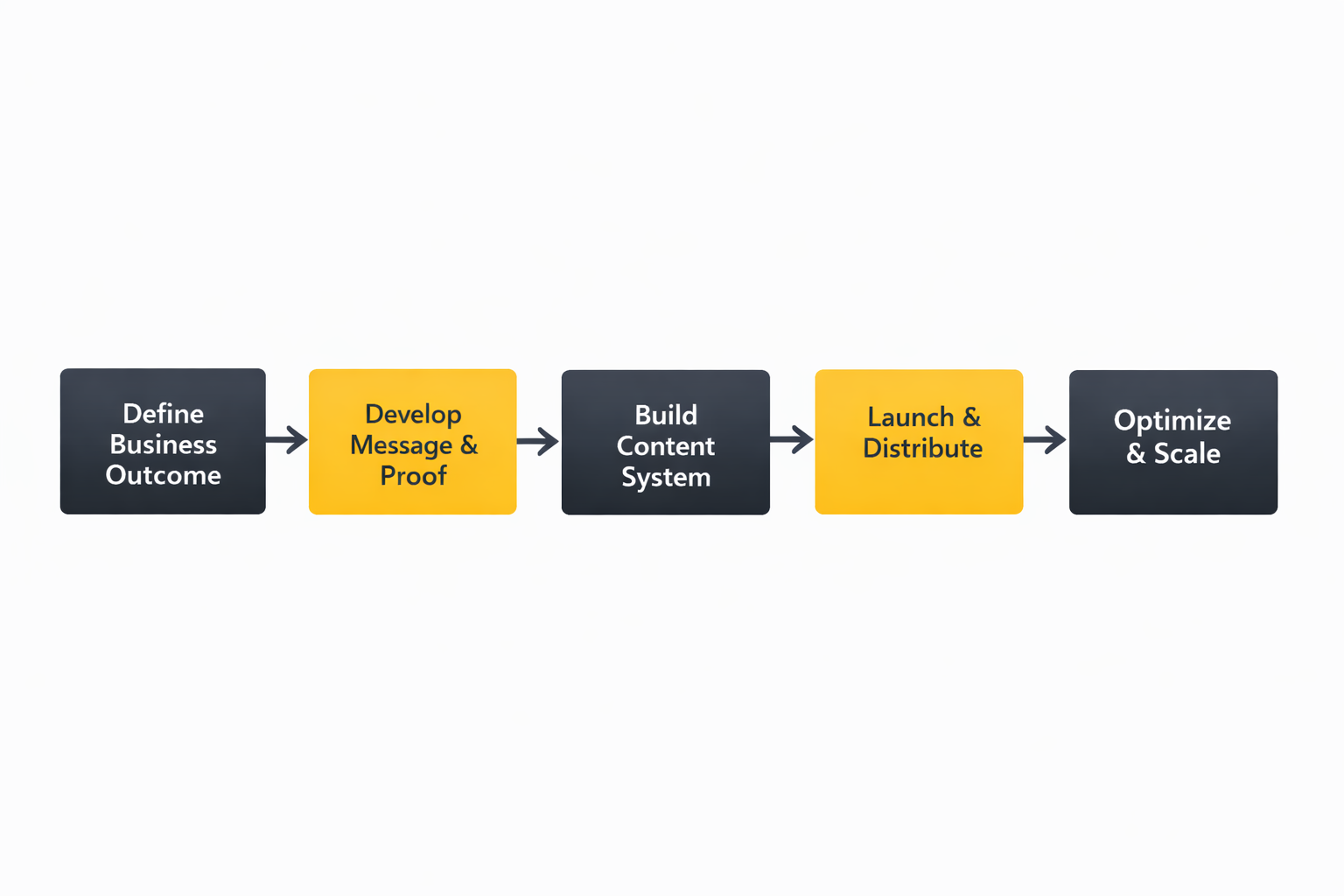
- Start with one business outcome. Clarity beats complexity when you’re building momentum.
- Build message and proof before “more content.” If the promise is vague, no volume will save it.
- Run a creative system, not a calendar. A system creates learning loops and repeatable wins.
- Scale through standardization. Winning units should be documented and reproduced, not rediscovered.
- Measure for decisions, not vanity. Calibrate platform reporting with experiments when stakes rise, using modern measurement principles like the ones outlined in Google’s Modern Measurement playbook.
- Protect trust as a performance variable. Provenance, disclosure, and transparency are increasingly tied to long-term results, as debates about authenticity labeling show in recent coverage of C2PA adoption and friction.
FAQ – Built for This Complete Guide
1) What does “social media and business marketing” really mean in practice?
It means using social platforms as a full business system, not a posting habit. You create demand (attention and trust), capture demand (clicks, leads, purchases), and prove demand (measurement that stakeholders believe). This system thinking matters more as budgets shift toward measurable formats like digital video, highlighted in IAB’s video ad spend reporting.
2) Should I prioritize organic content or paid social first?
Prioritize what gives you learning speed. Organic helps you learn messaging cheaply. Paid helps you learn faster with control and scale. A practical pattern is to validate hooks and proof organically, then amplify the winners through paid distribution, while keeping measurement solid through setups like Meta Pixel conversion tracking and server-side options like Meta Conversions API.
3) What metrics matter most if leadership only cares about revenue?
Use revenue-adjacent metrics that show movement toward purchase: qualified leads, booked calls, conversion value, and retention. When attribution is debated, bring in calibration logic from experiments and incrementality principles described in Google’s modern measurement framework.
4) How do I know if my tracking is “good enough” to scale?
Tracking is “good enough” when you can answer two questions consistently: what actions happened, and where they came from. For many teams, that means pairing browser tracking with server-side events where possible, supported in platform docs like Meta Conversions API and TikTok’s Events API overview.
5) Are creators worth paying for, or should I build everything in-house?
Creators are increasingly a budget category because they can compress trust-building. Market signals show the channel’s scale, including IAB’s reporting of creator ad spend at $29.5B in 2024 with a projection of $37B in 2025. The best results usually come from pairing creator authenticity with a clear amplification plan and measurable outcomes.
6) What’s changing with ad transparency laws and what should marketers do?
Expect stricter transparency expectations, especially in the EU, where advertising repositories and transparency obligations are part of DSA enforcement. The European Commission summarizes these requirements in its DSA impact overview, and enforcement pressure has been visible in coverage like Reuters’ reporting on DSA charges tied to ad transparency. For marketers, this means cleaner documentation, clearer disclosures, and tighter governance around targeting claims.
7) How do I handle influencer disclosures without killing performance?
Make disclosures normal and consistent so they don’t feel like a disruption. The FTC’s guidance emphasizes that material connections should be disclosed clearly in influencer marketing, explained in the FTC’s endorsements and influencers hub and formalized in the Federal Register’s revised Endorsement Guides publication.
8) Is social search actually replacing Google?
It’s less “replacement” and more “fragmentation.” People search differently depending on intent: quick opinions and recommendations often happen on social; deeper research often still happens on traditional search. Evidence of social search behavior shows up in multiple sources, including Forbes’ coverage of Gen Z using Instagram and TikTok for search and broader platform usage context in Sprout Social’s Gen Z data.
9) How do I protect my brand when AI-generated content becomes everywhere?
Build a trust policy: what you will and won’t generate, what you disclose, and how you verify claims. Provenance standards and authenticity labeling debates show why this matters, including platform friction described in coverage of C2PA labels and AI slop. The goal is not perfection. The goal is consistent integrity.
10) What’s the fastest way to improve results without increasing budget?
Fix the conversion path and follow-up speed. Most teams leak value after the click or DM: slow response, unclear next steps, weak proof, or confusing offers. In parallel, improve signal quality so you can learn faster using stable tracking approaches like Meta Pixel conversion tracking and server-side event collection like Meta Conversions API.
11) How do I decide what to test next when I have too many ideas?
Pick the biggest bottleneck first: attention, trust, intent, or conversion. Then test one variable at a time: hook, proof type, offer framing, or landing page structure. Keep your interpretation grounded in modern measurement thinking, including the calibration approach described in Google’s playbook.
Work With Professionals
If you’ve been doing everything “right” and it still feels like you’re pushing a boulder uphill, it’s usually because you’re missing one thing: a steady pipeline of real opportunities where your skills are the obvious solution. That’s the part most marketers and freelancers never systemize, and it’s why their social media and business marketing feels like constant hustle instead of compounding momentum.
Markework is built around a simple idea: remove the middleman friction so marketers and companies can connect directly. The platform positions itself as a marketing marketplace for hiring talent or landing your next gig, and it’s explicit about how it works: no project fees, direct communication, and a focused marketplace for marketing roles.
If you want proof that the marketplace is active, the listings page shows real volume right now, including 1007 active listings visible as “Showing 6 of 1007 active listings”. That matters because a pipeline changes how you work: you stop pitching into the void and start choosing the best-fit opportunities with clarity and confidence.
The offer model is also straightforward. Pricing is subscription-based and stresses no commissions and no project fees, so your earnings aren’t shaved down per contract. And because communication is direct, you can move faster, negotiate scope cleanly, and build relationships that lead to repeat work instead of one-off gigs.
If you’re ready to turn your skills into consistent work—without giving up a percentage every time you get paid—start here:
 Filip Konecny Enterprises