

Most brands don’t struggle because they “need more content.” They struggle because their social presence isn’t built like a system. Posting feels busy, results feel random, and every new campaign starts from scratch.
A solid social marketing strategy fixes that by turning social from a stream of posts into a repeatable growth engine. It clarifies who you’re trying to move, what you want them to do next, and how your content, community, and paid distribution work together.
This first part builds the foundation: a clear definition, why it matters now, a framework you can use, and the core components that keep execution sharp when the algorithm (and your priorities) inevitably change.
Article Outline
- What Is a Social Marketing Strategy?
- Why a Social Marketing Strategy Matters
- Framework Overview
- Core Components
- Professional Implementation
What Is a Social Marketing Strategy?

A social marketing strategy is the plan that connects your business goals to what you do on social platforms day to day: the audiences you prioritize, the messages you want remembered, the content you publish, the conversations you spark, and the distribution you pay for.
It’s easy to confuse “strategy” with a content calendar. A calendar is scheduling. Strategy is intent. It answers uncomfortable questions like: what does success look like in numbers, what are we willing to stop doing, and what must be true for social to actually contribute to revenue (or impact) instead of just “engagement.”
One important note on wording: “social marketing” also exists as a discipline in public health and behavior change (think anti-smoking campaigns, safety initiatives, or sustainability programs). The mechanics overlap (audience insight, messaging, behavior design), but in this article we’re focusing on the modern business meaning: using social platforms to drive commercial outcomes while still respecting trust, relevance, and community.
When your social marketing strategy is doing its job, you can explain your choices without hand-waving. You know why a post exists, who it’s for, what action it should trigger, and how it fits into a bigger journey that makes people more likely to buy, renew, refer, or advocate.
Why a Social Marketing Strategy Matters
Social isn’t a side channel anymore. At the start of 2025, platforms reached 5.24 billion social media user identities, which is exactly why “just show up and post” became the default. But scale cuts both ways: when everyone can publish, attention becomes expensive, and randomness stops working.
What’s changed is not simply volume. It’s where social sits in the customer journey. Brand discovery is increasingly social-adjacent: people find products through creators, recommendations, short-form video, and social ads, then validate with reviews, search, and community. That’s why discovery data like how consumers report finding new brands matters more than vanity follower counts.
Meanwhile, money keeps moving toward digital and social behaviors. In the US market, the IAB and PwC reported that social media advertising revenue reached $88.8B in 2024. And at the budget level, creators are no longer experimental; the IAB projects creator economy ad spend climbing to $37B in 2025, because creator distribution can outperform brand channels when trust and cultural relevance are the bottleneck.
There’s also a quieter reason strategy matters: consumer tolerance is thinner than most brands admit. When feeds feel repetitive or manipulative, people disengage, and you pay more for less. That’s why you’ll see serious teams treat social like a product: testing messages, tightening creative feedback loops, and building a content system that earns attention instead of demanding it.
Framework Overview
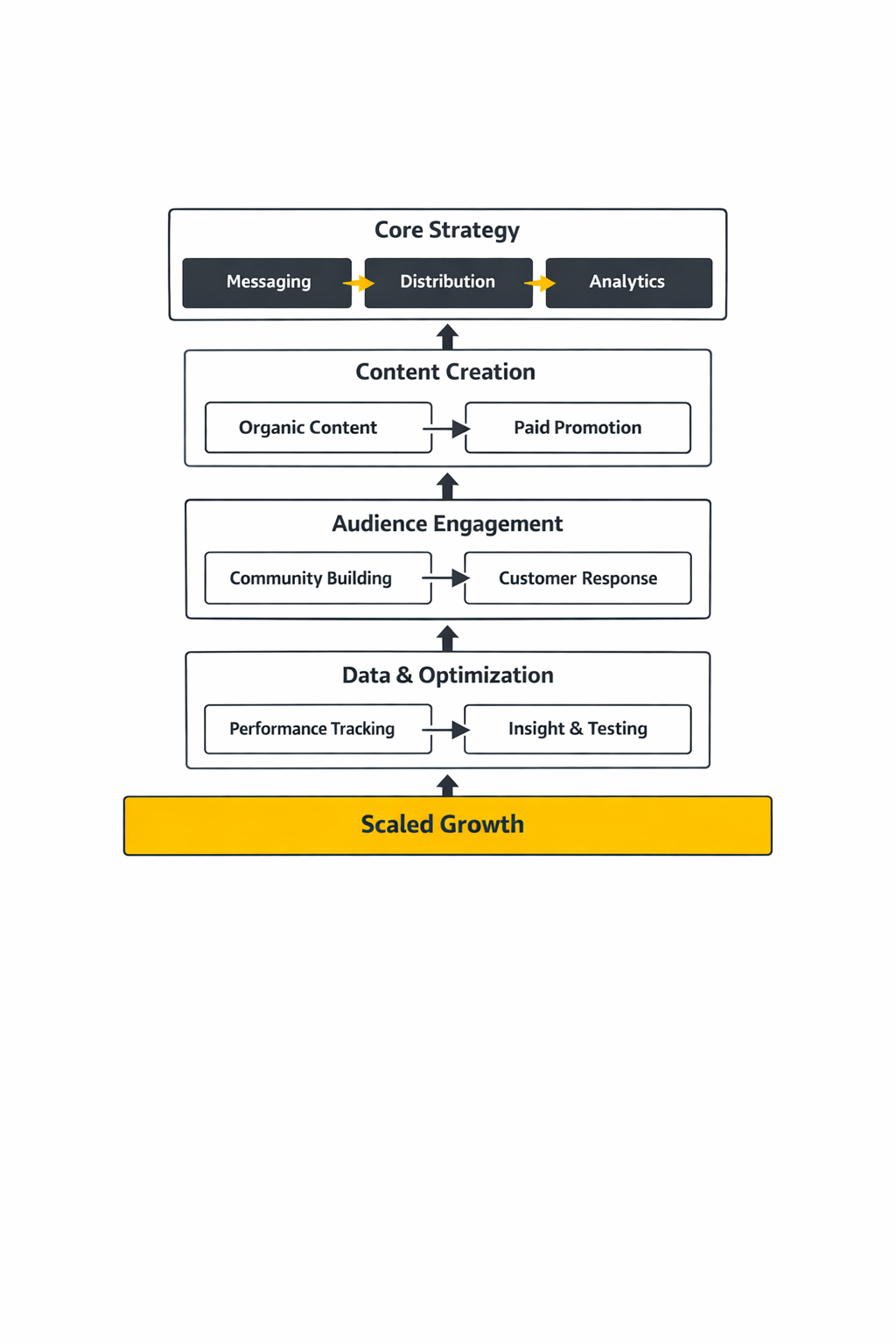
The cleanest way to build (and troubleshoot) a social marketing strategy is to think in five connected layers. When performance dips, you diagnose the layer that’s actually broken instead of panicking and changing everything at once.
- Goal: The measurable business outcome social is responsible for influencing (not “more awareness,” but a defined pipeline, retention, or conversion result).
- Audience: The specific people you’re trying to move, what they care about, and what stops them from taking action.
- Positioning: The message you want to own in their mind, plus proof that makes that message believable.
- Experience: The content, community, and customer touchpoints that deliver the message repeatedly without feeling repetitive.
- Distribution: The mix of organic, creator partnerships, and paid spend that ensures your best ideas actually reach the right people.
This framework keeps you honest. If your content looks good but sales don’t move, it’s often not a “creative problem.” It’s usually a mismatch between goal and measurement, an unclear audience, a weak offer narrative, or distribution that’s relying on luck.
Core Components
Below are the pieces that show up in every strong social marketing strategy, regardless of platform mix or industry. Think of them as the minimum viable structure that prevents your social program from becoming a pile of disconnected tactics.
1) A Single Primary Objective (and a Secondary One)
Pick one primary outcome for a period (a quarter is a good default): pipeline creation, trial starts, booked calls, repeat purchases, app installs, event registrations, or retention. Then pick one secondary objective that supports it, like improving speed of response or increasing saves on educational posts to strengthen mid-funnel intent.
This matters because social is a multi-touch channel. If you try to optimize one post for reach, another for conversions, and another for community sentiment without a clear hierarchy, you’ll constantly argue with your own data.
2) A Defined Audience Slice You Can Recognize
“Small businesses” is not an audience. A usable audience slice is something you can picture: the role, the context, the anxiety, and the trigger that makes them pay attention. The tighter the slice, the easier it is to write content that feels like it was made for one person instead of “for everyone.”
Good strategy teams also separate buyers from amplifiers. On social, the people who share and comment are not always the people who purchase, but they often influence the people who do.
3) Message Pillars That Don’t Drift
Message pillars are the few ideas you want repeated so often they become associated with you. Most brands drift because every new post is a new angle, a new offer, or a new personality. Consistency doesn’t mean being boring; it means making your value obvious from multiple angles, over time, without changing what you stand for.
4) Content Types Mapped to Intent
Not all content earns the same kind of attention. A practical social marketing strategy includes a deliberate mix:
- Discovery content that earns first-time attention (short-form video, bold opinions, sharp hooks).
- Trust content that proves competence (breakdowns, behind-the-scenes, comparisons, “how it works”).
- Conversion content that makes next steps frictionless (offers, demos, FAQs, proof, objections handled).
- Community content that turns your audience into participants (questions, duets/remixes, UGC prompts, feedback loops).
This approach matches how behavior actually forms: attention first, then belief, then action, then identity (“this brand is for people like me”).
5) A Distribution Plan That Matches Reality
Organic reach can be unpredictable, and that unpredictability is exactly why strategy requires distribution decisions. A modern plan typically combines:
- Owned (your brand account and email/site paths)
- Paid (boosting winners, retargeting engagers, and controlled acquisition)
- Partnered (creators, communities, affiliates, and collaborations)
Creator investment is rising for a reason: it’s one of the fastest ways to borrow attention and credibility when you haven’t earned it yet on your own channels, which aligns with the market trend of creator advertising growing rapidly.
Professional Implementation
Strategy only becomes valuable when it survives real-life constraints: limited time, shifting priorities, inconsistent stakeholders, and the constant temptation to chase whatever went viral yesterday.
Professional implementation means turning your social marketing strategy into operating habits. You document decisions, you build lightweight workflows, and you measure the few signals that tell you whether the system is improving or degrading. That way, the team doesn’t “start over” every month—it compounds.
In the next parts of this article, we’ll translate the framework into practical execution: how to set objectives you can defend, how to design content pillars that don’t drift, how to run creator and paid distribution without wasting budget, and how to build analytics that drive better creative decisions instead of just reporting numbers.
Step By Step Implementation
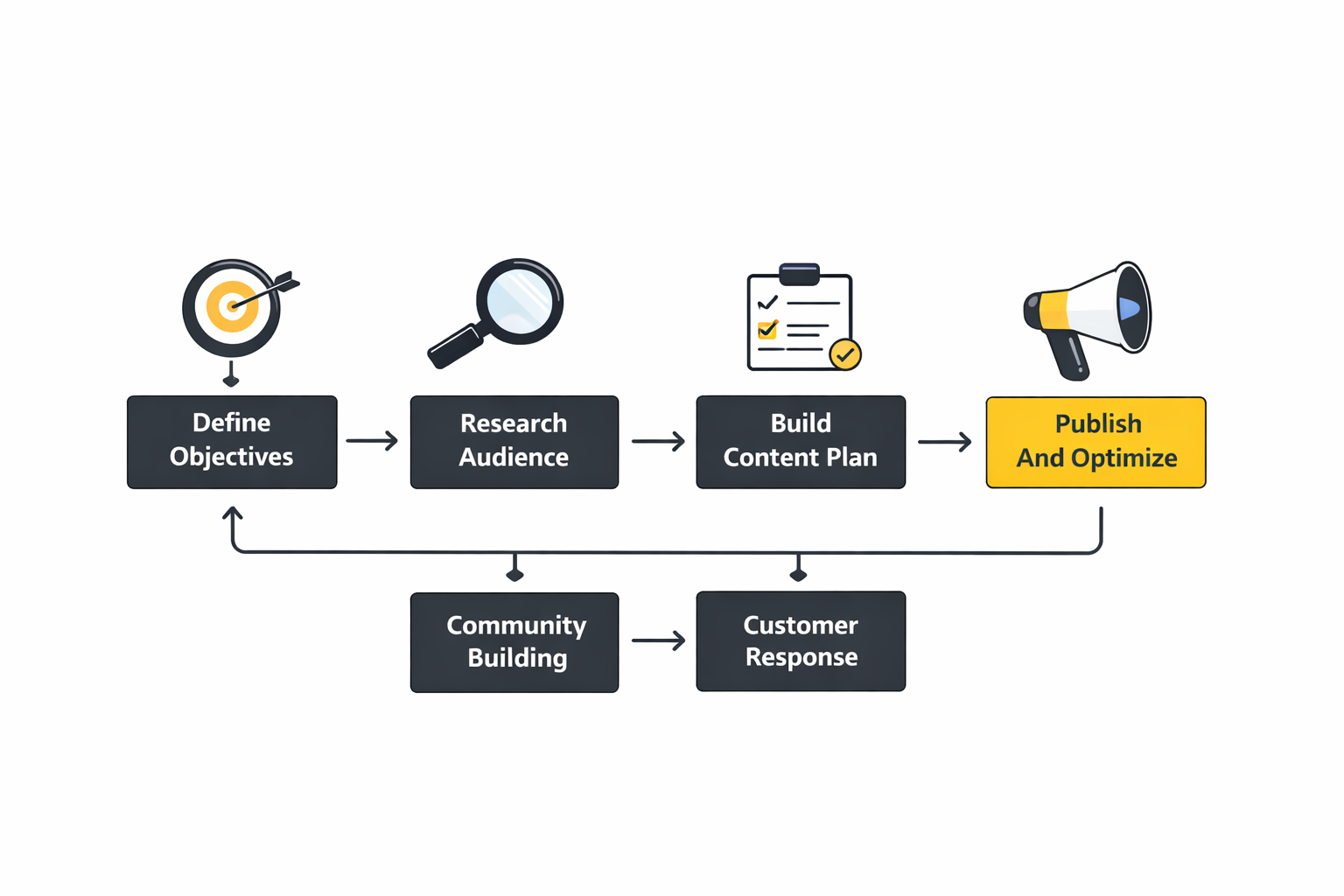
A social marketing strategy only becomes “real” when it turns into repeatable weekly behavior. The goal here isn’t to build a giant deck. It’s to build a system you can run, improve, and defend when priorities shift and everyone wants results yesterday.
This step-by-step flow is designed to keep decisions crisp: you’ll define outcomes, narrow the audience, lock the message, build a content and distribution plan, then instrument measurement so optimization is based on evidence instead of opinions.
Step 1: Set A Single Outcome You Can Prove
Pick one primary outcome for a cycle, then describe what “better” looks like in measurable terms. If your outcome is lead generation, decide what qualifies as a lead, where it lands, and how quickly it should be followed up. If your outcome is retention, define the behavior you’re trying to increase and how social will influence it.
Measurement is where teams get stuck, so make it boring and auditable early. Build your campaign URLs with GA4 campaign parameters and treat naming conventions like a shared language, not a personal preference. When stakeholders ask why you believe social is driving change, you want to point to a clean trail, not a messy guess.
Step 2: Choose An Audience Slice You Can Recognize
Write down the exact slice you’re prioritizing for the next cycle: role, context, and problem. Then write the “why now” trigger that makes them pay attention this month, not someday. A tight slice keeps your creative sharper, your targeting cleaner, and your analysis more meaningful.
If you’re doing paid social, tie this step to trackable conversion signals. For B2B, make sure your site and conversion tracking are set up through something like the LinkedIn Insight Tag so you’re not optimizing for clicks that never become pipeline. For TikTok and other performance placements, instrument events with the TikTok Pixel setup so your optimization loop has real feedback.
Step 3: Lock Your Message Pillars
Choose three to five message pillars you want to own. Each pillar should include one promise and the proof that makes that promise believable. If your message can’t be supported by evidence, your audience will feel the gap, and your content will start relying on louder hooks instead of stronger credibility.
To keep pillars from drifting, write one “what we refuse to do” line for each. It sounds strict, but it protects your strategy from slowly turning into generic noise. This is also where listening helps, because conversation trends can show what the market actually cares about, which is exactly why research like Deloitte Digital’s State of Social research emphasizes social-first brands building around community, content, and conversion instead of broadcasting.
Step 4: Build A Content System, Not A Calendar
A calendar is dates. A content system is repeatable formats that make creation faster and outcomes more consistent. Pick a few formats you can ship weekly, then map each format to intent: discovery, trust, conversion, or community.
Make your system realistic for the team you actually have. If you’re one person, you want formats that can be produced in batches and reused with small edits. If you’re a team, you want formats with clear handoffs and approvals, using a process that makes accountability visible, like an Airtable-style content workflow similar to this marketing content calendar approach.
Step 5: Decide Distribution Before You Post
Distribution is not something you do after a post “does well.” Decide in advance how winners will be amplified, how retargeting will work, and what role creators or partners will play. If creator collaboration is part of your plan, treat it like a channel with standards, not a one-off experiment, especially as the market continues investing in creator partnerships, reflected in coverage of the growth of LinkedIn’s creator and publisher video program.
If you’re testing, keep tests clean. Change one major variable at a time: hook, offer framing, creative style, or audience segment. When you change everything at once, your “learning” is just a story you tell yourself.
Step 6: Instrument Measurement And Use Incrementality When It Matters
Attribution is useful, but it can be misleading when platforms overlap and people discover you in one place and convert in another. That’s why incrementality approaches exist: they help you isolate what your media actually caused, not what it happened near.
If you have budget and volume, consider lift testing methods when you need stronger proof. Meta’s own case materials discuss using Conversion Lift with search lift methodology to evaluate incremental impact in real campaigns. And measurement research continues to push teams toward mixed approaches, which is one reason academic reviews like this 2025 study of marketing-mix models, attribution, and incrementality focus on building confidence through multiple measurement lenses rather than betting everything on last-click.
Execution Layers
Execution gets easier when you split your social marketing strategy into layers. Each layer has a job, a cadence, and an owner, so the work doesn’t collapse into “post more” when results dip.
Layer 1: Strategy And Guardrails
This is where the non-negotiables live: the outcome you’re driving, the audience slice, the message pillars, and the rules that keep quality consistent. It also includes governance decisions like approval requirements, escalation paths, and what content is off-limits. When teams skip guardrails, they end up re-litigating the same debates every week.
Layer 2: Creative Production
Production is where many strategies silently die, because teams plan ideas they can’t consistently ship. The fix is standardization: templates for hooks, structures for carousels or videos, and a repeatable review process. If your work spans multiple contributors, you want approvals that are clear and binary, using a mechanic like approval workflows instead of vague comment threads.
Layer 3: Community And Care
Social is a two-way channel, and ignoring that reality weakens both trust and performance. Community management needs its own rhythm: response standards, tagging, and escalation. If your brand handles high volume, it helps to align social messaging with customer care systems that support routing and channel management, like the way platforms describe social messaging workflows in Zendesk.
Layer 4: Paid Distribution
Paid is how you control reach, speed up learning, and turn your best creative into predictable delivery. The job here is structure: campaigns aligned to outcomes, audiences aligned to intent, and creative tests that actually teach you something. When paid is treated as a random boost button, you get random results and no learning.
Layer 5: Analytics And Insight
Analytics should answer two questions: what’s changing, and why. Reporting that only lists metrics doesn’t move a strategy forward; it just documents activity. Tools like Looker Studio data sources are useful when stakeholders need a shared view, and warehousing approaches like BigQuery documentation become relevant when you need stable historical reporting across platforms.
Optimization Process
Optimization is not “tweak the caption.” It’s a cycle of hypothesis, test design, measurement, and decisions that compound over time. When it’s done well, your social marketing strategy gets sharper every month without burning out the team.
The Weekly Loop
Once a week, review performance at the level of themes and formats, not individual posts. Identify what is consistently pulling the right kind of attention, what’s stalling, and what’s driving meaningful actions. Then decide what to repeat, what to improve, and what to stop.
This is where benchmarks help you stay grounded without copying competitors. Reports like the Emplifi Social Media Benchmarks Report 2025 are useful for sanity checks, but the real goal is internal progress: are your best formats improving because you’re learning, or because you got lucky?
The Monthly Loop
Monthly reviews should focus on strategy alignment. Are you still targeting the right audience slice, or are you accidentally optimizing toward the easiest engagement? Is your message still consistent, or have you drifted into generic content that feels safe but doesn’t move outcomes?
Use monthly reviews to plan deeper tests. If you’re testing creative direction, message framing, or channel mix, keep the test clean and instrument it properly. Brands and platforms are increasingly emphasizing measurement rigor, which shows up in content like TikTok’s discussion of building a measurement mindset and references to incremental testing in real performance programs.
The Quarterly Loop
Quarterly is where you make bigger calls: platform prioritization, budget allocation, and whether your strategy is still a fit for market reality. This is also the right cadence for re-validating the ecosystem you operate in, including how discovery and content consumption are shifting on social video platforms, which is a theme covered in research like Deloitte’s Digital Media Trends.
Implementation Stories
Implementation stories matter because they show what changes when teams commit to a system. The best ones aren’t “we posted more.” They’re “we got serious about measurement, creative structure, and operational discipline, and the results became easier to prove.”
Gruvi Turned Holiday Pressure Into A Measurable Social System
The pressure hit right before the holidays, when every brand competes for the same attention and every budget decision gets questioned. Sales targets were looming, and the team couldn’t afford to rely on “it feels like it’s working.” The worst part was knowing that if performance dipped, nobody would agree on why.
The backstory is familiar: holiday campaigns are high-stakes, and social is often expected to carry the load quickly. Gruvi needed to drive incremental sales in a noisy window, not just generate clicks that looked good in a report. They also needed measurement that stakeholders would trust after the season ended.
The wall was attribution uncertainty. When buyers see ads in multiple places and convert later through other channels, last-click reports can undercount or miscredit social. That uncertainty makes teams either overspend on what looks measurable or underinvest in what is actually working.
The epiphany was to treat measurement as part of the strategy, not as a post-campaign argument. Gruvi’s campaign documentation highlights using a Meta Conversion Lift study with search lift methodology across a defined holiday period. Instead of debating outcomes, they designed the program to isolate impact.
The journey was operational, not magical. They aligned campaign structure and measurement, then used the lift approach to understand what the ads changed in the real world, beyond organic activity. That shift is the difference between running social as a creative hobby and running a social marketing strategy as a business system.
The final conflict is that lift testing adds constraints. You need clean tracking, stable setups, and patience to let the test run long enough to produce credible evidence. It’s tempting to keep tweaking mid-flight, but that usually breaks the clarity you were trying to gain.
The dream outcome is confidence: a team that can say what worked and why, without hand-waving. Even without turning the story into a pile of vanity metrics, the campaign description makes it clear that the goal was incremental impact measurement, not just activity reporting, which is the whole point of using a structured approach like Conversion Lift.
Jasper Used Full-Funnel Structure To Make LinkedIn Performance Less Random
The moment their messaging shifted, the old playbook stopped working. Campaigns that used to generate demand started producing inconsistent lead quality, and the team couldn’t afford to keep paying for attention that didn’t convert. Every stakeholder meeting drifted into the same uncomfortable question: are we building momentum, or just buying noise?
The backstory is that rebrands and repositioning can break performance if the funnel doesn’t match the new story. When you change how you talk about the product, you need a new structure for how people discover you, learn, and take the next step. Without that structure, your social marketing strategy becomes a set of disconnected posts trying to do everything at once.
The wall was efficiency and quality at the same time. It’s one thing to drive more leads; it’s another to drive the right leads at a sustainable cost. If you chase volume without quality, sales loses trust in marketing, and the whole system slows down.
The epiphany was to treat LinkedIn like a full-funnel environment, not a single placement. Jasper’s LinkedIn case study describes building a full-funnel approach during a rebrand, with results framed around qualified lead lift and cost efficiency. The focus wasn’t “post more,” it was “design the journey.”
The journey involved aligning creative and targeting to stages of intent. Top-of-funnel messaging established what the new brand stood for, mid-funnel content built belief, and lower-funnel offers made action easy for the right prospects. That’s the practical difference between a content plan and a social marketing strategy built to convert.
The final conflict is that full-funnel programs expose weak links fast. If your lower-funnel experience is unclear, your mid-funnel content can’t save you. If your targeting is too broad, your creative learns the wrong lessons and optimizes toward cheap engagement instead of qualified demand.
The dream outcome is a funnel you can operate with discipline. When you have a structured program, you’re not forced to reinvent the strategy every month because performance fluctuates. You iterate within a system, which is exactly what stories like Jasper’s full-funnel LinkedIn case study are useful for illustrating.
Define Roles And Decision Rights
Make ownership explicit: who sets goals, who owns the calendar, who approves, who publishes, who responds, and who reports. If decision rights aren’t clear, feedback becomes endless and timelines collapse. Clear approvals also reduce risk, which is why teams often formalize review mechanics with systems like structured approval workflows.
Build A Cadence That Compounds
Run weekly performance reviews focused on themes and formats, monthly reviews focused on strategy alignment, and quarterly reviews focused on channel and budget decisions. This cadence prevents panic pivots because you always have a scheduled moment to make bigger adjustments. It also gives stakeholders predictable visibility, which lowers the pressure for constant ad-hoc reporting.
Document Your Operating System
Write down your naming conventions, tagging standards, creative templates, and what qualifies as a “win.” It sounds basic, but documentation is how strategy survives team changes and growth. When measurement is part of the operating system, your analytics stop being a debate and start being a tool, supported by disciplined URL tagging like GA4 campaign parameters and centralized reporting foundations like Looker Studio data sources.
Treat Learning As An Asset
The biggest advantage you can build is not a viral post. It’s a library of evidence about what works for your audience: hooks that pull the right people in, messages that change minds, offers that convert, and distribution patterns that scale. When your team treats learning like an asset, your social marketing strategy stops being a monthly scramble and starts becoming a compounding system.
Statistics And Data
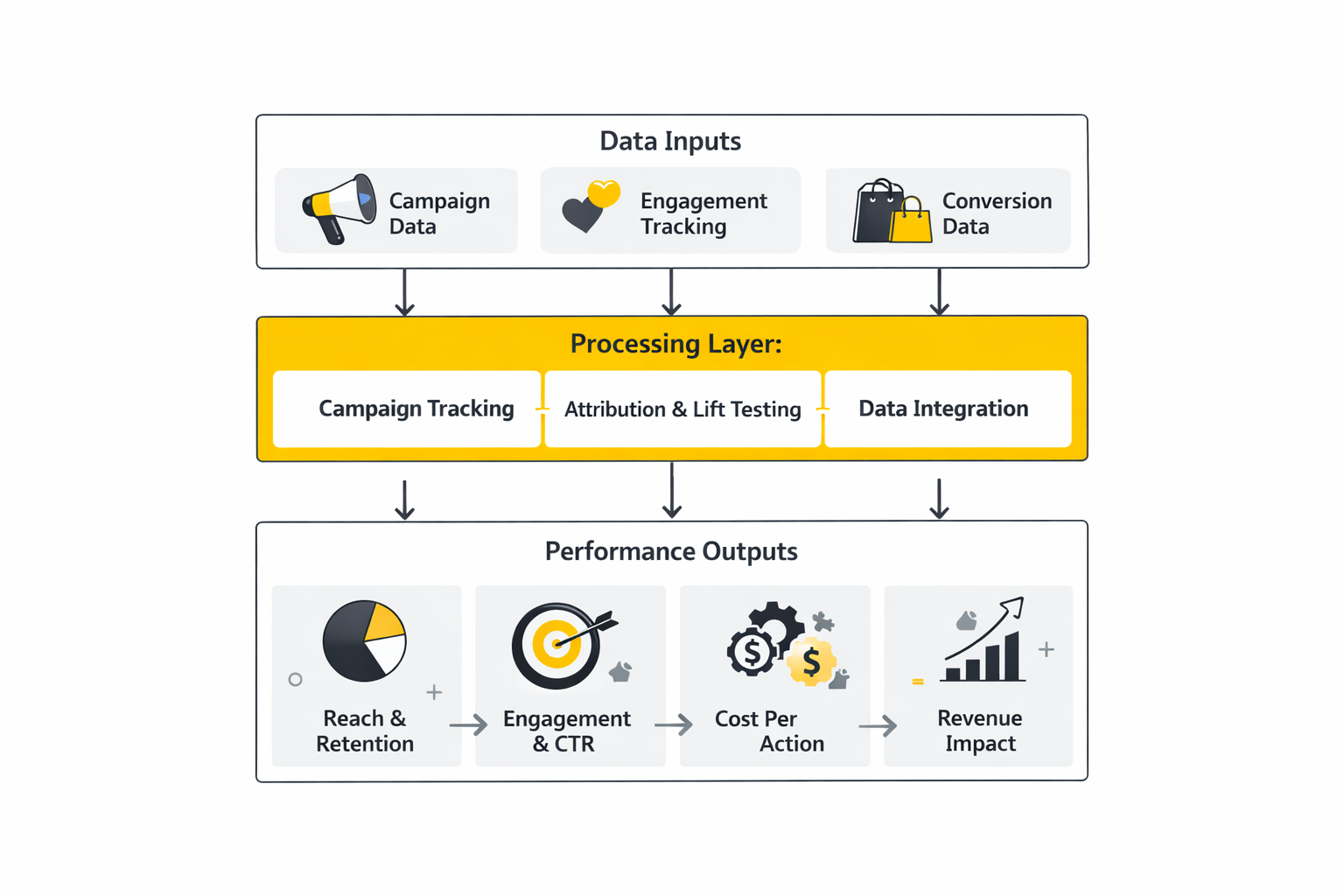
Analytics only helps a social marketing strategy when it reduces uncertainty. Not when it produces more dashboards. The simplest way to keep your data useful is to separate it into three layers: market context (what’s happening around you), platform delivery (what your distribution actually did), and business impact (what changed because of it).
Market Context: The Numbers That Explain The Environment
When someone asks, “Why is it harder to get attention this year?” market context gives you a grounded answer. Social and digital budgets have kept expanding, which raises competition and makes efficiency swings normal rather than alarming.
- US social media ad revenue: the market climbed to about $88.8B in 2024, a figure also summarized in IAB’s release notes and reported in coverage of the same dataset by Search Engine Land.
- European digital advertising growth: Europe reached €118.9B in 2024 with 16% growth, echoed in IAB Europe’s announcement and covered as an industry update by WARC.
- Creator partnerships turning into a budget line: US creator ad spend rose to $29.5B in 2024 and is projected to hit $37B in 2025, a projection also published on IAB’s newsroom and distributed through PR Newswire.
Platform Delivery: What The System Actually Did
This is where your social marketing strategy either becomes defensible or turns into vibes. Platform delivery data answers: did we reach the right people, often enough, with creative that held attention, and did distribution costs move in a direction we can explain?
One useful example is how platform economics shift even when your creative stays the same. Meta reported that the average price per ad increased 10% in 2024, a trend also shown in its full-year 2024 financial exhibit and summarized in its Q4 and full-year 2024 results release.
That kind of macro movement matters because it reframes what “good performance” looks like. If auctions tighten, your benchmarks should adjust before you start blaming the content.
Business Impact: The Evidence Stakeholders Believe
Business impact data connects activity to outcomes: incremental conversions, revenue lift, qualified leads, subscriptions, or retention behaviors. This is where many teams get trapped in last-click attribution debates, especially when multiple channels influence the same customer.
Incrementality methods exist specifically to reduce that argument. TikTok positions its Conversion Lift Study as an incrementality test, and Meta describes similar methodology through Conversion Lift studies with search lift approaches. The big idea is simple: if your social marketing strategy needs credibility, you measure what your campaigns caused, not just what they touched.
Performance Benchmarks
Benchmarks are guardrails, not goals. They keep you from overreacting to a single week, and they help you identify when something is truly broken. The professional move is choosing benchmarks that match your objective and your measurement model.
Benchmarks You Can Trust Without Copying Competitors
- Market benchmarks: use them to understand pressure and opportunity, like US digital ad revenue and category growth and Europe’s digital market growth.
- Platform benchmarks: use them to sanity-check format performance and directionality, like Emplifi’s view that short-form video formats remain strong across brands in its 2025 benchmarks report.
- Audience benchmarks: use them to validate expectations around social behavior and trust, which is why research like Deloitte Digital’s State of Social 2025 is useful for framing what people actually want from brands on social.
Benchmarks That Actually Help Optimization
When your goal is demand creation or lead generation, benchmarks should focus on signal quality. A high click rate means nothing if it produces low-intent traffic. In practice, teams use benchmarks to decide where to invest time:
- Top-of-funnel health: are your best formats consistently earning reach and engagement relative to your baseline?
- Mid-funnel trust: are saves, shares, and “I needed this” comments increasing on content built to educate and persuade?
- Bottom-funnel efficiency: are conversion events trackable through tools like GA4 campaign parameters and platform tags, so optimization isn’t guesswork?
If you want external benchmarks to calibrate expectations, pick sources that explain methodology and data volume, such as Emplifi’s cross-industry benchmark methodology and IAB Europe’s AdEx market reporting approach.
Analytics Interpretation
The most common analytics mistake is reading metrics in isolation. Interpretation is about relationships: which signals lead, which lag, and which are just noise. A social marketing strategy gets easier to run when everyone agrees on what each metric is allowed to “prove.”
Leading Signals Vs. Lagging Signals
Leading signals tell you whether the strategy is gaining traction before revenue shows up. Lagging signals tell you what the strategy ultimately produced.
- Leading: retention on videos, saves on educational content, positive sentiment in comments, profile visits from the right audience, repeat exposure from retargeting pools.
- Lagging: qualified leads, incremental purchases, booked calls, subscription starts, pipeline creation, revenue lift.
If you treat lagging signals like they should appear instantly, you’ll keep resetting your strategy before it has time to compound. That’s one reason measurement conversations increasingly emphasize experiments and incrementality, reflected in analysis like WARC’s discussion of why experiments are becoming more common.
Why Your Dashboard Can Lie
Dashboards can be accurate and still misleading if they’re missing context. Here are three common failure modes:
- Attribution bias: last-click reporting under-credits social when discovery happens on a platform but conversion happens later through another channel. That’s why tools like TikTok’s Conversion Lift Study and Meta’s lift testing approaches exist.
- Audience drift: the algorithm finds you cheap engagement from people who will never buy. Your strategy looks “healthy” until sales calls it out.
- Creative fatigue: distribution stays stable, but attention drops because formats are overused. You see it as a slow decline in hold time, saves, and share rate before conversion rates soften.
The Interpretation Habit That Changes Everything
Every review should end with a decision, not a summary. A professional analytics review inside a social marketing strategy answers:
- What should we repeat next week?
- What should we stop doing immediately?
- What is the single most important test to run next?
This is also where market context prevents panic. If the broader market is inflating, like the ongoing rise in creator spend documented in IAB’s creator economy report, it’s normal to see competition intensify and performance fluctuate even when your team is doing solid work.
Case Stories
Real case stories are useful because they show what changes when measurement becomes part of execution. Not as an afterthought, but as a design constraint from day one.
Aerie Used Lift Testing To Prove TikTok Search Ads Were Driving Incremental Purchases
The pressure point wasn’t a creative block. It was the holiday window, where budgets get judged brutally and “nice engagement” doesn’t save you when sales targets are looming. The team needed proof that their spend was creating incremental outcomes, not just shifting credit between channels. And they needed that proof fast, because the season doesn’t wait for perfect attribution.
The backstory is that TikTok had become part of how people discover products, but discovery and conversion don’t always happen in the same session. If you only look at standard attribution, you can end up undervaluing the moments that start the buying journey. That’s exactly why TikTok has been pushing measurement approaches like its Conversion Lift Study framework.
The wall was uncertainty around intent. Search behavior on TikTok was growing, but the team still had to justify adding a search component instead of putting everything into the familiar In-Feed mix. If they shifted budget and performance dipped, it would be blamed on the channel choice, not on the measurement gap. Without an incrementality test, the debate would turn into opinions and politics.
The epiphany was realizing they didn’t need a louder campaign, they needed a cleaner experiment. Aerie tested TikTok’s Search Ads Campaign alongside In-Feed Ads and used a lift study to isolate impact, described in TikTok’s write-up of how Search Ads Campaign drove incremental purchase lift. The details weren’t framed as vanity metrics; they were framed as incremental outcomes the business could understand.
The journey was a controlled pivot rather than a reinvention. They combined Search Ads Campaign with In-Feed Ads, then evaluated results with lift testing instead of hoping attribution would “figure it out.” TikTok’s materials describe the integrated setup producing more than a 3% lift in conversions, 3,800 incremental purchases, and a $2.64 iROAS, and the same results are captured in Aerie’s inspiration page for the Search Ads Campaign case overview. In other words, the strategy change came with measurement strong enough to defend it.
The final conflict is that lift testing forces discipline. You have to keep the setup stable long enough to learn, even when internal stakeholders want “quick optimizations” every few days. You also have to accept that the test might reveal uncomfortable truths, like a format you love not actually causing incremental conversions. That’s the trade: less freedom to tinker, more confidence in decisions.
The dream outcome is clarity at the exact moment teams usually lose it. Instead of arguing about which channel “deserved” credit, they could point to incrementality evidence. And when you can prove incremental purchases, your social marketing strategy stops being a content engine and becomes a growth system that can earn bigger bets.
Clarins Used Lift Measurement To Separate Real Impact From Nice-Looking Reporting
It started with a familiar kind of tension: plenty of activity, plenty of impressions, but rising pressure to prove what the spend was changing in the real world. When budgets tighten or leadership changes, “we’re getting good reach” is not a defense. The team needed something sturdier than attribution screenshots.
The backstory is that Clarins operates in a category where consideration matters. People don’t always buy the first time they see a product, and they may bounce between social, search, and retailer sites before converting. That journey can make social look weaker than it is if your measurement model only rewards the final click.
The wall was measurement credibility. If performance claims rely on one platform’s reporting alone, stakeholders eventually question whether the numbers are inflated or incomplete. Even strong teams get stuck here because the data is technically correct but strategically unconvincing. A social marketing strategy can’t scale inside a business when measurement is treated as debatable.
The epiphany was to treat lift testing as a confidence tool, not a “nice to have.” Meta’s case library describes Clarins evaluating campaigns using a conversion lift study alongside Google Analytics. Instead of trying to win the attribution argument, they changed the game and measured incrementality.
The journey was about building a campaign and a measurement approach that could survive scrutiny. The case description highlights the brand connecting social exposure to measurable business outcomes through lift-based evaluation methods, which helps teams explain impact in language leadership understands. It’s also a reminder that clean tracking discipline matters before you ever launch, supported by mechanics like consistent campaign parameters in GA4.
The final conflict is that lift measurement doesn’t eliminate complexity, it just replaces messy debates with better questions. If lift is lower than expected, you still need to diagnose whether the issue is creative, audience, offer, or landing experience. And because lift testing is more rigorous, it also makes it harder to hide behind vanity results. That can be uncomfortable, but it’s also where real improvement starts.
The dream outcome is a strategy that’s easier to defend and easier to improve. When you can separate “reported performance” from “caused impact,” you stop chasing superficial wins and start investing in what actually moves the business. That’s the difference between running social as content production and running a social marketing strategy as a measurable growth discipline.
Professional Promotion
This part isn’t about promoting a product. It’s about promoting the strategy itself inside your organization or to a client, so it gets the trust, budget, and runway it needs to compound.
Promote The Story, Not The Dashboard
Executives don’t want more charts. They want a confident narrative: what changed, why it changed, and what you’re doing next. Anchor the narrative in a few credible market signals, like digital ad market expansion in Europe and the scale of social advertising growth in the US, then connect it directly to your own results and decisions.
Sell Confidence With Measurement Rigor
If you want stakeholders to fund your social marketing strategy, make your measurement approach visible. Show your tagging discipline through consistent GA4 campaign parameters. When the stakes are high, show how you’ll validate incrementality with lift approaches, like TikTok’s Conversion Lift Study or Meta’s use of lift testing with search lift methodology. Rigor is persuasive because it reduces perceived risk.
Make The Ask Obvious
Promotion fails when it ends with “here’s what happened.” It succeeds when it ends with “here’s what we need.” Ask for one concrete resource tied to one concrete outcome: creative capacity for a high-performing format, budget to amplify proven winners, or time to run a lift test that turns uncertainty into confidence.
When you present your work this way, analytics stops being reporting and becomes leadership. And that is how a social marketing strategy earns the runway to get genuinely great.
Advanced Strategies
When a social marketing strategy is working, the next problem isn’t “what should we post.” It’s scale pressure. You need more output without lowering quality, more proof without drowning in reports, and more reach without becoming dependent on one platform’s mood.
Advanced strategy is mostly about control. You control who you’re speaking to, how often they hear your message, and how quickly you can turn what you learn into the next creative iteration. You also control risk by building measurement and workflow habits that survive growth.
Build A Full-Funnel Machine Instead Of A Single-Channel Plan
Scaling almost always fails when teams try to force every piece of content to do every job. A scalable social marketing strategy separates discovery, consideration, and conversion work so each stage can improve without fighting the others.
Full-funnel structure also makes budgets easier to defend, especially in B2B where stakeholders demand clarity. LinkedIn’s own customer story examples show how brands combine rich content formats and retargeting with Lead Gen Forms to drive dramatic efficiency shifts, including a 96% lower CPL for LSEG using Lead Gen Forms and a 79% increase in leads with steady CPL for SoSafe.
Scale Through Distribution, Not Just Production
Most teams try to scale by producing more. The smarter move is scaling the distribution of what already works. When you identify a format that consistently pulls the right audience, you amplify it, you repurpose it across placements, and you extend its life through paid and partner channels.
This is why creator collaboration and partner distribution keep growing into a structured budget line. The market signal is loud: US creator ad spend at $29.5B in 2024 with a $37B projection for 2025 is not “nice to have” money. It’s money following attention.
Learn Faster With Experiments Instead Of Opinions
At scale, small misreads get expensive. That’s why advanced teams use experiments to reduce uncertainty, especially when attribution gets messy across devices and channels.
Lift studies are one way to prove incremental impact when stakeholders don’t trust last-click. TikTok positions its Conversion Lift Study as an incrementality test, and Meta highlights similar measurement approaches in case libraries like campaign lift testing using search lift methodology. You don’t need to run these constantly, but you do want them in your toolkit for high-stakes budget decisions.
Scaling Framework
Scaling becomes simpler when you treat your social marketing strategy like an operating system. You’re not adding random tactics. You’re strengthening five scaling levers: focus, throughput, distribution, measurement, and governance.
Lever 1: Focus
Scaling demands ruthless prioritization. You pick the platforms where your audience actually behaves, the formats where you can win consistently, and the message pillars you can repeat without drifting into generic content.
One practical way to enforce focus is to set a “core channel” and a “support channel” for each quarter. Everything else becomes opportunistic experiments, not obligations.
Lever 2: Throughput
Throughput is the ability to ship consistently without panic. Templates, repeatable formats, and clear approvals make output predictable, which is what allows learning to compound.
If approvals are slow or political, scaling collapses. The fix is decision clarity: who can say yes, what “good” looks like, and what can go live without a committee.
Lever 3: Distribution
Distribution is how you control the pace of growth. Organic reach is valuable, but it’s not a reliable scaling mechanism on its own. Paid amplification and partner distribution let you push proven creative harder, faster, and more consistently.
On professional platforms, video is becoming a bigger lever for distribution. LinkedIn’s expansion of its video ad ecosystem, including BrandLink growth and metrics like video uploads up over 20% and views up 36% year-over-year, signals where attention is moving in B2B feeds.
Lever 4: Measurement
Scaling breaks when the team can’t explain results. The bigger the budget and the more stakeholders involved, the more your measurement needs to be consistent and auditable.
At minimum, you want disciplined campaign tagging through GA4 campaign parameters and a conversion-tracking setup that maps cleanly to outcomes. When stakes rise, incrementality tools like lift testing become the confidence layer that keeps strategy funded.
Lever 5: Governance
Governance is what keeps scaling from turning into chaos. It covers permissions, brand safety, escalation rules, and the operational discipline that prevents one rushed post from creating a reputation problem.
When governance is healthy, people move faster because they know the rules. When governance is vague, people move slower because every decision feels risky.
Growth Optimization
Optimization at scale is less about tiny tweaks and more about compounding advantages. You want the kind of growth where each month’s learning makes next month cheaper, faster, or more effective.
Build A Creative Feedback Loop That Rewards Winners
At scale, your best creative should earn more distribution automatically. The moment you find a format that reliably performs, you systematize it: variations, reuse, and amplification plans are baked into production.
This is how teams avoid the “one viral post” trap. They don’t celebrate the spike and move on. They extract the pattern and build it into the content system.
Protect Quality By Killing Work
The most underrated optimization lever is stopping. Scaling usually adds work until the team is exhausted, then quality drops, and performance follows. The fix is explicit de-prioritization: you remove formats that don’t contribute, even if they’re familiar or easy.
Benchmarks help you avoid emotional decisions, but the real standard is your own trajectory. Reports like the Emplifi Social Media Benchmarks Report 2025 are useful sanity checks, but internal progress is what compounds.
Align Social With Sales And CRM To Unlock Real Scale
True scaling happens when social doesn’t end at the click. When social and sales share definitions (MQL, SQL, SAL), reporting becomes less political and more useful. The strategy becomes a revenue system instead of a content machine.
This is where integration matters. SoSafe’s story highlights connecting LinkedIn Campaign Manager with marketing automation and CRM tools so lead scoring and nurturing could be tracked across the lifecycle, not just inside the ad account, described in SoSafe’s LinkedIn customer case study.
Scaling Stories
Scaling stories are valuable because they show what changes when a social marketing strategy is treated as an operating system. Not a campaign. Not a sprint. A system.
SoSafe Scaled Lead Generation By Treating Measurement And Integration Like The Strategy
The pressure started quietly, then suddenly became impossible to ignore. The team was generating leads, but leadership wanted proof that LinkedIn deserved a bigger, more permanent budget line. Every time they tried to defend spend, the conversation drifted into doubt: “Are these leads real, and do they turn into pipeline?”
The backstory is that SoSafe was growing, and growth creates a new kind of stress. Awareness and demand generation can’t be “nice marketing wins” when inside sales needs predictable volume and quality. The team had also been marketing on LinkedIn since early 2021, so expectations were rising: if you’ve been running long enough, people assume you should have certainty by now.
The wall was measurement credibility across the lead lifecycle. If a lead moves through nurturing, gets scored, gets accepted by sales, then becomes pipeline later, platform-level reporting doesn’t tell the full story. Without lifecycle clarity, a social marketing strategy looks like a cost center, even when it’s warming the right accounts.
The epiphany was realizing they didn’t need more reporting; they needed a tighter system. They integrated LinkedIn Campaign Manager with marketing automation and CRM tools so data could flow cleanly, described in SoSafe’s customer case study on LinkedIn. They also formalized lead scoring and nurturing so sales and marketing could talk about readiness in the same language.
The journey was full-funnel by design, not by buzzword. Top-funnel content built awareness and educated a broader audience, then mid- and bottom-funnel offers captured leads with actionable resources like a cyber security audit, documented in the solution section of the SoSafe story. ABM layers were added for industry-specific audiences so the team wasn’t forced to choose between volume and relevance.
The final conflict was operational, not creative. Integrations don’t magically work forever, and alignment isn’t a one-time meeting. The team had to keep data hygiene clean and keep marketing and sales aligned on objectives and actions, called out as a success factor in SoSafe’s “Data integration and internal alignment” section.
The dream outcome is the kind of result leadership can’t wave away. In nine months, SoSafe increased lead volume by 79% while maintaining cost-per-lead, and share of Sales Accepted Leads generated from LinkedIn jumped 213%. That’s what scaling looks like when the strategy is built around lifecycle proof rather than surface-level metrics.
Position Scaling As Risk Reduction
When you ask for more budget or more headcount, people hear “more risk.” Your job is to make scaling feel safer by showing the system behind it. Emphasize measurement rigor and explainability, using stable practices like GA4 campaign parameter discipline and, when needed, incrementality tools like lift testing.
Make The Investment Case With Market Signals
Scaling isn’t happening in a vacuum. Budgets follow attention, and attention is shifting toward creator-led and video-heavy environments. Market signals like the continued acceleration of creator ad spend and platform shifts like LinkedIn’s growing emphasis on video help stakeholders understand why your strategy needs to evolve.
End With A Specific Ask
Professional promotion fails when it ends with “look at this performance.” It succeeds when it ends with a clear request tied to a clear outcome. Ask for one investment that unlocks scale: a budget pool to amplify proven winners, a creator partnership line item, or integration work that turns social into a lifecycle engine.
That’s how a social marketing strategy grows from a set of tactics into something a business can confidently build on.
Future Trends
The fastest way to future-proof a social marketing strategy is to stop treating platforms like “channels” and start treating them like ecosystems: recommendation engines, commerce layers, and customer-service surfaces that just happen to look like feeds.
That shift is already visible in where budgets are moving. Social and creator-led advertising keeps expanding as a serious line item, including the IAB’s reporting of $29.5B in US creator ad spend in 2024 and a $37B projection for 2025. When money goes there, it’s usually following attention and conversion behavior, not hype.
Social As Search Becomes A Default Behavior
People increasingly use TikTok, Instagram, and YouTube the way they used Google a decade ago: to decide what’s worth buying, where to go, and which brand to trust. That matters because it changes what “SEO” means inside a social marketing strategy.
If your content isn’t structured to be found later, it won’t compound. The strongest signals tend to look like practical value: problem/solution titles, clear on-screen text, and repeatable formats people return to. You can see this shift being discussed in trend reporting like HubSpot’s 2025 Social Media Trends Report, where it frames social discovery as a primary brand research behavior.
Community And Customer Service Move From “Nice” To “Necessary”
Communities aren’t just engagement engines anymore. They are retention engines, feedback loops, and customer-care queues. Deloitte Digital’s State of Social Research 2025 frames social-first brands as doubling down on community, content, and conversion because efficiency and impact can coexist when the operational layer is strong.
This has a practical implication: a scalable social marketing strategy starts budgeting for community management and response quality, not only creative production. If your comments and DMs look like an abandoned inbox, your best content can still lose trust.
Social Commerce Keeps Flattening The Funnel
The funnel isn’t dead, but it’s definitely folded. People discover, evaluate, and sometimes purchase without leaving the platform, which forces brands to design content that sells without feeling like an ad.
Consumer willingness to buy directly inside social platforms is also becoming harder to ignore. Deloitte’s social commerce overview highlights that 72% of consumers surveyed were willing to buy directly within social media platforms. That doesn’t mean every brand should rush into native checkout, but it does mean your social marketing strategy should treat product education and buying friction as part of the content plan.
AI Raises Output, But Trust Becomes The Bottleneck
AI makes production faster, and that’s exactly why authenticity becomes more valuable. The risk isn’t just “low-quality content.” The risk is a trust collapse where audiences assume everything is synthetic or manipulative.
Platforms and regulators are responding with labeling and transparency expectations. Meta outlined its approach to labeling AI-generated images across Facebook, Instagram, and Threads, while EU policy work like the Code of Practice on marking and labelling AI-generated content is explicitly tied to transparency obligations. The takeaway for your social marketing strategy is simple: disclose what needs disclosing, build recognizable human voice, and use AI to amplify clarity, not to impersonate authenticity.
Regulation Pushes Transparency Into The Workflow
In Europe, transparency requirements are no longer theoretical. The Digital Services Act is already shaping how platforms handle reporting, advertising transparency, and data access, as shown in EU guidance like how the DSA enhances transparency online and official Commission summaries such as Digital Services Act: keeping us safe online.
For marketers, the practical change is governance: clear approval rules, clean ad disclosure habits, and creator agreements that account for transparency and brand safety. A future-ready social marketing strategy treats compliance as part of production, not a last-minute legal panic.
Strategic Framework Recap

Here’s the simplest way to remember the full social marketing strategy you’ve built across this guide: it’s an ecosystem that connects message, distribution, and measurement into a loop that gets smarter over time.
What You’re Building
- A clear narrative: message pillars that are repeatable, memorable, and specific enough to be owned.
- A distribution plan: organic formats that earn attention and paid amplification that extends winners.
- A measurement spine: tracking discipline and decision-focused reviews that lead to action, not slides.
- A compounding system: every week produces learning that improves the next week’s creative and targeting.
How To Run It Week To Week
- Publish with intent: each post has one job in the funnel, not five.
- Review for decisions: keep what’s working, cut what’s dragging, test one meaningful variable next.
- Scale winners: extend the lifespan of your best ideas through repurposing and amplification.
- Protect trust: respond, clarify, and keep your brand voice human even when AI speeds up production.
FAQ – Built For This Complete Social Marketing Strategy Guide
What Is A Social Marketing Strategy, In Plain English?
A social marketing strategy is your plan for how social platforms will create business value. It defines who you’re trying to reach, what you want them to believe, what you want them to do next, and how you’ll prove it worked.
How Is A Social Marketing Strategy Different From A Content Calendar?
A calendar tells you what you’ll post. A strategy tells you why you’re posting it, what outcome it’s designed to drive, and what you’ll change if the data says it isn’t working.
How Long Does It Take To See Results?
It depends on whether you’re measuring leading signals or lagging results. You can see traction signals (saves, watch time, profile visits from the right audience) within weeks, while pipeline and revenue often require consistent execution long enough for trust and repeated exposure to build.
What Should I Measure First If I’m Starting From Scratch?
Start with a small set of metrics tied to your goal: reach and retention for awareness, saves/shares and click quality for consideration, and conversions for revenue. If the tracking foundation is shaky, tighten it before you scale spend, using clean campaign parameter discipline like GA4 campaign parameters.
How Many Platforms Should I Focus On?
Usually fewer than you think. A strong social marketing strategy often runs best with one core platform where you can win consistently, one support platform that repurposes winners, and a small experimentation lane so you can adapt without chaos.
Do I Need Paid Ads, Or Can Organic Be Enough?
Organic can be enough early on, especially if your offer is clear and your content is useful. Paid becomes important when you need predictable reach, faster learning, or you want to scale what’s already proven rather than hoping the algorithm stays kind.
What Do I Post When I Feel Like I Have Nothing To Say?
Build repeatable formats: quick answers to common questions, breakdowns of mistakes you see, before/after examples, and “how it works” explainers. The goal isn’t novelty every day. The goal is clarity repeated long enough to become the trusted shortcut in your niche.
How Do I Balance Creator Partnerships With My Brand Voice?
Think of creators as distribution plus credibility, not as a replacement for your message. The best partnerships keep your positioning consistent while letting creators express it in a voice their audience already trusts. Market movement suggests this channel is becoming standard budget rather than experimental, reflected in IAB’s creator ad spend reporting.
How Do I Handle AI Content Without Damaging Trust?
Use AI to improve clarity, speed, and variation, but keep your point of view human. If you use photorealistic synthetic media, follow platform rules and disclose when required, aligning with approaches like Meta’s AI labeling direction and emerging transparency expectations such as the EU’s work on marking and labelling AI-generated content.
Why Does Social Feel More Competitive Every Year?
Because money keeps flowing in and content keeps expanding. For example, the IAB/PwC reporting shows US social media ad revenue reaching $88.8B in 2024. More spend typically means tougher auctions, more creators, and higher expectations for quality and relevance.
What If My Boss Or Client Doesn’t Trust Social?
Move the conversation from opinions to proof. Tighten tracking, define what success means, and use incrementality methods when attribution arguments won’t end. Tools like TikTok’s Conversion Lift Study exist specifically to measure what your campaigns caused, not just what they touched.
What’s The Biggest Mistake People Make With A Social Marketing Strategy?
Trying to scale randomness. Posting inconsistently, changing direction weekly, and treating metrics as a scoreboard instead of a steering wheel. A strategy works when it’s steady enough to learn from and flexible enough to adapt.
Work With Professionals
If you can build a strong social marketing strategy, you already have a valuable skill. The hard part is turning that skill into consistent, well-paying work without spending your life chasing leads, negotiating through middle layers, or losing a chunk of your income to platform commissions.
That’s why marketplaces built specifically for marketers are becoming more attractive. Markework positions itself as a marketing marketplace where you can post listings, build a profile, and connect directly, with no middleman and no project fees. The promise is simple: less friction between you and the company that wants your work.
If you’re serious about freelancing, imagine what changes when your pipeline isn’t random. When you can browse opportunities aligned with your skillset, present your experience clearly, and have direct conversations that lead to real contracts. Not “maybe someday.” Real work, with clear expectations, on timelines you can plan around.
And if you’re tired of platforms that feel like they’re designed to take a cut of your momentum, the “no commissions” approach stands out. Markework highlights simple monthly plans and direct communication, so the relationship stays between you and the client, where it should be.
 Filip Konecny Enterprises