

The phrase “smma business” gets thrown around like it’s a shortcut to easy money. In reality, a real SMMA business is just a service company: you solve a specific growth problem for a specific type of client, you prove it with measurement, and you keep delivering results month after month.
What makes this model powerful is timing. Social platforms now reach billions of people, and budgets keep shifting toward measurable, performance-driven channels. Meta alone reported $200.97B in 2025 revenue (mostly advertising), which is a useful reminder that clients are already spending—your job is to help them spend smarter. Meta’s 2025 results
This Part 1 sets the foundation: what an SMMA business actually is, why it matters now, the framework you’ll use throughout the guide, and how to think about the work like a professional agency instead of a hobby.
Article Outline
- What Is SMMA Business
- Why SMMA Business Matters
- Framework Overview
- Core Components
- Professional Implementation
- Measurement And Analytics
- The SMMA Business Ecosystem
- FAQ
- Conclusion And Next Steps
What Is SMMA Business

An SMMA business (social media marketing agency) is a client service model where you plan, produce, distribute, and optimize social media campaigns to drive business outcomes—usually leads, booked calls, purchases, or pipeline. That might include paid ads, creative production, landing page coordination, and reporting, but the core deliverable is not “posting” or “running ads.” The core deliverable is predictable growth the client can see in their numbers.
It helps to think of an SMMA business as a small operating system for demand creation. You take a client’s offer, translate it into a message that people actually care about, deliver it through the right channel (Meta, TikTok, LinkedIn, YouTube), and then measure what happens next. When the system works, the client doesn’t feel like they’re “doing marketing.” They feel like they’re turning a dial.
The best agencies narrow the scope early: one niche, one main channel, and one measurable outcome. That focus is what makes you fast, profitable, and referable. You’re not trying to be a full-stack marketing department on day one—you’re building a repeatable package that does one thing extremely well.
Why SMMA Business Matters
Clients are dealing with a blunt reality: attention moved, and it didn’t move back. Social platforms now account for billions of active user identities worldwide, which is why social has become a default place for discovery and decision-making. Digital 2025 global overview data
At the same time, leadership teams have become far less patient with “brand activity” that can’t be tied to outcomes. Marketing budgets are under pressure, but paid media often stays protected because it is easier to measure and adjust quickly. Gartner reported that paid media grew to 27.9% of marketing budgets in 2024, even while other categories saw pullbacks. Gartner’s 2024 CMO survey press release
There’s also a structural shift happening in the ad market. In the U.S., digital advertising hit a record $259B in 2024, and social media ad revenue reached $88.8B that year—big enough to support specialized agencies that only do one slice of the pie exceptionally well. IAB/PwC full-year 2024 internet ad revenue report
So the “why” is simple: businesses are already spending on social, they want it to perform, and the platforms keep evolving faster than most internal teams can keep up with. A serious SMMA business sits in that gap—turning platform complexity into business clarity.
Framework Overview
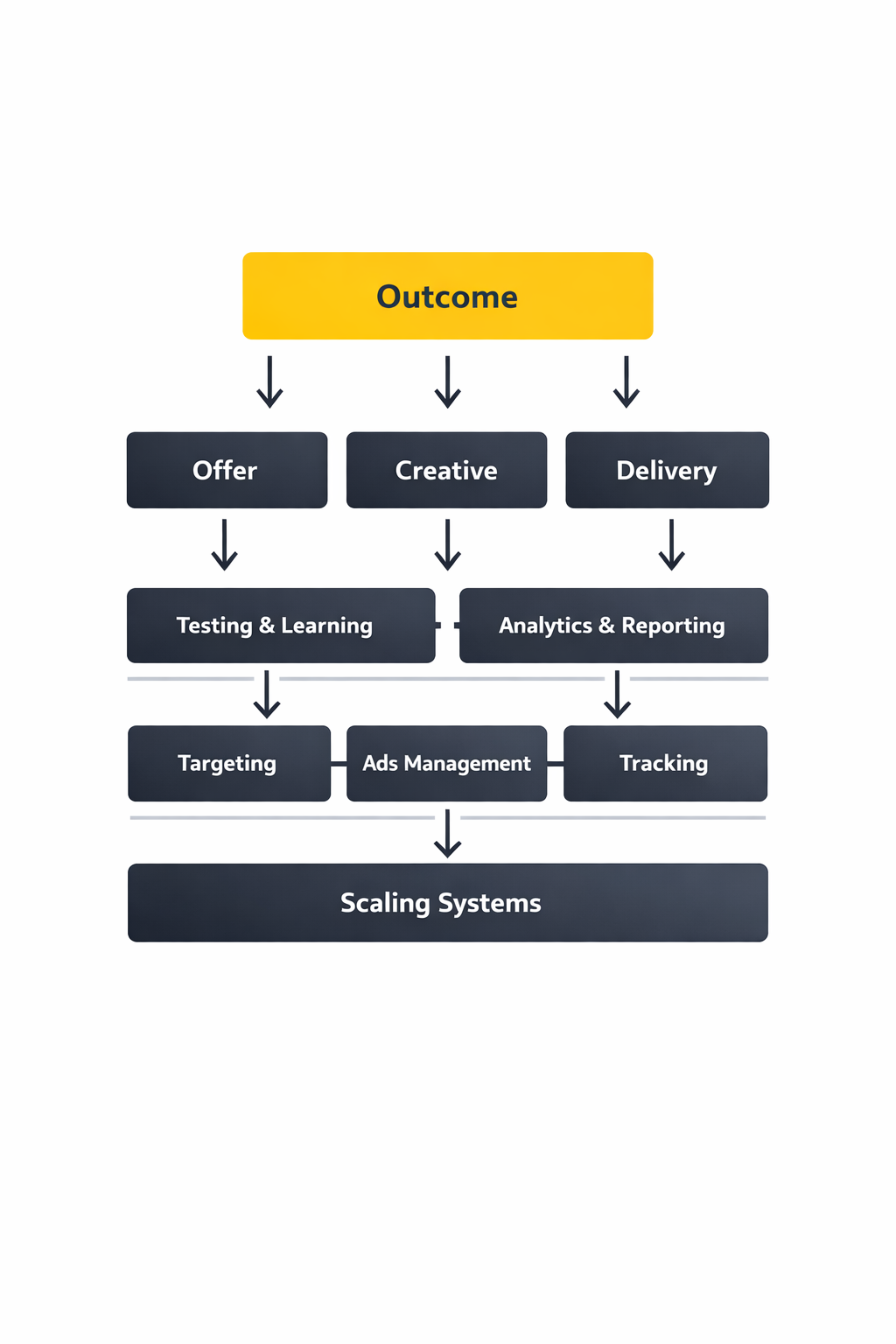
This guide uses a framework that keeps you out of random tactics and inside a professional workflow. You’ll see it repeated across all parts, because it’s how stable agencies operate when platforms, creative formats, and algorithms change.
1) Outcome
Define what “success” means in one sentence that a client can agree to without marketing jargon. Not “increase awareness,” but “increase qualified booked calls” or “increase first-time purchases at a sustainable CPA.” This step forces focus and protects you from being judged on vanity metrics.
2) Offer
Most campaigns fail because the offer is fuzzy, not because the ads are bad. Your job is to pressure-test: who is this for, what is the promise, what is the risk reversal, and what happens after they click? If the offer is weak, social just amplifies the weakness faster.
3) Creative
Creative is the targeting now. Modern platforms can find audiences, but they can’t fix boring messaging. A strong creative system produces multiple angles, hooks, and formats so you can learn quickly. If you only launch one idea, you can’t tell whether the channel failed or the message failed.
4) Delivery
This is channel choice, campaign structure, optimization events, and pacing. Professionals don’t “boost a post” and hope—they build a delivery plan that matches the buying cycle. They also think in sequences: awareness to consideration to conversion, not just one ad forever.
5) Measurement
Good measurement is what turns an SMMA business from “creative freelancer” into “growth partner.” Platforms are pushing incrementality and lift testing because attribution is messy. TikTok’s own documentation highlights conversion lift studies as a way to measure true impact, which is the direction the whole industry is moving. TikTok’s conversion lift study overview
Core Components
An SMMA business feels complicated until you separate it into a few components you can actually run and improve. These are the pieces you’re building, regardless of niche or platform.
Positioning That Wins A Specific Buyer
“We help businesses grow” is invisible. Clear positioning sounds like: “We help orthodontic clinics book consults using Meta ads and short-form creative,” or “We help B2B SaaS teams generate demo requests using LinkedIn paid + retargeting.” The narrower the buyer, the easier it is to write ads, choose offers, and close sales.
Fulfillment You Can Repeat
Repeatability is the whole business. You want an onboarding checklist, an account audit process, a creative pipeline, and a weekly reporting rhythm. When work is repeatable, it becomes trainable. When it’s trainable, you can scale without breaking your life.
Client Communication That Reduces Churn
Most churn isn’t “results dropped.” It’s “I don’t understand what you’re doing.” Clear communication turns performance into confidence: what we tested, what we learned, what we’re changing next, and what we need from you. If the client can retell the story, they stay longer.
Data Discipline
Benchmarks are useful, but context matters more. For example, engagement rates can vary widely by platform and industry, so you use benchmarks to ask better questions—not to declare success too early. Hootsuite’s 2025 engagement benchmarks roundup
Trust, Safety, And Compliance
Professional agencies also protect clients from platform risk: policy compliance, ad account hygiene, and scam awareness. This matters because social ad ecosystems are routinely targeted by fraud and malicious actors, which can affect brand trust and performance if ignored. Coverage of Gen Digital’s findings on malvertising in social ads
Professional Implementation
“Running an SMMA business professionally” means you operate like a partner with a system, not a vendor with a to-do list. It’s the difference between getting hired once and getting renewed for a year.
Set Scope Like An Agency, Not A Friend
Define deliverables in plain language: what you do, what you don’t do, what the client must provide, and what counts as a completed cycle (weekly or biweekly). This is how you avoid endless revisions and “quick favors” that quietly kill your margins.
Choose A Pricing Model That Matches Risk
Most agencies use a monthly retainer, project fees, or performance incentives, depending on the maturity of the client and the clarity of tracking. If you’re early, your pricing doesn’t need to be complicated, but it must be aligned with scope and responsibility. Why paid media is protected when budgets tighten
Onboarding That Gets Results Faster
Onboarding is where agencies win or lose the first 30 days. You’re collecting access (ad accounts, analytics, pixels), clarifying the offer and constraints, agreeing on reporting, and setting expectations for testing. The goal is momentum: you want the first learning loop completed quickly so you’re not “still setting up” weeks later.
Weekly Learning Loops
Instead of staring at dashboards all day, professionals run learning loops. Every week should produce clear answers: what improved, what got worse, why you believe that happened, and what you’re changing next. This is how you build compounding performance and a client relationship that feels steady.
What’s Next In Part 2
Now that the foundation is clear, the next part goes deeper into measurement and analytics—how to set up tracking that clients trust, how to read results without fooling yourself, and how to report in a way that keeps retainers healthy.
Step By Step Implementation
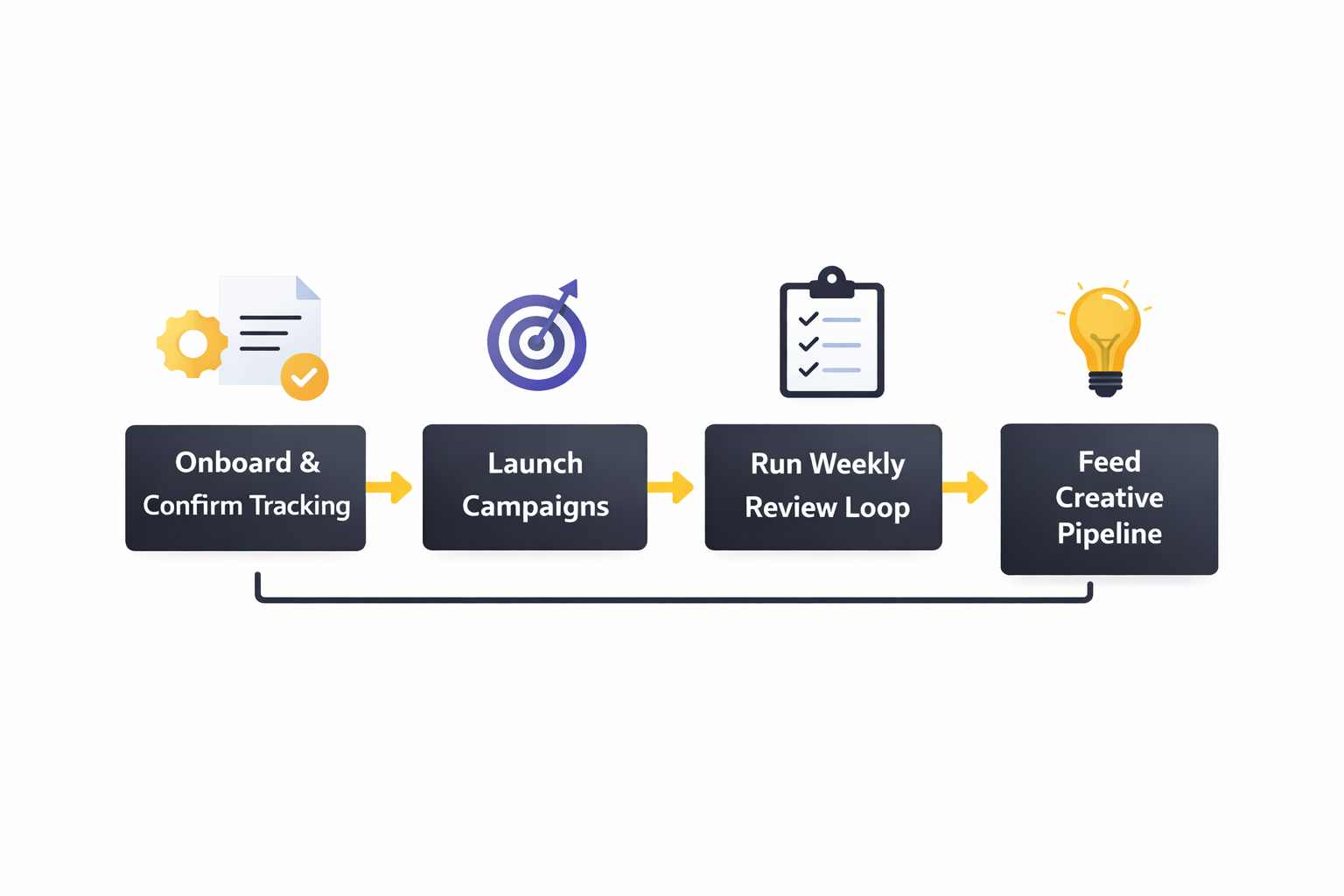
A reliable smma business isn’t built on “launching ads.” It’s built on an implementation routine that makes outcomes predictable: the right access, the right tracking, the right offer, the right creative system, and a launch plan that produces clean learning fast.
Step 1: Lock The Outcome And The Boundaries
Start by writing down one measurable outcome and two boundaries. The outcome is what the client is paying for (qualified booked calls, purchases, demos). The boundaries are what you will not be responsible for (sales closing, inventory issues, website rebuilds) unless it’s explicitly part of the scope.
This step sounds basic, but it prevents the most common agency failure: being judged on a mess you didn’t create. If a client’s pipeline is leaky, your ads might still “work” while revenue stays flat. Implementation begins with shared reality.
Step 2: Get Access And Stabilize The Account
Before you touch strategy, stabilize the environment. That means correct admin access, correct billing ownership, correct domain and page ownership (where relevant), and a clear record of what exists today.
If you inherit a messy account, document it. A simple “before” snapshot protects you from blame when a previous setup collapses mid-month, and it makes your early wins easier to see.
Step 3: Implement Measurement That Can Survive Reality
Measurement doesn’t need to be perfect to be useful, but it does need to be consistent. If the client is still relying on legacy analytics, it’s worth knowing that Google cut off access to Universal Analytics after July 1, 2024, which makes GA4 the baseline for most implementations. Google’s note on the Universal Analytics cutoff and GA4 key events
Once the baseline is in place, upgrade measurement when it’s justified. Google describes Enhanced conversions as a way to improve conversion measurement by sending hashed first-party data in a privacy-safe way. Meta frames Conversions API as a direct connection between marketing data and Meta’s systems, and it expects you to handle deduplication if you’re sending both browser and server events.
In practice, this step is about confidence. A professional smma business needs the client to trust the numbers enough to make decisions from them.
Step 4: Pressure-Test The Offer And The Next Step
Ads don’t fix a weak offer. Implementation is where you ask the uncomfortable questions: why should someone care, why now, and what happens after they click?
Then simplify the next step. If the client needs leads, choose one lead path and make it frictionless. If the client needs purchases, align the landing experience with the promise in the ad so people don’t feel tricked.
Step 5: Build A Creative Production System, Not A “One-Time Ad”
Creative is your growth engine, so you need a system that keeps producing it. Set a weekly quota of new angles and formats, and keep the process light enough to sustain.
Short-form video has reshaped how people absorb messaging, and WARC’s work on short-form video pushes the same point agencies learn the hard way: performance improves when creativity is designed for how audiences actually watch, not how marketers wish they watched. WARC on audience-first creative in short-form video
Step 6: Launch With A Learning Plan
The first launch should be designed to answer questions quickly, not to “get it perfect.” Pick a small set of hypotheses, make sure each one has a clean variable, and give the system enough time and budget to produce a signal.
Meta’s own help center explains A/B testing as a way to compare strategies by changing one variable like creative, audience, placement, or delivery. TikTok’s help center walks through how to create a split test, including a practical reminder that tests need enough time to collect a useful sample.
Step 7: Complete The First Weekly Loop
Your first “win” is not a record month. Your first win is a clean weekly loop: the client sees what was tested, what happened, what you believe it means, and what you’re doing next.
If your smma business can run this loop every week without drama, you’re already ahead of most competitors.
Execution Layers
Implementation feels overwhelming until you see it as layers. Each layer is a different kind of work, and the layers stack. When one layer is missing, the whole system wobbles.
Layer 1: Foundation
This is access, billing, policies, tracking, and basic reporting. It’s not glamorous, but it prevents chaos. Many “bad ad accounts” are just accounts with broken foundations.
Layer 2: Offer And Message
This is where you decide what you’re actually saying. It’s the promise, the proof, and the “why you” in language the buyer recognizes.
If the client can’t explain the offer in a sentence, your ads will struggle no matter how sophisticated your targeting is.
Layer 3: Creative System
This layer is your production cadence: briefing, scripting, filming or designing, editing, compliance checks, and versioning. Your goal is to make creative output predictable, not dependent on inspiration.
Layer 4: Delivery And Testing
This is campaign structure, placements, bidding, budget pacing, and experiments. When you want clarity, you run controlled tests. When you want scale, you standardize what worked and expand it.
Layer 5: Measurement And Decision
This is where you translate data into action. Google’s recent product updates emphasize making incrementality testing more accessible inside Google Ads because marketers need causal answers, not just platform-reported attribution. Google Ads highlights on incrementality measurement improvements
For an smma business, this layer is what allows you to say, calmly and credibly, “Here’s what moved the result, and here’s what we’re changing next.”
Optimization Process
Optimization is where agencies accidentally become reactive. They chase daily fluctuations, panic-edit budgets, and end up with noisy learning and inconsistent results. A professional process keeps you steady: fewer changes, better changes, and clearer reasons for every change.
1) Start With A Hypothesis
Write a sentence that predicts what will happen and why. “If we change the hook to address objection X, we’ll increase lead quality because the ad filters out the wrong buyer.”
This forces you to think like a scientist instead of a gambler.
2) Change One Primary Variable At A Time
If you change creative, targeting, and landing page in the same week, you won’t know what caused the improvement. The goal isn’t constant activity. The goal is clean learning.
Meta’s A/B testing guidance is built around this same idea: compare two versions by changing a variable like creative, audience, or placement. Meta’s overview of A/B testing for ads
3) Give Tests Enough Time To Speak
Platforms need time to deliver and stabilize. TikTok explicitly recommends setting split tests long enough to collect a useful sample, which is a practical guardrail against premature conclusions. TikTok’s split test setup steps
4) Make Decisions In A Weekly Rhythm
Daily checks are for emergencies: disapprovals, broken tracking, runaway spend. Strategic decisions belong in a weekly review where you can see patterns rather than noise.
This rhythm also makes client communication easier. Your client learns to expect clarity once a week, not constant micro-updates that create anxiety.
5) Scale The Winner, Then Refresh It
When something works, scale it deliberately and prepare a refresh. Creative fatigue is normal, not a moral failure. Your job is to keep the message effective while the audience saturates.
That’s why creative systems matter so much in a smma business: they protect performance when yesterday’s winner stops winning.
Implementation Stories
Good implementation looks boring on the surface. What makes it memorable is the moment things almost fell apart, and the team chose discipline over panic. These stories are useful because they show what “professional” looks like when pressure is real.
SnapLogic And LinkedIn Event Ads: When Pipeline Needed A Cleaner Path
The pressure didn’t show up as a dramatic dashboard crash. It showed up as a quieter fear: pipeline targets were looming, and the usual tactics felt like they were getting more expensive for less certainty. The team needed a way to create demand that felt credible, not like another noisy ad sprint. SnapLogic’s LinkedIn customer story
SnapLogic is a B2B company selling into a skeptical audience, where “lead volume” is meaningless if the leads aren’t the right people. Their marketing team leaned into LinkedIn Event Ads with a partner, because an event gives prospects a safer first step than a hard sales CTA. It’s easier to say yes to an idea than to commit to a sales conversation. LinkedIn’s event framework for matching objectives to formats
The wall was efficiency and consistency. If costs rise, everyone starts pointing fingers: the offer, the targeting, the creative, the follow-up. That’s where many agencies spiral into frantic changes that make performance even harder to interpret. SnapLogic’s LinkedIn customer story
The epiphany was that the campaign didn’t need more “hacks.” It needed a cleaner path that matched B2B buying behavior: attract the right audience, give them a valuable experience, then follow up with intent signals instead of guessing. LinkedIn’s own B2B guidance keeps coming back to the same theme: structure your marketing so it’s agile and data-driven, not just louder. LinkedIn’s 2024 B2B Marketing Benchmark hub
The journey looked like real implementation work: aligning the event topic with buyer pain, building creative that made the event feel worth time, and setting up follow-up that respected where attendees were in the journey. It also meant agreeing on what success looked like beyond vanity attendance numbers. A disciplined weekly review turned the campaign into a repeatable playbook instead of a one-off experiment. SnapLogic’s LinkedIn customer story
The final conflict was expectation management. Once early signs improved, the temptation is to scale too fast, change too much, and lose the clarity you earned. The team had to keep the implementation tight: stable measurement, stable audience logic, and a steady creative refresh so the system kept working as attention shifted. SnapLogic’s LinkedIn customer story
The dream outcome was a campaign the team could explain and repeat. Instead of telling a vague story about “brand,” they could point to an objective-aligned system: event-led demand capture, clearer lead efficiency, and a partner workflow that made iteration faster. For any smma business, that repeatability is the real asset you’re building. SnapLogic’s LinkedIn customer story
Turn Your Setup Into A Repeatable SOP
When you finish your first clean implementation, convert it into a standard operating procedure. Include access steps, tracking steps, naming conventions, launch steps, and weekly review steps.
This is what makes your business scale. Without SOPs, every new client feels like reinventing the wheel, and you end up stuck at a low capacity ceiling.
Run Tests With Governance, Not Gut Feel
Keep a simple testing log: hypothesis, variable, start date, end date, result, and decision. Use platform-native tools when possible, because they’re designed to separate test groups cleanly.
Meta’s ad testing overview and TikTok’s split testing documentation both reinforce the same operational truth: a test is only useful when it’s structured enough to teach you something. Meta’s A/B testing overview TikTok split test best practices
Upgrade Measurement When The Account Earns It
Not every client needs advanced measurement on day one, but every client needs measurement they can trust. When you do upgrade, choose upgrades with clear intent.
- Lead accuracy: Google positions enhanced conversions as a way to improve conversion measurement accuracy using hashed first-party data. Google Ads help on enhanced conversions
- Lead automation: Meta frames Advantage+ leads campaigns as AI-assisted lead generation designed to reach relevant audiences across placements. Meta help center on Advantage+ leads campaigns
- Causal clarity: Google is actively pushing incrementality experiments deeper into measurement because businesses want to know what marketing truly caused. Google’s note on strengthening measurement with incrementality experiments
Make The Client Experience Feel Steady
Most clients don’t want constant messages. They want confidence. Give them a predictable weekly update, a monthly summary that ties work to outcomes, and a clear list of what you need from them next.
When the client can feel the system, renewals get easier. That’s when your smma business stops feeling like freelancing and starts feeling like an agency with momentum.
Statistics And Data
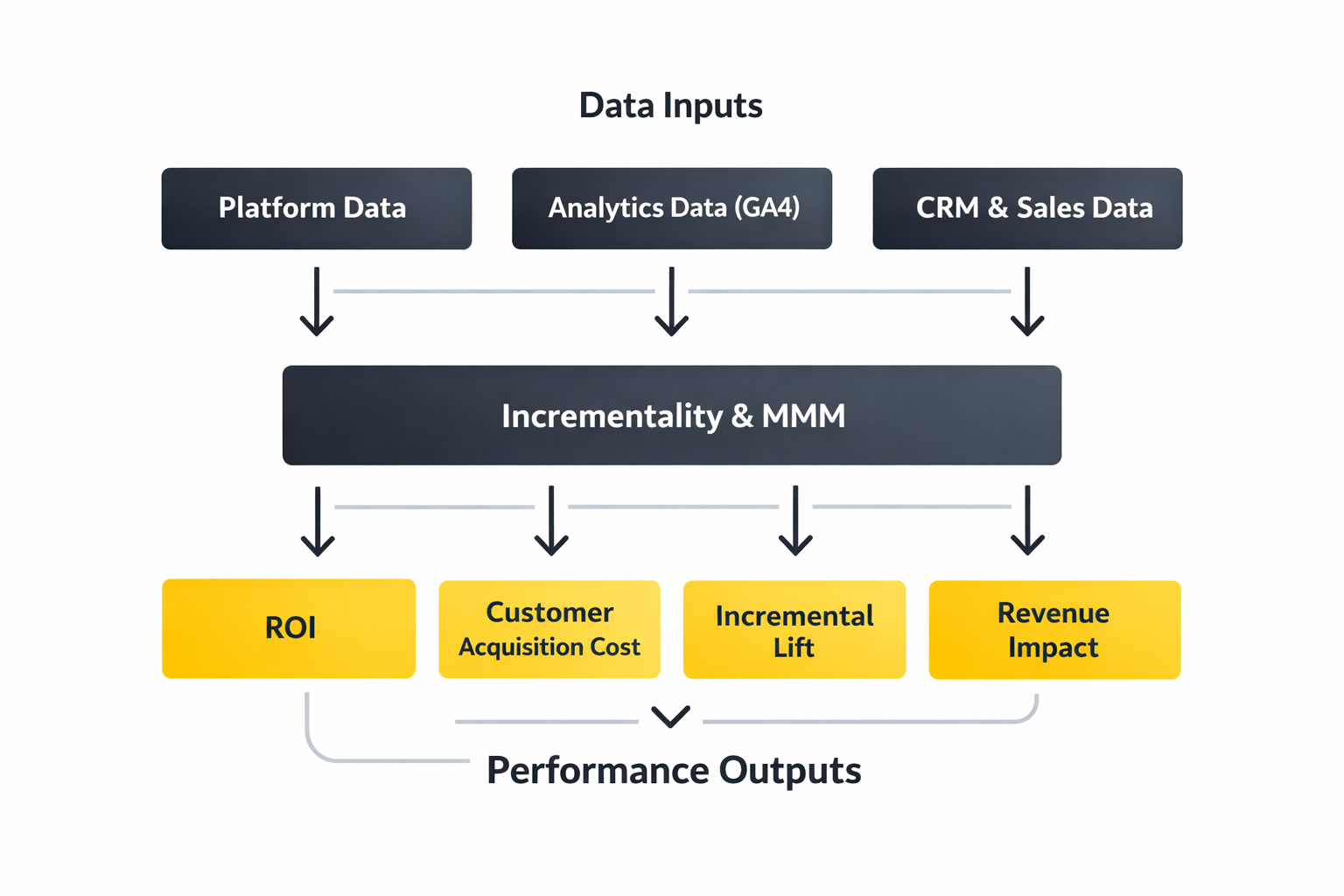
When people talk about an smma business like it’s “just running ads,” they miss what clients actually buy: certainty. Data is how you earn that certainty. Not by drowning clients in dashboards, but by using a few trustworthy signals to make decisions that predictably improve outcomes.
Zoom out first. In the U.S., digital advertising revenue reached $259 billion in 2024, up 15% year over year, which gives you a sober baseline: there is plenty of demand and budget, but competition is real. IAB’s Full Year 2024 internet ad revenue summary IAB/PwC Full Year 2024 report PDF Adweek’s coverage of the report
Inside that, social is not a side channel. Social media advertising revenue totaled $88.8 billion in 2024 in the same IAB/PwC reporting, which is why social performance expectations keep rising. Social revenue breakdown in the IAB/PwC report
Now zoom into platform economics. Meta reported $200.97 billion in 2025 revenue, which is a useful reality check for anyone building an SMMA business around Meta’s ecosystem: the market is enormous, and the platform is built to convert attention into dollars. Meta’s 2025 results press release
And while budgets are under pressure, performance channels keep getting protected. Gartner reported paid media grew to 27.9% of marketing budgets in 2024, even as other spending categories tightened, which explains why many clients will cut tools, agencies, and headcount before they cut the campaigns that are still producing pipeline. Gartner’s 2024 CMO spend survey press release
Performance Benchmarks
Benchmarks are not goals. They’re guardrails. In a healthy smma business, you use benchmarks to spot when something is broken, not to declare victory because your CTR looks “industry average.”
What To Benchmark First
- Cost to create an opportunity: leads are easy to buy; qualified pipeline is not. If you can’t connect ads to opportunity creation, you’re optimizing blind.
- Lead quality rate: the percentage of leads that become qualified, booked, or sales-accepted. This is where many campaigns quietly fail.
- Blended cost per outcome: not just “CPL on Meta” but the total cost across channels to produce the outcome the client actually cares about.
A Reality Check On Lead Costs
If you want a quick “market temperature” snapshot, WordStream’s benchmark reporting for Facebook Lead Ads put average cost per lead at $27.66 in 2025 and highlighted that lead costs rose year over year, even as some traffic costs improved. WordStream’s 2025 Facebook Ads Benchmarks Search Engine Land’s summary of the same benchmark set
The practical takeaway is not the number itself. It’s what the number implies: if your client’s offer, funnel, or follow-up is weak, higher lead costs will expose it fast. Benchmarks help you set expectations early so the client doesn’t panic when costs fluctuate, and you don’t overpromise on day one.
How Pros Use Benchmarks Without Lying To The Client
Use benchmarks like a doctor uses ranges. If your results are way outside the range, you investigate. If your results are inside the range, you still investigate, because “average” can hide a lot of waste.
Most importantly, you keep the benchmark conversation tied to the client’s economics. If the client can profitably pay $60 per qualified lead, then $30 CPL is not automatically “good” and $50 CPL is not automatically “bad.” The benchmark is the starting line. The unit economics are the finish line.
Analytics Interpretation
Analytics is where an smma business becomes a real business partner. Anyone can show a dashboard. Your value is translating messy reality into clear decisions that protect the client’s budget and build predictable growth.
Why Your Numbers Will Disagree And Why That’s Normal
Clients will eventually ask why Meta says one thing, GA4 says another, and the CRM says something else. That’s not a crisis. It’s the nature of attribution: different systems observe different parts of the journey, under different privacy constraints, and with different definitions of “a conversion.”
Your job is to prevent the argument from becoming emotional. You define one “decision source” for weekly optimization, then use other systems as cross-checks. When something shifts across all systems at once, it’s likely real. When it shifts in only one system, it may be tracking, attribution, or platform reporting behavior.
Build A Confidence Ladder
A useful way to interpret results is to rank signals by confidence:
- Highest confidence: business outcomes like revenue, orders, booked calls, and opportunities created in the CRM.
- Strong supporting signals: qualified lead rate, conversion rate on the landing experience, and call show-up rate.
- Directional signals: CTR, CPC, view-through engagement, video retention. Helpful for creative decisions, but not a business verdict by themselves.
When you build reporting around this ladder, clients stop obsessing over one platform metric and start thinking in outcomes. That’s the mindset shift that makes retention easier.
From Attribution To Incrementality
Attribution tells you where a conversion was credited. Incrementality asks a harder question: did the marketing cause the outcome that would not have happened otherwise?
This is why open-source marketing mix modeling is getting serious attention. Google launched Meridian as an open-source MMM to help teams measure across channels in a more privacy-durable way, and it’s designed for modern measurement needs where user-level tracking is less reliable than it used to be. Google’s Meridian announcement Meridian documentation
Meta’s Marketing Science team also maintains Robyn, an open-source MMM package, and even shipped a native Python package for it to make adoption easier for modern data teams. Robyn documentation site Meta’s announcement of Robyn for Python
You don’t need MMM on day one. But understanding the direction of measurement helps you build a smarter smma business: you stop promising “perfect attribution,” and you start promising “better decisions backed by stronger measurement.”
Case Stories
Analytics becomes real when it saves a campaign from the emotional spiral. The story below is useful because it shows how a brand used measurement that went beyond surface metrics, then used those insights to shape creative and investment decisions.
Aero And TikTok: When Brand Metrics Had To Prove Sales Impact
The pressure wasn’t subtle. Aero was launching a new product, and the goal wasn’t just to “make noise” online. They needed to push offline supermarket sales, which is where marketing teams often feel most exposed because the path from ad to purchase is harder to see. TikTok for Business: Aero success story
The backstory matters because it explains the constraint. Aero is a legacy UK brand, and the campaign was built around a new snack product, Aero Melts. The team wanted the new product to land emotionally with a broad audience while still driving measurable sales, which is a tricky combination if you only rely on in-platform metrics. Aero campaign objective and context
The wall showed up in production and proof. Aero did not have the capacity to produce native TikTok content beyond branded assets, which could have limited creative variety and reduced performance. And without a stronger measurement approach, it would have been easy to end the campaign with a vague “brand awareness” story that executives wouldn’t fund again. Aero’s stated creative constraint
The epiphany was to treat analytics as a design choice, not an afterthought. Instead of hoping attribution would magically connect ads to supermarket purchases, Aero chose to run both a Brand Lift Study and a Sales Lift Study with LiveRamp alongside their ads. That created a clearer causal lens by comparing exposed and control groups and then tying creative exposure patterns to lift. Aero’s brand lift and sales lift approach
The journey became a real implementation plan. To solve the creative constraint, Aero used TikTok’s Creative Exchange program and collaborated with partners to source creator content, making the campaign feel native rather than purely branded. The measurement plan ran in parallel, designed to identify which assets or combinations of assets were actually driving lift so the team could learn what to repeat. Aero’s Creative Exchange solution and measurement setup
The final conflict was that results can create their own chaos. When a campaign shows momentum, teams are tempted to over-credit one asset, shift budgets too fast, or simplify the story to something that sounds good but isn’t accurate. Aero’s lift approach helped reduce that risk by showing the strength of combining branded and creator-led assets rather than betting everything on one style of creative. Aero’s insight on combined asset exposure driving lift
The dream outcome was a performance story executives could fund. TikTok reported a £3.58 ROAS at the brand level, plus brand lift results including +20% ad recall and +6.9% brand association, and it also highlighted that 65% of spend uplift was associated with users who saw both branded and creator-led assets. That kind of outcome is more than “good metrics” because it creates a repeatable playbook: creative diversity, measurement discipline, and a clear link between what people saw and what they did next. Aero’s reported results and lift breakdown
Professional Promotion
This is the part most people skip: how you communicate performance without sounding like a dashboard narrator. A strong smma business uses analytics to promote the work in a way that builds trust, protects the client, and makes referrals feel inevitable.
Build A One-Page “Truth” The Client Can Forward
Clients forward stories, not spreadsheets. Build a one-page summary that includes the outcome, the investment, the main learning, and what you are doing next. Tie the story to stable market context so the client understands why your decisions are rational in a competitive environment. The $259B competitive reality in U.S. digital advertising
Make Experiments And Lift Sound Human
Clients don’t want to hear “methodology.” They want to hear “confidence.” When you run tests, explain them like this: we compared two approaches, kept one main change, and used the results to decide what to scale.
If you’re using incrementality thinking, anchor it to recognizable tools. Google built Meridian to help teams answer cross-channel measurement questions when user-level tracking is limited, and Meta’s Robyn exists for similar reasons. That framing helps clients understand you’re building durable measurement, not chasing vanity wins. Meridian documentation Robyn documentation
Use Benchmarks To Set Expectations, Not To Brag
Benchmarks are most powerful before money is spent. Use them to set the emotional temperature: costs can rise in competitive seasons, leads can get more expensive when targeting tightens, and quality matters more than volume. WordStream’s benchmark reporting on rising lead costs in Facebook Lead Ads is useful for setting that expectation early, so the client doesn’t misinterpret normal volatility as failure. WordStream’s 2025 benchmark reporting
Turn Results Into Assets That Attract Better Clients
When you have a clean story, turn it into assets: a short case write-up, a before-and-after chart, a quick “what we learned” post, and a simple offer page that explains who you help and what outcome you drive. This is how your smma business stops relying on cold outreach and starts compounding reputation.
In Part 5, we’ll connect the analytics layer to the ecosystem layer: how fulfillment, partnerships, and positioning work together so you can scale without the quality drop that kills most agencies.
Future Trends
The next phase of any smma business will feel less like “media buying” and more like running a smart system: stronger first-party measurement, faster creative production, and better proof that marketing caused outcomes.
AI Will Push Agencies Toward Creative Direction, Not Manual Setup
Platforms are moving toward a world where advertisers set goals and budgets, then AI generates variations, targets audiences, and optimizes delivery in real time. Reuters reported Meta’s ambition to enable much deeper ad automation with AI by 2026, including automated creation and targeting workflows. Meta’s AI automation push reported by Reuters
For an SMMA business, this is not “the end of agencies.” It’s a shift in where you provide value: offer strategy, creative direction, brand safety judgment, measurement integrity, and the discipline to run experiments without self-deception.
First-Party Measurement Becomes A Competitive Advantage
As privacy expectations rise, measurement that depends entirely on third-party cookies becomes fragile. Google’s product announcements emphasize building a robust first-party data strategy and improving consent tooling, which is the direction most serious advertisers are heading. Google Ads announcements on first-party data and consent tooling
Agencies that can implement consent-aware measurement and still keep performance stable will stand out. Clients don’t want perfect attribution. They want fewer surprises and better decisions.
Incrementality And Marketing Mix Modeling Move Closer To The Mainstream
More teams are accepting a simple truth: platform attribution is useful, but it’s not the same as causality. That’s why open-source MMM is getting real momentum. Google launched Meridian as an open-source MMM designed for modern measurement needs, and it’s being positioned as a practical tool for budget optimization, not just a data science hobby. Google’s Meridian overview Meridian documentation
Meta’s open-source MMM, Robyn, is also evolving, including a Python release that makes it easier for modern analytics teams to adopt. Meta’s announcement of Robyn for Python Robyn documentation
B2B Platforms Are Building Monetizable Video Ecosystems
LinkedIn is leaning hard into video, and that matters for agencies serving B2B and high-consideration buyers. Reuters reported LinkedIn’s expanding BrandLink program, with video views up 36% year over year and uploads up over 20%, alongside deeper partnerships with publishers and creators. LinkedIn’s video and BrandLink expansion reported by Reuters
The practical SMMA takeaway is straightforward: short-form video is no longer “just for consumer brands.” It’s becoming a default language for business decision-makers too, which changes what creative looks like for B2B clients.
Strategic Framework Recap

This complete guide has one goal: make your smma business feel predictable. Not perfect, not hype-driven—predictable enough that you can sell with confidence and deliver without chaos.
Outcome
Everything starts with a measurable result the client actually values. If you can’t say what success is in one sentence, you’ll end up defending vanity metrics instead of building revenue impact.
Offer
Most “ad problems” are offer problems. Your job is to clarify who it’s for, why it matters, what proof exists, and what the next step is. Strong offers make platforms look smarter than they are.
Creative
Creative is the engine that keeps learning alive. The agencies that win long term build a creative system that produces new angles every week, not a one-time campaign that fades.
Delivery
Delivery is where good ideas become consistent performance: clean campaign structure, sensible pacing, and controlled experiments. The goal is fewer changes with clearer reasons, not constant tinkering.
Measurement
Measurement is the layer that keeps clients calm. First-party resilience, consent-aware tracking, and credible reporting protect your reputation when numbers shift between platforms. If you can explain the story without panic, you keep clients longer.
FAQ – Built For The Complete Guide
What is an SMMA business in plain English?
An smma business is a service company that helps clients grow using social and performance marketing, then proves the impact with measurement. You’re not selling “posts” or “ads.” You’re selling outcomes the client can recognize in their pipeline or revenue.
How long does it usually take to land the first client?
It depends on your niche, proof, and outreach volume, but the fastest path is a narrow offer and direct conversations with the exact buyer you want. The bigger lever is not time—it’s focus. A clear “who and outcome” makes selling dramatically easier.
Do I need a niche, or can I serve anyone?
You can serve anyone, but you’ll grow slower and feel less confident. A niche makes your messaging sharper, your creative faster, and your results more repeatable. Most agencies that scale pick one buyer type and one primary outcome first, then expand later.
What services should I start with to keep delivery simple?
Start with one channel and one result: booked calls, purchases, demos, or qualified leads. Keep your promise tight so you can deliver consistently. As soon as you add “everything,” you create operational chaos and unclear accountability.
How should I price SMMA services?
Pricing should match scope and responsibility. Most beginners use a monthly retainer with clear deliverables and a clear reporting rhythm. As you gain proof, you can introduce performance incentives, but only if tracking and definitions are solid.
What metrics matter most for client retention?
Clients stay when they understand the story: investment, outcomes, quality, and what you’re doing next. Pipeline and revenue-adjacent signals matter most. Platform metrics like CTR help creative decisions, but they rarely keep retainers alive on their own.
Why do Meta, GA4, and the CRM show different numbers?
Because they observe different parts of the journey with different rules. Platforms optimize and attribute inside their ecosystem, analytics tools model and filter data differently, and CRMs reflect real sales processes with human behavior. A professional SMMA business sets one “decision source” for weekly optimization and uses the others as cross-checks.
What should I know about consent and tracking if I have EU traffic?
Consent-aware measurement matters because it directly affects what data models can learn from. Google’s consent tooling and first-party emphasis are being updated as privacy expectations evolve, so agencies that treat compliance and measurement as one system tend to avoid reporting shocks. Google Ads announcements on consent and first-party strategy
Do I need server-side tracking to succeed?
Not always. Many accounts do fine with a clean client-side setup. But as budgets rise, clients often want more resilience. Server-to-server approaches like Meta’s Conversions API exist to strengthen signal flow when browser-based tracking is limited. Meta Conversions API documentation
How do I scale without burning out or losing quality?
Scale the system, not your personal workload. Document onboarding, tracking, launch, and weekly review processes. Separate roles (creative, media, account management). If everything still depends on you, your smma business is still fragile, even if revenue is growing.
What happens if platforms automate most ad work?
Your value shifts upward. Automation can handle more setup, but it can’t replace business judgment, offer clarity, creative taste, measurement integrity, and client leadership. Meta’s publicly reported direction toward deeper AI automation is a signal that agencies should invest in strategy and creative systems, not manual button-clicking. Reuters report on Meta’s AI ad automation direction
How do I get better clients without doing endless cold outreach?
Build proof and distribution at the same time: publish short case explanations, show your weekly learning loop, and make your offer obvious. Then put yourself where buyers already search—marketplaces, referrals, and targeted communities—so you’re competing on clarity and credibility, not volume.
Work With Professionals
If you’re serious about growing your smma business, there’s a moment you’ll recognize: you’re doing the work, you know you can deliver, but client acquisition still feels like a second job. Weeks go by where performance improves, but your pipeline doesn’t. That gap is where most talented marketers stall out.
Meanwhile, the demand is real. Just one example: Upwork shows over 12,000 open marketing jobs, and that’s only one marketplace snapshot. Companies are constantly searching for paid social, SEO, lifecycle, content, analytics, and growth operators who can step in fast and produce outcomes.
MARKEWORK.com is built for that exact reality: a marketing-only marketplace where companies and marketers connect directly. The platform highlights no project fees and direct communication, which means you’re not getting squeezed by per-project platform charges while trying to build long-term client relationships. Pricing also emphasizes no commissions and no project fees, and the site makes it clear that companies and marketers handle contracts and payments independently, so you keep control of how you work and how you get paid. MARKEWORK.com FAQ on direct contracts and zero commissions
If you want a cleaner path to consistent opportunities, the fastest move is to put your positioning and proof where buyers already browse. Build a profile that shows outcomes, publish your rates with confidence, and apply to roles that match your exact lane. When your offer is clear and the marketplace is focused, you spend less energy chasing and more energy delivering.
 Filip Konecny Enterprises