

Social media looks simple from the outside: post consistently, reply to comments, run a few ads, and watch the growth happen. In reality, most brands hit the same wall—content goes out, engagement is inconsistent, leads are unpredictable, and nobody can clearly explain what’s working or why.
That’s where smm services earn their keep. Done well, they turn social from a noisy “we should be active” channel into a system: clear positioning, repeatable content production, community and customer care rhythms, performance marketing that doesn’t burn budget, and measurement that ties back to business outcomes.
Article Outline
- What Are SMM Services
- Why SMM Services Matter
- Framework Overview
- Core Components
- Professional Implementation
What Are SMM Services

SMM services (social media marketing services) are the professional capabilities that plan, produce, distribute, and optimize a brand’s social presence—across organic content, community, paid campaigns, and reporting—so social activity reliably supports business goals.
The easiest way to understand the scope is to picture social as four connected jobs that must work together:
- Strategy: deciding what the brand stands for, who it’s for, what to say, and how to win attention without copying everyone else.
- Execution: producing content (creative, copy, video), publishing with consistency, and keeping quality high across formats and platforms.
- Conversation: community management, customer-care workflows, and relationship building with creators, partners, and fans.
- Optimization: paid distribution, experimentation, and analytics that connect social activity to meaningful outcomes (leads, sales, retention, brand lift, pipeline influence).
Some providers bundle everything. Others specialize—content-only studios, performance-focused teams, or community-led operators. The common thread is that good smm services behave less like “posting” and more like a managed growth function: a pipeline of ideas, a production engine, and a feedback loop that gets smarter each month.
Why SMM Services Matter
Social isn’t a side channel anymore—it’s where markets form opinions in public, where buying intent gets sparked, and where brands get tested under pressure. The scale alone makes the point: the Digital 2025 global overview puts social media user identities at 5.24 billion, and the same figure is reflected across the broader Global Digital Report 2025 PDF and summaries like Meltwater’s Digital 2025 recap.
Money follows attention. Global advertising revenue is forecast to reach $1.14 trillion in 2025 in WPP Media’s This Year Next Year update, mirrored in the official two-page forecast PDF and covered in outlets like The Wall Street Journal’s report on the revised outlook.
What changed isn’t just volume—it’s behavior. Social now compresses the path from discovery to purchase. Sprout’s own research in The 2025 Sprout Social Index highlights how often social triggers buying impulses, and that same data is echoed in coverage like Nasdaq’s summary of Sprout’s findings and industry write-ups such as this overview of the 2025 Index.
For teams trying to “do social” on the side, these shifts create a predictable pattern: inconsistent creative, slow iteration, and reporting that can’t defend budget. Professional smm services matter because they bring operating discipline—clear roles, creative throughput, a testing cadence, and measurement that makes the channel governable.
Framework Overview
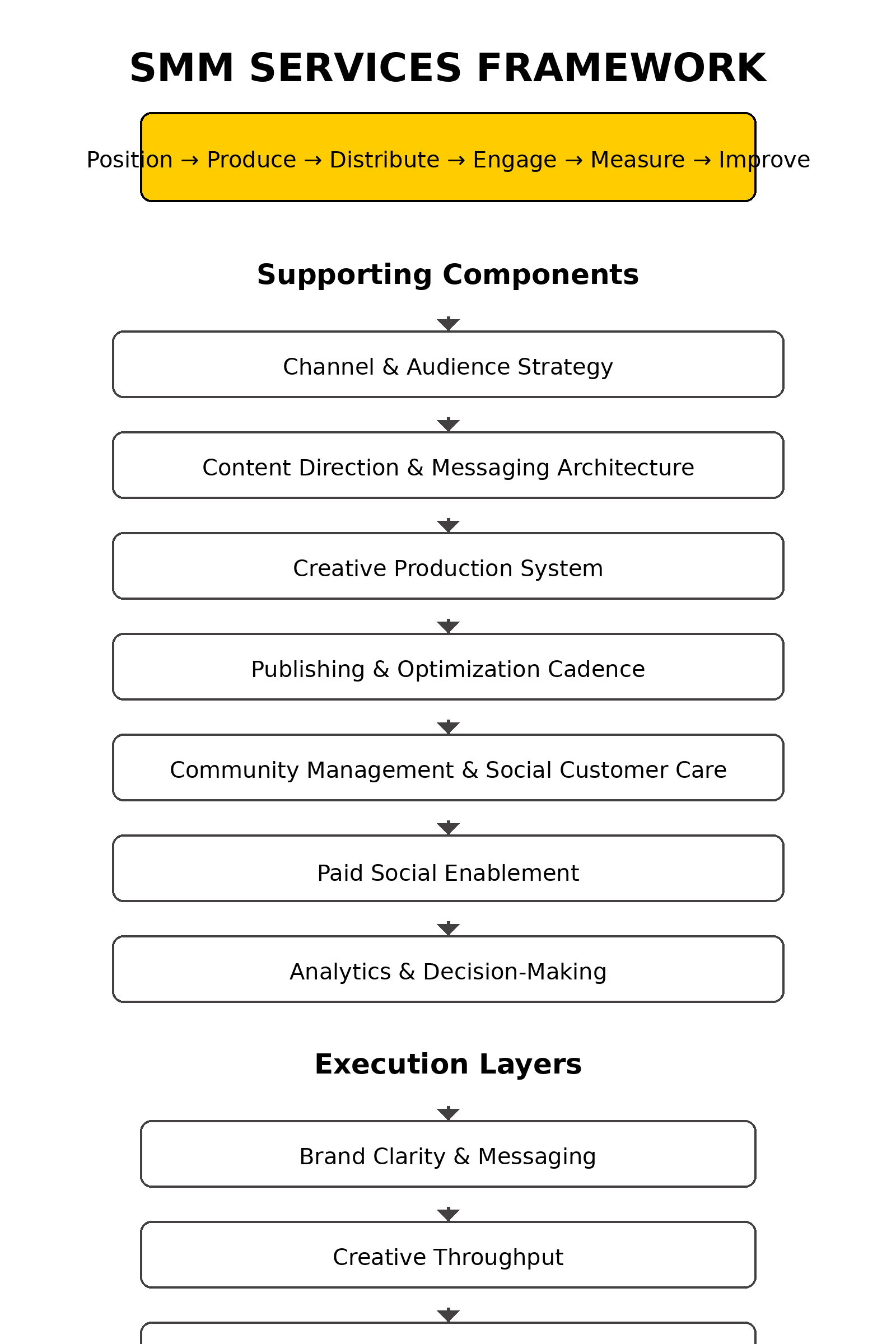
A practical way to evaluate (or deliver) smm services is to use a simple loop: Position → Produce → Distribute → Engage → Measure → Improve. The loop matters because social is not one activity—it’s a cycle. If any step is weak, the whole system becomes fragile.
- Position: the brand’s point of view, audience clarity, and the “why you” that makes content worth consuming.
- Produce: a repeatable content engine—formats, creative direction, workflows, and quality control.
- Distribute: platform-native publishing plus paid support where it accelerates reach and learning.
- Engage: community and customer care as a daily operating habit, not an afterthought.
- Measure: metrics that map to goals, with tracking that survives platform noise.
- Improve: structured experiments, creative iteration, and decisions based on evidence, not vibes.
This framework keeps teams honest. It prevents the classic trap where a brand posts more and more content while quietly losing strategic clarity, creative quality, and measurement discipline at the same time.
Core Components
Most smm services packages are sold as deliverables—“X posts per week,” “community management,” “monthly reporting.” Deliverables are useful, but the real value is in the components underneath them. These are the building blocks that determine whether social becomes a growth engine or a content treadmill.
- Channel and audience strategy: choosing platforms based on actual customer behavior, not trends, and defining what each channel is responsible for (awareness, consideration, community, support, conversion).
- Content direction and messaging architecture: a clear set of themes, offers, proof points, and storytelling angles that keep content coherent over months.
- Creative production system: briefing, scripting, filming/design, editing, approvals, and an asset library that prevents starting from zero every week.
- Publishing and optimization cadence: timing, format selection, and lightweight iteration—so posts get better through learning, not just repetition.
- Community management and social customer care: response playbooks, escalation paths, and brand-safe tone guidelines for public conversations.
- Paid social enablement: audience strategy, creative testing, conversion tracking, and budget pacing—used to amplify what works and learn faster.
- Analytics and decision-making: reporting that explains cause and effect, flags what to stop, and sets the next month’s experiments.
When you compare providers, look for how well they run these components—not just how many deliverables they promise. The difference shows up quickly: strong systems create momentum; weak systems create busywork.
Professional Implementation
Implementing smm services professionally is less about “getting content out” and more about installing an operating model. The first 30 days should feel like building infrastructure: aligning goals, cleaning up tracking, agreeing on brand voice, and setting a production workflow that can survive real-life bottlenecks.
A practical implementation sequence looks like this:
- Business alignment: define what social must achieve in the next 90 days (pipeline contribution, product adoption, recruiting, retention, customer care load reduction, or brand lift).
- Audience and offer clarity: confirm who you’re speaking to, what they want, and what the brand is willing to stand for publicly.
- Workflow design: decide who approves what, how fast, and what happens when approvals stall—because approvals are where “consistent posting” usually dies.
- Creative testing plan: pick a small set of repeatable formats and a weekly testing cadence so the team learns quickly without thrashing.
- Measurement setup: ensure attribution basics are in place before scaling output, otherwise reporting becomes guesswork and budget confidence disappears.
Most importantly, professional delivery makes tradeoffs explicit. Not every platform deserves equal effort. Not every trend deserves attention. Not every metric deserves a dashboard tile. The job is to build a social system that stays focused, gets sharper with repetition, and remains accountable to outcomes.
Step By Step Implementation
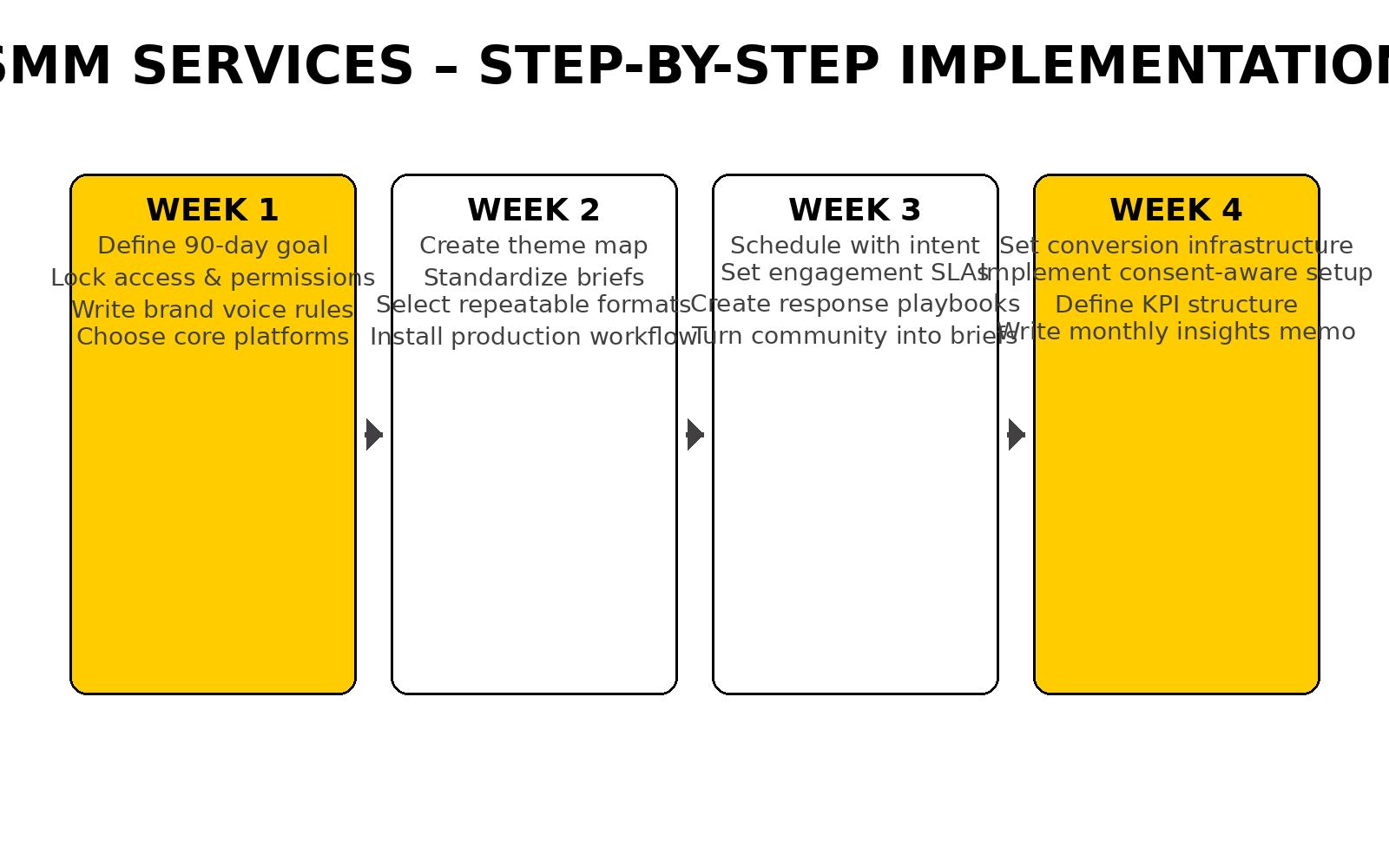
If you’re setting up smm services from scratch (or rebuilding a messy setup), the biggest risk is trying to “do everything” in week one. The smarter move is to install a working system in layers: lock down access and governance, build a repeatable content engine, then expand into paid distribution and deeper measurement once the fundamentals are stable.
Week 1: Set The Foundation So The Work Can Actually Ship
- Define one measurable goal for the next 90 days: not “grow,” but something concrete like qualified inquiries, product trials, store visits, or customer-care deflection.
- Lock down access and permissions: who can publish, who can approve, and who can respond. Use role-based access wherever possible and remove shared passwords.
- Write the brand voice as rules, not adjectives: how you greet people, how you handle criticism, and what you never say. Keep it short enough that people will actually use it.
- Choose your core platforms: pick the smallest set that matches how your customers discover and decide. Treat everything else as “later.”
Week 2: Build A Content Engine That Doesn’t Rely On Inspiration
- Create a theme map: 5–8 recurring themes that connect your offer to customer problems (proof, education, behind-the-scenes, comparisons, objections, stories, community).
- Standardize briefs: every piece gets a goal, a single audience, one main point, one call-to-action, and a success signal.
- Pick 3–5 repeatable formats: short video series, carousels, creator-style explainers, founder POV clips, customer Q&A. Repeat formats so quality improves faster.
- Install a production workflow: ideation → scripting → production → edit → approval → schedule. If approvals are slow, define a fallback path so the calendar doesn’t die.
Week 3: Make Distribution And Engagement A Daily Habit
- Schedule with intention: publish when you can reliably show up in the comments right after. Consistency beats “perfect timing” you can’t sustain.
- Set an engagement service level: what gets answered in minutes, what gets answered in hours, and what gets escalated.
- Create response playbooks: templates for FAQs, complaints, pricing questions, and sensitive topics—so replies stay human but never sloppy.
- Turn community into a pipeline: track recurring questions and turn them into content briefs for next week.
Week 4: Install Measurement That Survives Platform Chaos
Measurement is where most smm services either become credible or fall apart. If your tracking relies entirely on browser behavior, you’ll eventually lose confidence in your numbers as privacy settings shift and attribution gets noisier.
- Set up conversion infrastructure: use server-to-server options where appropriate, like Meta’s Conversions API, TikTok’s Events API, and the LinkedIn Conversions API.
- Handle consent properly: if you operate in regions with strict requirements, build your setup around consent-aware tagging like Google Consent Mode.
- Define a small KPI set: one outcome metric, two leading indicators, and one quality metric (for example, not just “leads,” but whether leads are actually relevant).
- Write a monthly insights memo: what worked, what didn’t, what you’re testing next, and what you’re stopping.
Execution Layers
Good smm services feel smooth from the outside because the execution is layered. Each layer supports the next, and you only add complexity when the earlier layer is stable enough to carry it.
Layer 1: Brand Clarity And Messaging
This is the “what we stand for” layer: the point of view that makes your content recognizable and your offers easy to understand. If this layer is weak, the team compensates by posting more, chasing trends harder, and rewriting captions endlessly.
Layer 2: Creative Throughput
This is where most teams discover the real constraint: not ideas, but production capacity. The fix is not to demand more content—it’s to reduce the cost of shipping content by repeating formats, reusing templates, and keeping the approval path simple.
Layer 3: Distribution And Channel Discipline
Distribution is the discipline of choosing where to win. When your team tries to be everywhere, your best work gets diluted and your learning gets scattered. When you pick a few channels and run them well, your content improves faster because feedback is clearer.
Layer 4: Community And Customer Care
This layer turns social into a relationship channel, not a broadcast channel. It also protects the brand, because public complaints become manageable when you have a response system and escalation paths.
Layer 5: Paid Amplification And Experimentation
Paid is most effective when it amplifies proven creative and accelerates learning. It’s a mistake to treat ads like a separate universe; the best performance often comes from the same creative ideas that already resonate organically, then refined with testing inside tools like Meta’s Business Help Center and TikTok Creative Center.
Optimization Process
Optimization in smm services isn’t a monthly “reporting ritual.” It’s a weekly loop where you reduce guesswork: pick one hypothesis, run a clean test, learn something real, and feed it back into production. The goal is not to chase every metric—it’s to make better decisions with less noise.
1) Observe With A Clear Lens
Start by separating performance into three buckets: what earned attention, what earned action, and what created business value. A post that gets views but no saves, clicks, replies, or meaningful engagement may still be useful for awareness—but it shouldn’t define your strategy.
2) Diagnose The “Why,” Not Just The “What”
When something works, ask what made it work: the first second of the video, the promise in the caption, the proof included, or the relevance of the topic. When something fails, don’t blame the algorithm—look for mismatched audience, weak hook, unclear takeaway, or a call-to-action that asks too much too early.
3) Test One Variable At A Time
Clean tests are boring, and that’s why they work. Choose one variable—hook, format, topic angle, offer framing, or targeting—and keep the rest consistent. For paid campaigns, follow platform guidance for conversion setup and signal quality, including server-side options like Meta’s Conversions API when you need stronger measurement reliability.
4) Scale What’s Proven, Retire What’s Draining You
Scaling doesn’t mean doing more of everything. It means doing more of what repeatedly performs and cutting the rest without guilt. When a format consistently creates high-quality conversations or qualified inquiries, turn it into a series and build a content calendar around it.
Implementation Stories
Implementation is where smm services stop being a strategy deck and start being a working operating system. The two stories below are built from published case studies and focus on what happened when real teams tried to run social under real pressure.
American Honda: The Moment A “Clunky Platform” Turned Into A Brand Risk
The breaking point didn’t arrive quietly. Messages kept stacking up, the team kept firefighting, and the work that actually builds relationships—community management—kept getting pushed aside. When support tickets started going unanswered and the tools didn’t keep up, the situation shifted from “annoying” to “dangerous,” exactly as described in American Honda’s published case study.
The backstory is a familiar one. A small team was expected to operate at the speed of social for a global brand, and the technology they inherited required constant manual maintenance. Over time, that mismatch turns social into a stress machine where people spend more time wrestling tools than listening to customers, a tension the case study narrative lays out clearly.
The wall was operational and emotional at the same time. The inbox volume was rising, expectations were rising, and the system was built for a lower era of demand. The team could keep sprinting, but sprinting forever is not a strategy, which is why the “survival mode” dynamic becomes so prominent in the account of Honda’s situation.
The epiphany was that social couldn’t be treated as a publishing task anymore. The team needed a partner and a platform that made customer conversations the default, not a chore squeezed in after scheduling. That shift—toward intuitive workflow and customer-centric operations—is exactly what the case study frames as the real change.
The journey was a rebuild, not a quick fix. They moved toward a unified workflow where publishing, engagement, and insights lived together, and they made “daily use” normal instead of exceptional. They also leaned into onboarding and guided implementation so the change didn’t collapse under confusion, something highlighted in the implementation sections of the case study.
Then the final conflict hit in the way it often does: success increases demand. When response quality improves, more people reach out, and internal stakeholders start paying closer attention to social as a data source. That’s where teams either revert back to chaos or mature into a stable system, which the later stages of the story describe as social becoming strategically valuable.
The dream outcome wasn’t just smoother publishing. It was social becoming a serious business input—something that could inform planning, identify customer sentiment, and support major initiatives without breaking the team. That transformation, from bottleneck to strategic asset, is the core arc documented in American Honda’s case study.
Salesforce: When The Biggest Event Of The Year Forces The Stack To Prove Itself
The pressure cooker wasn’t theoretical. Dreamforce isn’t a normal week, and the social team couldn’t afford slow approvals, scattered reporting, or workflow friction while the internet watched in real time. That high-stakes environment is why Salesforce’s case study reads like an operational stress test, not a marketing highlight reel.
The backstory is that social wasn’t optional for the brand—it was part of the event experience and the year-round relationship with the community. Managing social at that scale requires coordination across many channels, many stakeholders, and fast-moving moments that can’t wait for a meeting. The context is set directly in the opening of the published Salesforce story.
The wall was speed. Not “posting speed,” but decision speed: how quickly the team could spot what mattered, secure approvals, and respond without losing the moment. When your system requires manual reporting and fragmented workflows, you end up acting late—and late is the same as invisible during a live event, which is why workflow and automation are emphasized throughout the case study.
The epiphany was that social operations needed to be mobile and immediate. Approvals couldn’t be trapped behind desks, and insights couldn’t be trapped behind spreadsheets. That’s why the story puts so much weight on real-time access and reporting usability inside the implementation narrative.
The journey involved tightening how they listened, how they routed conversations, and how they kept stakeholders informed without creating admin overhead. Instead of treating reporting as something you do after the fact, they treated it as something you can share continuously while the work is happening. That “always know where things stand” approach is described in the middle sections of the case study.
The final conflict showed up the moment the system started working: the bar went up. When leadership sees clearer data and faster responsiveness, expectations rise, and the team has to keep delivering without burning out. The only way to survive that phase is with automation and workflow habits that protect the humans, which is why bandwidth and focus become recurring themes in the story.
The dream outcome was a social operation that could move fast without becoming sloppy. The team could engage meaningfully, share insights in real time, and keep pace with the speed of culture during the most demanding moments of the year. That’s what the Salesforce case study ultimately demonstrates: a stack and workflow that holds up under the kind of pressure most brands only experience a few times in their lifetime.
Build A Weekly Operating Rhythm
- Monday: review last week’s top performers and top conversations, then finalize the week’s publish plan.
- Midweek: run one focused creative test (hook, format, topic angle, or offer framing) and document what you expect to learn.
- Friday: capture insights, update the content backlog, and write a short “what we’re changing next week” note.
Install Quality Controls Without Killing Speed
- Pre-publish checks: claim accuracy, tone, accessibility basics, and a clear next step for the audience.
- Comment triage rules: what gets answered publicly, what moves to DMs, and what gets escalated.
- Creative library discipline: store proven hooks, structures, and visuals so you can scale what works without copying yourself.
Use Measurement Infrastructure That Supports Growth
If your reporting can’t be trusted, optimization becomes storytelling instead of decision-making. Build a setup that’s resilient, using platform-supported conversion pathways like Meta’s Conversions API and consent-aware tagging like Google Consent Mode when it applies to your region and stack.
Protect Focus With Scope Control
The hardest part of delivering smm services is not doing the work—it’s deciding what not to do. When everything feels urgent, quality collapses. Professional teams protect outcomes by keeping a tight platform scope, sticking to repeatable formats, and refusing to let “random requests” replace the plan.
Statistics And Data
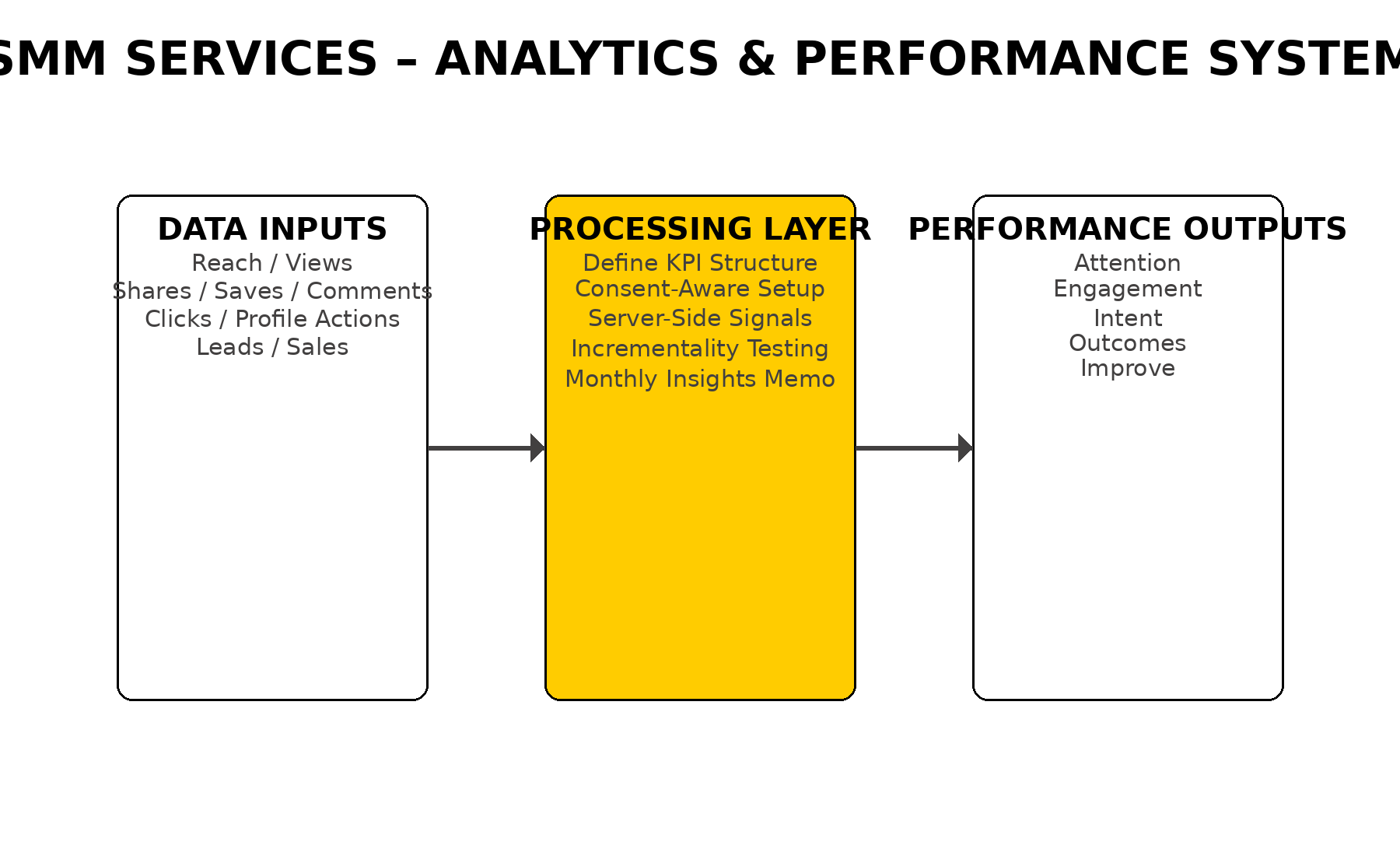
The fastest way to make smm services feel “real” (to a client, a CMO, or even your own team) is to treat social like an evidence pipeline: inputs you control, signals you can read, and outcomes you can defend. That mindset matters more than any single metric, because social platforms keep changing the rules while leadership still asks the same question: “Is this working?”
The good news is there’s plenty of current, decision-grade data if you know where to look. Social ad spend continues to grow, with WARC forecasting worldwide social ad expenditure at $286.2B in 2025 and exceeding $300B in 2026. On the operational side, teams are under pressure to do more with the same headcount, which is why measurement and reporting efficiency has become a competitive advantage—one Forrester study commissioned by Sprout found large reporting time savings and a quantified ROI picture over three years.
Benchmarks help, but only when you use them like guardrails instead of grades. Platform-wide medians can show direction (for example, Rival IQ’s reporting on engagement-rate declines across major platforms in its 2025 benchmark analysis), while industry-level cuts help you avoid comparing a B2B SaaS account to a sports league.
Statistics That Actually Help
- Demand signals: Social still influences buying behavior, especially for younger cohorts—Sprout’s consumer research highlights that Gen Z and Millennials over-index on buying things they discover on social.
- Attention signals: Engagement benchmarks move, but they’re still useful for spotting “content-market fit.” Recent benchmark reporting across industries is available via sources like Hootsuite’s 2025 engagement-rate breakdowns and Emplifi’s 2025 benchmarks PDF.
- Efficiency signals: When teams centralize measurement, reporting stops being a weekly panic. Sprout’s Forrester-backed findings note major reductions in time spent on social reporting, which is often the hidden reason execution improves.
Performance Benchmarks
Benchmarks are useful for smm services only when they answer one of three questions: Are we underperforming our peer set? Are we improving faster than the market? Or are we investing in the wrong place?
To keep benchmarks honest, always lock three variables before you compare: (1) the metric definition, (2) the denominator (followers, reach, impressions), and (3) the content mix (video-heavy vs static-heavy). Otherwise, you’ll “prove” whatever you want and still miss what’s actually happening.
Benchmark Sources Worth Using
- Cross-industry, multi-platform: Rival IQ’s benchmark reporting is widely referenced, including its 2024 benchmark analysis and the 2025 edition, which are useful for directional shifts (what’s rising, what’s falling, what formats lead).
- Platform and format performance: Emplifi’s benchmarks and quarterly updates are strong for format-level readouts; their 2025 report PDF includes reach and engagement comparisons, and their Q3 updates include performance notes like UGC-linked lifts (conversion and visits) within their measurement set.
- Industry slices with explanation: Hootsuite’s benchmark pages can be practical because they publish industry cuts and provide the “how to interpret” context, including how to think about benchmarking without chasing vanity numbers.
How To Use Benchmarks Without Getting Burned
- Use medians as guardrails, not targets: If your engagement rate is below a credible benchmark set, treat it like a diagnostic prompt: wrong content, wrong audience, wrong distribution, or wrong expectation.
- Benchmark trends, not ego: If the market drops and you drop less, that’s a win. Rival IQ explicitly calls out broad engagement declines in its 2025 benchmark reporting, which is exactly why trend context matters.
- Separate paid benchmarks from organic reality: Paid CTR and CPM benchmarks can move due to auction dynamics, targeting restrictions, and creative fatigue—so you track them for efficiency, but you judge them against business outcomes.
Analytics Interpretation
Analytics is where smm services either become a calm, repeatable system—or a weekly argument about what numbers “count.” The fix is simple: decide what each metric is allowed to mean, then build your reporting around decisions, not dashboards.
Start by dividing your metrics into four layers: Attention (reach, views), Engagement (comments, saves, shares), Intent (clicks, profile actions), and Outcome (leads, purchases, pipeline). That structure keeps you from overreacting to a reach dip when conversions are rising—or celebrating a viral post that didn’t move anything that matters.
Interpretation Rules That Keep You Honest
- Reach answers “How many people saw this?” Impressions answer “How many times was it shown?” Mixing them makes frequency invisible, which is how teams accidentally burn out an audience.
- Engagement rate needs a denominator you can defend: If you optimize for distribution, use reach or impressions; if you optimize for community depth, follower-based rates can still be useful—but don’t compare the two.
- Saves and shares often predict future performance: They can signal “this was valuable” even when likes are flat, which helps you choose what to build next.
- Social customer care metrics are performance metrics too: Response speed and resolution affect retention and sentiment. Emplifi’s consumer research and reporting emphasize how expectations keep tightening, including findings from their 2025 social customer care trends research.
Turning Insights Into Actions
Interpretation becomes action when you tie the metric to a decision. If “shares per reach” rises, you double down on the topic cluster and format. If “clicks per impression” falls, you revisit the hook and the landing page alignment. If response time spikes, you fix routing and staffing before you ship more content and invite more messages.
This is also where tooling matters: unified inboxes and automation can take pressure off teams without sacrificing quality. Hootsuite notes that automation and AI support can reduce message volume significantly in customer service contexts, including claims of large reductions in inbound message load when chatbots handle repetitive FAQs, which is exactly the kind of operational lift that improves both service and analytics clarity.
Case Stories
Here’s what analytics looks like when it’s not just measurement—it’s leverage.
Salomon: When The DMs Started Burning Down The Brand
It started like a slow-motion pileup: the comments were manageable, the DMs were “busy,” and then one launch weekend turned the inbox into a choke point. Customers weren’t just asking sizing questions—they were escalating delivery issues, warranty claims, and product availability in public. The worst part wasn’t the volume; it was the feeling that every unanswered message was quietly subtracting trust.
Salomon didn’t get into this mess because they didn’t care. They got into it because social became a frontline channel faster than their internal workflows evolved. Community managers were acting like human routers, manually forwarding conversations to customer service teams that lived in different systems. Meanwhile, leadership was still looking at surface-level engagement and wondering why sentiment felt “off.”
Then they hit the wall. Response times stretched, and what should have been quick resolutions turned into long threads with confused handoffs. People repeated themselves because context got lost. The team could feel the damage: the brand voice sounded inconsistent, and the backlog made everyone reactive instead of helpful.
The shift came when they treated analytics as an operational map, not a performance report. They stopped asking “How many messages did we get?” and started asking “Where do messages get stuck—and why?” The moment that clicked, the goal wasn’t prettier charts; it was redesigning how conversations flowed so the right team could answer fast, with context.
They moved from loose community management into a structured social care system and rebuilt routing around intent: sales questions, service issues, and product concerns stopped competing in the same queue. They defined ownership, created escalation paths, and measured the handoff itself as a KPI. Emplifi’s customer story documents the outcome after that transition: a 45% reduction in response time, 70% faster case handoffs, and 99.8% of cases handled efficiently.
But it didn’t go perfectly at first. When you speed up responses, you sometimes surface process debt you didn’t know you had—like missing policies, unclear refund rules, or product teams that aren’t ready for real-time feedback. Faster routing also meant more accountability, which can feel uncomfortable when teams are used to “someone else will pick it up.” The early weeks required tightening macros, retraining on tone, and setting expectations internally so speed didn’t come at the cost of empathy.
Once the system stabilized, the dream outcome wasn’t just a cleaner inbox—it was a brand that sounded confident again. Customers got answers quickly, and the team could finally see patterns instead of drowning in individual messages. Analytics stopped being a post-mortem and became an early-warning system: what people needed, what they were confused about, and what product issues were starting to trend. That’s the kind of win smm services are supposed to create—where measurement improves the experience, and the improved experience improves the business.
Professional Promotion
Promotion in smm services isn’t about hyping numbers—it’s about making your results easy to believe. When reporting is clear, you don’t have to “sell” your work; the work speaks for itself. That’s how you earn renewals, expansions, and referrals without sounding defensive.
How To Present Results Like A Pro
- Lead with the decision, not the metric: “We’re shifting budget from X to Y because Y is driving lower-cost intent” lands better than a slide full of CTRs.
- Use benchmark context sparingly: One credible benchmark reference is stronger than ten screenshots. Keep a short list you trust—like Emplifi’s benchmark reporting, Rival IQ’s annual benchmark analysis, and Hootsuite’s benchmark explainers.
- Show the “why” behind the trend: Pair performance with what changed—creative mix, posting cadence, targeting, or customer care workflow. Otherwise, it’s just a weather report.
- Include one operational win per report: Leaders love growth, but they also love control. Time saved on reporting and faster response loops (as shown in Forrester/Sprout’s reporting efficiency findings) is often the proof that your system is maturing.
The Client-Ready Reporting Loop
- Weekly: one page of signals (what moved, what it might mean, what you’ll test next).
- Monthly: outcomes and efficiency (what you drove, what it cost, what you learned, what you’re changing).
- Quarterly: strategy reset using market context (spend trends like WARC’s social ad forecasts) and performance benchmarks to validate your direction.
Future Trends
The next era of smm services will feel less like “managing social accounts” and more like operating a small media company with a measurable revenue engine. The brands that win won’t simply post more—they’ll ship faster, test cleaner, and prove impact in ways that survive privacy shifts, AI interfaces, and changing audience behavior.
Creator-led media keeps taking budget from traditional production. WPP Media’s midyear forecast notes that creator-generated revenue is projected to hit $184.9B in 2025 and more than double by 2030, which is the clearest signal that creators aren’t a “channel add-on” anymore—they’re the main feed for how people actually consume content.
AI becomes the default co-pilot, and trust becomes the differentiator. When Gartner surveyed CMOs, 65% said AI advances will dramatically change their role within two years. The practical meaning for smm services is that AI will help scale ideation, editing, and repurposing—but brands will still need human judgment to maintain credibility, avoid “samey” content, and keep tone consistent in public conversations.
Social becomes a search engine you can’t ignore. Audiences increasingly treat social feeds as discovery tools, especially for local and product research. One industry overview summarizes that eMarketer reports Gen Z and millennials often prefer social for search-style discovery, which is why modern smm services have to blend content strategy with search-style intent mapping (topics, questions, comparisons, and “best-of” decision content).
Retail media and social commerce tighten the loop. WARC’s research on commerce trends highlights how retail media and AI are reshaping digital commerce, including retail media’s scale and the rising role of AI and clean-room data approaches. For smm services, this pushes teams to think in ecosystems: social creates demand, retail media captures lower-funnel intent, and CRM turns buyers into repeat customers.
Proof-of-value gets stricter as budgets keep rising. WPP Media’s end-of-year forecast projects global ad revenue reaching $1.14T in 2025, which increases scrutiny. Leaders don’t just want activity—they want defensible impact. That’s why measurement methods like incrementality testing, server-side signals, and consent-aware setups are becoming standard practice in serious smm services.
Strategic Framework Recap
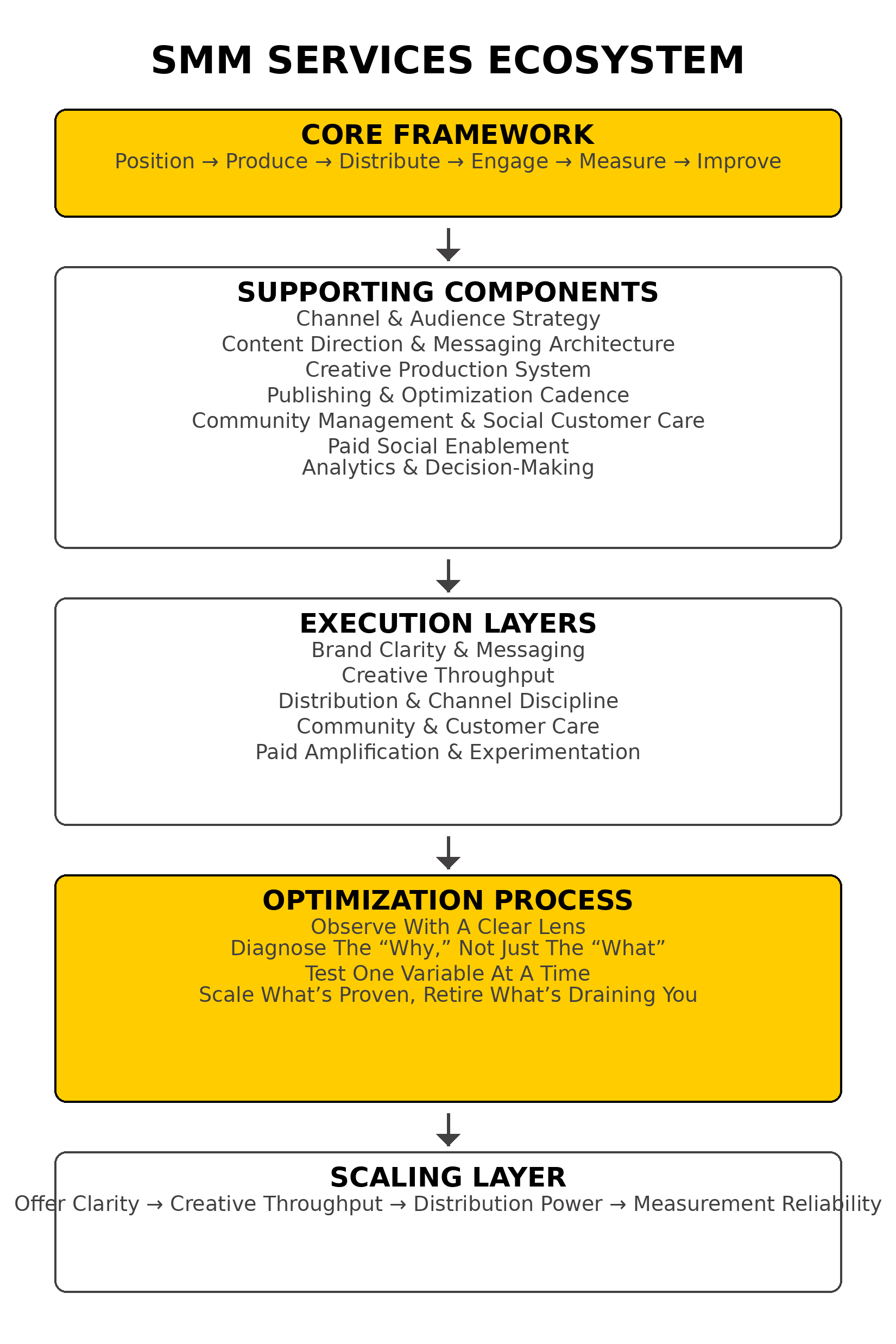
If you remember only one thing from this guide, let it be this: strong smm services are not a list of deliverables. They’re a system that makes attention, trust, and outcomes repeatable.
- Position: define who you’re for, what you stand for, and what you can prove.
- Produce: build a content engine with repeatable formats and a workflow that ships without drama.
- Distribute: publish with discipline, then use paid to amplify what already works and accelerate learning.
- Engage: treat community and customer care as daily operations, not an afterthought.
- Measure: track outcomes you can defend, then upgrade signal quality as you scale.
- Improve: run weekly tests, document learning, and compound small wins into big momentum.
This ecosystem approach is how you grow without burning out: fewer random requests, more consistent execution, and a clearer line between what you do on social and what the business actually gets back.
FAQ – Built For The Complete Guide
What do smm services usually include?
Most smm services combine strategy, content production, publishing, community management, basic analytics, and optimization. Some providers also handle paid campaigns, creator partnerships, social listening, and reporting that ties social performance to business outcomes.
How long does it take to see results from smm services?
You’ll often see early engagement signals within weeks, but reliable business outcomes usually take a few cycles of testing and iteration. The biggest factor is whether your smm services include a real optimization loop and measurement setup, not just posting.
Which platforms should smm services focus on first?
Start with where your customers already pay attention and where your team can sustain quality. The best smm services pick a small set of channels, build repeatable wins, and only expand once the workflow is stable and reporting is credible.
Do smm services need paid ads, or can organic be enough?
Organic can work when your offer and content are strong, but paid helps you learn faster and reach the right people consistently. Mature smm services treat paid as an accelerator for proven creative, not as a replacement for strategy and quality.
What metrics matter most in smm services?
It depends on your goal, but the common structure is attention (reach/views), engagement (shares/saves/comments), intent (clicks/profile actions), and outcomes (leads/sales). Good smm services define what each metric means and what decision it supports.
How do you avoid vanity metrics when reporting smm services?
Anchor reporting to outcomes first, then use leading indicators to explain why outcomes changed. If a report can’t answer “what are we changing next week,” your smm services are measuring activity instead of learning.
What should a client provide to make smm services work better?
Access, fast approvals, product knowledge, proof (reviews, case studies, demos), and someone who can make decisions. The best smm services still fail when approvals stall or the business can’t provide basic proof points.
How should smm services be priced?
Pricing usually reflects scope and complexity: platforms covered, content volume, creative formats (especially video), community management load, paid spend management, and reporting depth. The most sustainable smm services pricing aligns with capacity (time, production, expertise) rather than cheap deliverables.
Is it better to hire in-house, an agency, or a freelancer for smm services?
In-house works when you need deep brand immersion. Agencies work when you need multi-skill coverage and scale. Freelancers work when you want speed, specialization, and flexibility. Many teams combine all three: one internal owner plus specialized smm services support for creative, paid, or analytics.
What are the biggest mistakes that make smm services underperform?
The common failures are unclear positioning, inconsistent creative quality, trying to be everywhere at once, slow approvals, and weak measurement. Strong smm services fix these first, then scale.
How do I choose the right smm services provider?
Look for a clear operating model: how they brief, produce, approve, publish, engage, measure, and improve. If they can’t explain the system, they’ll default to posting and reporting screenshots—two things that rarely build durable growth.
Work With Professionals
If you deliver smm services as a freelancer or small studio, there’s a moment that hits hard: you’ve built the skill, you can do the work, but your pipeline still feels fragile. One month is packed, the next month is quiet, and you end up spending more time hunting opportunities than doing the kind of work you’re proud of.
That’s why marketplaces that remove friction can change your momentum. MARKEWORK is built around a simple idea: direct communication, predictable costs, and no commissions. Their model is explicit—no project fees and no commissions—and the work is already there, with the platform showing 1007 active listings publicly at the time of writing. When you’re trying to grow your client base, that matters more than another “networking strategy” that lives in a spreadsheet.
You can use it in the way that fits your style. If you want speed, you build a profile that makes your offer obvious, then apply to listings that match what you do best. If you want leverage, you position your smm services around outcomes—creative velocity, measurement clarity, and a weekly optimization loop—so you attract teams that value results instead of cheap deliverables.
And because the platform doesn’t sit in the middle of contracts or payments, you keep control of the relationship. The FAQ is clear that clients and marketers handle contracts and payments independently, which is exactly what many experienced freelancers prefer once they’re serious about building long-term client partnerships.
If you’re ready to trade “hoping for leads” for a pipeline you can actually work, start here:
markework.com Filip Konecny Enterprises