

Every brand is publishing. Every founder is posting. Every competitor is experimenting with short-form video, paid campaigns, community groups, or influencer collaborations. Yet despite the explosion of activity across platforms, very few businesses operate with a clear marketing strategy using social media that connects daily content to long-term revenue goals.
Without structure, social media becomes noise. Teams chase trends, celebrate vanity metrics, and burn budget without understanding what actually moves the business forward. With the right strategic foundation, however, social platforms evolve from content distribution channels into scalable growth engines that influence awareness, trust, conversion, and retention.
This first part builds the strategic groundwork. We will clarify what a marketing strategy using social media truly means, why it matters more than ever in today’s digital ecosystem, and how to design a framework that aligns with measurable business outcomes.
Article Outline
- What Is Marketing Strategy Using Social Media?
- Why Marketing Strategy Using Social Media Matters
- Framework Overview for Social Media Strategy
- Core Components of Social Media Strategy
- Professional Implementation of Social Media Strategy
What Is Marketing Strategy Using Social Media?

A marketing strategy using social media is a structured plan that defines how a business leverages social platforms to achieve specific commercial objectives. It goes far beyond posting consistently or boosting occasional content. It connects brand positioning, audience research, content architecture, paid distribution, data analysis, and customer lifecycle management into one coherent system.
At its core, this strategy answers five essential questions:
- Who exactly are we targeting and why?
- What role does social media play in our overall marketing ecosystem?
- Which platforms deserve focused investment?
- How will content guide users from discovery to decision?
- How will success be measured in revenue terms, not just engagement?
For example, platforms like Meta, LinkedIn, and TikTok provide advanced advertising and targeting capabilities, but those tools only produce results when they are guided by clear positioning and measurable objectives. Otherwise, campaigns become fragmented experiments rather than scalable systems.
Think of social media as infrastructure rather than promotion. When strategy leads, content becomes intentional. Paid campaigns become amplifiers of proven messaging. Analytics becomes a feedback loop instead of a reporting exercise.
Why Marketing Strategy Using Social Media Matters
Digital behavior has fundamentally shifted. Social platforms are no longer just communication tools; they are discovery engines, research hubs, and purchasing triggers. Data from DataReportal consistently shows that billions of people use social platforms monthly, with average daily usage exceeding two hours. That time represents attention, and attention—when structured strategically—translates into influence.
More importantly, consumer journeys are no longer linear. A prospect might discover a brand through a short-form video, validate credibility through user-generated content, read reviews, click a retargeting ad, and only then convert. A marketing strategy using social media ensures that each of those touchpoints is intentional and aligned.
Performance data published through Sprout Social and HubSpot’s marketing research shows that brands integrating organic content with paid social amplification consistently outperform those treating them separately. When content and paid campaigns operate within one strategic framework, cost efficiency improves and conversion rates stabilize.
Without that integration, three predictable problems emerge:
- Budget is spent on campaigns without clear attribution.
- Content teams optimize for engagement instead of revenue impact.
- Leadership questions ROI because metrics lack business context.
A well-designed marketing strategy using social media solves these problems by tying platform activity directly to business KPIs such as pipeline growth, customer acquisition cost, and lifetime value.
Framework Overview for Social Media Strategy
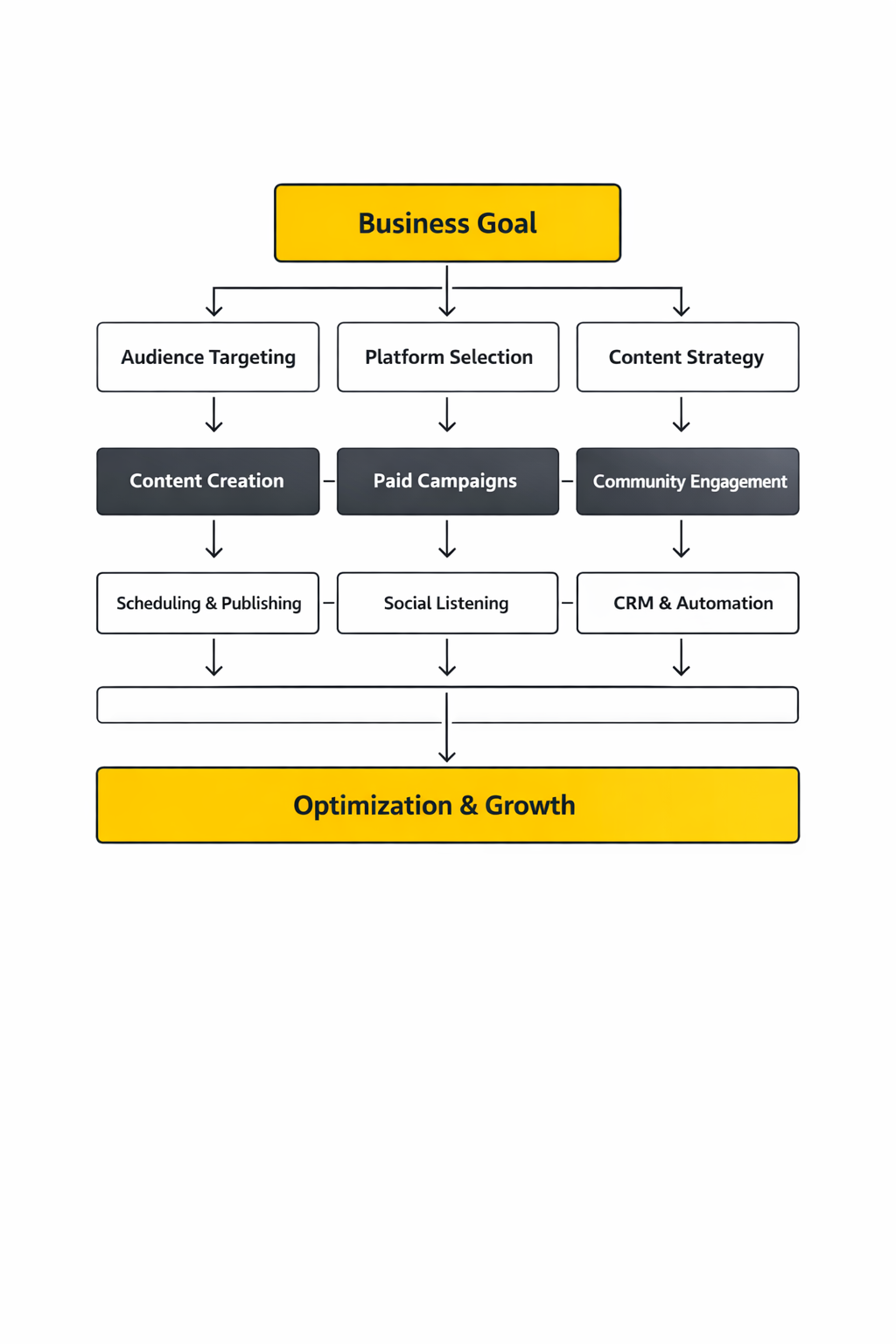
Building an effective strategy requires structure. The most reliable frameworks share common pillars that move from clarity to execution and then to optimization.
1. Strategic Positioning
Before selecting platforms or creating content calendars, the brand must clarify its positioning. This includes value proposition, differentiation, audience segmentation, and competitive landscape. Social content amplifies positioning—it cannot compensate for the lack of it.
2. Audience Intelligence
Modern platforms offer detailed demographic and behavioral insights. Data from platform-native tools and external analytics solutions allow marketers to understand interests, intent signals, and engagement patterns. A marketing strategy using social media relies heavily on this intelligence to personalize messaging and targeting.
3. Content Architecture
Rather than publishing random posts, strategic brands design content pillars aligned with stages of the customer journey. Educational content builds awareness. Authority-driven content strengthens credibility. Conversion-focused content moves prospects toward action. Each piece serves a defined role.
4. Paid Amplification Layer
Organic reach alone is rarely sufficient for predictable growth. Paid campaigns extend reach to targeted audiences, accelerate testing, and scale high-performing content. When integrated properly, paid and organic efforts reinforce each other.
5. Measurement and Optimization
Data closes the loop. Instead of reporting impressions in isolation, effective teams evaluate cost per acquisition, conversion paths, and revenue attribution. Insights from analytics refine messaging, audience targeting, and creative direction continuously.
Core Components of Social Media Strategy
A complete marketing strategy using social media integrates several interconnected components. Removing any one of them weakens the system.
Clear Objective Hierarchy
Objectives should cascade from high-level business outcomes down to platform-level KPIs. For example, if the primary goal is pipeline growth, then content engagement metrics only matter insofar as they influence qualified lead generation.
Platform Prioritization
Not every platform deserves equal investment. B2B brands often find stronger conversion performance on professional networks, while consumer brands may benefit more from visually driven or short-form platforms. Strategic focus prevents dilution of resources.
Consistent Brand Voice
Trust compounds over time. A unified voice across posts, campaigns, and interactions signals professionalism and reliability. Inconsistent messaging erodes authority and weakens recall.
Conversion Infrastructure
Social media rarely converts in isolation. Landing pages, CRM integration, retargeting sequences, and email automation must work together. The strategy connects platform engagement with backend systems that capture and nurture demand.
Data Governance
With increasing privacy regulations and platform changes, structured data management is essential. First-party data collection, proper tracking setup, and compliance considerations should be integrated from the beginning rather than retrofitted later.
Professional Implementation of Social Media Strategy
Even the most detailed strategy fails without disciplined implementation. Professional execution requires operational clarity, cross-functional alignment, and consistent review cycles.
First, responsibilities must be clearly defined. Content creation, paid media management, analytics, and community engagement require specialized focus. Blurred accountability often leads to inconsistent output.
Second, workflows should support iteration. Campaign testing, creative experimentation, and audience refinement should follow structured timelines. High-performing organizations treat social media not as a campaign channel, but as a continuously optimized growth environment.
Finally, leadership alignment is critical. When executives understand how a marketing strategy using social media connects to revenue objectives, resource allocation becomes easier and long-term investment becomes sustainable.
This strategic foundation sets the stage for deeper exploration in the next part, where we will examine platform selection, audience targeting precision, and performance measurement systems that turn social activity into measurable business growth.
Step By Step Implementation
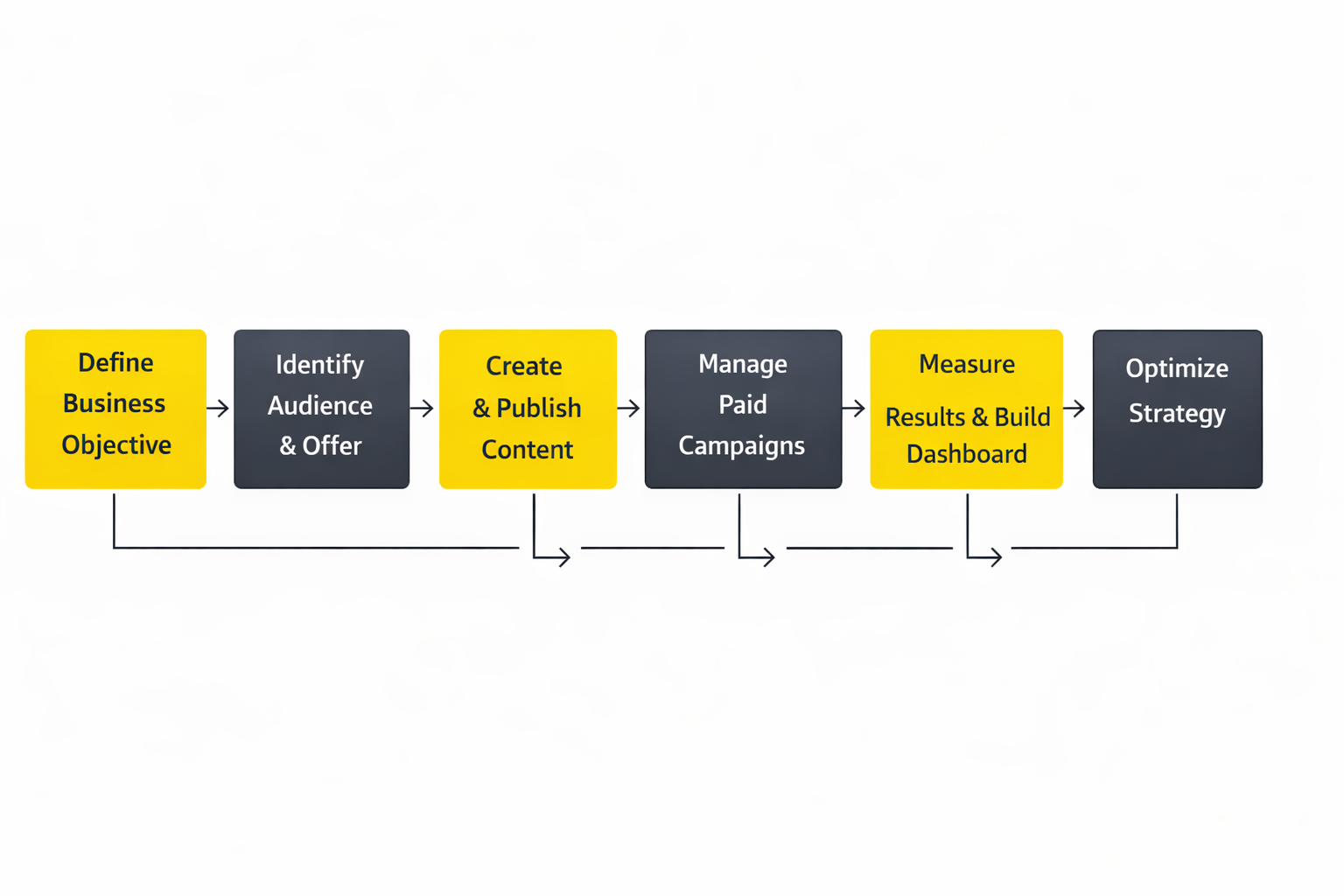
Once the framework is clear and your tool stack is ready, implementation is where a marketing strategy using social media either becomes a dependable growth system or turns into another “we tried posting more” experiment. The difference is usually process. High-performing teams treat social execution like product delivery: clear inputs, repeatable workflows, measurable outputs, and an optimization rhythm that never stops.
It also helps to keep a simple reality in mind: social is not a small channel anymore. The 2025 global data shows 5.24 billion active social media user identities, and the broader 2025 report ecosystem repeatedly lands around roughly two hours and twenty minutes of daily social use (with similar summaries across independent compilations like Smart Insights’ 2025 global social usage roundup). When attention is that concentrated, execution quality is not “nice to have.” It decides who gets remembered.
Step 1: Define One Primary Growth Goal
Start with one goal that leadership will defend when social activity gets noisy: pipeline, revenue, retention, app installs, qualified leads, or customer support deflection. You can absolutely track multiple metrics, but you need one north star so the team knows what “winning” looks like.
If your primary goal is pipeline, then your content has to earn trust and move people into conversations. If your primary goal is retention, then your content has to deepen habits and community. This isn’t philosophy. It’s how you decide what content gets made when the calendar gets full.
Step 2: Map Audience Intent to Platforms
Platform selection becomes much easier when you stop asking “Where is everyone?” and start asking “Where do they decide?” In many markets, people increasingly research brands through social video and creator content, which is why measurement-focused organizations have become obsessed with real attribution, incrementality testing, and media-mix modeling.
In the UK alone, usage patterns show how quickly attention shifts toward video platforms: Ofcom’s 2025 report shows YouTube time rising to an average of 51 minutes a day, and the same figure is reinforced in Ofcom’s explainer page covering 2025 online habits and recapped in Reuters’ reporting on the regulator’s findings. That’s a strong signal: your platform mix should follow where your audience actually spends time, not where your team feels comfortable publishing.
Step 3: Build a Content System, Not a Calendar
A calendar answers “what do we post next Tuesday?” A system answers “how do we repeatedly create content that moves the business?” Build your system around a small set of repeatable formats that match your audience’s decision process:
- Discovery formats that earn first attention (short video hooks, bold POV posts, creator collaborations).
- Trust formats that prove competence (breakdowns, behind-the-scenes, customer outcomes, product education).
- Conversion formats that trigger action (offers, demos, lead magnets, trial pushes, event sign-ups).
- Retention formats that keep people close (community prompts, updates, user spotlights, ongoing education).
This is also where brand voice becomes operational. You are not “finding your tone” on every post. You are reinforcing a recognizable personality that makes people feel like they know you.
Step 4: Set Up Tracking and Attribution Before Scaling
Most social programs fail silently in measurement first. A marketing strategy using social media becomes financially credible when you can connect content and campaigns to real outcomes without pretending everything is last-click.
At minimum, set up:
- Clean UTM conventions (so your reporting isn’t a guessing game).
- Platform pixels and server-side signals where possible, especially as privacy changes continue to limit browser-only tracking.
- GA4 reporting and attribution review so paid and organic insights align with how customers actually convert.
For attribution, GA4 and the wider Google ecosystem provide documentation around data-driven approaches and measurement tooling, which helps teams move away from simplistic credit models. Useful starting points include Google’s GA4 implementation documentation and Google’s guidance on data-driven attribution requirements.
Step 5: Launch With Controlled Experiments
Instead of “posting more,” launch like a scientist. Pick two creative angles, two audiences, and one offer. Run for a short cycle, then decide what earned the right to scale. This is where many teams waste months by changing everything at once and learning nothing.
If paid media is part of your plan, incrementality testing and lift studies can prevent you from confusing correlation with causation. TikTok’s measurement materials outline experimentation-based approaches like conversion lift studies and related measurement tooling (conversion lift study overview and TikTok’s measurement solutions PDF).
Execution Layers
Professional execution usually happens in layers, because social marketing is not one activity. It’s multiple systems running at the same time. When teams blend these layers deliberately, a marketing strategy using social media starts to feel predictable.
Layer 1: Organic Content and Community
This layer builds your identity and creates the “why them?” feeling. It’s also where you learn. Comment sections, DMs, stitches, duets, and quote-tweets are continuous qualitative research. Strong teams treat community interaction as part of their creative development, not an afterthought.
Layer 2: Paid Distribution and Creative Scaling
Paid media is the accelerator. It does two jobs: it amplifies what’s already working organically, and it speeds up learning through faster testing. The critical discipline is not budget size. It’s creative iteration speed and the ability to measure what truly changed outcomes.
On Meta’s side, automation and machine learning systems have become central to performance advertising, especially in e-commerce. Meta’s developer content discusses automation products like Advantage+ Shopping Campaigns, and measurement infrastructure such as Conversions API that connects marketing events more directly to optimization systems.
Layer 3: Data and Measurement
Measurement is where social becomes a business function, not a content hobby. In mature teams, reporting isn’t just “what happened.” It’s “what did we learn, what did we change, and what improved?”
Industry reporting increasingly emphasizes holistic measurement because customer journeys are fragmented across platforms and devices. Nielsen’s 2025 marketing research highlights the push toward clearer measurement in a chaotic environment (overview of Nielsen’s 2025 Annual Marketing Report and the report PDF).
Layer 4: Collaboration and Governance
As soon as social starts working, more stakeholders show up: sales wants leads, support wants deflection, product wants announcements, leadership wants brand safety. Governance prevents chaos. That means clear approval paths, brand guardrails, escalation rules, and a decision-maker who can protect creative momentum without creating risk.
Optimization Process
Optimization is how you turn momentum into compounding growth. The biggest mistake teams make is “optimizing” by chasing whatever went viral last week. Real optimization is a loop: observe, interpret, decide, test, and document.
Weekly Loop: Creative and Signal Review
Every week, review what your audience rewarded. Not just likes, but watch-time patterns, saves, shares, profile clicks, and the kinds of comments people leave when they’re leaning in versus scrolling past. Pair that with paid performance signals if you’re running ads. Then decide what creative themes deserve another iteration and what needs to be retired.
Monthly Loop: Funnel and Attribution Check
Monthly reviews should connect platform activity to the funnel. Which content actually produced site actions? Which audiences moved into retargeting pools? Which segments converted? If the measurement view looks messy, don’t blame the platform. Fix the tracking, simplify campaigns, and restore clarity.
Quarterly Loop: Strategy and Budget Reallocation
Quarterly, re-evaluate your platform mix and creative strategy. Consumer behavior changes quickly, and macro signals matter. If your audience is spending more time on video platforms, your content system needs to match that reality. Regulatory and usage research like Ofcom’s 2025 reporting on how people spend time online is a reminder that attention is not static (Online Nations Report 2025 PDF).
Implementation Stories
If you want to see what disciplined implementation looks like in the real world, Duolingo is one of the clearest recent examples. The story matters because it isn’t just “funny TikToks.” It’s an operational system that treats social as a product surface, with creative speed, community feedback, and executive buy-in.
The moment of high drama came in late 2025. Duolingo’s leadership was on an earnings call addressing performance and market expectations, and the conversation unexpectedly turned into something that sounded like pop culture, not finance: the company talked about a wave of people dressing up as Duo for Halloween. The same quarter included volatility that made it obvious the company couldn’t rely on hype alone, which is exactly why the marketing machine had to be structured rather than accidental (Q3 2025 earnings call transcript and related reporting in Business Insider’s coverage).
The backstory is that Duolingo’s brand has always relied on habit-building and a recognizable personality, but social media gave that personality a stage where it could evolve in public. Instead of treating the mascot as a logo, the team treated Duo as a character with lore, conflict, and comedic tension. Over time, that approach built a fan relationship that looks more like entertainment than advertising, and it’s been discussed as a deliberate strategy in marketing coverage and interviews (Adweek’s profile of Duolingo’s approach and Marketing Brew’s breakdown of how stunts translate into growth).
The wall showed up in a familiar place: scale and consistency. It’s one thing to have a few viral posts; it’s another to build a dependable engine that hits week after week without breaking brand trust or losing speed to approvals. Many brands freeze at this stage, either over-controlling creativity or letting randomness take over until the audience loses interest.
The epiphany for Duolingo was to operationalize what most brands only talk about. The company empowered a dedicated social team to move quickly, treat comments as creative prompts, and produce content that feels native to the platform rather than “brand-safe” in the boring sense. That internal trust shows up repeatedly in how leadership participates and how the brand commits to the bit, even when it looks absurd from the outside (Adweek’s reporting on executive participation).
The journey was not just creative. It included a real implementation discipline: building repeatable formats, responding in the comment section like a creator, and connecting cultural moments back to the product habit. Duolingo’s investor materials consistently frame the business as product-led, which is exactly why the social engine works: the content keeps bringing people back into a product that rewards consistency (Duolingo’s strategy overview and the Q3 2025 shareholder letter).
Then came the final conflict: even strong brands get tested. In 2025, Duolingo drew backlash around its “AI-first” positioning, and that backlash played out in the exact arena the brand had mastered: social media. The challenge wasn’t just reputation. It was maintaining tone and trust while the internet was watching for mistakes (coverage of the backlash and social response pressure).
The dream outcome is what most companies want but rarely achieve: cultural relevance that shows up in behavior, not just metrics. The brand’s TikTok audience has been reported at around 16.8 million followers, echoed in Business Insider and reflected in public transcript coverage where the company discusses the Halloween phenomenon (earnings call transcript). The lesson is not “be weird.” The lesson is to implement a marketing strategy using social media with enough structure that creativity can compound instead of burning out.
Professional Implementation
Professional implementation is the difference between a strategy deck and a working growth machine. If you are building a marketing strategy using social media for real clients or a real company, treat this as your operational checklist.
- Define ownership. One person owns the social system end-to-end, even if specialists own pieces (creative, paid, analytics, community).
- Document the content system. Formats, hooks, content pillars, publishing rhythm, and “what good looks like” should be written down so execution is repeatable.
- Protect speed with guardrails. Brand safety improves when rules are clear. Ambiguity creates slow approvals and reactive overcorrection.
- Make measurement a weekly habit. Don’t wait for monthly reports to discover you were optimizing the wrong thing.
- Use experimentation deliberately. Creative testing, lift studies, and attribution reviews keep decisions grounded in reality, not vibes.
- Close the loop with the business. Social performance should connect to pipeline, revenue, retention, or support outcomes, depending on the north star.
When these practices are in place, execution stops feeling chaotic. Your marketing strategy using social media becomes a system that can be improved on purpose, week after week, without losing the human energy that makes social work in the first place.
Statistics And Data
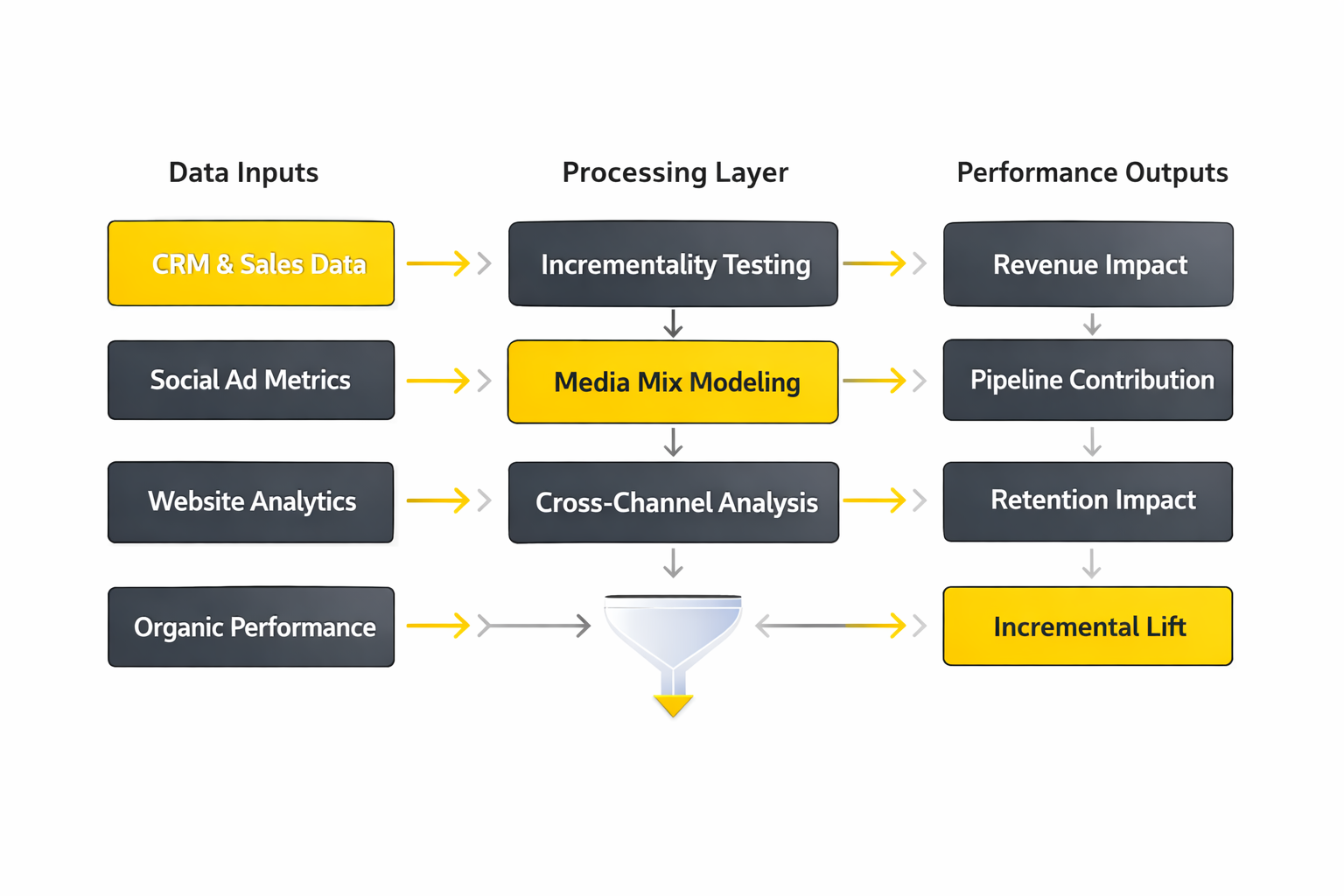
Data is the part of a marketing strategy using social media that keeps everyone honest. It separates “we feel like it worked” from “we can prove what changed,” and it makes decisions easier when budgets get tight. The goal is not to drown in dashboards. The goal is to understand attention, cost, and outcomes well enough to scale what works and kill what doesn’t.
The audience reality is still massive. The 2025 global reporting shows 5.24 billion active social media user identities, while the same reporting ecosystem repeatedly lands around roughly 2 hours and 21 minutes per day spent on social media, reinforced in a separate summary built from the same datasets that highlights 2 hours and 21 minutes of daily social use. That is a lot of daily surface area for discovery, persuasion, and relationship-building.
Platform ecosystems are also continuing to consolidate attention. In the UK, Ofcom’s 2025 reporting shows YouTube time rising to an average of 51 minutes a day, and the same figure appears in Ofcom’s companion explainer page on how the UK goes online in 2025, with a matching headline in Reuters’ coverage of the regulator’s findings. Even if your business does not operate in the UK, the pattern matters: attention shifts toward the platforms that win daily time, and your social mix has to adapt.
Spend is following attention. In the US, the IAB/PwC full-year 2024 report shows social media advertising revenue reaching $88.8 billion in 2024, and IAB’s release page frames the broader digital market at $259 billion in 2024 revenue, with industry coverage spotlighting social’s rebound and the same $88.8 billion social figure plus the year-over-year jump. This is why measurement matters: money is pouring into social, and leadership will expect proof.
On the largest networks, scale is still expanding. Meta’s 2025 results note Family daily active people (DAP) at 3.58 billion on average for December 2025, along with year-over-year changes in ad impressions and average price per ad in the same release. That kind of reach is exactly why social measurement cannot stop at clicks.
Performance Benchmarks
Benchmarks are useful when you treat them like street signs, not finish lines. A marketing strategy using social media should use benchmarks to ask better questions: Are we underperforming because our creative is weak, because our audience definition is sloppy, or because the offer is not compelling? Benchmarks don’t solve those issues, but they help you notice them early.
Benchmark 1: Platform Engagement Shifts
Organic engagement rates and content performance fluctuate year to year as feeds evolve. Benchmark reports can help you understand whether your results reflect your execution or reflect a broader algorithmic shift. For example, Emplifi’s benchmarking work summarizes patterns across brands and industries in its Social Media Benchmarks Report 2025, which is valuable for context when your numbers suddenly move.
For LinkedIn specifically, Social Insider publishes ongoing benchmark snapshots that track engagement by format and time window, including its 2025 benchmark page on LinkedIn engagement rates by impressions and post type, and Sprout Social references the same benchmark dataset in a more practical explainer on how to interpret LinkedIn engagement rate benchmarks. The practical takeaway is not a single “good” number. It is noticing which formats your audience actually rewards on the platform right now.
Benchmark 2: Paid Market Pressure
In paid social, costs are shaped by auction dynamics, seasonality, targeting competitiveness, and creative quality. When costs rise, teams often panic and cut spend right when they should be improving creative and measurement. Meta’s reporting on year-over-year changes in ad impressions and the average price per ad provides macro context for why the market can feel more expensive even when your creative quality is stable (Meta’s 2025 results release).
At the same time, broader ad-market forecasts help you understand whether pressure is localized or industry-wide. WARC’s outlook pages and industry summaries show the market continuing to grow into 2025 and beyond (Global Ad Spend Outlook 2024/25 and a 2025 revision summary via eMarketer’s write-up of WARC’s updated forecast). If your costs rise inside a rising market, you need measurement rigor, not guesswork.
Benchmark 3: Business-Level Metrics
The most useful benchmarks are the ones that connect to business outcomes: qualified leads per week, pipeline contribution, customer acquisition cost, and retention signals. This is where many teams get stuck because platform dashboards were never designed to tell the full story across channels.
Nielsen’s 2025 work emphasizes the push toward holistic measurement and clearer decision-making in a fragmented environment, which aligns with what high-performing teams are already doing: connecting brand and performance signals into one measurement narrative (Nielsen’s 2025 Annual Marketing Report release and the report PDF).
Analytics Interpretation
Analytics interpretation is where a marketing strategy using social media becomes a decision system. You are not collecting data for reporting theater. You are collecting data to decide what to do next.
Don’t Confuse Attention With Impact
High reach can be meaningless if it doesn’t change belief or behavior. A viral post might build awareness but attract the wrong audience. A smaller post might generate fewer likes but bring the right people into a demo, a trial, or a sales conversation. Interpretation starts by separating top-of-funnel attention from bottom-of-funnel movement.
Look For Consistent Lift, Not Perfect Attribution
Social rarely gets clean last-click credit, especially when people watch, think, search later, and convert on a different device. This is why incrementality testing exists. Meta’s documentation explains how conversion lift testing is designed to estimate the incremental impact of campaigns by comparing exposed groups and holdouts (Meta Conversion Lift overview), and TikTok’s documentation explains how its conversion lift studies aim to answer whether ads drove incremental business outcomes (TikTok Conversion Lift Study help center).
When you cannot run lift studies every month, you can still interpret responsibly by focusing on directional patterns: what audiences are repeatedly converting, what creatives are repeatedly pulling qualified traffic, and what offers repeatedly lower acquisition cost.
Make Your Dashboard Tell A Story
A good dashboard reads like a narrative: what we tried, what changed, what we learned, and what we will do next. If your analytics dashboard forces stakeholders to do detective work, it will not survive busy leadership cycles. This is also why many teams build a single “source of truth” view that combines platform metrics, web analytics, and CRM outcomes.
When you need multi-touch visibility across devices and channels, GA4 is often used as a practical baseline measurement layer, with guidance on implementation living in Google’s own documentation (GA4 collection documentation) and business-focused explainers showing how data-driven attribution can be applied in real workflows (Google’s example of SMBs using GA4 data-driven attribution).
Case Stories
Analytics becomes real when it changes the outcome of a campaign, not just the look of a report. Here is a real implementation story that shows how measurement and interpretation can reshape decisions inside a marketing strategy using social media.
Clarins: From Fragmented Signals To Confident Decisions
The pressure hit in the middle of a campaign window, not after it. Teams could see activity in dashboards, but nobody could confidently answer the question leadership cared about most: did social media create incremental outcomes, or did it just steal credit from other channels? The numbers looked encouraging, yet the uncertainty felt expensive.
Clarins’ backstory is a global premium skincare brand with a long history of in-store experiences and advisory-led selling. As customer behavior shifted online, the brand had to translate that guidance and trust-building into digital environments where the journey is messy and spread across platforms. That shift made measurement harder because results were distributed across regions, tools, and teams.
The wall was not creativity. It was fragmentation. Clarins faced disconnected data sources and reporting methods that made it difficult to build one view of performance across markets, which is a common reason social teams get stuck defending their value instead of scaling it. Without unified measurement, every performance conversation turns into debate.
The epiphany was to treat measurement as infrastructure rather than a monthly task. Clarins’ work with partners focused on creating scalable reporting that could unify marketing data and make performance comparable across markets, instead of letting each region define success differently. One partner case study describes building a cloud-based reporting framework designed to centralize data and create a standardized view (Cosmo5’s Clarins reporting framework case study).
The journey then extended into channel-level decision-making. On the paid social side, Clarins used experimentation-based measurement approaches to evaluate campaign impact, including conversion lift study methodology and cross-checking results with web analytics tools, which is described in Meta’s success story write-up (Meta’s Clarins campaign measurement summary). Separately, Clarins’ shift toward delivering a digital version of its in-store experience has been documented through workflow and tooling changes that support social execution at scale (Hootsuite’s Clarins story on bringing the in-store experience online).
Then the final conflict arrived the way it often does: the measurement environment itself changed. Privacy constraints, platform tracking limitations, and cross-device behavior made it easy for teams to fall back into “it’s working, trust us” narratives. That is exactly the moment when disciplined teams double down on incrementality thinking and unified reporting rather than chasing prettier vanity metrics.
The dream outcome is not a single magic number. It is confidence. When teams can unify data, evaluate incrementality, and explain performance in plain language, they get budget stability and creative freedom at the same time. That combination is what turns a marketing strategy using social media into an engine instead of an argument.
Professional Promotion
Professional promotion is what happens after the numbers are in. This section is not about “promoting a post.” It is about promoting the work internally and externally so your strategy earns investment, trust, and long-term runway.
Translate Metrics Into Decisions
Leaders do not want spreadsheets. They want clarity. A strong performance narrative connects metrics to a decision: we are reallocating budget to the audience that converts, we are scaling the creative theme that consistently drives qualified actions, and we are pausing the format that brings attention without impact. The IAB’s reporting on how quickly social ad revenue rebounded in 2024 is a reminder that social is a serious budget line (IAB/PwC 2024 revenue report PDF), so decision narratives need to be equally serious.
Show Confidence With Rigor
When stakeholders push for proof, offer methodology, not excuses. Even if you cannot run lift tests constantly, you can explain what you are doing to isolate impact: controlled tests, audience exclusions, creative holdouts, and attribution sanity checks. That mindset aligns with how major platforms describe measurement best practices, such as Meta’s explanation of conversion lift testing (Meta’s lift testing overview) and TikTok’s explanation of conversion lift studies (TikTok’s lift study documentation).
Package Results For Reuse
Build a simple “results package” every month: one-page narrative, a short learning log, and a short list of next experiments. This becomes a reusable asset for leadership updates, sales enablement, investor decks, and client renewals. Over time, you are not just running social campaigns. You are building a documented body of evidence that your marketing strategy using social media is improving the business on purpose.
Advanced Strategies
Once the basics are stable, a marketing strategy using social media becomes a game of leverage. You stop asking, “How do we post more?” and start asking, “How do we turn one strong signal into ten compounding outcomes?” The advanced layer is where creativity, distribution, and measurement blend into systems that scale without burning out the team.
Build A Creator Partner Engine
Creators are no longer just “influencers.” For many brands, they function like a distributed sales and content network, especially when affiliate links and social commerce tools make performance measurable. That shift is one reason big advertisers are structurally reallocating spend toward social and creators, highlighted by reporting on Unilever’s plan to work with far more influencers and shift a large share of its ad budget into social channels (how Unilever’s influencer-first push accelerated the creator economy).
To make creators scale, treat partnerships like a pipeline:
- Recruitment: identify creators whose audience language matches your customer objections, not just your aesthetic.
- Briefing: give creators a clear “problem-to-solution” narrative and let them keep native tone.
- Iteration: refresh angles fast, the way TikTok performance teams describe cycling creative frequently for sustained results (Quay’s TikTok conversion lift case study notes frequent creative refresh cycles).
- Scaling: promote proven creator content through paid amplification where platform policies allow, instead of betting budget on untested studio creatives.
Design For Social Commerce, Not Just Traffic
Social has been moving from “influence” to “checkout,” and the pace is accelerating. In the US, social commerce sales are estimated at $87.02 billion in 2025, and TikTok Shop’s share is described as nearly 20% of US social commerce.
If social commerce is relevant to your business model, the strategy changes:
- Content becomes the storefront: product demos, comparisons, and creator “proof” replace polished brand ads as the primary persuasion layer.
- Distribution becomes the inventory: you plan creator supply the way you plan stock, because selling pressure now lives inside content cadence.
- Measurement becomes incremental: you need to know whether social commerce content created new demand or simply converted people already on the edge of buying.
Use Video-First Flywheels In B2B
B2B social has been quietly shifting toward video and creator-led formats, especially on LinkedIn. LinkedIn has publicly framed video as a fast-growing format and expanded its video ad ecosystem through BrandLink (LinkedIn’s video and BrandLink update), while reporting describes BrandLink revenue rising sharply in mid-2025 and the program adding publishers and creators (Reuters coverage of LinkedIn’s BrandLink expansion).
The advanced move here is building a “trust flywheel”:
- Organic video builds familiarity: short clips that explain decisions, tradeoffs, and lessons create a relationship before a sales call exists.
- Paid amplifies proof: you boost the videos that already earned strong watch-time and high-intent actions.
- Sales uses the same assets: the same clips become enablement for outbound, nurtures, and deal acceleration.
Automate Where It Frees Creative, Not Where It Blinds You
Automation can scale outcomes, but it can also hide learning if you treat it like a black box. The professional approach is to automate targeting and delivery where platforms are strongest, while keeping creative development and measurement rigor in human hands. Many platform-native success stories emphasize pairing automation with disciplined testing and measurement (for example, Meta’s case study library frequently highlights automation paired with lift thinking and conversion optimization workflows, such as Meta’s NOW case study referencing Advantage+ and a measurable lift).
In practice, automation works best when your team maintains control over:
- Creative direction: a steady stream of native, audience-relevant angles.
- Testing design: holdouts, creative splits, and clear hypotheses.
- Business constraints: margin, inventory, lead quality, and customer experience standards.
Scaling Framework
Scaling a marketing strategy using social media is less about “more spend” and more about “more certainty.” You scale the parts of the system that are repeatably true, and you contain the parts that still rely on luck. A clean scaling framework keeps teams from confusing momentum with sustainability.
Stage 1: Prove The Signal
Before scaling, prove that the strategy works in a controlled environment. This means one clear audience segment, one offer, and a small set of creative angles that you can iterate quickly. For many teams, running incrementality experiments is the fastest way to avoid scaling an illusion, which is why platforms provide lift study methodologies as core measurement tools (Meta conversion lift overview and TikTok conversion lift documentation).
Stage 2: Systematize Production And Distribution
Once you have a signal, scaling is mostly operational. You build repeatable creative formats, establish creator partner workflows, and create a publishing cadence that doesn’t depend on heroics. Distribution becomes a deliberate layer: paid amplification supports what already resonates, and retargeting sequences reinforce the narrative instead of repeating the same ad forever.
Stage 3: Expand Safely Across Audiences And Markets
Scaling across audiences and markets requires governance. You define what cannot change (brand promise, positioning, compliance rules) and what must be localized (language, objections, cultural references, creator selection). This is also where teams that rely on a single platform become fragile, because platform shifts can change costs and reach overnight.
Stage 4: Commit To Holistic Measurement
As you scale, attribution becomes messier, not cleaner. That is why many organizations are rebuilding measurement around incrementality and media mix modeling to bridge gaps in a privacy-first environment, reflected in measurement trend analysis focused on MMM and incrementality leading 2026 measurement planning (eMarketer on MMM and incrementality trends shaping 2026).
Growth Optimization
Optimization is how you protect scaling from decay. As soon as you scale, performance will try to deteriorate through fatigue, rising auction pressure, and audience saturation. A marketing strategy using social media stays profitable when optimization is treated as a standing operating rhythm rather than a reaction to bad weeks.
Creative Velocity As A KPI
Many teams track ROAS and CPA, but ignore the real driver: how fast you can produce and validate new creative. Creative fatigue is predictable, so the solution is also predictable: maintain a pipeline of angles, hooks, and creator formats. This is one reason TikTok measurement and performance guidance repeatedly emphasizes experimentation and structured refresh cycles (TikTok’s post on conversion lift and incrementality).
Build A Paid-And-Organic Feedback Loop
Organic performance is a testing ground for messaging and format. Paid performance is a scaling engine for proven creative. When the two are connected, you stop treating organic content as “brand” and paid content as “performance,” and you start treating both as parts of the same learning system.
Shift From Channel Metrics To Business Metrics
As budgets grow, leadership stops caring about platform wins and starts caring about business outcomes. If social commerce is part of your strategy, revenue context matters, especially as the market expands toward the $87.02 billion US social commerce figure in 2025 and growth projections continue. If B2B is your focus, initiatives like LinkedIn’s BrandLink expansion signal where attention and ad formats are moving, which should influence your content system (Reuters on LinkedIn’s BrandLink and video push).
Scaling Stories
Scaling stories are valuable when they show the real tradeoffs: speed versus sustainability, incentives versus trust, and growth versus operational reality. This story matters because it highlights what can go wrong when scale is pursued without a stable economic engine underneath the content.
Flip: The Cost Of Buying Growth
The collapse didn’t look like a slow decline. It looked like a fast-motion accident: a social shopping app that had momentum, money, and creators—then suddenly layoffs, eviction headlines, and shutdown. People who had been watching downloads spike realized the growth was not the same thing as stability.
The backstory was ambitious. Flip wanted to merge creator-led video reviews with ecommerce in a way that felt like entertainment, and it attracted major investor interest and significant funding. The company even expanded aggressively through acquisitions and creator incentives as it tried to become a serious competitor in social commerce (Business Insider’s reporting on Flip’s rise, funding, and incentives).
The wall arrived when the market context shifted. Flip’s early 2025 surge was amplified by uncertainty around TikTok’s future in the US, but when that uncertainty eased, the tailwind disappeared. At the same time, the economics of rapid growth became heavier: rising costs, high user acquisition spend, and creator payments that were hard to sustain at scale (the same Business Insider investigation details cost pressure and unsustainable incentives).
The epiphany, unfortunately, came too late. The company’s momentum revealed a hard truth that applies to any marketing strategy using social media: if you buy growth without aligning incentives to profitable retention, your “success” can be temporary. Social-driven scale is unforgiving when the unit economics are not healthy enough to survive the next market shock.
The journey became a scramble to stabilize. Reports describe layoffs, operational disruption, and a rapid attempt to reduce burn while maintaining the creator and brand flywheel that made the product feel alive. But scaling a content-and-commerce ecosystem requires ongoing investment, and once the funding narrative cracks, the ecosystem can unravel quickly (Flip’s reported layoffs and operational breakdown).
The final conflict was structural competition. TikTok Shop continued scaling and shaping social commerce behavior at a massive level, with analyses describing it reaching ecommerce scale comparable to established platforms and highlighting how creator-driven video sells products differently than traditional marketplaces (Wired’s reporting on TikTok Shop’s rapid ecommerce scale). Flip was trying to compete in a category where platform giants can subsidize experimentation far longer than a startup can.
The dream outcome for marketers is the lesson, not the collapse. Flip’s story teaches that scaling social-driven growth must be anchored in sustainable economics: creator incentives tied to real margin, retention designed into the product experience, and paid acquisition that can survive when the “novelty spike” fades. If you internalize that lesson, your marketing strategy using social media becomes resilient instead of fragile.
Sell The System, Not The Post
Executives don’t fund posts. They fund systems that produce predictable outcomes. Tie your social plan to the market reality that spend is concentrated here—social ad revenue in the US reached $88.8 billion in 2024—and show how your system converts that spend into measurable business results rather than temporary reach.
Frame Measurement Like Risk Management
As scale increases, so does the cost of being wrong. Present incrementality testing and MMM as risk management: tools that prevent over-investing in channels that look good inside dashboards but don’t move the business in reality. Measurement trend analysis shows MMM and incrementality gaining priority for 2026 planning because they help bridge gaps created by privacy and cross-device journeys (MMM and incrementality trends defining 2026).
Make Partnerships Visible
Advanced social growth often depends on partners: creators, platforms, and sometimes publishers. When LinkedIn expands creator-led video programs and publishers to draw ad spend, it signals how quickly platforms are re-shaping distribution opportunities for brands (LinkedIn’s BrandLink update and Reuters on BrandLink’s expansion and reported revenue growth). Show stakeholders where your brand sits inside these shifts, and what access you are building before competitors catch up.
Protect The Team From Burnout
Scaling can destroy teams if every win demands heroics. Operationalize creative velocity, creator pipelines, and review rhythms so the system produces consistently without constant emergencies. The brands that scale best are not the ones that “work hardest,” but the ones that build a marketing strategy using social media that keeps working even when the team takes a breath.
Future Trends
The next wave of a marketing strategy using social media will be shaped less by “new platforms” and more by new behavior. People still scroll, but they increasingly search inside apps, buy inside feeds, and use AI-driven discovery to skip the old journey of “Google, then compare, then decide.”
AI Discovery And Conversational Shopping
Social shopping is moving from static search bars to conversational discovery. LTK’s rollout of an AI shopping chatbot powered by OpenAI is a signal that commerce platforms want users to talk their way to a purchase, guided by creator content and personalized context (LTK’s AI chatbot launch and how it uses creator content for product discovery). For marketers, this means your creative library becomes a dataset: the content you publish today can become the answers users receive tomorrow.
Social Commerce Keeps Expanding, But Execution Gets Stricter
Social commerce growth is no longer just hype; it is a measurable market. In the US, social commerce sales are estimated at $87.02 billion in 2025, and TikTok Shop is described as capturing nearly 20% of that market. As the category matures, platforms will increasingly reward operational excellence: authentic product demos, fast creative iteration, lower return rates, and customer experience that can survive volume.
The Authenticity Rebound And Community Validation
As AI-generated content floods feeds, human-led communities become more valuable. Vogue’s reporting on Reddit positions the platform as an “antidote” to AI shopping because it provides real, messy, experience-based conversations and purchase validation behavior (how Reddit is leaning into authenticity and community-led product validation). For brands, this changes how trust is earned: it becomes less about polished persuasion and more about showing up in the right places with proof people can discuss.
Creator Marketing Becomes Structural, Not Experimental
The shift toward creators is now being treated as a strategic restructuring decision at the biggest advertisers. Reporting on Unilever’s push to dramatically increase influencer partnerships underscores how seriously major brands are re-allocating attention and spend toward creator-led distribution (Unilever’s influencer expansion and the ripple effect across the creator economy). A marketing strategy using social media that ignores creators increasingly risks being out-executed by competitors who build creator pipelines like a core capability.
Measurement Shifts From Attribution To Incrementality
As privacy changes, cross-device journeys, and walled gardens keep making “perfect attribution” unrealistic, measurement is shifting toward incrementality and modeling. Survey-based research summarized by EMARKETER shows many marketers planning to invest more in marketing mix modeling (MMM), and MMM being ranked as a highly trusted methodology (MMM and incrementality trends shaping measurement priorities into 2026). For execution, that means your reporting must become narrative and decision-oriented, not a list of platform metrics.
Strategic Framework Recap

If you only remember one thing from this guide, let it be this: a marketing strategy using social media is not content. It is a system that turns attention into outcomes.
- Start with clarity: one primary business goal that your team can defend when priorities compete.
- Choose platforms by intent: publish where your audience decides, not where you feel comfortable.
- Build repeatable execution: formats, workflows, and governance that prevent chaos as you grow.
- Use tools to scale discipline: scheduling, listening, paid management, CRM, and analytics that reduce operational friction.
- Measure what matters: focus on incrementality, pipeline, revenue, retention, and decision-grade reporting.
- Scale through leverage: creator pipelines, paid amplification of proven content, and creative velocity as a real KPI.
When these pieces connect, social stops feeling like a slot machine. You gain a predictable engine you can refine, scale, and defend with real evidence.
FAQ – Built For The Complete Guide
What Is A Marketing Strategy Using Social Media, In Plain English?
It is a structured plan for how your brand uses social platforms to achieve specific business outcomes. It defines who you target, what you publish, how you distribute it, and how you measure whether it created real value, not just engagement.
How Do I Pick The Right Platforms Without Spreading Too Thin?
Choose platforms based on where your audience makes decisions. If your buyers research through video, prioritize video-first workflows. If your deals require trust and proof, prioritize the platforms where credibility is built and shared. Use market signals like the growth of video time and platform investments in video ad ecosystems to guide your choices (how LinkedIn is deepening its video advertising push).
How Often Should I Post For Consistent Results?
Consistency matters more than volume. Start with a cadence you can maintain without burnout, then scale through repeatable formats and creator partnerships. A sustainable system beats a short sprint that collapses after a month.
Should I Run Paid Ads Or Go Organic First?
Use organic to learn what resonates and paid to scale what already works. If you have budget, run controlled experiments early so you can validate messaging faster and build retargeting pools sooner.
What Metrics Actually Matter In A Professional Setup?
Track metrics that connect to business outcomes: qualified leads, pipeline contribution, customer acquisition cost, retention signals, and incremental lift. Platform engagement still matters, but mainly as an early indicator of whether your message is earning attention and trust.
How Do I Prove ROI When Attribution Is Messy?
Shift from “who gets credit” to “what changed outcomes.” Use incrementality approaches and controlled testing when possible, and complement with modeling as budgets grow. The industry trend toward MMM and incrementality is accelerating because it helps teams make decisions in a privacy-constrained environment (why incrementality and MMM are becoming core measurement priorities).
What Content Formats Work Best Right Now?
Formats that feel native win. Short video that demonstrates real usage, creator-style explanations, and community-led proof tend to outperform polished “brand ads” in many categories, especially as platforms reward watch time and authentic interaction.
How Do I Use Creators Without Wasting Budget?
Treat creators like a pipeline. Recruit based on audience-match, brief with clear problem-to-solution narratives, iterate quickly, and only scale what proves performance. The biggest brands are expanding creator investments because they see creator distribution as structural, not optional (how major advertisers are scaling influencer partnerships).
What If My Brand Feels “Boring” On Social Media?
“Boring” usually means unclear positioning or weak storytelling. Focus on customer problems, behind-the-scenes decision-making, practical lessons, and proof. Authority content can be just as engaging as entertainment when it is honest, specific, and useful.
When Should I Expand To More Platforms?
Expand after you can reliably produce content, measure outcomes, and iterate on one or two primary platforms. Scaling channels before scaling execution creates fragmentation and makes optimization harder.
How Is Social Changing With AI Shopping And Chatbots?
Discovery is becoming conversational. As platforms like LTK introduce AI tools that use creator content and personalization to guide product choices, your creative library becomes an asset that can drive future recommendations (LTK’s AI shopping chatbot and the role of creator content).
What Is The Fastest Way To Start If I’m A Freelancer?
Pick a narrow outcome (paid social lead gen, creator partnerships, content systems, analytics), build a simple portfolio with real deliverables, and pitch a clear transformation. Freelancers win when they sell a repeatable system, not “help with social.”
Work With Professionals
If you have made it this far, you already know the truth: a marketing strategy using social media is not hard because the ideas are complicated. It is hard because execution is relentless. Creative needs to ship on schedule. Measurement needs to stay clean. Clients and stakeholders need proof that your work is moving the business, not just filling feeds.
That is why the best freelancers build two things at the same time: a reliable delivery system and a reliable pipeline. When you only have one, you either deliver great work and panic about the next client, or you chase clients and never get enough breathing room to do your best work.
Markework is built for that second problem. It is a marketplace designed to help marketing professionals land work while keeping the relationship direct. The platform highlights no commissions with simple monthly plans, direct communication for negotiating without a middle layer, and a model that lets you browse openly and unlock opportunities through tokens when you need them.
And the market demand is not small. On Upwork alone, the marketing category can show over 12,000 open marketing jobs at a given moment. That does not even count roles across LinkedIn, niche communities, and direct referrals. The opportunity is real, but it rewards marketers who can show proof, move fast, and stay consistent.
If you want your social strategy skills to turn into stable income, focus on becoming the person companies trust to run the system: the content engine, the paid testing loop, the measurement narrative, and the scaling plan. Then put yourself where those companies are actively searching and ready to hire.
 Filip Konecny Enterprises