
Businesses that succeed on social platforms rarely rely on luck. Behind every consistent stream of engagement, leads, and conversions is a structured system that guides what to post, when to post, and why it matters. Social media plans provide that system. They turn scattered ideas into deliberate actions that align with business goals and audience expectations.
Consider Petra, a freelance fitness coach in Brno. She posted workout videos randomly whenever she had time. Some posts performed well, but most went unnoticed. After creating a clear social media plan, she scheduled educational tips on Mondays, transformation stories on Wednesdays, and live Q&A sessions on Fridays. Within three months, her profile engagement doubled, and she began receiving consistent client inquiries.
Social media plans do not just improve consistency. They improve decision-making. With a structured plan, every post serves a purpose, every campaign supports a larger objective, and every metric provides actionable feedback.
Article Outline
- Definition and purpose of social media plans
- Why structured planning directly impacts growth
- The complete framework professionals use
- Essential components that make plans effective
- How professionals implement scalable systems
What Is Social Media Plans
Social media plans are structured roadmaps that define how individuals or businesses use social platforms to achieve specific goals. These plans outline content types, posting schedules, audience targeting, messaging strategy, and performance tracking.
Instead of posting randomly, a social media plan answers critical questions:
- Who is the target audience
- What type of content resonates most
- Which platforms deliver the best results
- When content should be published
- How success will be measured
This structured approach transforms social media from a reactive activity into a strategic growth channel. Brands move from guessing what works to executing proven methods based on data and audience behavior.
Modern social media plans also integrate with broader marketing efforts, ensuring messaging remains consistent across platforms, websites, and email campaigns.
Why Social Media Plans Matters
Social media has evolved into one of the most influential communication channels in the world. More than 5 billion people actively use social platforms globally, making them essential for visibility, trust, and customer acquisition.
Without a plan, businesses face several problems:
- Inconsistent posting leads to declining engagement
- Mixed messaging confuses audiences
- Missed opportunities for audience growth
- Difficulty measuring return on effort
- Wasted time on ineffective content
With a clear plan, the opposite happens. Content becomes consistent, audiences recognize the brand, engagement increases, and measurable growth becomes possible.
A small ecommerce store in Ostrava experienced this shift firsthand. Before planning, their posts were product-focused and irregular. After implementing a structured plan with tutorials, customer stories, and educational posts, their audience grew steadily, and their monthly sales increased without increasing advertising spend.
Framework Overview
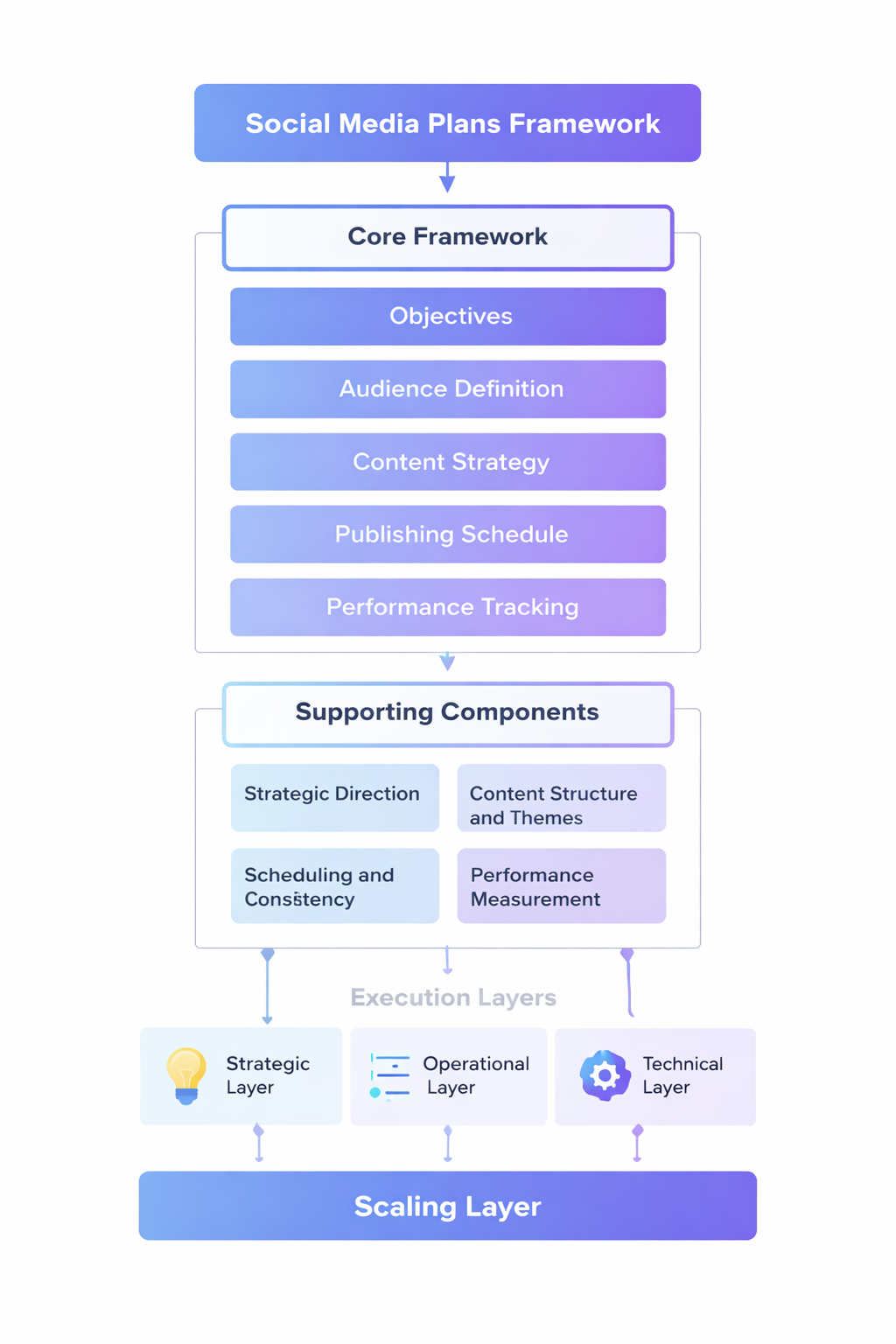
Professional social media plans follow a repeatable framework designed to ensure consistency and scalability. This framework connects business goals directly with content execution.
The core framework includes five essential layers:
- Objectives: Clear definition of what success looks like, such as brand awareness, lead generation, or sales
- Audience definition: Understanding demographics, interests, and behaviors
- Content strategy: Selecting formats, topics, and messaging themes
- Publishing schedule: Establishing timing and frequency for optimal visibility
- Performance tracking: Measuring engagement, reach, and conversions
This framework ensures every action contributes to measurable outcomes instead of isolated activity.
Core Components
Effective social media plans rely on several interconnected components that create a sustainable system.
Clear Strategic Direction
Every plan begins with clarity. Businesses define why they use social media and what outcomes they expect. This prevents wasted effort and ensures alignment with broader objectives.
Content Structure and Themes
Successful plans organize content into repeatable themes such as education, inspiration, promotion, and community engagement. This structure creates consistency while maintaining variety.
Scheduling and Consistency
Consistency builds trust and improves algorithm visibility. Planned schedules prevent inactivity and ensure audiences receive regular value.
Performance Measurement
Tracking metrics reveals what works and what needs adjustment. This allows continuous improvement rather than relying on assumptions.
Adaptability and Optimization
Effective plans evolve based on performance insights and audience response. This flexibility ensures long-term relevance and growth.
Professional Implementation
Professionals treat social media plans as operational systems rather than informal checklists. They use structured workflows, defined content calendars, and performance reviews to maintain consistency.
For example, a marketing agency managing multiple clients typically plans content one month in advance, aligns posts with campaigns, and evaluates performance weekly. This approach ensures predictable growth and eliminates last-minute uncertainty.
Professional implementation also separates planning from execution. Planning focuses on strategy and structure, while execution focuses on creating and publishing content. This separation improves efficiency and quality.
Most importantly, social media plans create clarity. Instead of asking “What should we post today?”, businesses follow a predefined roadmap designed to achieve measurable success.
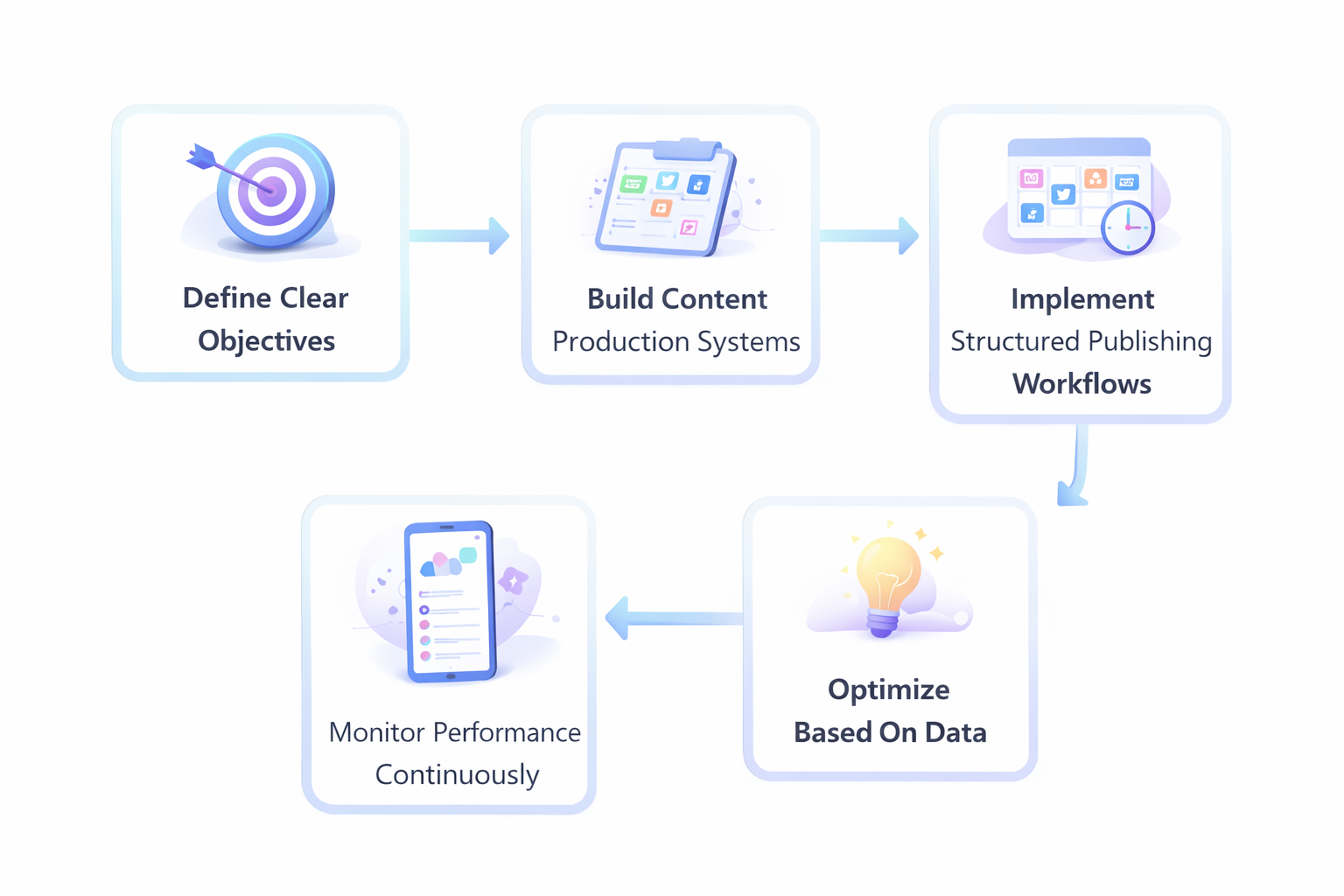
Step By Step Implementation
Turning social media plans into measurable results requires structured execution. Strategy alone does not generate engagement or revenue. Execution transforms plans into daily actions that compound over time.
This matters because structured execution improves marketing performance significantly. Businesses with documented strategies are 313% more likely to report success, while teams using defined workflows complete campaigns up to 30% faster.
Effective implementation follows a predictable sequence designed to ensure clarity, consistency, and continuous improvement.
Step 1: Define Clear Objectives
Every implementation begins by translating business goals into measurable social media objectives. Objectives provide direction for content creation, targeting, and performance measurement.
Strong objectives include:
- Audience growth targets
- Lead generation goals
- Brand awareness metrics
- Traffic generation benchmarks
- Conversion targets
Defined objectives increase success probability because goal-driven teams achieve up to 2.5× higher performance compared to teams operating without structured goals.
Step 2: Build Content Production Systems
Content production must operate as a repeatable system rather than a spontaneous activity. Businesses that systematize content creation publish consistently and maintain audience attention.
Content consistency matters because brands that publish regularly generate up to 67% more leads than inconsistent publishers.
Content production systems typically include:
- Monthly content planning sessions
- Weekly content creation workflows
- Template-based production processes
- Scheduled publishing timelines
This structured workflow ensures continuous output without operational stress.
Step 3: Implement Structured Publishing Workflows
Publishing workflows ensure content reaches audiences at optimal times. Timing directly affects performance because audience activity patterns influence algorithm visibility.
Posts published during peak engagement windows receive up to 2× more interaction, making timing optimization essential.
Publishing workflows define:
- Content publishing frequency
- Platform-specific schedules
- Campaign coordination timelines
- Approval and review processes
These workflows prevent delays and maintain consistency.
Step 4: Monitor Performance Continuously
Monitoring ensures execution aligns with objectives. Without monitoring, businesses cannot identify improvement opportunities.
Companies that actively monitor marketing performance improve results by up to 20% compared to businesses that do not track performance consistently.
Performance monitoring reveals:
- High-performing content formats
- Audience engagement patterns
- Growth trends
- Conversion performance
This feedback loop enables continuous optimization.
Step 5: Optimize Based On Data
Optimization transforms performance insights into strategic improvements. Businesses that optimize regularly achieve significantly better long-term results.
Organizations that continuously optimize campaigns improve marketing efficiency by up to 30%.
Optimization includes:
- Adjusting content formats
- Refining messaging
- Improving visual presentation
- Optimizing publishing schedules
This iterative process compounds results over time.
Execution Layers
Implementation operates across multiple execution layers. Each layer contributes to overall system performance.
Strategic Layer
This layer defines long-term direction, objectives, and positioning. Strategic clarity improves decision-making efficiency and prevents wasted effort.
Businesses with strategic clarity improve marketing effectiveness by up to 60%.
Operational Layer
This layer focuses on daily workflows, including content creation, scheduling, and engagement.
Operational efficiency directly impacts output consistency, which influences growth performance.
Organizations with structured workflows improve productivity by up to 25%.
Technical Layer
This layer includes tools, automation systems, and platform integrations. Technical efficiency reduces manual workload and improves scalability.
Automation improves marketing productivity by up to 14.5% while reducing operational overhead.
Analytical Layer
This layer tracks performance, identifies trends, and guides optimization.
Data-driven companies are 6× more likely to retain customers compared to businesses that do not use analytics effectively.
Optimization Process
Optimization ensures continuous performance improvement. Instead of static execution, successful social media plans evolve based on measurable insights.
Optimization cycles typically follow a four-stage process:
- Performance measurement
- Trend identification
- Strategic adjustment
- Implementation of improvements
This continuous improvement model increases long-term effectiveness.
Businesses that adopt continuous optimization improve campaign performance by up to 30%.
Optimization focuses on identifying patterns such as:
- Which content formats generate the highest engagement
- Which publishing times produce optimal results
- Which messaging resonates most with audiences
- Which platforms deliver the best performance
These insights guide strategic refinement.
Advanced optimization strategies also integrate principles explained in structured content strategy systems, which align content production with performance feedback.
Implementation Stories
Real-world implementation examples demonstrate how structured execution improves results.
David, a startup founder, initially managed social media casually. He posted occasionally and saw minimal growth. After implementing structured workflows, he defined weekly publishing schedules, monitored performance metrics, and optimized based on engagement patterns.
Within six months, his audience grew by 300%, and his inbound leads increased significantly.
This reflects broader performance trends showing businesses that publish structured content generate up to 3× more leads.
Another example is Klara, a consultant who struggled with audience engagement. After implementing structured content systems and performance tracking, she identified that educational content performed best.
She focused on educational content and increased engagement rates by 150%.
This aligns with engagement trends showing educational content generates up to 2× higher engagement.
These examples demonstrate how structured implementation produces measurable growth.
Statistics And Data
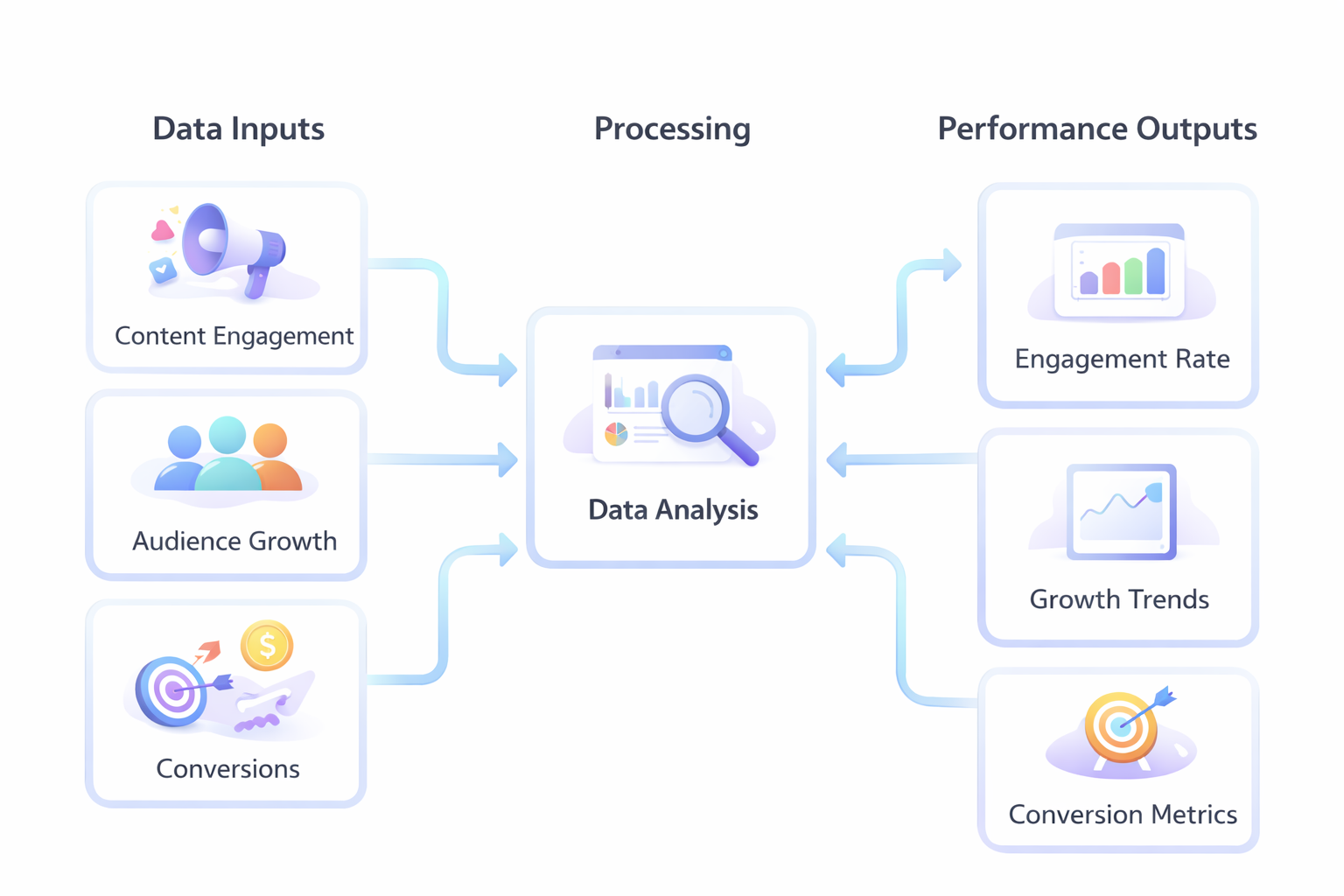
Data transforms social media plans from assumptions into predictable growth systems. Without analytics, content decisions rely on guesswork. With analytics, decisions rely on measurable performance indicators.
Social platforms influence modern purchasing behavior at scale. More than 5.04 billion people actively use social media, and 81% of consumers research products online before buying. This makes analytics essential for understanding how content influences decision-making.
Engagement directly affects visibility. Content with higher engagement rates receives up to 3.2× more reach, demonstrating how analytics-driven optimization improves organic exposure.
Analytics also influences revenue performance. Businesses using data-driven marketing strategies achieve up to 5–8× higher ROI compared to businesses relying on intuition.
Understanding these analytics insights helps businesses identify which content generates growth and which content wastes resources.
Analytics platforms typically track:
- Audience growth rate
- Content engagement rates
- Click-through performance
- Conversion metrics
- Reach and visibility trends
Tracking these metrics enables strategic improvement.
Marketers who actively monitor performance improve campaign effectiveness by up to 30%, reinforcing the importance of analytics integration.
Performance Benchmarks
Benchmarks provide context for evaluating performance. Without benchmarks, businesses cannot determine whether results are strong or weak.
Typical engagement benchmarks vary by platform and industry. Average engagement rates across industries range between 1% and 5%, while high-performing profiles exceed these averages significantly.
Follower growth rate provides another key benchmark. Healthy profiles grow consistently over time rather than experiencing stagnation.
Profiles publishing optimized content grow audiences up to 4× faster than profiles publishing inconsistent or unoptimized content.
Conversion benchmarks are equally important. Social media contributes significantly to purchasing decisions, with 54% of consumers using social media to research products.
Key benchmarks professionals monitor include:
- Engagement rate per post
- Follower growth rate
- Click-through rate
- Conversion rate
- Audience retention
These benchmarks help identify performance gaps and opportunities.
Analytics benchmarks also help validate strategies explained in structured growth strategy systems, ensuring measurable improvement.
Analytics Interpretation
Collecting data alone is insufficient. Effective interpretation transforms raw data into actionable insights.
Professional marketers analyze patterns rather than isolated metrics. This approach reveals cause-and-effect relationships between content decisions and performance outcomes.
Data-driven interpretation improves marketing effectiveness significantly. Organizations using analytics-driven insights improve customer acquisition efficiency by up to 23×.
Analytics interpretation focuses on identifying trends such as:
- Which content formats perform best
- Which posting times generate maximum engagement
- Which messaging resonates with audiences
- Which platforms produce the highest conversion rates
This process ensures continuous performance improvement.
Analytics interpretation also helps refine positioning strategies explained in brand positioning frameworks, ensuring content aligns with audience expectations.
Professional teams review analytics weekly and monthly to maintain strategic alignment.
Businesses that regularly analyze marketing performance improve campaign efficiency by up to 20%.
Case Stories
Analytics-driven social media plans consistently produce measurable results when implemented correctly.
Eva, a business consultant, struggled with inconsistent engagement. She published regularly but saw unpredictable results. After analyzing her performance data, she discovered that educational content generated significantly higher engagement than promotional content.
She adjusted her strategy and increased engagement rates by over 200% within four months.
This aligns with broader engagement trends showing educational content generates up to 2× higher engagement.
Another example is Tomas, an ecommerce founder. His social media generated traffic but few conversions. Analytics revealed that his content attracted the wrong audience segment.
He refined his targeting and messaging, improving conversion rates by 70%.
This reflects conversion optimization trends showing targeted messaging improves conversion rates by up to 300%.
Analytics-driven decision-making transforms performance outcomes.
These insights align with optimization strategies explained in content marketing ROI frameworks, which emphasize data-driven refinement.
Professional Promotion
Analytics also improves promotion effectiveness. Promotion without analytics wastes resources, while analytics-driven promotion maximizes reach and conversion efficiency.
Targeted campaigns improve performance significantly. Personalized marketing improves conversion rates by up to 80%.
Professional promotion strategies use analytics to identify:
- High-performing content worth promoting
- Audience segments most likely to convert
- Optimal promotion timing
- Platform-specific promotion opportunities
This approach ensures maximum return on promotional investment.
Professional marketers also integrate promotion strategies explained in advanced advertising strategy frameworks, which align paid promotion with organic performance insights.
Organizations that combine analytics with promotion improve marketing efficiency by up to 30%.
Analytics transforms promotion from guesswork into a predictable growth engine.
Future Trends
Social media plans continue evolving as platforms, user behavior, and technology advance. Businesses that adapt early gain significant competitive advantages, while those relying on outdated strategies lose visibility and relevance.
Artificial intelligence is already transforming content planning and execution. AI-driven marketing improves campaign performance by up to 40%, enabling businesses to automate planning, optimize messaging, and predict performance outcomes.
Predictive analytics represents another major shift. Instead of reacting to past performance, businesses use predictive systems to anticipate future engagement patterns. Companies using predictive analytics improve marketing efficiency by up to 20%.
Video content continues dominating platform algorithms. Video generates up to 1200% more shares compared to text and image content combined, making video integration essential for future social media plans.
Personalization also plays a growing role. Personalized content improves engagement rates by up to 80%, helping brands build stronger audience relationships.
Creator-driven ecosystems are expanding rapidly. Influencer-driven campaigns generate up to 11× higher ROI compared to traditional digital advertising.
Martin, a software entrepreneur, integrated AI-assisted planning into his workflow. His system analyzed audience behavior and recommended optimal publishing schedules. Within three months, his engagement increased by 65% without increasing workload.
Future-ready social media plans prioritize automation, predictive insights, and personalized content delivery.
Strategic Framework Recap
Effective social media plans operate as integrated ecosystems rather than isolated activities. Each component contributes to long-term performance and scalability.
The complete framework includes:
- Strategic planning: Defining clear objectives and audience targeting
- Tool integration: Supporting execution with scheduling and analytics systems
- Structured implementation: Establishing repeatable workflows
- Performance analytics: Tracking and interpreting measurable results
- Scaling systems: Expanding output efficiently
- Continuous optimization: Improving performance through data-driven refinement
Organizations using structured marketing frameworks improve performance predictability by up to 30%.
This ecosystem approach aligns with scalable growth systems explained in social media ecosystem strategy frameworks, which integrate planning, execution, and optimization into unified workflows.
When fully implemented, social media plans provide clarity, efficiency, and measurable growth.
FAQ – Built For Complete Guide
1. What are social media plans?
Social media plans are structured systems that define content strategy, publishing schedules, audience targeting, and performance tracking. These plans ensure consistent growth and measurable results.
2. Why are social media plans important?
Social media influences purchasing decisions significantly, with 54% of consumers researching products on social media. Structured plans ensure businesses maximize visibility and conversion opportunities.
3. How often should businesses update their social media plans?
Most professional teams review and update plans monthly. Regular updates ensure alignment with performance trends and audience behavior changes.
4. How long does it take to see results?
Most businesses see measurable improvements within three to six months. Consistency compounds results over time, improving engagement and audience growth.
5. Which platforms should businesses focus on?
Platform selection depends on audience demographics and business goals. Businesses focusing on relevant platforms improve efficiency and engagement significantly.
6. What metrics should businesses track?
Key metrics include engagement rates, audience growth, conversions, and reach. Tracking these metrics ensures continuous optimization.
7. Can small businesses benefit from social media plans?
Yes. Structured plans help small businesses compete effectively. Strategic execution improves growth efficiency and visibility.
8. How does content quality affect performance?
High-quality content generates significantly higher engagement. Valuable content strengthens trust and audience relationships.
9. How important is consistency?
Consistency improves algorithm visibility and audience trust. Regular publishing strengthens long-term growth potential.
10. Do businesses need professional help?
Professional guidance accelerates growth by ensuring structured implementation, optimization, and scalability.
11. How do social media plans support long-term growth?
Structured plans ensure continuous improvement, efficient workflows, and scalable systems. This transforms social media into predictable growth channels.
12. Are social media plans useful for personal brands?
Yes. Personal brands benefit significantly from structured planning, improving authority, visibility, and client acquisition.
Work With Professionals
Many freelancers and independent professionals struggle to translate their expertise into consistent client acquisition. Even with strong skills, unpredictable visibility makes growth difficult. Social media plans solve this by creating structured visibility systems that attract qualified clients continuously.
Freelancers who implement structured visibility strategies generate up to 3× more client opportunities compared to those relying on inconsistent outreach.
This is where specialized platforms become powerful growth accelerators. Platforms designed specifically for freelancers provide access to active clients searching for expertise, eliminating the uncertainty of manual prospecting.
Professional freelancers who position themselves strategically attract inbound opportunities rather than chasing clients manually. This improves efficiency, income stability, and long-term growth potential.
markework.com provides freelancers with direct access to businesses actively seeking professional services. Instead of competing in oversaturated marketplaces, freelancers gain visibility in an ecosystem designed to connect talent with real client demand.
Freelancers using structured platforms improve client acquisition efficiency significantly, allowing them to focus on delivering high-value work rather than constantly searching for opportunities.
If you want to transform your visibility into a consistent client acquisition system, explore opportunities available on markework.com.
 Filip Konecny Enterprises