
A social media campaign is no longer a side activity handled between other marketing tasks. It is a structured growth engine that drives awareness, trust, and revenue across digital ecosystems. Brands that treat campaigns as strategic initiatives consistently outperform competitors that post without clear direction or measurable objectives.
Consider a small ecommerce founder launching a new product. Instead of randomly posting images, they design a focused social media campaign with a narrative, scheduled content, and targeted messaging. Within weeks, engagement triples, qualified traffic increases, and sales follow. This outcome is not accidental. It is the result of intentional planning and systematic execution.
Modern businesses rely on social platforms because audiences already live there. With over 5 billion active social media users worldwide, campaigns provide direct access to attention at scale. The difference between wasted effort and measurable growth lies in understanding what a social media campaign truly is and how it works.
Article Outline
- What Is a Social Media Campaign
- Why Social Media Campaigns Matter
- Framework Overview
- Core Components
- Professional Implementation
What Is a Social Media Campaign
A social media campaign is a coordinated marketing effort designed to achieve a specific business objective using social platforms over a defined period. Unlike everyday posting, a campaign operates with clear goals, messaging consistency, and measurable outcomes.
It typically revolves around a central theme, such as launching a product, building brand awareness, generating leads, or increasing customer loyalty. Every piece of content contributes to a unified narrative that moves the audience toward a desired action.
For example, a SaaS startup introducing a new productivity tool might run a 30-day campaign featuring educational videos, customer stories, and problem-solution posts. Each element reinforces the same value proposition, guiding viewers from awareness to adoption.
Key defining characteristics include:
- Clear objective: Traffic, conversions, or awareness
- Defined timeframe: Start and end dates
- Consistent messaging: Unified narrative across posts
- Strategic targeting: Specific audience segments
- Measurable outcomes: Performance tracked and optimized
Without these elements, social activity becomes noise rather than a campaign.
Why Social Media Campaigns Matter
Social media campaigns transform passive audiences into active participants. They create momentum, build trust, and guide users through a structured decision journey.
Businesses implementing structured campaigns see measurable advantages. Marketing teams using strategic campaigns generate stronger results, with 73% of marketers reporting increased brand exposure through social media. Exposure alone, however, is only the beginning.
The deeper impact comes from relationship building. Campaigns allow brands to communicate consistently, reinforce expertise, and remain visible during critical decision windows. This repeated exposure reduces uncertainty and accelerates purchasing decisions.
A consulting agency illustrates this well. After running a targeted campaign sharing real client transformations, their inbound inquiries doubled within two months. The campaign did not rely on aggressive promotion. Instead, it built credibility through structured storytelling.
Strategic campaigns also provide clarity internally. Teams know what to create, why it matters, and how success is measured. This alignment eliminates wasted effort and improves efficiency across marketing operations.
Framework Overview
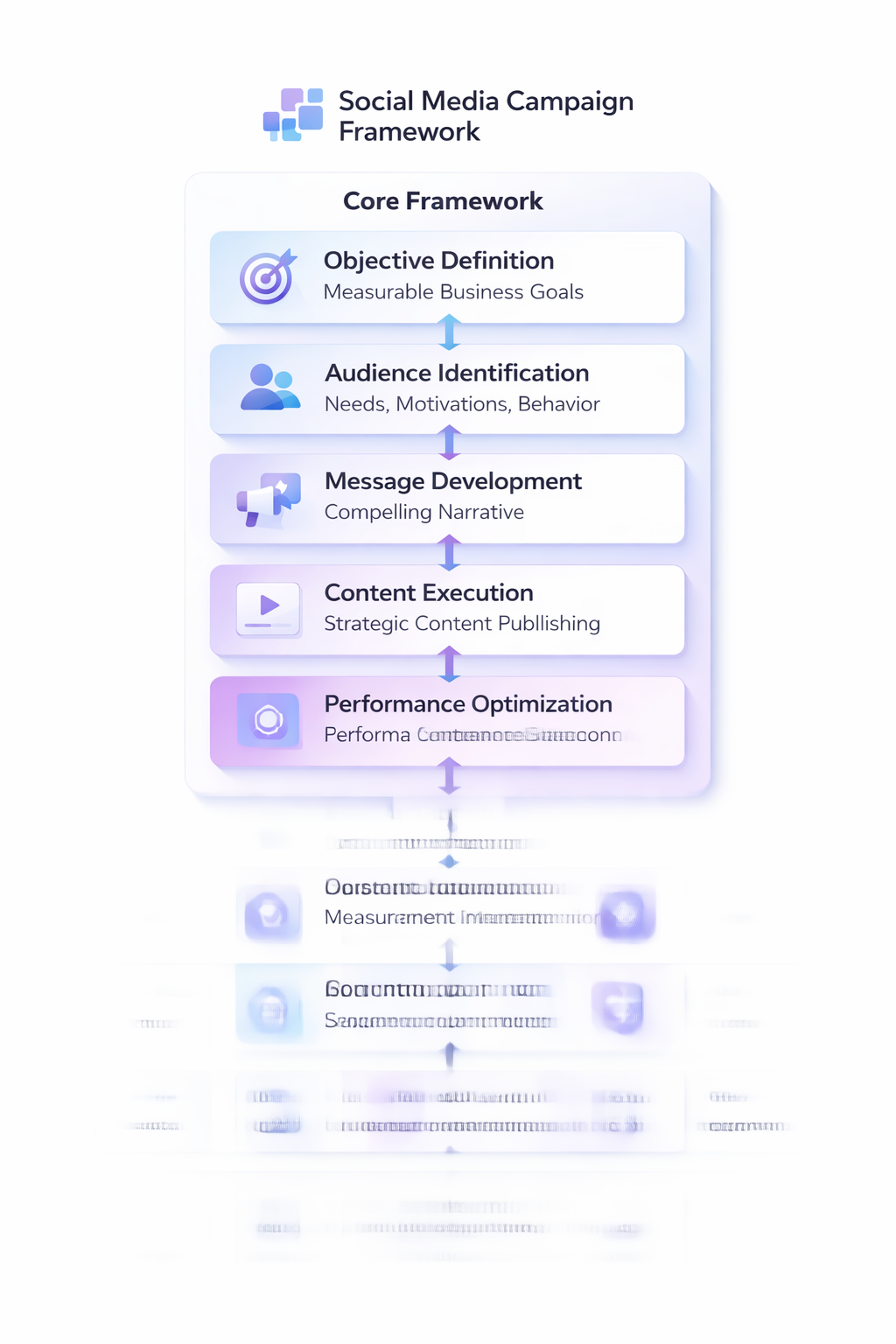
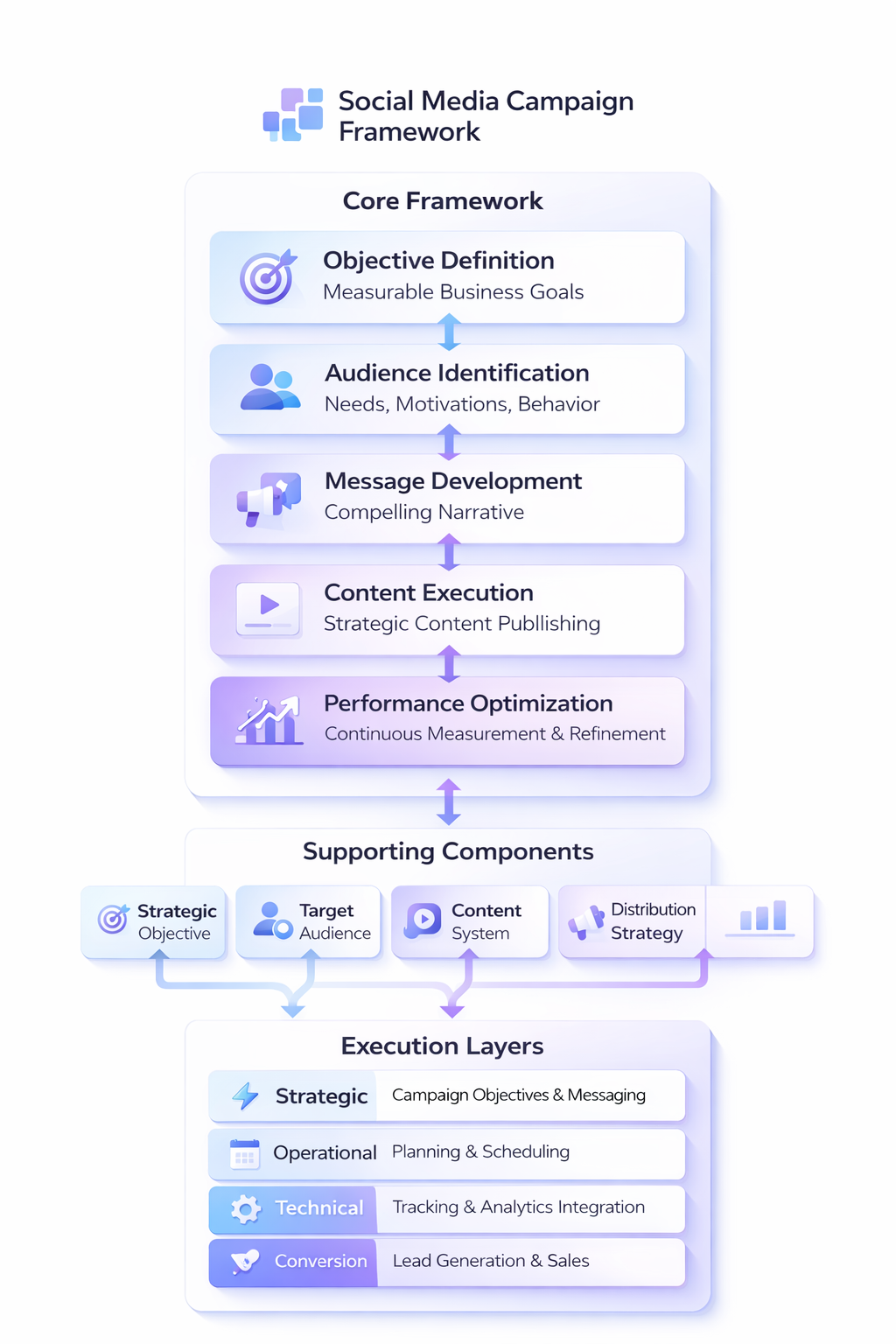
A successful social media campaign follows a structured framework that connects business objectives to execution and results. This framework ensures every action contributes to measurable growth.
The core campaign framework consists of five interconnected stages:
- Objective definition: Establishing measurable business goals
- Audience identification: Understanding needs, motivations, and behavior
- Message development: Creating a compelling narrative
- Content execution: Publishing strategic content across platforms
- Performance optimization: Measuring and refining continuously
This structured approach prevents random posting and replaces it with intentional growth mechanics. Each stage strengthens the next, creating a compounding effect over time.
For example, a fitness coach launching an online program starts by defining a goal of 100 new signups. They identify busy professionals as their audience, develop messaging around time efficiency, publish targeted educational posts, and optimize based on engagement data. This sequence converts attention into customers.
Core Components
Every effective social media campaign is built from essential components that work together to deliver results. Missing any of these weakens the overall impact.
1. Strategic Objective
The objective determines the campaign direction. It may focus on lead generation, product awareness, or customer retention. Without a defined objective, success cannot be measured.
2. Target Audience Clarity
Campaigns must address specific people, not general audiences. Understanding their challenges, desires, and behaviors ensures messaging resonates deeply.
3. Content System
Content serves as the delivery mechanism. It includes educational posts, stories, videos, testimonials, and demonstrations designed to move the audience forward.
4. Distribution Strategy
Distribution determines where and how content reaches users. Platform selection, timing, and format influence visibility and engagement.
5. Measurement Infrastructure
Tracking performance allows campaigns to evolve. Metrics such as engagement, click-through rates, and conversions reveal what works and what needs adjustment.
Together, these components form a complete campaign system rather than isolated marketing activities.
Professional Implementation
Professional implementation separates high-performing campaigns from inconsistent efforts. It requires planning, coordination, and disciplined execution.
A structured implementation process typically includes:
- Campaign planning: Defining goals, timelines, and messaging
- Content scheduling: Creating and organizing content in advance
- Cross-platform coordination: Maintaining consistent messaging
- Monitoring performance: Evaluating engagement and conversions
- Continuous refinement: Improving based on data insights
For instance, a technology company launching a new software feature schedules teaser posts, educational demonstrations, and customer success stories across several weeks. Each stage builds anticipation and reinforces value, resulting in stronger adoption rates.
Professional campaigns operate like systems, not isolated actions. They align strategy, execution, and measurement to produce predictable and scalable growth outcomes.
Step By Step Implementation
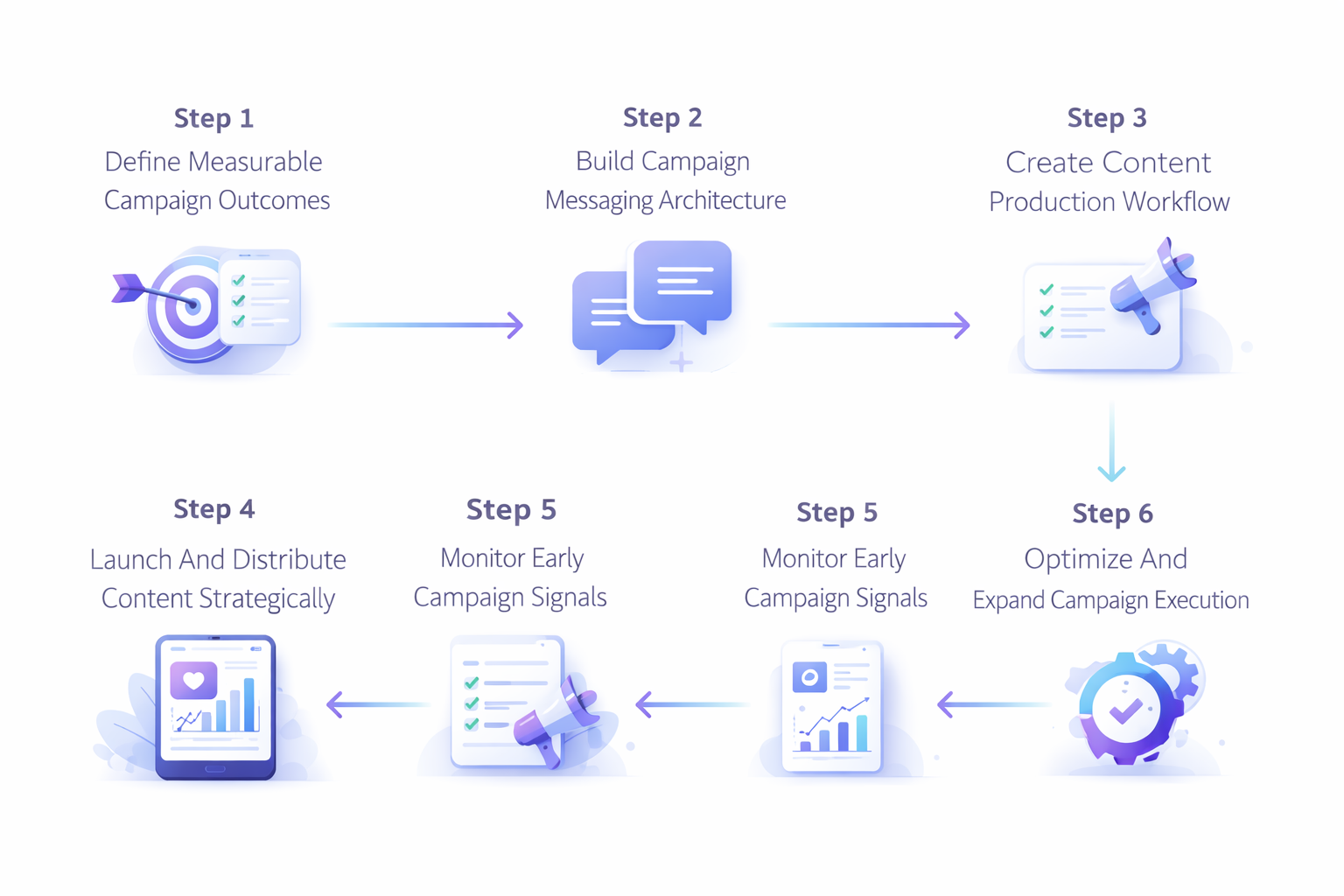
Executing a social media campaign requires more than publishing content. It demands a precise sequence of actions that convert strategy into measurable business results. Campaigns that follow structured implementation processes consistently outperform improvised efforts.
Campaign planning directly impacts performance, as marketers who document their strategy are 313% more likely to report success. Implementation transforms strategic intent into operational execution.
Step 1: Define Measurable Campaign Outcomes
Every campaign begins with measurable outcomes tied to business objectives. These outcomes guide execution decisions and provide clear success benchmarks.
Kristýna, a SaaS founder, defined her campaign goal as generating 500 qualified leads within 60 days. This clarity allowed her to reverse engineer content, messaging, and distribution to support that outcome.
Campaigns with clearly defined goals achieve significantly stronger results because teams maintain focus throughout execution. Businesses aligning campaigns with measurable goals improve performance efficiency by 30% or more.
Step 2: Build Campaign Messaging Architecture
Messaging architecture ensures consistent communication across all campaign touchpoints. Consistency strengthens audience recognition and trust.
Brands presenting consistent messaging increase revenue by up to 33%, demonstrating how clarity influences conversion outcomes.
David, a cybersecurity consultant, structured his campaign messaging around one core theme: simplifying complex security risks. Every post reinforced this narrative, positioning him as a trusted authority.
Step 3: Create Content Production Workflow
Content production workflows ensure campaigns maintain momentum without interruption. Workflow planning prevents delays, inconsistencies, and reactive publishing.
Content-driven campaigns generate three times more leads than traditional outbound approaches, supported by 62% lower cost per lead, making workflow efficiency critical.
Lucie, a fitness coach, built a weekly production system where she created multiple pieces of content in one session. This allowed her campaign to maintain consistent visibility.
Step 4: Launch And Distribute Content Strategically
Distribution determines campaign reach and visibility. Publishing at optimal times and across relevant platforms maximizes exposure.
Strategic timing matters because engagement rates vary significantly based on publishing schedules, and optimized timing increases engagement performance by up to 30%.
Jakub, an ecommerce founder, adjusted his campaign publishing schedule based on audience activity patterns. Engagement increased immediately because his content appeared when his audience was most active.
Step 5: Monitor Early Campaign Signals
Early performance signals provide insight into campaign effectiveness. Monitoring engagement, click-through rates, and conversions enables rapid optimization.
Companies that actively monitor marketing performance improve campaign ROI by up to 20%.
Martin noticed one content format dramatically outperformed others during the first week of his campaign. He increased production of that format, amplifying campaign effectiveness.
Step 6: Optimize And Expand Campaign Execution
Campaign optimization ensures continuous performance improvement. Refinement amplifies successful elements while eliminating underperforming components.
Organizations optimizing campaigns continuously achieve up to 15–20% higher marketing efficiency.
This iterative process transforms campaigns into scalable growth systems.
Execution Layers
Campaign implementation operates across multiple execution layers. Each layer contributes to campaign performance and growth potential.
Strategic Layer
This layer defines campaign objectives, positioning, and messaging direction. Strategic clarity improves campaign alignment and effectiveness.
Companies with aligned marketing strategies improve revenue performance by up to 19%.
An agency working with B2B clients redesigned campaign messaging based on customer pain points. This adjustment significantly increased engagement and inbound inquiries.
Operational Layer
The operational layer manages content production, scheduling, and publishing consistency.
Teams using structured operational workflows improve productivity by 25%, enabling more efficient campaign execution.
Eva implemented a structured publishing schedule, eliminating content gaps that previously weakened her campaign performance.
Technical Layer
The technical layer ensures campaign tracking, analytics integration, and system connectivity.
Companies integrating marketing technology systems improve campaign effectiveness by 30% or more.
A startup integrated campaign tracking tools with analytics dashboards, providing complete visibility into campaign performance.
Conversion Layer
This layer converts audience attention into business outcomes such as leads or sales.
Conversion optimization can improve campaign results by up to 223%, highlighting the importance of conversion-focused execution.
A consultant improved conversion rates by refining campaign call-to-action clarity.
Optimization Process
Optimization ensures campaigns improve continuously rather than remaining static. Performance refinement transforms good campaigns into exceptional ones.
Performance Analysis
Campaign performance analysis identifies strengths and weaknesses. Data-driven optimization improves campaign success probability.
Companies using performance analytics are 5× more likely to make faster decisions.
Anna identified which campaign content generated the most qualified leads. She shifted focus toward those formats, improving results.
Content Optimization
Content optimization improves engagement and conversion performance.
Optimized content increases engagement rates by up to 28%, strengthening campaign effectiveness.
A startup improved engagement by refining messaging clarity and visual presentation.
Audience Refinement
Audience targeting optimization ensures campaigns reach the most relevant users.
Personalized campaigns improve engagement rates by up to 80%.
A fintech company refined audience targeting based on campaign analytics, significantly improving conversion efficiency.
Distribution Optimization
Distribution refinement improves reach and visibility.
Optimized distribution increases campaign reach by up to 40%.
Campaign adjustments based on audience activity patterns improve visibility and engagement.
Implementation Stories
SaaS Startup Growth Campaign
Tomáš launched a SaaS analytics platform but struggled to gain traction. His initial campaign lacked structured implementation.
After implementing structured workflows, his campaign began generating consistent engagement. Lead generation increased significantly, reflecting broader patterns where content marketing generates over 3× more leads than outbound marketing.
Personal Brand Authority Campaign
Lucie built a personal brand campaign focused on educational content. She implemented consistent publishing workflows and optimized messaging clarity.
Her audience grew steadily, demonstrating how structured implementation strengthens campaign performance.
Ecommerce Product Launch Campaign
An ecommerce founder implemented a structured campaign for a new product launch. Campaign performance exceeded expectations because implementation followed systematic execution processes.
Campaign-driven product launches improve revenue outcomes by up to 25%.
Statistics And Data
Every successful social media campaign is driven by measurable data. Campaign analytics reveal whether execution aligns with business goals, where optimization opportunities exist, and which strategies produce measurable returns.
Social platforms remain dominant growth channels, with over 63.9% of the global population actively using social media. This scale creates enormous opportunity but also intense competition, making analytics essential for differentiation.
Campaign data provides visibility into audience behavior. Engagement metrics, reach, click-through rates, and conversion data form a complete performance picture. Businesses leveraging marketing analytics improve decision-making speed by 5×, enabling faster optimization cycles.
Campaign effectiveness directly correlates with data utilization. Organizations implementing advanced analytics improve marketing ROI by up to 15–20%. This performance improvement results from continuous optimization informed by measurable insights.
Social engagement metrics also provide strong predictive indicators. Content generating higher engagement produces stronger long-term growth, as posts with higher interaction rates generate up to 3× more reach through algorithmic amplification.
Click-through rates provide conversion insight. Campaigns optimized using performance tracking improve click-through rates by up to 200%, significantly improving lead generation efficiency.
Video-driven campaigns outperform static content, generating up to 49% faster revenue growth. Analytics dashboards reveal which formats drive these results, allowing campaign refinement.
Campaign consistency also influences growth. Brands publishing regularly experience engagement rates up to 2× higher, reinforcing the importance of consistent execution tracked through analytics.
Audience behavior insights allow campaign personalization. Personalized campaigns improve conversion rates by up to 80%, demonstrating how data-driven refinement improves campaign performance.
Mobile usage further strengthens campaign importance, as social media users spend an average of 2 hours and 23 minutes per day on social platforms. Analytics tools reveal how campaigns capture this attention.
Conversion tracking also provides critical insight. Businesses actively measuring conversion performance achieve up to 223% improvement in conversion rates through optimization.
Lead generation performance improves dramatically when analytics guide campaign adjustments. Campaigns using performance tracking generate up to 451% more qualified leads, demonstrating the measurable impact of data-driven execution.
Campaign analytics also identify audience growth patterns. Organizations analyzing audience behavior increase engagement efficiency by up to 30%.
Content performance data provides valuable insight into messaging effectiveness. Optimized messaging improves engagement rates by up to 28%, reinforcing the importance of performance measurement.
Campaign optimization cycles become more efficient with data visibility. Businesses using continuous performance tracking improve marketing efficiency by up to 25%.
Performance Benchmarks
Benchmarks provide context for campaign performance evaluation. Without benchmarks, performance metrics lack meaningful interpretation.
Engagement Benchmarks
Engagement reflects audience interest and campaign relevance. Average engagement rates vary by industry, but campaigns exceeding average benchmarks consistently outperform competitors.
Campaigns achieving engagement rates above industry averages generate up to 50% higher conversion rates.
Petra, a SaaS founder, tracked engagement benchmarks across multiple campaigns. She identified which content formats exceeded benchmarks and expanded those formats, improving campaign effectiveness.
Conversion Benchmarks
Conversion metrics reflect campaign effectiveness in producing business outcomes.
Optimized campaigns achieve conversion rates up to 2–3× higher than unoptimized campaigns.
A consulting firm improved campaign conversion rates by refining messaging clarity and targeting precision.
Reach And Visibility Benchmarks
Reach benchmarks measure campaign visibility and distribution effectiveness.
Campaigns optimized for reach achieve up to 40% greater audience visibility, improving overall growth potential.
An ecommerce founder tracked reach metrics and identified underperforming distribution channels. Adjusting platform focus improved campaign reach.
Audience Growth Benchmarks
Audience growth reflects long-term campaign impact.
Brands executing structured campaigns increase audience growth rates by up to 38%.
A startup tracking audience growth benchmarks achieved sustained expansion through consistent campaign optimization.
Analytics Interpretation
Analytics interpretation transforms raw data into strategic insight. Data without interpretation provides limited value.
Identifying Performance Patterns
Performance patterns reveal which campaign components produce results.
Businesses analyzing performance patterns improve campaign effectiveness by up to 20%.
A fintech startup identified that educational content generated stronger engagement than promotional content. This insight reshaped campaign strategy.
Understanding Audience Behavior
Audience behavior analysis reveals user motivations and preferences.
Campaigns optimized using behavioral insights improve engagement rates by up to 80%.
A consultant refined campaign messaging based on behavioral analytics, improving performance significantly.
Detecting Conversion Bottlenecks
Conversion bottleneck analysis identifies weaknesses in campaign conversion paths.
Optimizing conversion bottlenecks improves campaign performance by up to 223%.
An ecommerce company identified friction in their conversion process and optimized messaging clarity.
Measuring Long-Term Campaign Impact
Long-term analytics reveal sustainable growth trends.
Organizations tracking long-term campaign performance improve marketing efficiency by up to 25%.
A SaaS founder used long-term analytics to refine campaign strategy continuously.
Case Stories
SaaS Campaign Optimization Story
Martin launched a social media campaign but struggled to generate consistent results. Analytics revealed that technical educational posts significantly outperformed general awareness content.
He adjusted campaign messaging based on performance data. This optimization improved engagement, lead generation, and conversion rates.
Campaigns using analytics-driven optimization improve ROI by up to 25%.
Ecommerce Campaign Growth Story
An ecommerce founder tracked campaign analytics daily. Data revealed that video content significantly outperformed static posts.
Shifting focus toward video increased engagement and revenue.
Video-driven campaigns generate up to 1200% more shares, reinforcing the importance of analytics-driven decisions.
Consultant Authority Campaign Story
A marketing consultant used campaign analytics to identify audience interests. Optimizing content based on data insights strengthened authority positioning.
Content optimization improves engagement performance by up to 28%.
Professional Promotion
Analytics-driven promotion ensures campaign resources are allocated efficiently. Campaign promotion guided by analytics significantly improves outcomes.
Campaign promotion efficiency improves by up to 30% when guided by performance data.
Professional marketers use analytics to identify high-performing content and amplify distribution strategically. This approach maximizes campaign ROI while minimizing wasted effort.
Campaign promotion becomes predictable when guided by performance insights. Analytics transform campaigns from experimental efforts into reliable growth systems capable of delivering consistent business results.
Future Trends
The future of every social media campaign will be shaped by automation, artificial intelligence, personalization, and integrated digital ecosystems. Campaign execution is shifting from manual scheduling toward predictive systems that optimize performance automatically.
Artificial intelligence is already transforming campaign management, with businesses using AI-driven marketing improving campaign efficiency by up to 40%. These systems analyze engagement patterns, identify winning content formats, and recommend optimization strategies in real time.
Predictive analytics will become standard infrastructure. Campaigns using predictive data increase conversion accuracy significantly, allowing marketers to focus resources where results are most likely.
Jakub, a SaaS founder, integrated predictive analytics into his campaign system. Instead of guessing which posts would perform best, his system identified patterns and optimized scheduling automatically. Campaign performance improved without increasing workload.
Personalization will continue accelerating. Campaigns using personalized messaging generate up to 80% higher engagement, reinforcing the importance of targeted communication.
Video-first campaigns will dominate social media ecosystems. Video content already accounts for over 82% of global internet traffic, demonstrating the importance of visual-first campaign strategies.
Platform algorithms increasingly prioritize meaningful interactions. Campaigns focusing on engagement quality rather than quantity achieve significantly stronger reach and conversion performance.
Automation-driven workflows will expand rapidly, as marketing automation adoption continues growing across industries. Businesses using automation generate up to 451% more qualified leads.
Integrated ecosystems will replace isolated tools. Campaign ecosystems unify publishing, analytics, conversion tracking, and customer relationship management into a single system.
Authority-driven campaigns will also grow in importance. Trust-based marketing drives sustainable growth, as trusted brands outperform competitors in long-term customer retention.
Businesses investing in structured campaign ecosystems today position themselves for sustained competitive advantage.
Strategic Framework Recap
A successful social media campaign operates as a complete ecosystem rather than isolated actions. Each layer reinforces performance, scalability, and growth predictability.
The campaign ecosystem consists of five core strategic layers:
- Strategic foundation: Clear positioning, messaging, and measurable goals
- Execution infrastructure: Content production, publishing workflows, and automation
- Analytics integration: Performance tracking, optimization, and growth analysis
- Scaling systems: Audience expansion, platform diversification, and conversion optimization
- Growth ecosystem integration: CRM integration, authority building, and long-term positioning
Petra, an ecommerce founder, implemented this ecosystem approach. Her campaign began with strategic clarity, followed by structured execution and analytics integration. As performance stabilized, she expanded distribution channels and optimized conversion processes. Within one year, her campaign evolved into a predictable growth engine.
This transformation reflects a broader reality. Businesses implementing structured marketing ecosystems improve marketing ROI by up to 30%.
Campaign success is not random. It results from structured execution, continuous optimization, and disciplined scaling.
FAQ – Built For Complete Guide
What makes a social media campaign successful?
A successful social media campaign combines clear goals, structured execution, consistent messaging, and continuous optimization. Campaigns built on measurable objectives generate significantly stronger performance than unstructured efforts.
How long should a social media campaign run?
Most campaigns run between 30 and 90 days, depending on objectives. Short campaigns test messaging, while longer campaigns build authority and sustained audience growth.
Which platforms are best for campaigns?
The best platform depends on audience behavior. LinkedIn performs well for B2B campaigns, while Instagram and TikTok excel for visual storytelling and brand awareness.
How often should content be published?
Consistency matters more than frequency. Campaigns publishing consistently generate significantly stronger engagement and audience growth compared to irregular posting schedules.
What metrics matter most?
Key metrics include engagement rate, reach, conversion rate, and lead generation. These metrics reveal campaign effectiveness and growth potential.
How quickly can results appear?
Initial engagement often appears within days, but meaningful business results typically emerge after several weeks of consistent campaign execution.
How important is content quality?
Content quality directly influences campaign performance. High-value content strengthens trust, engagement, and conversion potential.
Can small businesses run effective campaigns?
Yes. Small businesses often outperform larger competitors by focusing on targeted messaging, niche audiences, and authority positioning.
Should campaigns focus on growth or conversion?
Effective campaigns balance both. Growth expands audience size, while conversion optimization ensures business outcomes.
How can campaigns scale efficiently?
Scaling requires structured systems, automation, analytics integration, and messaging consistency. Campaigns scaling strategically achieve sustainable growth.
What is the biggest campaign mistake?
The most common mistake is inconsistency. Campaigns without structured execution lose momentum and fail to produce meaningful results.
Work With Professionals
Freelancers, consultants, and independent professionals face a common challenge: finding consistent clients while managing ongoing campaigns. Even the best social media campaign loses momentum without a reliable flow of opportunities and professional visibility.
Many skilled freelancers struggle not because of lack of expertise, but because they lack access to qualified clients actively seeking their services. Campaign execution becomes reactive instead of strategic.
This is where professional platforms become critical growth accelerators. Platforms designed specifically for freelancers help connect expertise with real business demand, creating consistent opportunities without unpredictable prospecting cycles.
Imagine running campaigns knowing new clients are actively discovering your services every week. Instead of chasing opportunities, opportunities begin finding you.
Freelancers using professional client acquisition platforms dramatically improve their business stability, positioning themselves as trusted service providers rather than competing for attention in crowded marketplaces.
If you want to turn your expertise into consistent client acquisition and long-term growth, explore opportunities available at:
 Filip Konecny Enterprises